WEEKLY CLIMATE NEWS
WEEK TEN: 7-11 November
2016
ITEMS
OF INTEREST
- Presidential elections and weather -- Tuesday (8 November 2016) is National Election Day, when the citizens of the United States vote for the electors for a President, a third of the members of the U.S. Senate, the entire U.S. House of Representatives, and various state and local officials. Has the weather affected an election?
According to weather historian, David Ludlum, in his book "The Weather Factor", weather may have played a part in various past Presidential Elections, especially in close elections when only a few thousand votes in key states would have swung the outcome in the other direction. Some people have argued that large voter turnouts occur when the weather is favorable. However, others have argued that when the nation was more rural and more agrarian, if the weather were inclement the number of voters would have increased because the farmers would have had time to vote than if the weather were favorable for late season field work. The voter turnout often times would have been beneficial to one political party at the expense of the other.
A study in 2007 of fourteen Presidential elections (1948-2000) by researchers indicates that rain tends to reduce voter participation by nearly one percent for each inch of rain, while an inch of snow would reduce voter turnout by nearly one half of a percent. The inclement weather also was found to benefit the Republican Party's vote share.
- Free admission into the National Parks -- The National Park Service has been designated Veterans Day (Friday, 11 November 2016) as being a part of its fee-free days program, which in this case is to honor the nation's veterans. This fee waiver will cover entrance and commercial tour fees in many of the national parks and monuments administered by the Park Service. [National Park Service Fee Free Days] Special observances for veterans will be held at several military parks, battlefields and historic sites. [National Park Service Military Honor]
- Celebrate Geography Awareness Week -- Next week (13-19 November 2016) has been identified as Geography Awareness Week. National Geography Awareness Week, launched by presidential proclamation in 1987, is designed to draw attention to geo-literacy and "the importance of geographic understanding in ensuring our nation's economic competitiveness, national security, environmental sustainability, and the livability of our communities in the 21st century." Since the US National Park Service is celebrating its 100th anniversary, this year's Geography Awareness Week theme is "Explore the Power of Parks."
- Linking weather and climate -- Read
this week's Supplemental
Information.. In Greater Depth for a description the
distinction between atmospheric conditions that can be considered as
weather events, which may last for time spans of up to a week, from
those events with longer time spans of a month to three months that can
be considered within the ream of climate analysis or forecasting.
CURRENT
CLIMATE MONITORING
- Locating the "graveyard orbits" and the "afterlife" of satellites -- In keeping with the Halloween season, NOAA's National Environmental Satellite, Data, and Information Service (NESDIS) posted an article describing where inoperative and decommissioned Earth-orbiting satellites reside after their service in monitoring the planet's atmosphere, oceans and climate. Some low orbiting satellites will naturally reenter the atmosphere and burn up within 25 years, while others will have to be subjected to controlled maneuver that takes them out of orbit. The satellites in a geosynchronous orbit are sent into "graveyard orbits" that are at least 200 miles farther away from Earth and away from the orbits for functional geosynchronous satellites. [NOAA NESDIS News]
CLIMATE
FORCING
- Impacts of contributions of individuals to climate change are calculated -- Researchers from the National Snow & Ice Data Center in Boulder, CO and Germany's Max Planck Institute for Meteorology have developed a scheme that they claim provides the public with a better way of grasping the impact that an individual's contribution would have on Earth's changing climate, in particular upon disappearance of summer sea ice in the Arctic. According to the researchers' calculations, three square meters of summer sea ice would disappear in the Arctic for every metric ton of carbon dioxide gas that a person directly or indirectly produces. [National Snow & Ice Data Center Newsroom]
- First global maps of human-made carbon dioxide emissions made from satellite observations -- A team of scientists from the Finnish Meteorological Institute, Helsinki, produced maps of human emissions of carbon dioxide gas into the atmosphere from data collected by instruments onboard NASA's Orbiting Carbon Observatory-2 (OCO-2) satellite. In addition, the team developed new data-processing technique that accounts for seasonal changes in carbon dioxide resulting from the plant growth and dormancy cycles, as well as the background carbon dioxide level. Three maps were generated, with each centered upon one of Earth's highest-emitting regions: the eastern United States, central Europe and East Asia. Comparison of these results was made with measurements of nitrogen dioxide, another gas emitted from fossil fuel combustion, obtained from the Ozone Monitoring Instrument on NASA's Aura satellite. [NASA Jet Propulsion Laboratory News]
- Research aims at determining if Arctic warming is fueling midlatitude severe winter weather -- An international team of scientists including those from NOAA's Pacific Marine Environmental Laboratory have been attempting to ascertain if the recent warming of the Arctic has been affecting the flow patterns in the upper tropospheric jet stream, which would then be responsible for fueling more severe winter weather across the mid-latitudes, along with cold weather across the eastern North America. [NOAA Office of Oceanic Atmospheric Research News]
CLIMATE
FORECASTS
- Climate scientist explains the "terrifying" trends of climate change -- Galen McKinley, the Bryson Professor in the Nelson Institute's Center for Climatic Research at the University of Wisconsin-Madison, was recently interviewed about the consequences of the projected climate change in the future that have been deemed "terrifying" by President Obama this past September. [Nelson Institute for Environmental Studies: University of Wisconsin-Madison News]
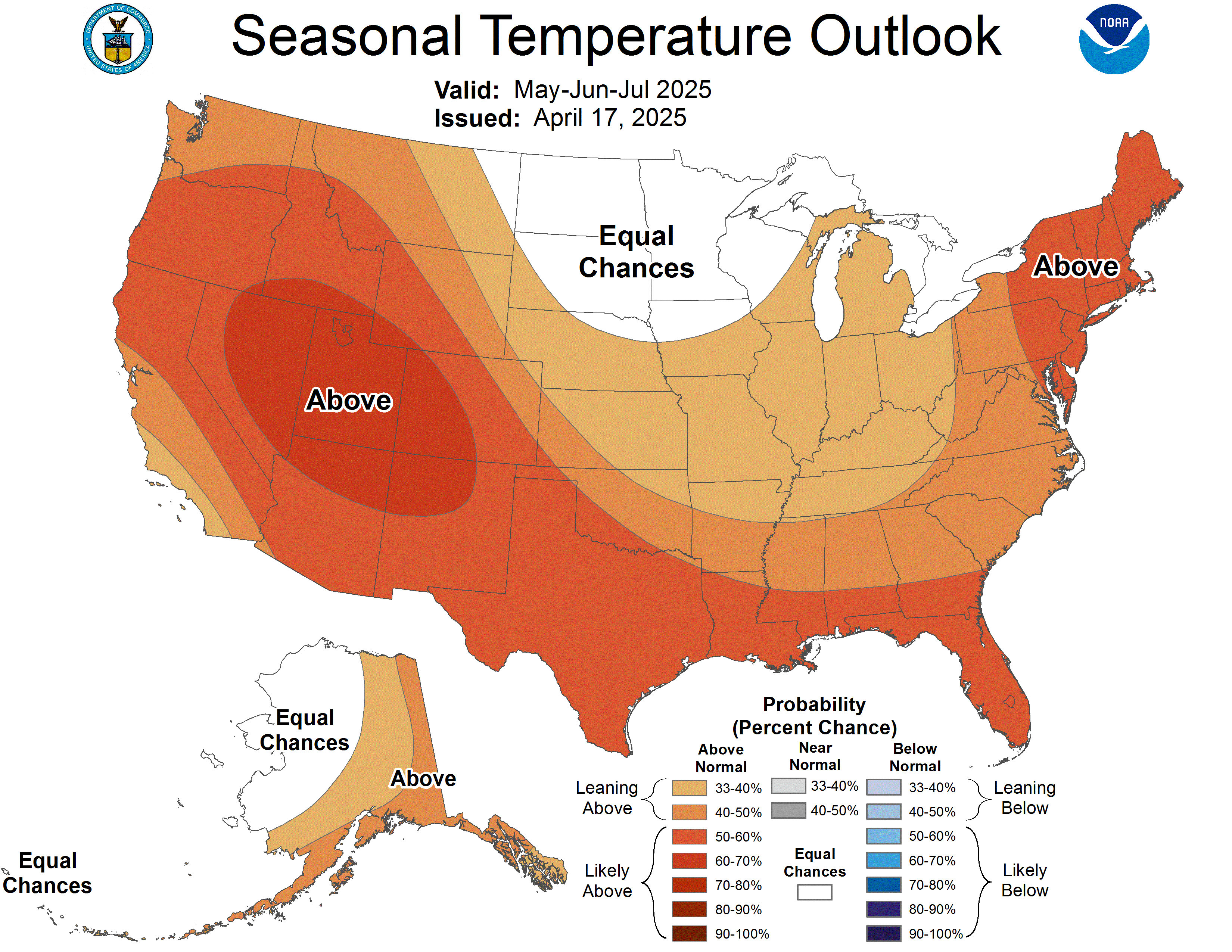
- Canadian national seasonal outlook issued -- Forecasters with Environment Canada issued their outlooks for temperature and precipitation across Canada for November 2016 through January 2017, which represents the last month of meteorological autumn and the first two months of meteorological winter. The temperature outlook indicates that essentially all of Canada should experience above normal (1981-2010) temperatures for these three months.
The Canadian precipitation outlook for late autumn 2016 and the start of the 2016-17 winter season indicates a few widely scattered areas along the US-Canadian border (southern sections of Saskatchewan, Manitoba and Ontario) and across coastal sections of eastern Canada could experience below average precipitation. On the other hand, large sections of British Columbia in the west and northern Canada extending from the Northwest Territory eastward into northern Quebec and northward into the Canadian Archipelago, should experience above average precipitation for the upcoming three months. Elsewhere, near average precipitation should be expected.
[Note for comparisons and continuity with the three-month seasonal outlooks of temperature and precipitation generated for the continental United States and Alaska by NOAA's Climate Prediction Center, one would need to use Environment Canada's probabilistic forecasts for temperature and precipitation.]
CLIMATE
AND HUMAN HEALTH
- Sunshine matters more than temperature, pollution or rain to mental health -- According to researchers at Brigham Young University, the amount of sunshine, as determined by the amount of time between sunrise and sunset, appears to be the weather element that matters most in a person's mental and emotional health, more than several other weather elements such as air temperature, air pollution or rain. The researchers found these results apply to the clinical population at large and not just those individuals diagnosed with Seasonal Affective Disorder (SAD). [Brigham Young University News]
CLIMATE AND THE
BIOSPHERE
- Crucial symbiotic relationship between algae and coral dates back to the Triassic -- An international team of scientists have found that a mutually beneficial or symbiotic relationship between algae and coral began more than 210 million years ago during the Triassic Period, a time of massive worldwide coral-reef expansion. The coral reefs provide algae with shelter, while the algae give coral reefs their colors and supplies both organisms with nutrients. [News at Princeton University]
CLIMATE AND SOCIETY
- How changing climate is affecting mummies -- An article in the NOAA Climate.gov ClimateWatch Magazine describes how curators at Chile's Universidad de Tarapacá museum in Arica are concerned that the changing climate of the dry mountainous areas of South America is causing more rapid deterioration of the Chinchorro mummies of the high desert of northern Chile and southern Peru in their collection. The higher atmospheric humidity is boosting the growth and metabolism of bacteria that live on the mummies' skin, causing some of the mummies to turn to black ooze. This climate change is of concern to anthropologists who continue to study these ancient cultural relics which are up to 7000 years old. [NOAA Climate.gov News]
- Satellite sees "slash and burn" agriculture underway in India -- A visible image obtained early from data collected by the VIIRS instrument onboard the NOAA/NASA Suomi NPP satellite shows the smoke rising from the "slash and burn" agriculture practice conducted by the farmers in India's Punjab province in order to clear out pests that eat crops and turning crop residues from the previous season into fertilizing ash. [NASA Feature]
- Experiments conducted for flooding vulnerability in Midwestern communities -- Using the U.S. Environmental Protection Agency's "Stormwater Management Model" to predict flooding in the two Midwestern communities of Victoria and Hiawatha, MN, researchers from Kansas State University, the University of Minnesota and their colleagues found various precipitation scenarios represent different states of vulnerability depending on the adaptive capability of the communities' stormwater systems. Adaptation of green infrastructure strategies incorporating stormwater infiltration could reduce the cost of adaptation and provide more benefits than gray infrastructure involving gray storm drains and tunnels alone. [NOAA Climate Program Office News]
- Diminished sea ice could "heat up" naval operations in Arctic Ocean -- Scientists sponsored by the US Navy's Office of Naval Research have been investigating the role that diminishing sea ice in the Arctic Ocean has upon the expansion of navigable waters in that ocean. The scientists measured the strength and intensity of waves and swells moving through the weakened Arctic sea ice and used used sophisticated oceanographic and acoustic sensors to gauge temperature, salinity, ice and ambient noise conditions under the surface of the ice and water.[US Navy Office of Naval Research News]
- Earthweek -- Diary of the Planet [earthweek.com]
Concept of the Week: Evolution of
Climate Models
Climate scientists have been building increasingly
sophisticated, mathematical climate models to serve two main purposes:
test the sensitivity of the climate to altered conditions and simulate
climate over time, either back into the past or forward into the
future. The simplest, early type of climate model (zero dimensional)
was the "energy balance model", which provides an average planetary
temperature from incoming and outgoing radiation. A one-dimensional
energy balance model determines the surface temperature from the energy
balance at individual latitude belts.
More complex models involve the physical equations of motion
(gas laws, thermodynamics and radiation interactions) subject to
climate forcings, the boundary conditions of solar radiation, surface
properties and atmospheric composition. As computers improved, models
have included a three-dimensional oceanic circulation
("atmosphere-ocean coupling"), then interactions between the
atmosphere, cryosphere and geosphere, with climate feedback mechanisms
involving the exchanges of heat and water. Finally, models have been
able to incorporate the improved knowledge of the biogeochemical
processes. Climate models calculate variables such as temperature at
individual points within the three-dimensional grid of cells across the
Earth's surface and vertically through the atmosphere, ocean, ice and
land. A tradeoff exists between the number of grid points (the spatial
resolution) and the number of numerical computations. Time and space
accuracy costs increased computational time and expense.
The development of numerical weather prediction models during
the 1960s and 1970s spurred the development of General Circulation
Models (GCMs) for climate. One of the early atmospheric GCMs was
developed at Princeton University's Geophysical Fluid Dynamics
Laboratory (GFDL). By the 1990s, comprehensive climate models were
being perfected with three-dimensional oceanic circulation. Ultimately,
the term GCM could be used to refer to a Global Climate Model that
represents the major climate system components (atmosphere, ocean, land
surface and polar ice) and their interactions. The Community Climate
Model at the National Center for Atmospheric Research is one of the
most comprehensive climate models currently available. This model has
been used to determine the future temperature response for several
scenarios concerning the release of greenhouse gases through the 21st
century as proposed by the IPCC reports.
Concept of the Week: Questions
(Place your responses on the Chapter Progress Response Form
provided in the Study Guide.)
- General circulation models are generally [(less),
(more)] sophisticated
than energy balance models.
- Increasing the spatial resolution of a global climate model
causes the computational time to [(increase),(decrease),(remain
the same)].
Historical Events:
- 7 November 1986...Temperatures reached a daily record 86
degrees at New Orleans, LA, equaling the highest ever for November.
(Storm Data) (Intellicast)
- 8 November 1914...On this date the longest "official"
rain-free time span on record for the U.S. of 767 days ended in Bagdad,
CA. Some meteorologists question the accuracy of this record kept by
railroad employees at that time. (Accord Weather Guide Calendar)
- 8 November 1966...The temperature in downtown San Francisco
reached a November record of 86 degrees. (The Weather Channel)
- 8 November 1991...The first week of November ended in Iowa
with the average temperature for the state of 18.3 degrees, a full 24.7
degrees below normal. Easily this was the coldest first week of
November ever. (Intellicast)
- 8 November 1999...The temperature reached 89 degrees at
Kennebec, South Dakota, breaking the all time record for the warmest
November maximum temperature ever recorded in the state. (The Weather
Doctor)
- 9 November 1913...The "Freshwater Fury", a rapidly
deepening cyclone, caused unpredicted gales on the Great Lakes.
Cleveland, OH reported 17.4 inches of snow in 24 hours, and a total of
22.2 inches, both all-time records for that location. During the storm,
winds at Cleveland averaged 50 mph, with gusts to 79 mph. (David
Ludlum) (The Weather Channel)
- 11-12 November 1911...The central U.S. experienced perhaps its
most dramatic cold wave of record. During the early morning,
temperatures across the Central Plains ranged from 68 degrees at Kansas
City to 4 degrees above zero at North Platte, NE. In Kansas City, the
temperature warmed to a record 76 degrees by late morning before the
arctic front moved in from the northwest. Skies became overcast, winds
shifted to the northwest, and the mercury began to plummet. By early
afternoon, it was cold enough to snow, and by midnight the temperature
had dipped to a record cold reading of 11 degrees above zero. Oklahoma
City also established a record high of 83 degrees and record low of 17
degrees by midnight that same day (11/11/11), followed by 14 degrees,
another record low, by the next morning. In southeastern Kansas, the
temperature at Independence plunged from 83 degrees to 33 degrees in
just one hour. (David Ludlum) (The Weather Channel) (The Kansas City
Weather Almanac) (Intellicast)
- 12 November 1906...The mercury soared to 106 degrees at
Craftonville, CA, a November record for the U.S. (The Weather Channel)
- 12 November 1959...Between noon on the 11th and noon on the
12th, a winter storm buried Helena, MT under 21.5 inches of snow, which
surpassed their previous 24 hour record by seven inches. (The Weather
Channel)
- 12 November 1980...A fringe rain band from Hurricane
Jeannie in the Gulf of Mexico let loose a deluge of 23.38 inches of
rain in 24 hours at Key West, FL, an all-time 24 hour record.
(Intellicast)
- 12 November 1987...Heavy snow spread across much of New
England. The seven inch total at the Logan Airport in Boston was their
highest of record for so early in the season, and the 9.7 inch total at
Providence, RI was a record for November. (Storm Data) (The National
Weather Summary)
- 13 November 1933...The first dust storm of the Great Dust
Bowl era of the 1930s occurred. The dust storm, which had spread from
Montana to the Ohio Valley the day before, prevailed from Georgia to
Maine resulting in a black rain over New York and a brown snow in
Vermont. Parts of South Dakota, Minnesota and Iowa reported zero
visibility on the 12th. On the 13th,
dust reduced the visibility to half a mile in Tennessee. (David Ludlum)
(The Weather Channel)
Return to RealTime Climate Portal
Prepared by Edward J. Hopkins, Ph.D., email hopkins@aos.wisc.edu
© Copyright, 2016, The American Meteorological Society.