Drought, a lengthy period of abnormally dry weather, can have far-reaching and costly impacts on agriculture and other water-dependent activities. Prolonged drought cuts crop yields, reduces the discharge of rivers and impedes navigation, decreases the hydroelectric power potential, lowers water tables, stresses municipal water supplies, and increases the risk of wildfire. Drought can occur anywhere at any time but drought is most frequent in areas where the average precipitation is already relatively low.
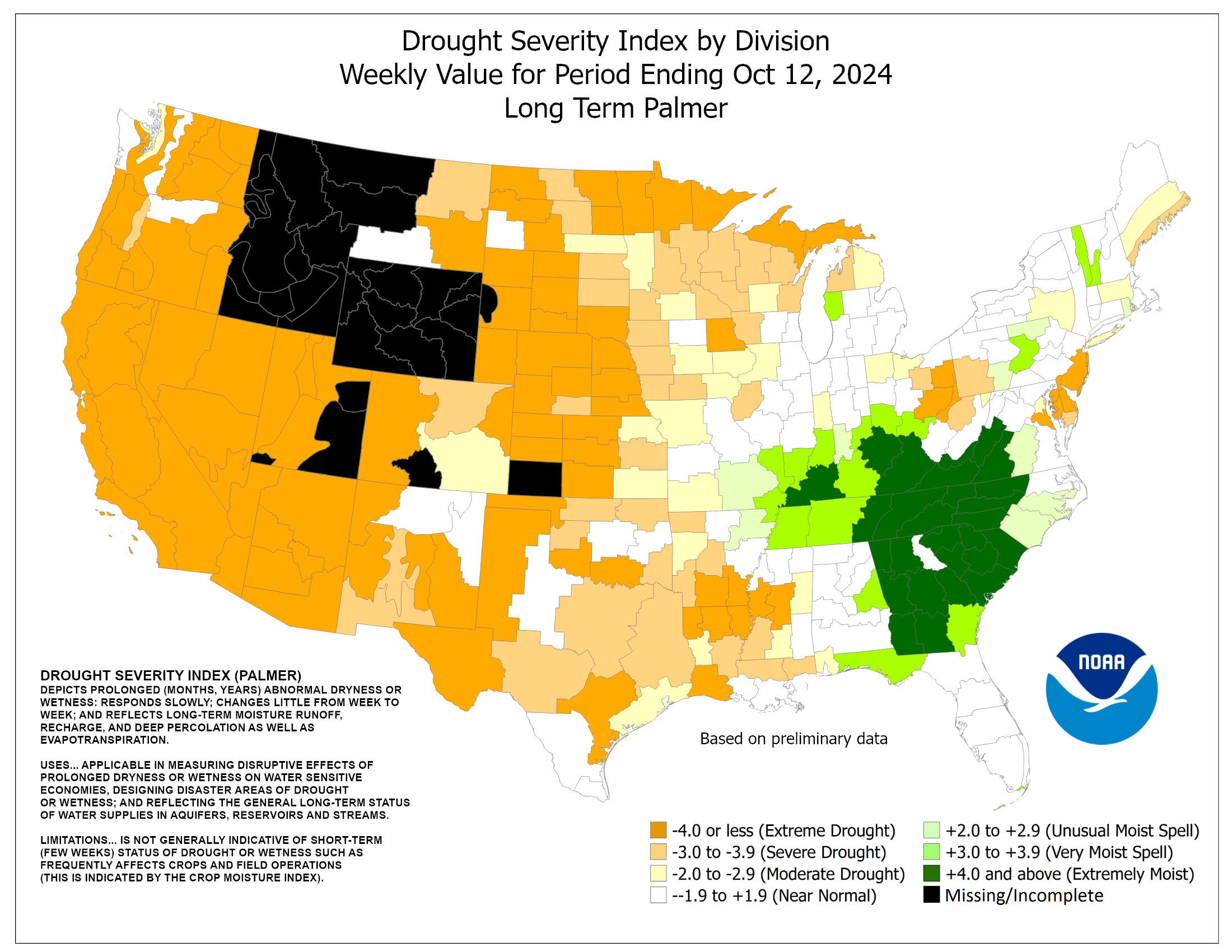
What constitutes a drought? One of the most important indices used by NOAA's National Weather Service to identify locales experiencing drought and assess its severity is the Palmer Drought Severity Index. The Palmer Index, developed by Wayne C. Palmer in the 1960s, incorporates temperature and rainfall data in a formula to determine abnormal dryness or wetness over various time intervals, ranging from one month to years. As such, this drought index primarily reflects meteorological drought. (For the distinction among types of drought, see p. 99 of the DataStreme WES Textbook.) The National Weather Service and U.S. Department of Agriculture jointly compute the Drought Index weekly for each of 344 climatological divisions across the United States, which conform to the crop reporting districts. A map of the current Drought Index is available that shows those divisions experiencing drought with negative index values and varying shades of red, while those regions with excess precipitation have positive values and varying shades of green. Unfortunately, the index is slow to detect fast-emerging droughts and does not reflect the contributions of snowpack, an important component of water supply in the West.
The most recent map (weekly index values ending 29 September 2007) shows a widespread region of moderate to extreme drought across much of the West, including the northern Rockies and the sections of northern Plains, the northern Great Lakes and a large section of the Southeast, including the Ohio and Tennessee Valleys. On the other hand, unusually moist to extremely moist conditions prevail across Texas and sections of New Mexico northward into the central Plains. Near normal soil moisture conditions prevailed over the remainder of the nation.
In the last several years, the National Drought Mitigation Center, a group consisting of several governmental agencies along with the University of Nebraska-Lincoln, has maintained a Drought Monitor site that provides weekly updates of current drought information and forecasts of the potential for drought across the nation. Their current summary map of drought conditions attempts to improve upon the Palmer Drought Severity Index and synthesize five other indices, together with a certain amount of subjectivity to arrive at six drought severity categories. They attempt to show the impacts of the drought upon agriculture and wildfire potential. Their most recent map (2 October 2007) shows extreme to exceptional agricultural drought extending across the Southeast, especially across sections of North Carolina, Tennessee, Georgia and Alabama. Moderate to extreme agricultural and hydrological drought continues in the West, primarily in southern California and across the Great Basin northward to northern Rockies of Idaho and western Montana. The regions around Lakes Superior, Michigan, Huron and Ontario were also experiencing moderate to severe drought conditions. An accompanying narrative entitled "National Drought Summary" also provides a five-day forecast and a 6- to 10-day outlook for precipitation and temperature across the country. This site also includes animated Drought Monitor maps for the prior six and twelve weeks. The Drought Impact Reporter is an interactive tool that permits exploration of the reported drought impacts across the nation. The goal is to assist in risk management that could ultimately help shape drought related policy at the state and federal levels.
The US Seasonal Drought Outlook released on 4 October 2007 by the Climate Prediction Center and valid through December 2007 indicates that the drought should persist across the Southwest and sections of the Middle Atlantic States, while the sections of the Great Basin, the Southeast and the Ohio Valley could experience varying degrees of improvement. Sections of the eastern Gulf Coast, the Interior Northwest and the Northern Great Lakes should experience improvement in their drought conditions.
Palmer, W.C., 1988. The Palmer Drought Index: When and how it was developed. Weekly Weather and Crop Bulletin, 75 (28), 5.
Return to DataStreme WES Website
Prepared by Edward J. Hopkins, Ph.D., email
hopkins@meteor.wisc.edu
© Copyright, 2007, The American Meteorological Society.