Weekly Water News
DATASTREME WES PREVIEW WEEK: 15-19 January 2007
Water in the News:
- (Thurs.)Water and waxy surface almost mix -- University of
Illinois and Argonne Laboratory scientists have determined that water molecules
form a single molecule-thick layer on hydrophobic (water repelling) surfaces
when water evaporates. This confirms long speculated behavior in water bonding
as opposed to suggestions on nanobubbles in the layer. [EurekAlert!]
- (Thurs.) Brazilian dam failure dumps mine waster into river
-- The earthen dam at a bauxite mine in southeastern Brazil broke letting
toxic mine wastes into the rivers supplying drinking water to Rio de Janeiro
and Minas Gerais states. [US Water
News]
- (Tues.) Utah and Nevada need to get along -- Utah and Nevada
are negotiating for rights to draw on a Snake Valley aquifer for growing Las
Vegas water needs. [US Water
News Online]
- Submarine earthquake does not generate major tsunami -- A
major 8.2 magnitude earthquake occurred below the floor of the western
North Pacific to the east of the Japanese archipelago on Saturday (local time)
and produced a tsunami of four inches in Japan and one foot in the western
Aleutian Islands of Alaska. Following the detection of the earthquake,
tsunami warnings had been issued for many coastal locales along the rim of the
Pacific. [CNN]
- Ice storm cripples nation's midsection -- Cold air moving southward
across the Plains at the start of this past weekend was responsible for the
development of an ice storm, as ice from freezing rain accumulated on roads,
trees and power lines. At least 14 people were killed by this storm, 12 due to
a traffic accident on an icy highway in Oklahoma. The rain falling along
the cold front passed into a shallow layer of cold air near the earth's surface
and froze on contact with cold exposed surfaces, producing the freezing rain
event. [USA
Today] A visible image obtained by sensors onboard NOAA's GOES-12
satellite shows the clouds accompanying the cold front that stretched across
the central and southern Plains, along with the Mississippi Valley. [NOAA OSEI]
- Where is the snow? A map of snow cover generated by the
NOAA National Operational Hydrologic Remote
Sensing Center at the end of last week indicates many areas of the country that
typically would have snow cover at this time of year are essentially bare of
snow, while the western mountains, especially in Colorado and northern New
Mexico, have above average snow cover from recent storms. [NOAA
News] A visible image generated from data collected from the MODIS
instrument on NASA's Terra satellite one week ago shows the snow cover across
Colorado, western Kansas, western Nebraska and southern Wyoming following the
third major snowstorm in three weeks, just prior to more snowfall during this
past week. [NASA
Earth Observatory]
- Skiing in Utah could become a memory -- Although the ski slopes in
Utah have benefited from the recent winter storms, researchers at the
University of Colorado, Boulder and a Boulder environment and energy research
firm warn that by 2075 much of the precipitation could fall as rain and the
noted dry and fluffy powder snow could become a hard and wet pack due to
projected increased global temperatures. [USA
Today]
- Record Texas drought could ease -- In 2006, Texas ranchers and
farmers experienced the worst single-year loss in livestock and crops, as a
nearly two-year long drought continued across the Lone Star State.
However, some forecasters are expecting relief with more precipitation
anticipated during the upcoming year. [US Water
News Online]
- More tracking of the collapsed ice shelf -- Images were
released that were made by the Advanced Spaceborne Thermal Emission and
Reflection Radiometer (ASTER) instrument on NASA’s Terra satellite before
and after the 13 August 2005 collapse of the Ayles Ice Shelf on Canada's
Ellesmere Island. [NASA
Earth Observatory]
- Monitoring vegetation and rainfall across the Sahel from space --
High resolution images of the vegetation and the rainfall across Africa's
Sahel made by NASA satellites over nearly one quarter century are being used by
researchers in the Global Inventory Modeling and Mapping Studies group at the
Goddard Space Flight Center to assess the impact that variations of rainfall
have had on this region south of the Sahara Desert. [NASA
Earth Observatory]
- You can touch it, but do not drink it -- Researchers from Dowling
College, Cornell University and New York's Polytechnic University have
developed a method to eliminate 100 percent of the microbes in water from New
Orleans following Hurricane Katrina using a simple water purification
technique. While the treated water is clean, it is not drinkable at this
time. [EurekAlert!]
- Environmental impacts of aircraft deicers to be examined -- The US
Geological Survey has been examining various formulations of chemicals used to
deice aircraft in order to ascertain the relative the toxicity that these
formulations have upon aquatic life. [EurekAlert!]
- Global and US Hazards/Climate Extremes -- A review and analysis of
the global impacts of various weather-related events, including drought, floods
and storms during the current month. [NCDC]
- Global Water News Watch -- Other water news sources can be obtained
through the SAHRA Project at the University of Arizona [SAHRA Project]
- Earthweek -- Diary of the Planet [earthweek.com] Requires
Adobe Acrobat Reader.

Concept of the Week: Touring the DataStreme WES website
Welcome to DataStreme Water in the Earth System (WES)! You are embarking on
a unique teacher-enhancement experience that focuses on water and energy flow
in the global water cycle from an Earth system perspective. Throughout this
learning experience, you will be accessing the
DataStreme WES
website frequently to obtain and interpret a variety of environmental
information, including the latest observational data. The objective of this
initial Concept of the Week is to explore features of the DataStreme
WES website.
On Monday of each week of the course, we will post the current Weekly
Water News that includes Water in the News(a summary listing of
current events related to water), Concept of the Week (an in-depth
analysis of some topic related to water in the Earth system), and Historical
Events (a list of past hydrologic events such as major floods). When
appropriate, Supplemental Information will be provided on some topic
related to the principal theme of the week.
You will use the DataStreme WES website to access and download the
second part of weekly Investigations A & B (plus supporting images) that
begin in your DataStreme WES Investigations Manual. These materials
should be available by noon (Eastern Time) on Tuesday and Thursday. Click the
appropriate buttons to download and print these electronic components of the
investigations as well as your Chapter Progress and Investigations Response
forms.
The body of the DataStreme WES website provides links to the Earth
System, Atmospheric, Oceanic (Inland Seas), and Terrestrial Information, and
extras--glossaries of terms, maps, educational links, and WES information.
Following each section is a link to other sites that examine the various
subsystems of the Earth system. Let's take a quick tour to become more familiar
with the WES website.
Under Atmospheric Information, click on
Water vapor
(WV) Satellite. This is the latest satellite depiction of atmospheric
water vapor at altitudes generally between 3000 and 7000 m (10,000 to 24,000
ft). Press your "back" button and then click on
Latest
WV Animation to view the movement of water vapor and clouds in the
atmosphere. Although water vapor is an invisible gas, satellite technology
makes it possible for us to "see" and follow the flow of water vapor
in the atmosphere as part of the global water cycle. Bright white blotches are
clouds; black indicates areas of very little or no water vapor and, at the
other extreme, milky white signals a relatively high concentration of water
vapor. Use the "back" button on your viewer to return to the
DataStreme WES website.
The flow and transformations of energy are fundamental aspects of the global
water cycle. Heat flows within the Earth system from warmer to colder regions.
In this regard, it is useful to monitor temperatures remotely, by satellite.
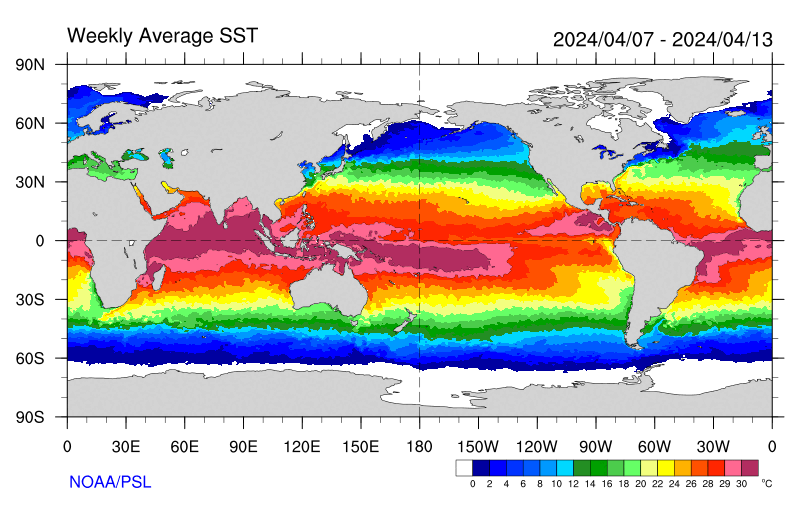
For a global view of the satellite-derived pattern of sea-surface temperatures,
click on Sea
Surface Temperatures under Oceanic (and Inland Seas)
Information. Note that the color scale at the bottom is in degrees Celsius
and temperatures are averaged over a 7-day period. (Depending on your browser,
you may have to place your mouse cursor on the slide bar to the right and
scroll down to view the entire image.) Return to the DataStreme WES
website.
As part of the global water cycle, precipitation that reaches the ground
vaporizes back into the atmosphere, runs off into rivers and streams, seeps
into the ground, or is stored in lakes or glaciers. Under Terrestrial
Information, click on
National Streamflow for the recent status of streamflow monitored at
various US Geological Survey gauging stations around the nation. Note that in
the Map Legend, the current streamflow is compared to the percentiles of daily
streamflow for the given day of the year based upon a historic data set for the
station stretching back at least 30 years. Now return to the DataStreme
WES website.
Extras include color photographs arranged by week (chapter) to
supplement your study of the DataStreme WES textbook. For example, click on
Chapter 1
and then click on the first thumbnail for an enlarged image with the caption,
"Water in Three Phases."
Take a few minutes when you have time to browse the other data and
information sources available via the DataStreme WES website. You may
want to "bookmark" this page on your computer. Return frequently to
get into the flow of DataStreme WES!
Concept of the Week: Questions
- The latest WV Animation indicates that clouds and water vapor generally
move from [(west to east)(east to west)] across the
nation.
- In the tropical Pacific, the highest sea-surface temperatures occur in the
[(western)(eastern)] portion of the ocean basin.
Historical Events
- 15 January 1932...Up to two inches of snow whitened the Los Angeles basin
of California. The Los Angeles Civic Center reported an inch of snow, and even
the beaches of Santa Monica were whitened with snow, in what proved to be a
record snowstorm for Los Angeles. (David Ludlum) (The Weather Channel)
- 15 January 1952...A six-day snowstorm was in progress in the western U.S.
The storm produced 44 inches of snow at Marlette Lake, NV, 52 inches at Sun
Valley, ID and 149 inches at Tahoe CA, establishing single storm records for
each of those three states. In addition, 24-hour snowfall totals of 22 inches
at the University of Nevada and 26 inches at Arco, ID established records for
those two states. The streamliner, 'City of San Francisco' was snowbound in the
Sierra Nevada Range, near Donner Summit. (David Ludlum)
- 15 January 1988...A small storm over the Atlantic Ocean produced heavy snow
along the coast of North Carolina. The five inch total at Wilmington NC was
their third highest for any storm in January in 117 years of records. (National
Weather Summary)
- 16 January 1831...A great snowstorm raged from Georgia to Maine. Snowfall
totals greater than 30 inches were reported from Pennsylvania across southern
New England. (David Ludlum)
- 16-17 January 1987...A winter storm spread snow from the Southern Rockies
into the Middle Mississippi Valley and southwestern sections of the Great Lakes
Region. A total of 61 inches of snow was reported at Rye CO and wind gusts to
100 mph in Utah. As the storm moved across the southern Plains, Tulia, TX
received 16 inches of snow, up to 14 inches were reported in western Oklahoma
and 12 inches fell at Wellington, KS. The storm also produced freezing rain
across Texas and Oklahoma. (National Weather Summary) (Storm Data)
- 16 January 1988...A small storm in the western U.S. produced a foot of snow
and wind gusts to 70 mph in the Lake Tahoe Basin of Nevada. Showers and
thunderstorms produced 2.28 inches of rain at Brownsville TX, their third
highest total for any day in January. (National Weather Summary) (Storm Data)
- 16 January 1990...Heavy snow fell across the Prince Williams Sound area and
the Susitna Valley of southern Alaska. Valdez was buried under 64.9 inches of
snow in less than two days, including a record 47.5 inches in 24 hours. Up to
44 inches of snow was reported in the Susitna Valley. The heavy snow blocked
roads, closed schools, and sank half a dozen vessels in the harbor. (Storm
Data)
- 17 January 1972...A single storm unloaded 77.5 inches of snow at Summit, MT
to establish a state record. (The Weather Channel)
- 18-22 January 1978...The Atlantic's first-ever January subtropical storm
with tropical characteristics since records began in 1871 organized 1500 miles
east-northeast of Puerto Rico. The storm finally dissipated on the 22nd
approximately 200 miles north of Puerto Rico. (Accord's Weather Guide Calendar)
- 19 January 1996...The tug Scandia and its barge, the North
Cape, ran aground on the shore of Rhode Island, spilling 828,000 gallons of
oil, resulting in the worst spill in that state's history. The Coast Guard
rescued the entire crew, pumped off 1.5 million gallons of oil and conducted
skimming operations. (USCG Historian's Office)
- 20 January 1493...Streets in Florence, Italy were blocked by snow and
violent winds as a blizzard struck the city. (The Weather Doctor)
- 20 January 1606...As many as 2000 people died around the Severn Estuary in
England as the result of severe flooding. (The Weather Doctor)
- 21 January 1863...A severe coastal storm dropped heavy rain on the
Fredericksburg area of Virginia. It disrupted a Union Army offensive in an ill
famed "mud march." (David Ludlum)
- 21 January 1880...Memphis, TN began construction of the first independent
municipal sewage system in the U.S. (Today in Science History)
Return to DataStreme WES website
Prepared by WES Central Staff and Edward J. Hopkins, Ph.D.,
email hopkins@meteor.wisc.edu
© Copyright, 2007, The American Meteorological Society.