Weekly Ocean News
DATASTREME OCEAN WEEK ONE: 23-27 January 2006
Ocean in the News:
- (Tues.) Geosynchronous satellite to be moved -- Last week,
the U.S. National Oceanic and Atmospheric Administration (NOAA), the Argentina
Comisión Nacional de Activades Espaciales and the World Meteorological
Organization announced that NOAA's Geostationary Operational Environmental
Satellite (GOES)-10 will be repositioned in October pending the launch of
GOES-N in order to provide satellite coverage over South America. [NOAA News]
- (Tues.) Invasion of giant jellyfish -- Representatives from
Japanese fishing communities met last week to find a solution to problems
associated with the invasion of Echizen kurage, or Nomura's jellyfish that
started last July, moving from the Sea of Japan to the Pacific coast of the
Japanese Islands. [ENN]
- (Tues.) Overfishing could result in smaller fish --
Researchers at the University of California-Riverside report that the selective
overfishing of the largest sized individual fish from a given fish population
could result in genetic changes in the species that would result in fewer fish
eggs and smaller sized fish. [University of
California-Riverside]
- Gulf seafood quality appears not to have been negatively impacted --
Scientists from the NOAA Fisheries Service recently announced that the results
of their analyses of the second and third rounds of toxicology surveys of
samples of Gulf water, marine species and sediment appear to indicate no
significant elevated levels of toxins of bacteria following last fall's
Hurricane Katrina [NOAA News]
- Wilma was a record setter -- Scientists with the National Hurricane
Center released their report of Hurricane Wilma early last week, which adjusted
the strength of last fall's Hurricane Wilma. Although Wilma appears to have
made landfall slightly weaker than previously thought, the scientists
determined that it was the most powerful hurricane that has been recorded in
the North Atlantic basin in over 150 years, based on the lowest minimum central
pressure (882 millibars or 26.04 inches of mercury) and strongest maximum
sustained wind speeds (185 mph). [USA
Today] The complete Wilma
report from
the National Hurricane Center is available in pdf format.
- Whale rescue was unsuccessful -- A whale that swam upstream along
Britain's Thames River to central London died Saturday despite efforts by
rescuers to transport it back to the North Sea. This bottle-nosed whale was the
first whale to be seen near Big Ben and Parliament since whale-watching records
commenced in 1913. [CNN]
- Sea surface height changes could signal La Niña conditions --
Measurements of the sea surface height to within centimeters obtained from
the US-French Jason satellite have shown a gradual cooling of the eastern
equatorial Pacific late last year, consistent with the development of a weak La
Niña episode. A La Niña episode is an anomalous atmospheric and
oceanic circulation regime that can affect the weather around the planet. [NASA
Earth Observatory]
- A warning issued concerning dwindling fish stocks -- Citing a
report issued late last week, the fisheries commissioner for the European Union
has warned that member countries are not making as great an effort as needed to
police fishing restrictions, meaning that overfishing soon could cause
commercial extinction of some fish stocks. [ENN]
- Hazard mitigation could be cost-effective -- A researcher at
Pennsylvania State University who led a team for the National Institute of
Building Sciences claims that for every dollar spent to mitigate the effects
associated with such natural hazards such as hurricanes and flooding, four
dollars would not be needed in the future to repair the damages or compensate
for losses from subsequent disasters. [EurekAlert!]
- Global and US Hazards/Climate Extremes -- A review and analysis of
the global impacts of various weather-related events, including drought,
floods, and storms during the current month. [NCDC]
- Earthweek -- Diary of the Planet [earthweek.com] Requires
Adobe Acrobat Reader.

Concept of the Week: Touring the DataStreme Ocean Website
NOTE: This Concept for the Week is a repeat of that which appeared in
last week's Weekly Ocean News.
Welcome to DataStreme Ocean! You are embarking on a study of the world ocean
and the role of the ocean in the Earth system. This unique teacher enhancement
course focuses on the flow and transformations of energy and water into and out
of the ocean, the internal properties and circulation of the ocean,
interactions between the ocean and the other components of the Earth system,
and the human/societal impacts on and responses to those interactions.
Throughout this learning experience, you will be using the
DataStreme
Ocean website to access and interpret a variety of environmental
information, including recent observational data. The objective of this initial
Concept of the Week is to explore features of the DS Ocean
website.
On Monday of each week of the course, we will post the current Weekly
Ocean News that includes Ocean in the News (a summary listing of
recent events related to the ocean), Concept of the Week (an in-depth
analysis of some topic related to the ocean in the Earth system), and
Historical Events (a list of past events such as tsunamis or specific
advances in the understanding of oceanography). When appropriate,
Supplemental Information will be provided on some topic related to the
principal theme of the week.
You will use the DS Ocean website to access and download the second
part of weekly Investigations A & B (plus supporting images) that begin in
your DataStreme Ocean Investigations Manual. These materials should be
available by noon (Eastern Time) on Tuesday and Thursday. Click the appropriate
links to download and print these electronic components of the investigations
as well as your Chapter Progress and Investigations Response forms.
The body of the DS Ocean website provides links to the Earth System,
information on Physical & Chemical, Geological, and Biological aspects of
the ocean, Atmosphere/Ocean Interaction, the Great Lakes, and extras--a
glossary of terms, maps, educational links, and DataStreme Ocean
information. Following each section is a link to other sites that examine the
various subsystems of the Earth system. Let's take a quick tour to become more
familiar with the DS Ocean website.
Under Physical & Chemical, click on
Sea Surface
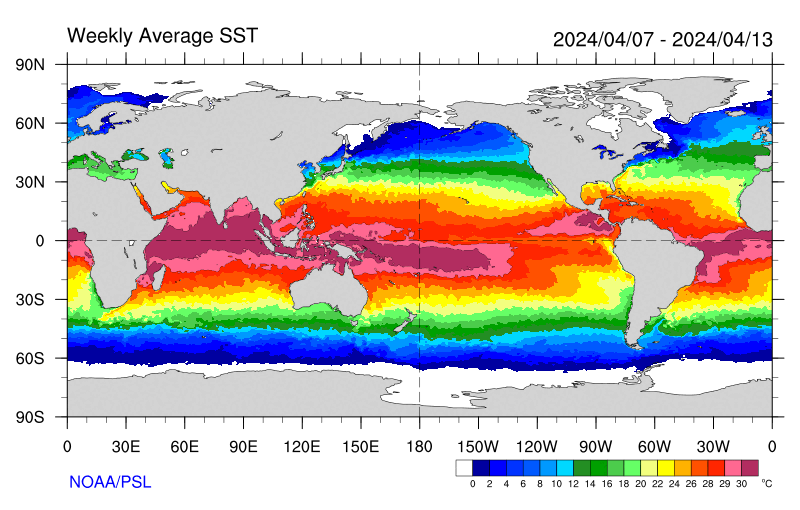
Temperatures. This image uses a color scale to depict the global
pattern of sea surface temperatures (SSTs) (in degrees Celsius) averaged over a
recent 7-day period and based on measurements by infrared sensors onboard
Earth-orbiting satellites. (Depending on your browser, you may have to place
your mouse cursor on the slide bar to the right and scroll down to view the
entire image.) Compare SSTs in the Northern Hemisphere with those in the
Southern Hemisphere. Return to the DS Ocean website.
Under Geological, click on
Current Earthquake
Activity. (Note: This may load slowly.) The USGS Current World
Seismicity page provides a global map of the locations of seismic (earthquake)
events color-coded for the last week or 30 days. The diameters of the circles
represent the magnitude of the most recent earthquakes. Note how earthquakes
are concentrated along the margin of the Pacific Ocean. Details of recent
earthquakes can be found by clicking on their map circles and are given in
Current Earthquakes for the U.S. and World. Return to the DS
Ocean website.
The ocean is home to a wide variety of habitats and organisms. Under
Biological, click on
Ocean
"Color" (Productivity). This is a satellite-derived
(SeaWiFS) color-coded map of biological productivity in the surface waters of
the world ocean averaged for the period October 1978 to date. Orange and red
indicates the highest productivity and dark blue and violet indicate the lowest
productivity. Note the vast areas of relatively low productivity over the
central regions of the subtropical ocean basins. Now return to the DS
Ocean website.
Under Atmosphere/Ocean Interaction, click on
TRMM
Tropical Rainfall. The TRMM (Tropical Rainfall Measuring
Mission) page includes color-coded maps of the Monthly Mean Rainrate (in mm
per day) across the tropics. Click on "July" for example. Changes in
rainfall are linked to large-scale shifts in the atmosphere/ocean circulation
in the tropics. Now return to the DS Ocean website.
Take a few minutes when you have time to browse the other data and
information sources available via the DS Ocean website. You should
"bookmark" ("favorites") this page on your computer. Return
frequently to learn more about the many resources on the ocean in the Earth
system. Bon voyage!
Concept of the Week: Questions
- The latest global sea surface temperature map indicates that SSTs are
generally higher over the
[(western)(eastern)] tropical Pacific Ocean.
- The USGS map of Current Earthquake Activity indicates that earthquakes
appear to be more common along the
[(east)(west)] coast of North America.
Historical Events
- 26 January 1700...The Cascadia Earthquake (magnitude 9) took place off the
coast of British Columbia, as evidenced by Japanese records. Landslides and a
tsunami destroyed many Native American villages along the coasts of Washington,
Oregon and British Columbia, including Vancouver Island. Japanese written
history tells of a massive tsunami striking fishing villages the next day along
the coast of Honshu, killing hundreds. (Wikipedia) (Today in Science History)
- 26 January 1983...The California coast was battered by a storm, which
produced record high tides, thirty-two foot waves, and mudslides, causing
millions of dollars damage. The storm then moved east and dumped four feet of
snow on Lake Tahoe. (22nd-29th) (The Weather Channel)
- 28 January 1946...Canada's greatest sailing ship, Bluenose,
foundered on a Haitian reef; all hands were saved. Her likeness remains on the
Canadian ten-cent coin. (Wikipedia)
- 28 January 1969...A series of storms that battered Southern California from
the 18th to the 28th led to $125 million damage in the
Los Angeles Basin, along with approximately 9 storm and traffic-related deaths
in California. Twenty feet of water covered Sherman Island, a region that
contains more than 10,000 dike-protected agricultural acres, when a dike
failed. (Accord's Weather Guide Calendar)
- 28 January 1971...A waterspout swept into Hawaii's Kailua Bay, then into
the business and hotel district of Kailua-Kona, destroying or severely damaging
a number of buildings including 40 apartment units and collapsing a 6-story
hotel under construction. Amazingly, only four people were injured. (Accord's
Weather Guide Calendar)
- 29-30 January 1966... A hurricane that struck Samoa was responsible for 50
deaths, destroyed more than one-third of the homes and damaged the remainder.
As many as 50,000 people were left homeless. Swains Island was leveled by the
hurricane. Winds gusted to 100 mph at Pago Pago. (Accord's Weather Guide
Calendar)
- 29 January 1983...A series of Pacific coast storms finally came to an end.
The storms, attributed in part to the anomalous ocean-atmosphere phenomenon,
"El Niño," produced ocean swells 15 to 20 feet high that
ravaged the beaches of southern California. Much of the damage was to homes of
movie stars in the exclusive Malibu Colony. (The Weather Channel)
Return to DataStreme Ocean Website
Prepared by DS Ocean Central Staff and Edward J. Hopkins, Ph.D.,
email hopkins@meteor.wisc.edu
© Copyright, 2006, The American Meteorological Society.