Weekly Ocean News
DATASTREME OCEAN PREVIEW WEEK: 15-19 January 2007
Ocean in the News:
- (Thurs.) Ralph's passing a mystery -- Georgia Aquarium
scientists are trying to determine why Ralph. the aquarium's whale shark, died
last week. Whale sharks are the largest fish and much is still not understood
about them. However, even Ralph's necropsy (animal autopsy) has shown how the
fish control their eyes and filter food. [CNN
News]
- (Tues.) Brazilian algae may fight HIV -- Brazilian
researchers are developing an antibacterial gel from coastal algae that may
help in preventing HIV infections. This is part of a worldwide effort of
searching for microbiocides, new materials from plants. [BBC News]
- Submarine earthquake does not generate major tsunami -- A
major 8.2 magnitude earthquake occurred below the floor of the western
North Pacific to the east of the Japanese archipelago on Saturday (local time)
and produced a tsunami of four inches in Japan and one foot in the western
Aleutian Islands of Alaska. Following the detection of the earthquake,
tsunami warnings had been issued for many coastal locales along the rim of the
Pacific. [CNN]
- Satellites helped save people last year -- NOAA officials recently
announced that 272 people were saved from potentially life-threatening
emergency situations across the United States and surrounding waters in 2006
through the assistance of NOAA geosynchronous and polar orbiting
satellites. These satellites, along with Russia's Cosaps spacecraft,
detect and relay distress signals from emergency beacons to the SARSAT (Search and Rescue Satellite-Aided Tracking System)
Mission Control Center, where rescue personnel from the US Air Force or
US Coast Guard are deployed to make the rescue on land or
sea. [NOAA News]
- More tracking of the collapsed ice shelf -- Images were released
that were made by the Advanced Spaceborne Thermal Emission and Reflection
Radiometer (ASTER) instrument on NASA’s Terra satellite before and after
the 13 August 2005 collapse of the Ayles Ice Shelf on Canada's Ellesmere
Island. [NASA
Earth Observatory]
- Ban on oil and gas drilling in Alaskan fishery is lifted -- Last
week, President George W. Bush lifted the ban that had been in place on oil and
gas drilling in Bristol Bay, an embayment of the Bering Sea off the coast of
southwest Alaska that represents the world's largest run of sockeye
salmon and a region frequented by endangered whales. [MSNBC]
- Clear guidelines should be formulated for marine aquiculture -- The
Marine Aquaculture Task Force, a group of researchers from Woods Hole
Oceanographic Institution, recommends that the federal government should fund
and encourage the research, development and operation of sustainable marine
aquaculture. Congress should also enact legislation to ensure strong
environmental standards are established to maintain sustainable marine
aquaculture. [Woods
Hole Oceanographic Institution] [Christian Science
Monitor]
- Beachgoers made breathless by "red tide" -- A medical
doctor at the University of Miami's Rosenstiel School of Marine and Atmospheric
Science reports that people with asthma could experience respiratory problems
due to highly potent toxins that develop in the algal bloom commonly called
Florida "red tide" in the Gulf of Mexico and then become airborne as
tiny aerosols. [EurekAlert!]
- New life forms discovered in the Arctic Ocean -- An international
team of scientists from Canada, France, Germany and Spain report that they have
discovered a new group of microscopic organisms in the Arctic Ocean, which they
have called "picobiliphytes". [EurekAlert!]
- New findings made concerning nitrogen fixation in the oceans --
Researchers with the University of Washington, Princeton University, ETH
Zurich, Switzerland, the University of California, Los Angeles; and NOAA's
Geophysical Fluid Dynamics Laboratory have found that the Pacific and Indian
Oceans fix approximately twice as much atmospheric nitrogen into nitrogen
compounds as the Atlantic Ocean, These results are counter to the
commonly held belief. [EurekAlert!]
- Global and US Hazards/Climate Extremes -- A review and analysis of
the global impacts of various weather-related events, including drought,
floods, and storms during the current month. [NCDC]
- Earthweek -- Diary of the Planet [earthweek.com] Requires
Adobe Acrobat Reader.

Concept of the Week: Touring the DataStreme Ocean Website
Welcome to DataStreme Ocean! You are embarking on a study of the world ocean
and the role of the ocean in the Earth system. This unique teacher enhancement
course focuses on the flow and transformations of energy and water into and out
of the ocean, the internal properties and circulation of the ocean,
interactions between the ocean and the other components of the Earth system,
and the human/societal impacts on and responses to those interactions.
Throughout this learning experience, you will be using the
DataStreme
Ocean website to access and interpret a variety of environmental
information, including recent observational data. The objective of this initial
Concept of the Week is to explore features of the DS Ocean
website.
On Monday of each week of the course, we will post the current Weekly
Ocean News that includes Ocean in the News (a summary listing of
recent events related to the ocean), Concept of the Week (an in-depth
analysis of some topic related to the ocean in the Earth system), and
Historical Events (a list of past events such as tsunamis or specific
advances in the understanding of oceanography). When appropriate,
Supplemental Information will be provided on some topic related to the
principal theme of the week.
You will use the DS Ocean website to access and download the second
part of weekly Investigations A & B (plus supporting images) that begin in
your DataStreme Ocean Investigations Manual. These materials should be
available by noon (Eastern Time) on Tuesday and Thursday. Click the appropriate
links to download and print these electronic components of the investigations
as well as your Chapter Progress and Investigations Response forms.
The body of the DS Ocean website provides links to the Earth System,
information on Physical & Chemical, Geological, and Biological aspects of
the ocean, Atmosphere/Ocean Interaction, the Great Lakes, and extras--a
glossary of terms, maps, educational links, and DataStreme Ocean
information. Following each section is a link to other sites that examine the
various subsystems of the Earth system. Let's take a quick tour to become more
familiar with the DS Ocean website.
Under Physical & Chemical, click on
Sea Surface
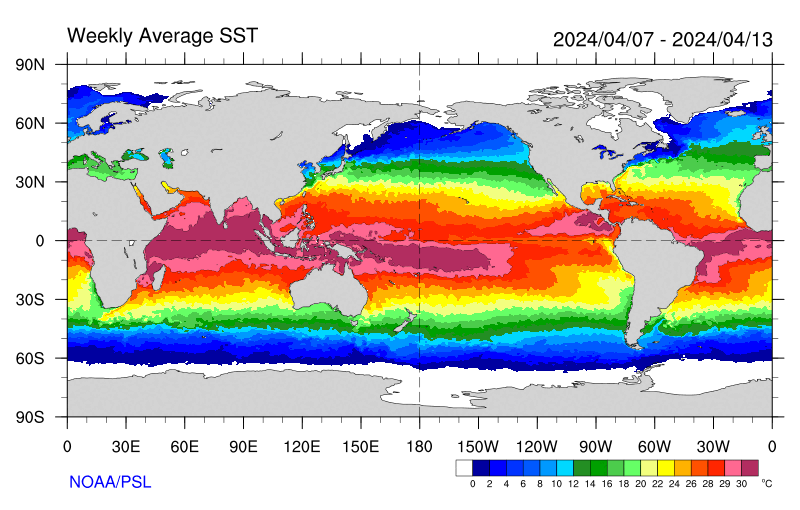
Temperatures. This image uses a color scale to depict the global
pattern of sea surface temperatures (SSTs) (in degrees Celsius) averaged over a
recent 7-day period and based on measurements by infrared sensors onboard
Earth-orbiting satellites. (Depending on your browser, you may have to place
your mouse cursor on the slide bar to the right and scroll down to view the
entire image.) Compare SSTs in the Northern Hemisphere with those in the
Southern Hemisphere. Return to the DS Ocean website.
Under Geological, click on
Current Earthquake
Activity. (Note: The contents of this link may load slowly.) The USGS
Current World Seismicity page provides a global map of the locations of seismic
(earthquake) events color-coded up to the last week. The size of the yellow
squares represent the magnitude of the most recent earthquakes. Note how
earthquakes are concentrated along the margin of the Pacific Ocean. Details of
recent earthquakes can be found by clicking on their map squares. Return to the
DS Ocean website.
The ocean is home to a wide variety of habitats and organisms. Under
Biological, click on
Ocean
"Color" (Productivity). This satellite-derived
(SeaWiFS) color-coded map of biological productivity in the surface waters of
the world ocean is averaged from October 1978 to date. Orange and red indicates
the highest productivity, while dark blue and violet indicate the lowest
productivity. Note the vast areas of relatively low productivity over the
central regions of the subtropical ocean basins. Individual months within this
period may be chosen for viewing. Now return to the DS Ocean website.
Under Atmosphere/Ocean Interaction, click on
TRMM
Tropical Rainfall. Under Atmosphere/Ocean Interaction, click on
TRMM Tropical Rainfall. The TRMM (Tropical Rainfall Measuring
Mission) page includes links to color-coded maps of the Monthly Mean
Rainrate (in mm per day) across the tropics for the last 30 days ending on the
present date, along with an anomaly map displaying the differences between the
recent 30-day averages and the corresponding multi-year averages. Changes in
rainfall are linked to large-scale shifts in the atmosphere/ocean circulation
in the tropics. Now return to the DS Ocean website.
Take a few minutes when you have time to browse the other data and
information sources available via the DS Ocean website. You should
"bookmark" ("favorites") this page on your computer. Return
frequently to learn more about the many resources on the ocean in the Earth
system. Bon voyage!
Concept of the Week: Questions
- The latest global sea surface temperature map indicates that SSTs are
generally higher over the
[(western)(eastern)] tropical Pacific Ocean.
- The USGS map of Current Earthquake Activity indicates that earthquakes
appear to be more common along the
[(east)(west)] coast of North America.
Historical Events
- 15 January 1833...HMS Beagle anchored at Goeree Tierra del Fuego.
- 17 January 1773...HMS Resolution, commanded by English explorer
Captain James Cook, became the first ship to cross the Antarctic Circle
(66º 33' S). (Wikipedia)
- 17 January 1779... The English explorer Captain James Cook made his last
notation in ship's log Discovery. He was killed less than one month
later on Hawaii's Big Island.
- 18 January 1778...The English explorer Captain James Cook sailed past the
island of Oahu, thereby becoming the first European to see the Hawaiian
Islands, which he called the "Sandwich Islands." (The History
Channel)
- 18-22 January 1978...The Atlantic's first-ever January subtropical storm
with tropical characteristics since records began in 1871 organized 1500 miles
east-northeast of Puerto Rico. The storm finally dissipated on the 22nd
approximately 200 miles north of Puerto Rico. (Accord's Weather Guide Calendar)
- 19 January 1840...LT Charles Wilkes, USN was the first American to sight
the eastern Antarctic coast, claiming this portion of the continent for the
United States. The group that he led explored a 1500-mile stretch of the coast
of eastern Antarctica, which later became known as Wilkes Land. (Naval
Historical Center)
- 19 January 1946...Staged jointly by the USCG and USN, the first public
demonstration of LORAN was held at Floyd Bennett Field in New York. (USCG
Historian's Office)
- 19 January 1996...The tug Scandia and its barge, the North
Cape, ran aground on the shore of Rhode Island, spilling 828,000 gallons of
oil, the worst spill in that state's history. The Coast Guard rescued the
entire crew, pumped off 1.5 million gallons of oil and conducted skimming
operations. (USCG Historian's Office)
- 20 January 1606...As many as 2000 people died around the Severn Estuary in
England as the result of severe flooding. (The Weather Doctor)
- 20 January 1850...The Investigator, which was the first ship
to effect a Northwest Passage, left England.
- 20 January 1914...The International Ice Patrol Convention was signed. (USCG
Historian's Office)
- 20 January 1986...The United Kingdom and France announced plans to
construct the Channel Tunnel, a railway tunnel underneath the English Channel,
also known as the "Chunnel." (Wikipedia)
- 21 January 1881...The light was first shown at Tillamook Lighthouse,
located 19 miles south of the Columbia River entrance on the Oregon coast.
(USCG Historian's Office)
- 21 January 1941...The first commercial extraction of magnesium from
seawater was made at Freeport, TX.
- 21 January 1954...The first nuclear powered submarine, the USS Nautilus,
was launched on the Thames River in Groton, CT, representing a landmark in the
history of naval engineering and submersible craft. First Lady Mamie Eisenhower
christened the vessel, which sailed beneath the Arctic icepack to the North
Pole in 1958. (Today in Science History)
Return to DataStreme Ocean Website
Prepared by DS Ocean Central Staff and Edward J. Hopkins, Ph.D.,
email hopkins@meteor.wisc.edu
© Copyright, 2007, The American Meteorological Society.