Weekly Ocean News
DATASTREME OCEAN PREVIEW WEEK: 19-23 January 2009
Ocean in the News:
Eye on the Tropics -- A tropical cyclone (low-pressure system that forms over a tropical ocean basin) developed continued to travel across the South Indian Ocean over this recent weekend. This system, identified as Tropical Storm Eight, was moving along the east coast of Madagascar.
Another tropical cyclone, identified as Tropical Cyclone Dongo, moved to the south-southeast across the central South Indian Ocean south of Diego Garcia and weakened by early last week.
In the South Pacific Ocean off the coast of northern Australia, Tropical Cyclone Charlotte made a brief appearance last weekend. More detailed information for Tropical Cyclone Charlotte, along with satellite imagery may be obtained from the NASA Hurricane Page.
- Marine mammal protection measures provided for Navy sonar training --
NOAA’s Fisheries Service has issued regulations to require the U.S. Navy to implement measures to protect marine mammals while conducting sonar training exercises around the main Hawaiian Islands. [NOAA News]
- Guidelines proposed for determinations of fishery disasters --
NOAA’s Fisheries Service is seeking public comment on a proposed rule that outlines guidelines and procedures for initiating or responding to requests for fishery disaster determinations. [NOAA News]
- Annual catch limits designed to end overfishing --
Based upon recent amendments to the Magnuson-Stevens Fishery Conservation and Management Act, NOAA's Fisheries Service has issued final guidance on annual catch limits of fish starting in 2010 designed to end overfishing and help restore federally managed marine fish stocks. [NOAA News]
- Black abalone granted endangered species status --
NOAA's Fisheries Service recently declared the black abalone, an edible marine mollusk found in intertidal waters along the West Coast, as endangered and eligible for protection under the Endangered Species Act, effective in mid-February 2009. [NOAA News]
- Interim Northeast groundfish rules proposed --
NOAA has proposed interim measures that would govern Northeast groundfish fisheries at the start of the new fishing year in May. [NOAA News]
- Nationalities of vessels involved in unregulated or illegal fishing are identified --
NOAA officials recently issued a first-ever report to the US Congress that identified six countries (France, Italy, Libya, Panama, the People's Republic of China, and Tunisia ) that had fishing vessels that engaged in illegal, unreported, and unregulated (IUU) fishing during the last two years. [NOAA News]
- Losses of Louisiana wetlands and barrier islands due to Gustav are documented --
Images obtained from sensors on NASA's Landsat 5 satellite before and after the landfall of Hurricane Gustav on the Louisiana coast have been analyzed by NASA researchers at the Goddard Space Flight Center and have been found to contain information concerning the loss of wetlands and barrier islands due to this strong category 2 hurricane on the Saffir-Simpson Scale. [NASA GSFC]
- Effects of Arctic climate amplification studied --
In a report "Synthesis and Assessment Product 1.2: Past Climate Variability and Change in the Arctic and at High Latitudes" commissioned by the US Climate Change Science Program, a team of climate scientists from United States, Germany, Canada, the United Kingdom and Denmark claims temperature across the Arctic is changing more rapidly than elsewhere in the Northern Hemisphere, resulting in more rapid melting of glaciers and ice sheets, more sea ice retreat and greater coastal erosion than previously expected. [USGS Newsroom]
- Decline in northern fur seal pups is noted --
Based upon data collected in 2008, researchers at the National Marine Mammal Laboratory of NOAA’s Alaska Fisheries Science Center report a decline in the number of northern fur seal pup births in the depleted species' main gathering spots along Alaska's Pribilof Islands in the Bering Sea, marking the lowest birth rate since 1916. [NOAA News]
- Eight marine protected areas designated as safe havens for deep-water fish --
NOAA's Fisheries Service recently established eight separate marine protected areas in federal waters off the Southeastern States with the goal to shield over 70 species of deep-water fish species and their habitats from fishing. [NOAA News]
- Recreational saltwater fishing boosts nation's economy --
A new study issued by NOAA's Fisheries Service shows that during 2006, more than $31 billion was put into the US economy by recreational saltwater anglers through the purchase of fishing equipment and fishing trip-based expenses. The coastal states of Florida, Texas, California, Louisiana, and North Carolina benefited the most. [NOAA News]
- West Coast ocean research and management will be supported by high-tech airplane --
The NOAA Office of Marine and Aviation Operations recently dedicated a specially equipped twin-engine NOAA aircraft along with a flight crew based in Monterey, CA to support a variety of NOAA ocean research and management programs along the West Coast and Alaska, including those involving five national marine sanctuaries locate in California and Washington State. [NOAA News]
- Fish may play important role in the marine carbon cycle --
An international team of scientists from the University of Miami's Rosenstiel School of Marine and Atmospheric Science, the United Kingdom and Canada claim that they solved a long-standing mystery concerning the carbonate balance in seawater, demonstrating that marine fish contribute a significant fraction of the oceans' calcium carbonate production, which ultimately affects the delicate acidity-alkalinity (pH) balance of seawater. [EurekAlert!]
- Sponges appear to save coral reef --
A Dutch researcher at the Royal Netherlands Institute for Sea Research reports that his investigation of coral caves near Curacao and Indonesia suggests that sponges in these caves appears to filter dissolved organic material and provide sufficient food for other organisms on the reef. [Netherlands Organization for Scientific Research]
- North Atlantic Oscillation variations linked to changes in climate --
Researchers at the Woods Hole Oceanographic Institution who created a 218-year reconstruction of the marine temperature record based on the growth rings on Bermuda brain coral claim that the monthly changes in the ocean temperatures can be linked to the North Atlantic Oscillation (NAO), a wide-ranging pressure seesaw that drives winter climate over much of North America, Europe and North Africa. [Woods Hole Oceanographic Institution]
- Review of global temperatures in 2008 -
Preliminary analysis of worldwide land and ocean surface temperatures for the recently-concluded calendar year of 2008 by scientists at NOAA’s National Climatic Data Center (NCDC) indicates that 2008 was the eighth warmest year since 1880, when sufficiently detailed world-wide climate data became available. Because of slightly different methodology used in averaging, NASA’s Goddard Institute for Space Studies had reported that 2008 was the ninth warmest. According to NCDC statistics, the global land surface temperature for 2008 was the sixth warmest, while the global ocean surface temperature was the tenth warmest. [NOAA News]
- An All-Hazards Monitor --
This Web portal provides the user information from NOAA on current environmental events that may pose as hazards such as tropical weather, marine weather, tsunamis, rip currents, Harmful Algal Blooms (HABs) and coral bleaching. [NOAAWatch]
- Global and US Hazards/Climate Extremes --
A review and analysis of the global impacts of various weather-related events, including drought, floods, and storms during the current month. [NCDC]
- Earthweek -- Diary of the Planet
[earthweek.com] Requires Adobe Acrobat Reader.
Concept of the Week:
Touring the DataStreme Ocean Website
Welcome to DataStreme Ocean! You are embarking on a study of the world ocean and the role of the ocean in the Earth system. This unique teacher enhancement course focuses on the flow and transformations of energy and water into and out of the ocean, the internal properties and circulation of the ocean, interactions between the ocean and the other components of the Earth system, and the human/societal impacts on and responses to those interactions. Throughout this learning experience, you will be using the DataStreme Ocean website to access and interpret a variety of environmental information, including recent observational data. The objective of this initial Concept of the Week is to explore features of the DS Ocean website.
On Monday of each week of the course, we will post the current Weekly Ocean News that includes Ocean in the News (a summary listing of recent events related to the ocean), Concept of the Week (an in-depth analysis of some topic related to the ocean in the Earth system), and Historical Events (a list of past events such as tsunamis or specific advances in the understanding of oceanography). When appropriate, Supplemental Information will be provided on some topic related to the principal theme of the week.
You will use the DS Ocean website to access and download the second part of weekly Investigations "Current Ocean Studies" (plus supporting images) that begin in your Online Ocean Studies Investigations Manual. These materials should be available by noon (Eastern Time) on Tuesday and Thursday. Click the appropriate links to download and print these electronic components of the investigations as well as your Chapter Progress and Investigations Response forms.
The body of the DS Ocean website provides links to the Earth System, information on Physical & Chemical, Geological, and Biological aspects of the ocean, Atmosphere/Ocean Interaction, the Great Lakes, and extras–a glossary of terms, maps, educational links, and DataStreme Ocean information. Following each section is a link to other sites that examine the various subsystems of the Earth system. Let's take a quick tour to become more familiar with the DS Ocean website.
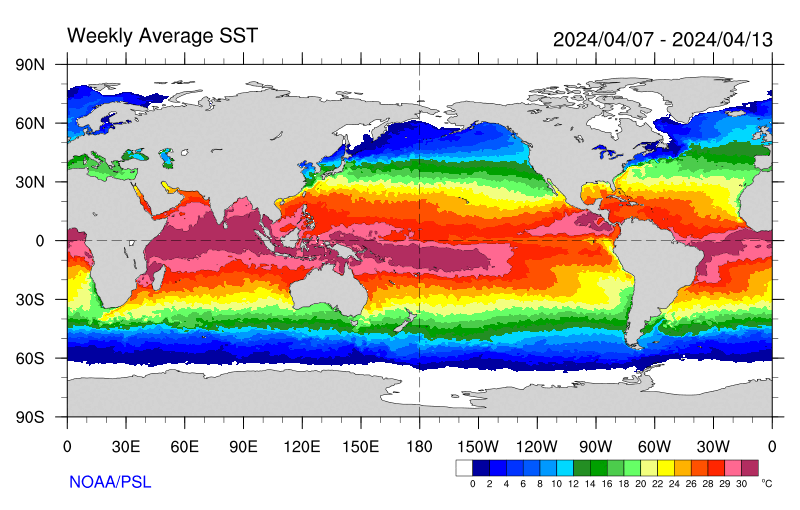
Under Physical & Chemical, click on Sea Surface Temperatures. This image uses a color scale to depict the global pattern of sea surface temperatures (SSTs) (in degrees Celsius) averaged over a recent 7-day period and based on measurements by infrared sensors onboard Earth-orbiting satellites. (Depending on your browser, you may have to place your mouse cursor on the slide bar to the right and scroll down to view the entire image.) Compare SSTs in the Northern Hemisphere with those in the Southern Hemisphere. Return to the DS Ocean website.
Under Geological, click on Current Earthquake Activity. The USGS Current World Seismicity page provides a global map of the locations of seismic (earthquake) events color-coded for the past seven days. The size of the squares represents the magnitude of recent earthquakes. Note how earthquakes are concentrated along the margin of the Pacific Ocean. Details of recent earthquakes can be found by clicking on their map squares. Return to the DS Ocean website.
The ocean is home to a wide variety of habitats and organisms. Under Biological, click on Ocean "Color" (Productivity). This is a satellite-derived (SeaWiFS) color-coded map of biological productivity in the surface waters of the world ocean is averaged from October 1978 to date. Orange and red indicates the highest productivity, while dark blue and violet indicate the lowest productivity. Note the vast areas of relatively low productivity over the central regions of the subtropical ocean basins. Individual months within this period may be chosen for viewing. Now return to the DS Ocean website.
Under Atmosphere/Ocean Interaction, click on TRMM Tropical Rainfall. The TRMM (Tropical Rainfall Measuring Mission) page includes color-coded maps of the Monthly Mean Rainrate (in mm per day) across the tropics for the last 30 days ending on the present date. Changes in rainfall are linked to large-scale shifts in the atmosphere/ocean circulation in the tropics. Now return to the DS Ocean website.
Take a few minutes when you have time to browse the other data and information sources available via the DS Ocean website. You should "bookmark" ("favorites") this page on your computer. Return frequently to learn more about the many resources on the ocean in the Earth system. Bon voyage!
Concept of the Week: Questions
- The latest global sea surface temperature map indicates that SSTs are generally higher over the [(western)(eastern)] tropical Pacific Ocean.
- The USGS map of Current Earthquake Activity indicates that earthquakes appear to be more common along the [(east)(west)] coast of North America.
Historical Events
19 January 1840...LT Charles Wilkes, USN was the first American to sight the eastern Antarctic coast, claiming this portion of the continent for the United States. The group that he led explored a 1500-mile stretch of the coast of eastern Antarctica, which later became known as Wilkes Land. (Naval Historical Center)
19 January 1946...Staged jointly by the USCG and USN, the first public demonstration of LORAN was held at Floyd Bennett Field in New York. (USCG Historian's Office)
19 January 1996...The tug Scandia and its barge, the North Cape, ran aground on the shore of Rhode Island, spilling 828,000 gallons of oil, the worst spill in that state's history. The Coast Guard rescued the entire crew, pumped off 1.5 million gallons of oil and conducted skimming operations. (USCG Historian's Office)
20 January 1606...As many as 2000 people died around the Severn Estuary in England as the result of severe flooding. (The Weather Doctor)
20 January 1850...The Investigator, which was the first ship to effect a Northwest Passage, left England.
20 January 1914...The International Ice Patrol Convention was signed. (USCG Historian's Office)
20 January 1986...The United Kingdom and France announced plans to construct the Channel Tunnel, a railway tunnel underneath the English Channel, also known as the "Chunnel." (Wikipedia)
21 January 1881...The light was first shown at Tillamook Lighthouse, located 19 miles south of the Columbia River entrance on the Oregon coast. (USCG Historian's Office)
21 January 1941...The first commercial extraction of magnesium from seawater was made at Freeport, TX.
21 January 1954...The first nuclear powered submarine, the USS Nautilus, was launched on the Thames River in Groton, CT, representing a landmark in the history of naval engineering and submersible craft. First Lady Mamie Eisenhower christened the vessel, which sailed beneath the Arctic icepack to the North Pole in 1958. (Today in Science History)
Return to DataStreme Ocean Website
Prepared by DS Ocean Central Staff and Edward J. Hopkins, Ph.D.,
email hopkins@meteor.wisc.edu
© Copyright, 2009, The American Meteorological Society.