Weekly Ocean News
DATASTREME OCEAN WEEK ONE: 26-30 January 2009
Ocean in the News:
- Eye on the Tropics -- Tropical cyclone (low pressure systems that
develop over tropical ocean basins) activity continued in the South Indian
Ocean basin.
Tropical Storm Eric had formed last weekend over the waters of the East Indian
Ocean to the east of Madagascar. Eric moved southward, brushing the coast of
Madagascar before dissipating during the early part of last week.
Another system, Tropical Cyclone Fanele developed over the Mozambique Channel
at the start of the week, traveled initially to the northeast and then to the
southeast as it intensified to become a major category-3 cyclone on the
Saffir-Simpson Intensity Scale just prior to its travel across southern
Madagascar, where it caused significant damage. Fanele continued to travel to
the southeast across the waters of the western South Indian Ocean before
changing from a tropical to an extratropical storm system during the later
stages of the week and finally dissipating over this just-concluded weekend. A
visible image obtained from the MODIS (Moderate Resolution Imaging
Spectroradiometer) sensor on NASA's Terra satellite shows the clouds associated
with the recently formed Tropical Cyclone. [NASA
Earth Observatory] (Editor's note: The swirl of clouds surrounding
this Southern Hemisphere low-pressure system is in a clockwise direction,
opposite that of what is seen for a corresponding system in the Northern
Hemisphere. EJH) Additional information and satellite images for both
Eric and Fanele can be found on the
NASA
Hurricane Page.
A tropical depression, identified as Tropical Depression 10, formed over the
South Indian Ocean waters off the northwest coast of Australia on Sunday (local
time).
- New satellite to watch Earth's climate and weather to be launched --
NOAA officials have announced that a new polar-orbiting satellite,
identified as NOAA-N Prime (with subsequent name change to NOAA-19 after it
becomes operational), launched during the first week of February. This new
satellite will have a variety of sensors that will monitor atmospheric and
oceanic conditions that will provide data as part of the international Global
Earth Observation System of Systems (GEOSS) to be used in support of the
agency's weather and climate forecasts. Search and rescue operations will also
be improved by this satellite. [NOAA
News]
- Navy provided with sonar training guidelines to protect marine mammals
-- NOAA's Fisheries Service recently released regulations to the US Navy
that are designed to help protect marine mammals in the waters off the Atlantic
coast and in the Gulf of Mexico as the Navy's Atlantic Fleet conducts active
sonar training in these waters. [NOAA
News]
- Debate on river dolphins pits science against emotion -- Federal
wildlife officials ran into opposition from the public when they decided not to
help a family of bottlenose dolphins in a frigid New Jersey river, even if the
dolphins would die. [Newsday]
- Channel Islands marine sanctuary plans released -- NOAA officials
have recently released a set of documents that includes the final management
plan, regulations and environmental impact statement for its Channel Islands
National Marine Sanctuary located off the southwestern coast of California. [NOAA
News]
- Revised recovery plan for threatened sea turtles released -- In a
joint statement, NOAA’s Fisheries Service and the U.S. Fish and Wildlife
Service recently announced a final revised recovery plan for the Northwest
Atlantic population of the loggerhead sea turtle, which is listed as a
threatened species. [NOAA
News]
- Another view of global temperatures in 2008 -- Researchers at the
NASA Goddard Institute for Space Studies (GISS) recently announced that their
analysis of global temperatures shows that while 2008 appears to be the coolest
calendar year since 2000, preliminary temperature data indicates it to be one
of the tenth warmest since widespread temperature records began in 1880. Their
map showing the global distribution of temperature anomalies (differences
between observed and long-term average values) indicates the widespread cool
surface waters of the equatorial Pacific Ocean associated with an ongoing La
Niña episode. [NASA Earth
Observatory] The (GISS) global temperature analysis for 2008 differs
slightly from that provided last week by NOAA's National Climatic Data Center
(NCDC). [NOAA
News]
- Reconstruction of past global ocean temperatures could improve climate
model reliability -- A team of researchers from Italy, France, Germany and
the United States have created a new quantitative tool called MARGO (Multiproxy
Approach for the Reconstruction of the Glacial Ocean Surface) that reconstructs
the sea surface temperature from around the globe between 23,000 and 19,000
years ago, during the Last Glacial Maximum. One of the goals of the project is
to provide high resolution historical data for improved climate models. [EurekAlert!]
- Danube Delta sediments could help resolve "Noah's Flood"
debate -- A geologist at Woods Hole Oceanographic Institution along with
Romanian colleagues who have analyzed sediment cores from the delta formed by
eastern Europe's Danube River as it enters the Black Sea suggest that a flood
which occurred approximately 9500 years ago along the Black Sea and often
identified as "Noah's Flood" appears to be smaller than previously
proposed by other researchers. [Woods
Hole Oceanographic Institution]
- Deep-sea discoveries made from a scientific sub -- An international
research team from the US and Australia using Jason, an autonomous submersible
vessel, operated to depths of 6000 meters from the Woods Hole Oceanographic
Institution's Research Vessel Thomas G. Thompson discovered new species
of marine animals and obtained more evidence of the impact of increased
atmospheric carbon dioxide upon deep-sea coral during a four-week scientific
expedition in ocean waters off Tasmania. [CSIRO]
- Coral health is threatened bacterial pathogens and rising temperatures
-- Researchers at the Woods Hole Oceanographic Institution and colleagues
have found that a bacterial infection known as yellow band disease has sickened
coral colonies and seems to worsened as water temperatures have increased. [EurekAlert!]
- Water levels on Great Lakes sensitive to climate change --
Scientists from the US and Canada have reported that their analysis of
Great Lakes water levels during the Holocene (since the last Ice Age
approximately 11,000 years ago) indicates that these water levels are highly
sensitive to climate changes, citing the dramatically low lake levels that
caused the lakes to become disconnected from various rivers between 7900 and
7500 years ago during a time of extended dry climatic conditions. [EurekAlert!]
- Better flood maps could help avert significant losses -- A report by
the National Research Council conducted for NOAA and FEMA (the Federal
Emergency Management Agency) indicates that more accurate FEMA flood maps
containing high-accuracy and high-resolution land surface elevation data could
help save lives and avoid significant damages and losses to property and
infrastructure as a result of flood events. [EurekAlert!]
- An All-Hazards Monitor --This Web portal provides the user
information from NOAA on current environmental events that may pose as hazards
such as tropical weather, marine weather, tsunamis, rip currents, Harmful Algal
Blooms (HABs) and coral bleaching. [NOAAWatch]
- Global and US Hazards/Climate Extremes -- A review and analysis of
the global impacts of various weather-related events, including drought,
floods, and storms during the current month. [NCDC]
- Earthweek -- Diary of the Planet [earthweek.com] Requires
Adobe Acrobat Reader.

Concept of the Week: Touring the DataStreme Ocean Website
NOTE: This Concept for the Week is a repeat of that which appeared in
last week's Weekly Ocean News.
Welcome to DataStreme Ocean! You are embarking on a study of the world ocean
and the role of the ocean in the Earth system. This unique teacher enhancement
course focuses on the flow and transformations of energy and water into and out
of the ocean, the internal properties and circulation of the ocean,
interactions between the ocean and the other components of the Earth system,
and the human/societal impacts on and responses to those interactions.
Throughout this learning experience, you will be using the
DataStreme
Ocean website to access and interpret a variety of environmental
information, including recent observational data. The objective of this initial
Concept of the Week is to explore features of the DS Ocean
website.
On Monday of each week of the course, we will post the current Weekly
Ocean News that includes Ocean in the News (a summary listing of
recent events related to the ocean), Concept of the Week (an in-depth
analysis of some topic related to the ocean in the Earth system), and
Historical Events (a list of past events such as tsunamis or specific
advances in the understanding of oceanography). When appropriate,
Supplemental Information will be provided on some topic related to the
principal theme of the week.
You will use the DS Ocean Studies website to access and download the
"Current Ocean Studies" (plus supporting images) that complement your
Ocean Studies Investigations Manual. These materials should also be
available by noon (Eastern Time) on Monday. Click the appropriate links to
download and print these electronic components of the investigations as well as
your Chapter, Investigations and Current Ocean Studies Response forms.
The body of the DS Ocean website provides links to the Earth System,
information on Physical & Chemical, Geological, and Biological aspects of
the ocean, Atmosphere/Ocean Interaction, the Great Lakes, and extras–a
glossary of terms, maps, educational links, and DataStreme Ocean
information. Following each section is a link to other sites that examine the
various subsystems of the Earth system. Let's take a quick tour to become more
familiar with the DS Ocean website.
Under Physical & Chemical, click on
Sea Surface
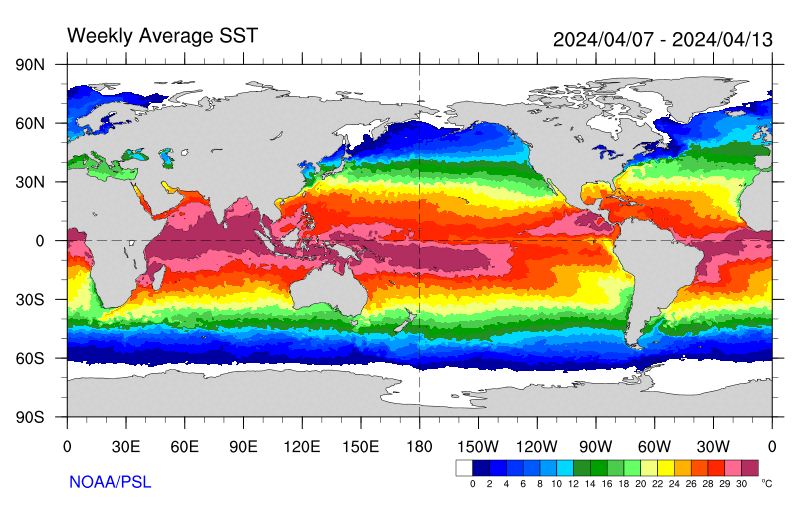
Temperatures. This image uses a color scale to depict the global
pattern of sea surface temperatures (SSTs) (in degrees Celsius) averaged over a
recent 7-day period and based on measurements by infrared sensors onboard
Earth-orbiting satellites. (Depending on your browser, you may have to place
your mouse cursor on the slide bar to the right and scroll down to view the
entire image.) Compare SSTs in the Northern Hemisphere with those in the
Southern Hemisphere. Return to the DS Ocean website.
Under Geological, click on
Current Earthquake
Activity. The USGS Current World Seismicity page provides a global map
of the locations of seismic (earthquake) events color-coded for the past seven
days. The size of the squares represents the magnitude of recent earthquakes.
Note how earthquakes are concentrated along the margin of the Pacific Ocean.
Details of recent earthquakes can be found by clicking on their map squares.
Return to the DS Ocean website.
The ocean is home to a wide variety of habitats and organisms. Under
Biological, click on
Ocean
"Color" (Productivity). This is a satellite-derived
(SeaWiFS) color-coded map of biological productivity in the surface waters of
the world ocean is averaged from October 1978 to date. Orange and red indicates
the highest productivity, while dark blue and violet indicate the lowest
productivity. Note the vast areas of relatively low productivity over the
central regions of the subtropical ocean basins. Individual months within this
period may be chosen for viewing. Now return to the DS Ocean website.
Under Atmosphere/Ocean Interaction, click on
TRMM
Tropical Rainfall. The TRMM (Tropical Rainfall Measuring
Mission) page includes color-coded maps of the Monthly Mean Rainrate (in mm
per day) across the tropics for the last 30 days ending on the present date.
Changes in rainfall are linked to large-scale shifts in the atmosphere/ocean
circulation in the tropics. Now return to the DS Ocean website.
Take a few minutes when you have time to browse the other data and
information sources available via the DS Ocean website. You should
"bookmark" ("favorites") this page on your computer. Return
frequently to learn more about the many resources on the ocean in the Earth
system. Bon voyage!
Concept of the Week: Questions
- The latest global sea surface temperature map indicates that SSTs are
generally higher over the
[(western)(eastern)] tropical Pacific Ocean.
- The USGS map of Current Earthquake Activity indicates that earthquakes
appear to be more common along the
[(east)(west)] coast of North America.
Historical Events
- 26 January 1700...The Cascadia Earthquake (magnitude 9) took place off the
coast of British Columbia, as evidenced by Japanese records. Landslides and a
tsunami destroyed many Native American villages along the coasts of Washington,
Oregon and British Columbia, including Vancouver Island. Japanese written
history tells of a massive tsunami striking fishing villages the next day along
the coast of Honshu, killing hundreds. (Wikipedia) (Today in Science History)
- 26 January 1983...The California coast was battered by a storm, which
produced record high tides, thirty-two foot waves, and mudslides, causing
millions of dollars in damage. The storm then moved east and dumped four feet
of snow on Lake Tahoe. (22nd-29th) (The Weather Channel)
- 28 January 1946...Canada's greatest sailing ship, Bluenose,
foundered on a Haitian reef; all hands were saved. Her likeness remains on the
Canadian ten-cent coin. (Wikipedia)
- 28 January 1969...A series of storms that battered Southern California from
the 18th to the 28th led to $125 million damage in the
Los Angeles Basin, along with approximately 9 storm and traffic-related deaths
in California. Twenty feet of water covered Sherman Island, a region that
contains more than 10,000 dike-protected agricultural acres, when a dike
failed. (Accord's Weather Guide Calendar)
- 28 January 1971...A waterspout swept into Hawaii's Kailua Bay, then into
the business and hotel district of Kailua-Kona, destroying or severely damaging
a number of buildings including 40 apartment units and collapsing a 6-story
hotel under construction. Amazingly, only four people were injured. (Accord's
Weather Guide Calendar)
- 29-30 January 1966...A hurricane that struck Samoa was responsible for 50
deaths, destroyed more than one-third of the homes and damaged the remainder.
As many as 50,000 people were left homeless. Swains Island was leveled by the
hurricane. Winds gusted to 100 mph at Pago Pago. (Accord's Weather Guide
Calendar)
- 29 January 1983...A series of Pacific coast storms finally came to an end.
The storms, attributed in part to the anomalous ocean-atmosphere phenomenon,
"El Niño," produced ocean swells 15 to 20 feet high that
ravaged the beaches of southern California. Much of the damage was to homes of
movie stars in the exclusive Malibu Colony. (The Weather Channel)
- 30 January 1790...The Original, the first boat specialized as a lifeboat to
rescue people from stormy seas was tested on the River Tyne. This 30-foot long
self-righting craft went out to shipwrecks for 40 years, saving hundreds of
lives. William Wouldhave and Lionel Lukin both claimed to be the inventor of
the first lifeboat. (Wikipedia) (Today in Science History)
- 30 January 1997...Surf up to 12 feet, with sets to 15 feet, pounded the
north and west shores of Hawaii. A wave swept eight people into the ocean at
Keane Point on Maui. Four tourists who were taking pictures of the waves
drowned. (Accord's Weather Guide Calendar)
- 1 February 1788...A patent for a steamboat was issued by the state of
Georgia to Isaac Briggs and William Longstreet. The patent was the only one
ever to be issued by Georgia, and first in the U.S. for a steamboat. Much
development had to follow before the steamboat would be commercially viable.
(Today in Science History)
- 1 February 1838...A U.S. patent (No. 588) was issued for the screw
propeller to John Ericsson, (1803-89), a Swedish American engineer, who later
designed and built the Monitor for the Union Navy in the War of the Rebellion.
(Today in Science History)
- 1 February 1811...The Bell Rock Lighthouse was lit for the first time
eleven miles off the east coast of Scotland. Using 24 lanterns, it began
flashing its warning light atop a 100-foot white stone tower. As the oldest
sea-washed lighthouse in existence, it was built by Robert Stevenson on a
treacherous sandstone reef, which, except at low tides, lies submerged just
beneath the waves. In the centuries before, the dangerous Bell Rock had claimed
thousands of lives, as vessels were wrecked on its razor-sharp serrated rocks.
(Today in Science History)
- 1 February 1953...An intense low-pressure system (966 millibars or 29.52
inches of mercury) swept across the North Sea. Wind speeds at Aberdeen,
Scotland exceeded 125 mph. A storm surge of 13 feet, aided by a high spring
tide, breached the dams in as many as 100 places along the Zuider Zee in The
Netherlands, flooding 3.95 million acres or one-sixth of the country. More than
1800 deaths were attributed to drowning and 50,000 people were evacuated. In
addition, this storm was responsible for the loss of 100,000 poultry, 25,00
pigs and 35,000 cattle. (The Weather Doctor) (Accord's Weather Guide Calendar)
Return to DataStreme Ocean Website
Prepared by DS Ocean Central Staff and Edward J. Hopkins, Ph.D.,
email hopkins@meteor.wisc.edu
© Copyright, 2009, The American Meteorological Society.