WEEKLY CLIMATE NEWS
5-9 December 2016
DataStreme Earth's Climate Systems will return for Spring 2017 with new Investigations files starting during Preview Week, Monday, 23
January 2017. All the current online website products, including
updated issues of Weekly Climate News, will
continue to be available throughout the winter break period.
ITEMS
OF INTEREST
- NOAA's Climate Stewards Education Project Webinar features assessment of climate change impacts on food safety -- The NOAA Climate Stewards Education Project (CSEP) has arranged to have Dr. Marianne Fatica, Consumer Safety Officer at the US Food and Drug Administration, as this month's featured speaker in its Webinar that is scheduled for Monday, 5 December, at 7:30 PM Eastern Time. Dr. Fatica's topic is "Weathering Food Safety: Assessing Climate Change Impacts on Our Food." Since space is limited, reservations are needed to be made. [NOAA Climate.gov Teaching Climate Feature]
- Celebrate World Soil Day -- This Monday, 5 December 2016, has been declared to be World Soil Day, an event that is annually held on the 5th of December "to celebrate the importance of soil as a critical component of the natural system and as a vital contributor to human wellbeing" as made in a resolution by the International Union of Soil Sciences (IUSS). This year's theme for World Soil Day is 'Soils and pulses, a symbiosis for life'. [UN Sustainable Development Goals - World Soil Day]
CURRENT
CLIMATE STATUS
- Additional summaries of 2016 hurricane seasons in North Atlantic and the eastern and central North Pacific basins -- After the end of the official 2016 hurricane season in the North Atlantic, eastern North Pacific and central North Pacific basins last Wednesday (30 November 2016), NOAA scientists issued their preliminary assessment of this hurricane season in all three basins, stating that all three basins experienced above-normal seasons. They noted that for the first time since 2012. the Atlantic basin experienced above average tropical cyclone activity in 2016, as five tropical systems made landfall along the US coasts. [NOAA News]
The forecast team at Colorado State University released their summary of the tropical cyclone activity in the North Atlantic basin during 2016 along with a verification of their long-range seasonal and two-week forecasts. [Tropical Meteorological Project] - Waters of the Great Lakes remain relatively warm for late November -- Maps generated by the NOAA Coastwatch's Great Lakes Environmental Research Laboratory depicting the Great Lakes surface temperatures for late November in 2014 and 2016 indicates the lake surface temperatures during this just concluded month were higher than those two years ago. The data for these plots were collected from several satellites. With the Great Lakes being as warm as in November 2010, the lakes should remain open and the potential source of ample amounts of lake effect snow on locations downwind of the lakes if cold winds blow across the lakes in a favorable direction. Graphs of average surface water temperatures over the last five years for each of the Great Lakes are available.
More information on satellite-derived measurements of sea (and lake) surface temperature is available here.
[NOAA Environmental Visualization Laboratory]
- "Night shining" (noctilucent) clouds seen from a satellite perspective -- A mosaic image of the array of noctilucent or polar mesospheric clouds over Antarctica was produced from data collected during the last two weeks of November by NASA's Aeronomy of Ice in the Mesosphere (AIM) spacecraft, a sun synchronous and polar orbiting satellite. The cloud image was of the cloud albedo, or the reflectivity of the cloud tops that are situated at altitudes between 30 to 55 miles above Earth. These observations made by AIM indicates an earlier than usual start to the noctilucent cloud season in the Antarctic. Some scientists believe that the early start to the noctilucent cloud season is a sign of the impact the build-up of greenhouse gases is having on Earth's climate. [NASA Goddard Space Flight Center Feature]
or [NASA Earth Observatory]
- South American wet season starts dry --A map of the cumulative precipitation anomaly (the difference between observed and long-term average precipitation) across a large section of South America through October 2016 reveals that most of the region was experiencing rainfall deficits. This map was obtained from data compiled by the Global Precipitation Climatology Centre, a German contribution to the World Climate Research Programme (WCRP) and to the Global Climate Observing System (GCOS). The wet season in South America typically runs from October through March. [NASA Earth Observatory]
CURRENT
CLIMATE MONITORING
- More frequent and more intense storms causing heavier spring rains in nation's midsection -- A team of researchers from the US Department of Energy's Pacific Northwest National Laboratory has found an explanation for the more frequent and longer-lasting mesoscale convective systems (MCS)of spring that move across the Great Plains and Midwest during the last 35 years, creating excessive rainfall events. Studying satellite, radar and rain gauge data, the researchers found the frequency of very long-lasting MCS events increased by about 4 percent per decade, most notably in the northern half of the central region just to the southwest of the Great Lakes. They feel that the temperature difference between the Southern Great Plains and the Atlantic Ocean produces winds that carry abundant quantities of water vapor northward from the Gulf of Mexico to the Great Plains. [Pacific Northwest National Laboratory News]
- Has a changing climate been responsible for increasing tornado outbreaks? -- A professor at Columbia University's Engineering School and his colleagues have found that the average number of tornadoes that develop during large scale multiday day severe weather outbreaks has risen since 1954. They found a trend in the severity of tornado outbreaks, defined as the number of tornadoes per outbreak, has been increasing most rapidly for the most extreme outbreaks. However, they still remain uncertain as to what has been responsible for this recent trend and the role of a changing climate has on the tornado outbreaks. [Columbia University Engineering News]
CLIMATE
AND HUMAN HEALTH
- Assessing the impact of coldest decade of the last millennium upon humans -- An international team of researchers from Switzerland, Italy, Austria, the Czech Republic, the United Kingdom, Germany, Canada and the US have been investigating the social and economic impacts that the exceptionally cold decade of the 1430s had upon northwestern and central Europe. The cold conditions led to harvest failures in many places, which then resulted in rising food prices, famine and epidemic diseases. The team reconstructed the climate of the 400 year interval (1300 to 1700 CE) from proxy indicators such as tree rings, ice cores, lake sediments and historical documents, finding that winters across the region during the 1430s were extremely cold while summers were normal to warmer than normal. However, the origin of this anomalous climate still remains uncertain and could involve external factors such as increased volcanic activity or changes in solar activity or even natural variability internal to the climate system. [European Geosciences Union News]
CLIMATE
FORECASTS
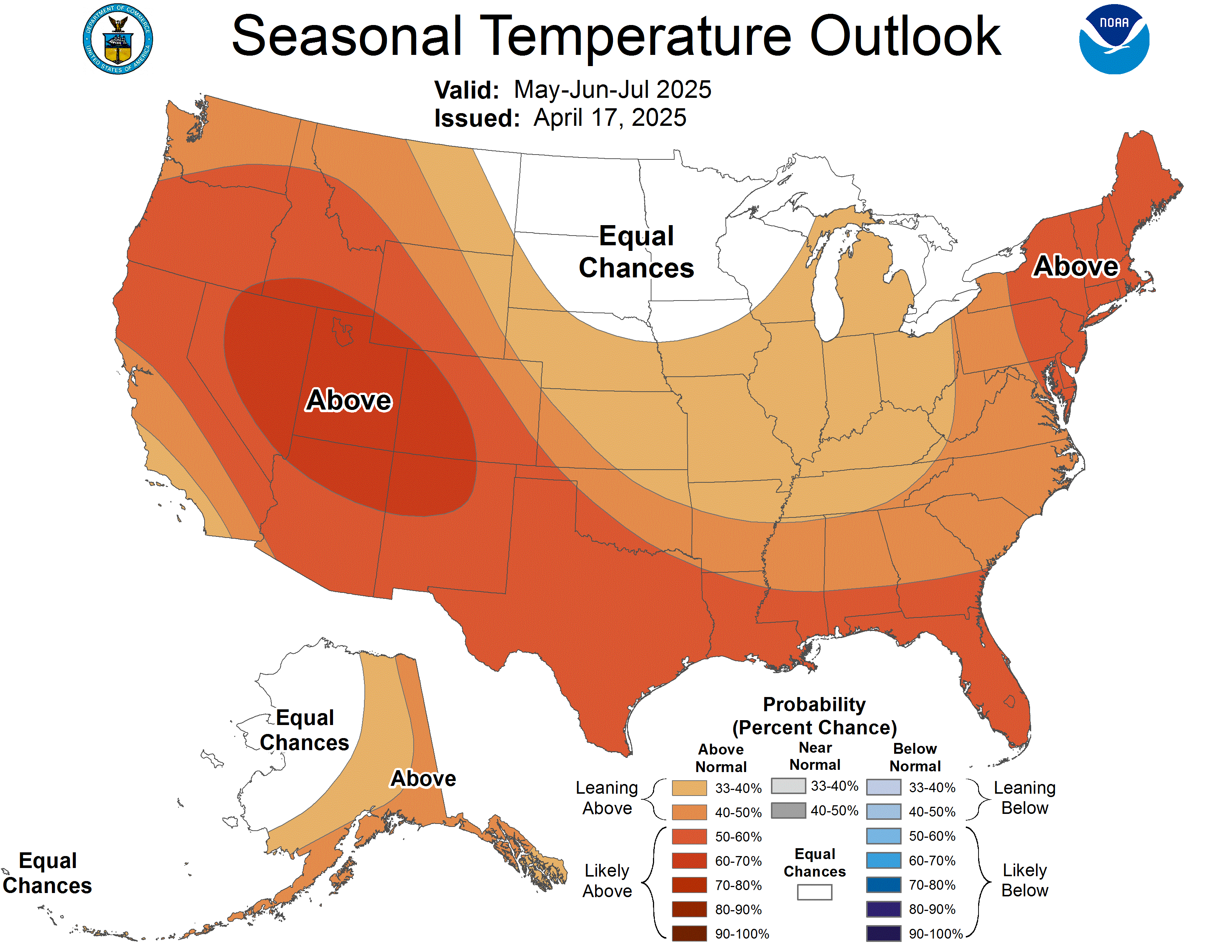
- Regional outlooks issued for winter 2016-17 -- Forecasters for NOAA's Climate Prediction Center are predicting some impacts from La Niña conditions this winter in outlooks for the Midwest, Great Lakes, and Missouri basin. [NOAA NCEI News]
- Canadian national seasonal outlook issued -- Forecasters with Environment Canada issued their outlooks for temperature and precipitation across Canada for December 2016 through February 2017, which represents meteorological winter. The temperature outlook indicates that the eastern two-thirds of Canada could experience above normal (1981-2010) temperatures for these three months. However, sections of the western third of Canada could see average temperatures, with western sections of the Yukon Territory possibly receiving below average winter temperatures.
The Canadian precipitation outlook for the 2016-17 winter season indicates that above average precipitation was to be anticipated across many large areas scattered across southern, northern and eastern Canada. Only a small area eastern Canada between Baffin Island and northern Labrador could have below average precipitation. Elsewhere, near-average winter precipitation was expected.
[Note for comparisons and continuity with the three-month seasonal outlooks of temperature and precipitation generated for the continental United States and Alaska by NOAA's Climate Prediction Center, one would need to use Environment Canada's probabilistic forecasts for temperature and precipitation.]
CLIMATE
AND SOCIETY
Historical Events:
- 5 December 1941...The temperature at Enosburg Falls soared
to 72 degrees to establish a state record for Vermont for the month of
December. (The Weather Channel)
- 6 December 1950...Duluth, MN had their greatest 24-hour
snowfall when 25.4 inches fell. (Intellicast)
- 8 December 1938...The temperature at La Mesa, CA soared to
108 degrees to set a U.S. record for the month of December. Los Angeles
reached 91 degrees, the only time a 90-degree reading was reached in
December in that city's history. (The Weather Channel) (Intellicast)
- 10 December 1919...A 28-inch snowfall for 24 hours at Bend,
OR set a new 24-hour snowfall record for the state. (Intellicast)
- 10 December 1946...The temperature at New York City soared
to 70 degrees, the highest ever for a December day. (David Ludlum)
(Intellicast)
- 11 December 1905...The highest recorded temperature in South America was 120 degrees set in Rivadavia, Argentina. (National Weather Service files)
- 11 December 1944...Toronto, Canada, received a record one day snowfall of 19 inches. (National Weather Service files)
- 10 December 1949...The barometric pressure at Las Vegas, NV
reached a record low reading of 29.17 inches (987.8 millibars). (The
Weather Channel)
- 10 December 1995...Intense lake effect snow squalls buried
Buffalo, NY under 37.9 inches in 24 hours, the city's greatest 24-hour
snowfall and biggest snowstorm ever. Watertown, NY recorded 39 inches
in just 12 hours and had 4 inches of snow an hour each hour for six
consecutive hours. (Intellicast)
- 11 December 1932...Very cold weather prevailed along the
West Coast. San Francisco received 0.8 inch of snow, and at the airport
the temperature dipped to 20 degrees. At Sacramento, CA, the mercury
dipped to 17 degrees to establish an all-time record low for that
location. Morning lows were below freezing from the 9th to the 15th at Sacramento, and the high on the 11th was just 34 degrees. The cold wave dealt severe damage to truck crops
and orange groves in the Sacramento Valley. (David Ludlum) (The Weather
Channel)
- 11 December 2010...A blizzard hit much of southern Minnesota. Minneapolis received a December record 16.3 inches of snow in one calendar day and much of the metro area saw between 15 and 20 inches of snow. (National Weather Service - Twin Cities)
Return to RealTime Climate Portal
Prepared by Edward J. Hopkins, Ph.D., email hopkins@aos.wisc.edu
© Copyright, 2016, The American Meteorological Society.