WEEKLY CLIMATE NEWS
DataStreme ECS WEEK TEN: 6-10 April
2015
ITEMS OF
INTEREST
- Masters climatology -- The 2015
Masters Golf Tournament, one of professional golf's four major
championships, will be held this coming week ( 9 April – 12 April 2015) at the
Augusta National Golf Club in Augusta, GA. The Southeast Regional
Climate Center has produced a Masters
Climatology for 1934-2014 that includes the daily maximum and
minimum temperatures and the 24-hour precipitation totals for each day
of the four-day event in early April, extending over the last 78 years.
- Update on the Cherry Blossom Watch
in Washington, DC-- Many tourists descend upon Washington, DC during the
spring to view the sights, including the blossoming cherry trees that
line the Tidal Basin along the Potomac River. The National Park service
operates a website
that reports the status of the cherry blossoms in anticipation of the
103rd annual Cherry Blossom Festival that is running through next week (Sunday, 12 April 2015). This site also has
a listing of the phenological observations for past bloom dates.
According to a recent update on BlooomWatch!, experts expect that the trees should be
at peak bloom between 11-14 April due to the cold winter and early spring. The bloom that typically occurs at the start of April. However, recent warm weather could cause a bloom between the 9th and the 13th. [Capital Weather Gang]
- Linking weather and climate -- Read
this week's Supplemental
Information.. In Greater Depth for a description the
distinction between atmospheric conditions that can be considered as
weather events, which may last for time spans of up to a week, from
those events with longer time spans of a month to three months that can
be considered within the ream of climate analysis or forecasting.
CURRENT
CLIMATE STATUS
- Small snowpack in the Sierra Nevada -- A natural-color image made of the Sierra Nevada Mountains in California from data collected by the MODIS sensor on NASA's Aqua satellite at the start of last week shows the near record low snowpack across the Sierras. Comparison of this image has been made with an image made from the same sensor in late March 2010, the last year with average winter snowfall. In addition scientists working with NASA's Airborne Snow Observatory (ASO) found the snowpack in California's Tuolumne Basin near Yosemite National Park contained just 40 percent as much water in 2015 as it did at its highest level in 2014. [NASA Earth Observatory]
CURRENT CLIMATE
MONITORING
- Monitoring global lightning activity from space -- A global map of the average annual counts of lightning flashes per square kilometer from 1995 to 2013 has been generated from data collected by the Lightning Imaging Sensor on NASA's Tropical Rainfall Measuring Mission (TRMM) satellite, and the Optical Transient Detector on the OrbView-1/Microlab satellite. The highest densities of lightning flashes were found across tropical Africa in the eastern Democratic Republic of Congo, and over northwestern Venezuela in South America. [NASA Earth Observatory ]
- Seasonal greening across the nation mapped -- Researchers for the US Forest Service have developed a tool called "ForWarn" that land managers can monitor the seasonal "greenup" that involves the growth and development of vegetation signaling the start of a new growing season. This "ForWarn" tool can be used to characterize the start of this greenup more precisely and compare its timing with the 14 previous years. Three online maps detailing greenup in forests and grasslands, agricultural lands, and urban areas are currently available. [Southern Research Station US Forest Service]
CLIMATE FORECASTS
- ...]
- First-quarter 2015 Regional Climate Impacts and Outlooks reports released -- NOAA and its partners recently released a series of eight regional climate outlooks for the first quarter of 2015 that are designed to inform the public of recent climate impacts within their respective regions. These regional future climate outlooks span the upcoming three months of July through September 2014. In addition, major climate events that occurred during the three months from October through December 2014 are discussed and historical seasonal assessments described. [US Drought Portal]
- CHECK -- Updated regional climate impacts and outlooks released -- During the last week NOAA scientists and their colleagues in other partner agencies released a set of regional quarterly climate impact and outlook reports entitled
"Regional Climate Trends and Scenarios for the U.S. National Climate
Assessment." These reports that outlines historical climate trends, describe major climate events that occurred during the previous three months that constitute meteorological winter (December 2014 through February 2015) and provide future climate
outlooks for spring 2015 (March-May 2015) for each of eight regions around the nation. [NOAA NCDC News]
- New method appears to improve long-range forecasts of hurricane season activity -- A team of atmospheric scientists at the University of Arizona has developed a model that they claim improves the accuracy of long-range forecasts of the number of hurricanes over the North Atlantic and Gulf of Mexico by as much as 23 percent. Furthermore, these predictions would be made prior to the start of the six-month hurricane season, which would assist in emergency planning. Based upon hurricane data collected over the 20th century, this new statistical hurricane forecast model uses the state of a longer-term climate cycle called the Atlantic Multidecadal Oscillation (AMO) to judge how much influence the El Niño-La Niña climate cycle has upon hurricane formation in a particular year. The AMO represents the cyclic oscillation in ocean temperatures in the Atlantic with a periodicity ranging from 40 to 70 years. The majority of the other seasonal hurricane models rely only on the state of the El Niño climate cycle, which has a periodicity that ranges between three and seven years. [University of Arizona News]
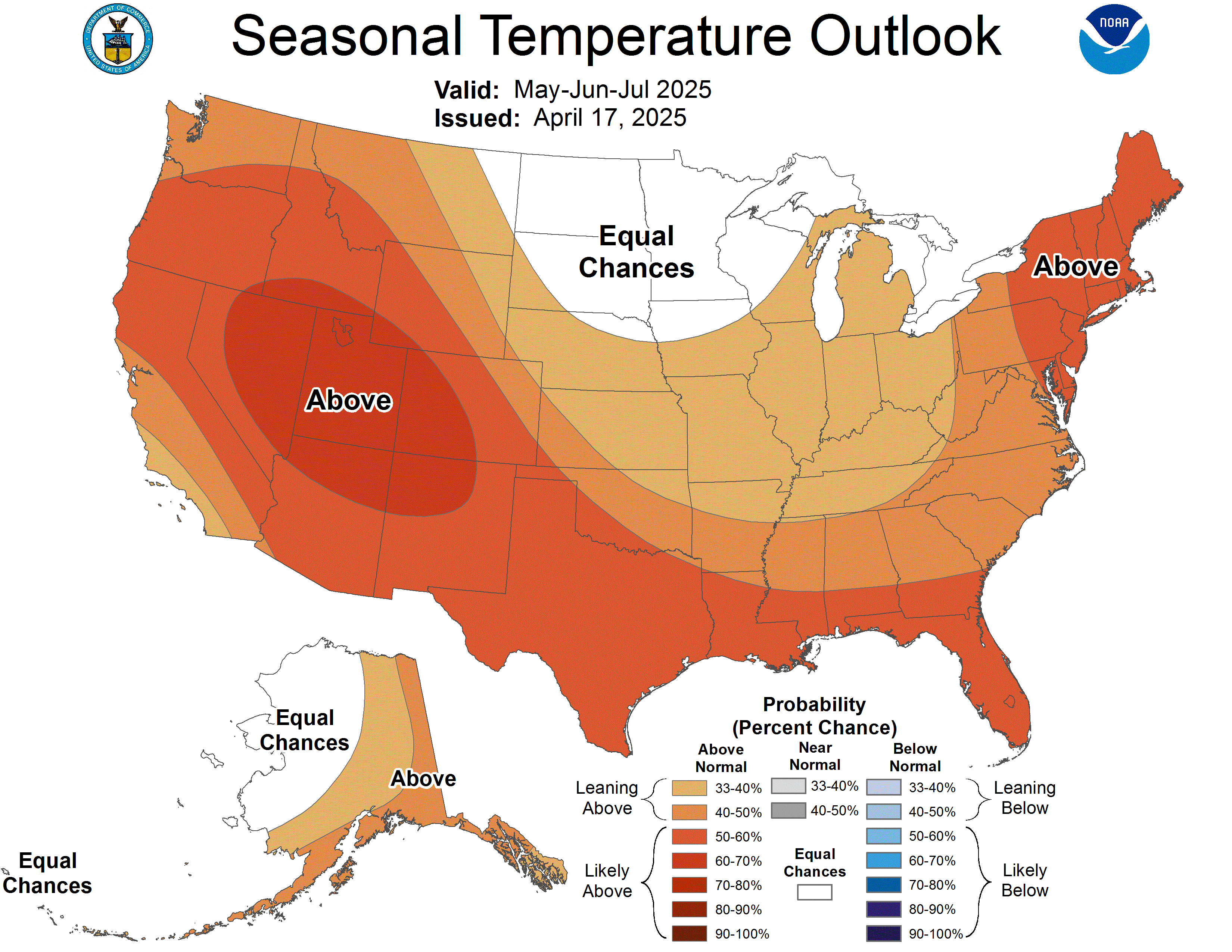
- Canadian national seasonal outlook issued -- Forecasters with Environment Canada issued their outlooks for temperature and precipitation across Canada for the three months of April through June 2015, which represents the last two months of meteorological spring and the start of meteorological summer. The temperature outlook indicates that most of southern Canada running from British Columbia eastward to the Great Lakes should experience above normal (1981-2010) temperatures for these three months. In addition, sections of the Canadian Archipielago should also have above average spring and early summer temperatures. A few areas in Atlantic Canada would have below average temperatures for the next three months. Elsewhere across Canada, near normal spring temperatures were anticipated.
The Canadian precipitation outlook for April through June 2014 indicates that above normal precipitation for the next three months would be possible across widely scattered areas of the nation, especially across the western provinces. Likewise, a few areas scattered across the Canadian Arctic could experience below average precipitation. Many areas of Canada should receive near normal precipitation for the months running from April through June. .
[Note for comparisons and continuity with the three-month seasonal outlooks of temperature and precipitation generated for the continental United States and Alaska by NOAA's Climate Prediction Center, one would need to use Environment Canada's probabilistic forecasts for temperature and precipitation.]
CLIMATE
MODELLING
- Preparing for a major flooding rain event -- The experiences learnt by several communities in south-central Wisconsin from a two-week span of flooding rains in June 2008 are described. With indications pointing to increased frequencies of heavy downpours across many sections of the nation in the future attributed to changing climate, the experiences in Wisconsin should cause community planners elsewhere to become better prepared for the possibility of flooding that could be life-threatening and could cause major problems to community infrastructure. Using funding from NOAA, scientists at the University of Wisconsin-Madison has built a computer model that simulates changes in runoff, stream flow and lake level in a river basin if the observed NOAA radar data collected from nearby extreme rainfall events were laterally "transposed" as a virtual storm to this new basin.
[NOAA Climate.gov News]
- Studies made of flood zones along the Pacific Northwest coast -- Researchers at Oregon State University have been using the computer modeling resources at the University of Texas at Austin to study the flood zones along the Oregon coast in the Pacific Northwest. One of the findings of this research has been that coastal flooding in the Pacific Northwest primarily comes from large ocean waves that have been generated by major midlatitude storms rather than by tropical cyclones such as hurricanes as found along the Atlantic and Gulf Coasts. Furthermore, changing climate could result in more frequent and intense storms that could result in greater devastation to coastal communities from waves, storm surge and winds. Extreme water levels for different locations in an estuarine environment were calculated for 10-year, 50-year, and 100-year periods, with the resulting water levels overlaid on a digital model of these areas to identify the zones of inundation. These findings should help in reassessing flood maps along the Oregon coast. [Texas Advanced Computing Center, University of Texas at Austin]
- Large-scale deforestation seen to affect climate and global food production -- Researchers at the University of Maryland's National Socio-Environmental Synthesis Center have recently published their findings on how large-scale deforestation could impact global food production by triggering changes in local climate. Changes in surface albedo (or reflectivity) and evapotranspiration caused by the deforestation are considered to be the primary drivers in changing the local air temperature, which could substantially impact the yields of crops, especially those that are highly susceptible to slight changes in climate conditions. Data collected from the MODIS sensors on NASA's Aqua and Terra satellites were used in this study. [University of Maryland Right Now News]
CLIMATE AND
THE BIOSPHERE
- Assessing how climate change could affect tropical forests -- A new international project called Next Generation Ecosystem Experiment–Tropics (NGEE-Tropics) is being readied to commence that will explore how tropical forests will respond to changing climate in terms of increasing atmospheric carbon dioxide levels, rising temperatures and shifting precipitation patterns. This 10-year project will be led by the US Department of Energy's Berkley National Laboratory and include scientists from other national laboratories in the US and Brazil. A high-resolution tropical forest ecosystem model is to be developed that will study soil and vegetation processes at a resolution better than 10 kilometers. [NCAR/UCAR AtmosNews]
- New high-resolution projections of coral bleaching in Caribbean and Gulf of Mexico to help prepare for future -- Researchers at the University of Miami's Rosenstiel School and NOAA's Atlantic Oceanographic and Meteorological Laboratory have developed high resolution projections of the occurrence of coral bleaching in the waters of the Gulf of Mexico and the Caribbean Sea based upon downscaling of the global climate models from the Fifth Assessment IPCC Report to a 10-kilometer resolution. Although many coral reef locations in these waters would experience bleaching by 2050, some locations with lower rates of temperature increase and fewer extreme events could be "relative refugia" where reefs would have more time to adapt to climate change. [NOAA Oceanic and Atmospheric Research News]
CLIMATE
AND HUMAN HEALTH
- Identifying the nation's spring "Allergy Capitals" for 2015 -- The Asthma and Allergy Foundation of America recently released its annual rankings of the top 100 cities across the nation identified as the "most challenging places to live with allergies" for the spring allergy season based upon measured pollen levels (airborne grass/tree/weed pollen and mold spores), allergy medications administered per capita and the number of allergists per capita for each major city. A similar tabulation is also made for the fall allergy season. [Asthma and Allergy Foundation of America]
COMPARATIVE PLANETOLOGY
- Martian rover analyzes Martian atmosphere -- Instruments on NASA's Curiosity rover recently conducting a Sample Analysis at Mars (SAM) experiment that analyzed the inert gas xenon in the Martian atmosphere. Scientists involved in this mission will be studying xenon because its inertness makes it an excellent tracer of the history of the planetary atmosphere. [NASA Jet Propulsion Laboratory]
- Earthweek --
Diary of the Planet [earthweek.com]
Requires Adobe Acrobat Reader.

Concept of the Week: Evolution of
Climate Models
Climate scientists have been building increasingly
sophisticated, mathematical climate models to serve two main purposes:
test the sensitivity of the climate to altered conditions and simulate
climate over time, either back into the past or forward into the
future. The simplest, early type of climate model (zero dimensional)
was the "energy balance model", which provides an average planetary
temperature from incoming and outgoing radiation. A one-dimensional
energy balance model determines the surface temperature from the energy
balance at individual latitude belts.
More complex models involve the physical equations of motion
(gas laws, thermodynamics and radiation interactions) subject to
climate forcings, the boundary conditions of solar radiation, surface
properties and atmospheric composition. As computers improved, models
have included a three-dimensional oceanic circulation
("atmosphere-ocean coupling"), then interactions between the
atmosphere, cryosphere and geosphere, with climate feedback mechanisms
involving the exchanges of heat and water. Finally, models have been
able to incorporate the improved knowledge of the biogeochemical
processes. Climate models calculate variables such as temperature at
individual points within the three-dimensional grid of cells across the
Earth's surface and vertically through the atmosphere, ocean, ice and
land. A tradeoff exists between the number of grid points (the spatial
resolution) and the number of numerical computations. Time and space
accuracy costs increased computational time and expense.
The development of numerical weather prediction models during
the 1960s and 1970s spurred the development of General Circulation
Models (GCMs) for climate. One of the early atmospheric GCMs was
developed at Princeton University's Geophysical Fluid Dynamics
Laboratory (GFDL). By the 1990s, comprehensive climate models were
being perfected with three-dimensional oceanic circulation. Ultimately,
the term GCM could be used to refer to a Global Climate Model that
represents the major climate system components (atmosphere, ocean, land
surface and polar ice) and their interactions. The Community Climate
Model at the National Center for Atmospheric Research is one of the
most comprehensive climate models currently available. This model has
been used to determine the future temperature response for several
scenarios concerning the release of greenhouse gases through the 21st
century as proposed by the IPCC reports.
Concept of the Week: Questions
(Place your responses on the Chapter Progress Response Form
provided in the Study Guide.)
- General circulation models are generally [(less),
(more)] sophisticated
than energy balance models.
- Increasing the spatial resolution of a global climate model
causes the computational time to [(increase),(decrease),(remain
the same)].
Historical Events:
- 6 April 1886...Detroit, MI recorded its biggest snowfall in
24 hours when 25.4 inches fell. (Intellicast)
- 6 April 1989...Unseasonably hot weather prevailed in
California. Afternoon highs of 91 degrees in Downtown San Francisco, 93
degrees at San Jose, 98 degrees at San Diego, 103 degrees at Santa
Maria, 104 degrees at Riverside, and 106 degrees in Downtown Los
Angeles established records for the month of April. (The National
Weather Summary)
- 6 April 1990...The last measurable snowfall of the 1989-90
season occurred at Valdez, AK. This brought the season snowfall to a
whopping 560.2 inches, breaking the old record of 517 inches set back
in the 1928-29 season. (Intellicast)
- 8-10 April 1958...A global 48-hour precipitation record was
established at Aurere, La Reunion Island, when 97.1 in. of rain from a
tropical cyclone fell on the Indian Ocean island. (The Weather Doctor)
- 8 April 1989...Two dozen cities in the southwestern U.S.
reported new record high temperatures for the date. Phoenix, AZ equaled
their record for April of 104 degrees established just the previous
day. (The National Weather Summary)
- 9 April 1983...Hottest day in Malaysian historical record,
as the temperature reached at Chuping, Malaysia reached 101 degrees, a
record that was tied nine days later. (The Weather Doctor)
- 9 April 2000...A record April snowfall of 14.6 in. shut
down Montreal, Quebec. Snow removal contracts had ended on 1 April.
(The Weather Doctor)
- 9 April 1995...Glasgow, MT recorded 12.2 inches of snow in
24 hours, its greatest 24-hour snowfall on record. (Intellicast)
- 10 April 1985...A late season cold snap in the east set
record low April temperatures in the following cities: Asheville, NC,
23 degrees; Beckley, WV, 11 degrees; Elkins, WV, 3 degrees. April
record lows were tied in Raleigh-Durham, NC (23 degrees) and Roanoke,
VA (20 degrees). (Intellicast)
- 10 April 1996...A wind gust of 253 mph was measured when
the eyewall of Tropical Cyclone Olivia passed over Australia's Barrow
Island. This gust became the highest surface wind speed record,
replacing the 231-mph wind gust measured at New Hampshire's Mount
Washington Observatory on 12 April 1934. (Accord Weather Guide
Calendar)
- 12 April 1815...Massive eruption of Mount Tambora in
Indonesia blew 400 cubic kilometers (100 cubic miles) of ash skyward.
Eruption disrupted the global weather for several years, particularly
noteworthy: the cold summer of 1816 in North America and Europe. (The
Weather Doctor)
- 12 April 1934...Winds atop Mount Washington, NH (elevation
6288 feet) averaged a world record 186 mph for five minutes, with a
peak gust from the southeast of 231 mph, which is the highest wind
speed ever clocked in the world. (David Ludlum) On 10 April 1996, a
wind gust of 253 mph was measured when the eyewall of Tropical Cyclone
Olivia passed over Australia's Barrow Island and is now considered to
be the highest surface wind speed record. (Accord Weather Guide
Calendar)
- 12 April 1985...Key West, FL set a new record for April
rainfall in a 24-hour period as 6.06 inches of rain were recorded,
eclipsing the previous record of 6.04 inches which fell on 29 April
1941. In addition, the heavy rainfall shattered the old record for this
date set back in 1931 when 1.49 inches of rain fell. (Intellicast)
- 12 April 1996...Duluth, MN recorded 1.7 inches of snow on
this day to raise its seasonal snowfall total to 132.8 inches -- its
snowiest winter on record. The old record was 131.6 inches set back in
1949-50. (Intellicast)
Return to DataStreme
ECS website
Prepared by Edward J. Hopkins, Ph.D., email hopkins@meteor.wisc.edu
© Copyright, 2015, The American Meteorological Society.