WEEKLY CLIMATE NEWS
1-5 May 2017
DataStreme Earth Climate System will return for Fall 2017 with
new Investigations files starting during Preview Week, Monday, 21 August 2017. All the current online website products will continue to
be available throughout the summer break period.
ITEMS
OF INTEREST
- Between equinox and solstice -- Monday (1 May 2017) is May Day, which had its
origins as a great Celtic festival Beltane. This date is close to the
traditional "cross quarter" day, roughly halfway between the vernal
equinox (20 March 2017) and the summer solstice (21 June 2017). (Note
that Friday 5 May 2017 is closer to the halfway point between the
equinox and solstice. EJH)
- High-quality maps of May temperature and precipitation normals across US available -- The PRISM Climate Group at Oregon State University's website has prepared high-resolution maps depicting the normal maximum, minimum and precipitation totals for May and other months across the 48 coterminous United States for the current 1981-2010 climate normals interval. These maps, with a 800-meter resolution, were produced using the PRISM (Parameter-elevation Regressions on Independent Slopes Model) climate mapping system.
- May weather calendar for a city near you -- The Midwestern Regional Climate Center maintains an interactive website that permits the public to produce a ready to print weather calendar for any given month of the year, such as May, at any of approximately 270 weather stations around the nation. (These stations are NOAA's ThreadEx stations.) The entries for each day of the month includes: Normal maximum temperature, normal minimum temperature, normal daily heating and cooling degree days, normal daily precipitation, record maximum temperature, record minimum temperature, and record daily precipitation; the current normals for 1981-2010.
- May is American Wetlands Month -- The US Environmental Protection Agency (EPA), along with other federal agencies and environmental groups, has designated May as American Wetlands Month in an effort to increase public awareness of the importance of protecting and preserving the nation's wetlands. [EPA-Wetlands]
- Kentucky Derby climatology -- With the 143rd running of the Kentucky Derby set for next Saturday (6 May 2017), the National Weather Service's Louisville (KY) Forecast Office has posted a climatology for Derby Day, including the historical weather extremes. [Louisville NWSFO] A climatology for the Longines Kentucky Oaks, a lucrative race for three-year old fillies (female horses) held each year on the day before the Kentucky Derby, is also available.
- "Be Air Aware" -- National Weather Service and the US Environmental Protection Agency have announced that this upcoming week (1-5 May 2017) is Air Quality Awareness Week and they are urging Americans to "Be Air Aware." [NOAA Air Quality] Individual states and localities will have specific Air Quality Awareness Week activities. Air quality curriculum resources, activities and materials are available in Tools for Teachers.
CURRENT
CLIMATE STATUS
- Looking "Beyond the Data" -- Derek Arndt, Chief of the Climate Monitoring Branch at NOAA's NCEI, posted a blog on the "Beyond the Data" site discussing five topics concerning the weather and climate around the globe during the first three months of 2017 and how the public perceives this facts. [NOAA Climate.gov News]
- Rapid start to the 2017 US tornado season discussed -- A meteorologist with NOAA's Climate Prediction Center wrote a feature article for ClimateWatch Magazine describing the rapid start to the tornado season across the United States in 2017. As of end of the third week of April, 570 tornadoes had been reported, which was approximately one hundred more than average. Attention was drawn to the large number of tornadic thunderstorms found across the Gulf Coast and Southeastern US over the first four months of the year, due to the position of the polar front jet stream and the influx of humid and unstable air from off the Gulf of Mexico. [NOAA Climate.gov News]
CURRENT
CLIMATE MONITORING
- Fifty anniversary of historic ozonesonde launch observed -- A specially built instrumented weather balloon designed to measure atmospheric ozone from the surface upward to into the stratosphere was launched 50 years ago. The launch of what later became known as an "ozonesonde" was made in 1967 by researchers from Environmental Science Services Agency (ESSA), the predecessor of NOAA, near Boulder, CO. Over the last half century, data collected from the ozonesonde launches from around the globe have been used to monitor changes in ozone concentrations, especially in the stratosphere. [NOAA Office of Oceanic & Atmospheric Research News]
- New type of drifter will measure directional properties of water waves -- Recently, researchers at Scripps Institution of Oceanography have begun releasing the "Directional Wave Spectra (DWS) Drifter", a new type of drifter that will measure the directional properties of ocean waves using the Global Positioning System (GPS). Measurements of the waves should improve the forecasting of surface waves associated with tropical cyclones in the Atlantic and Pacific oceans. These new drifters, which will be a part of the Global Drifter Program (GDP), will also measure sea surface temperature (SST) and sea-level atmospheric pressure that are used to validate satellites and in models for weather prediction. [NOAA Climate Program Office News]
- Space telescope detects gamma-ray flashes from tropical cyclones -- NASA's low-orbit Fermi Gamma-ray Space Telescope has recorded more than 4000 terrestrial gamma-ray flashes (TGFs) emanating from the tops of thunderstorm clouds since this spacecraft was launched in 2008. These TGFs emit gamma rays that generate more energy than regular visible light. The scientists believe that studying these TGFs will provide a better understanding of lightning activity, storm strength and the life cycle of tropical and extratropical cyclones. [NASA Goddard Space Flight Center Feature]
CLIMATE FORECASTS
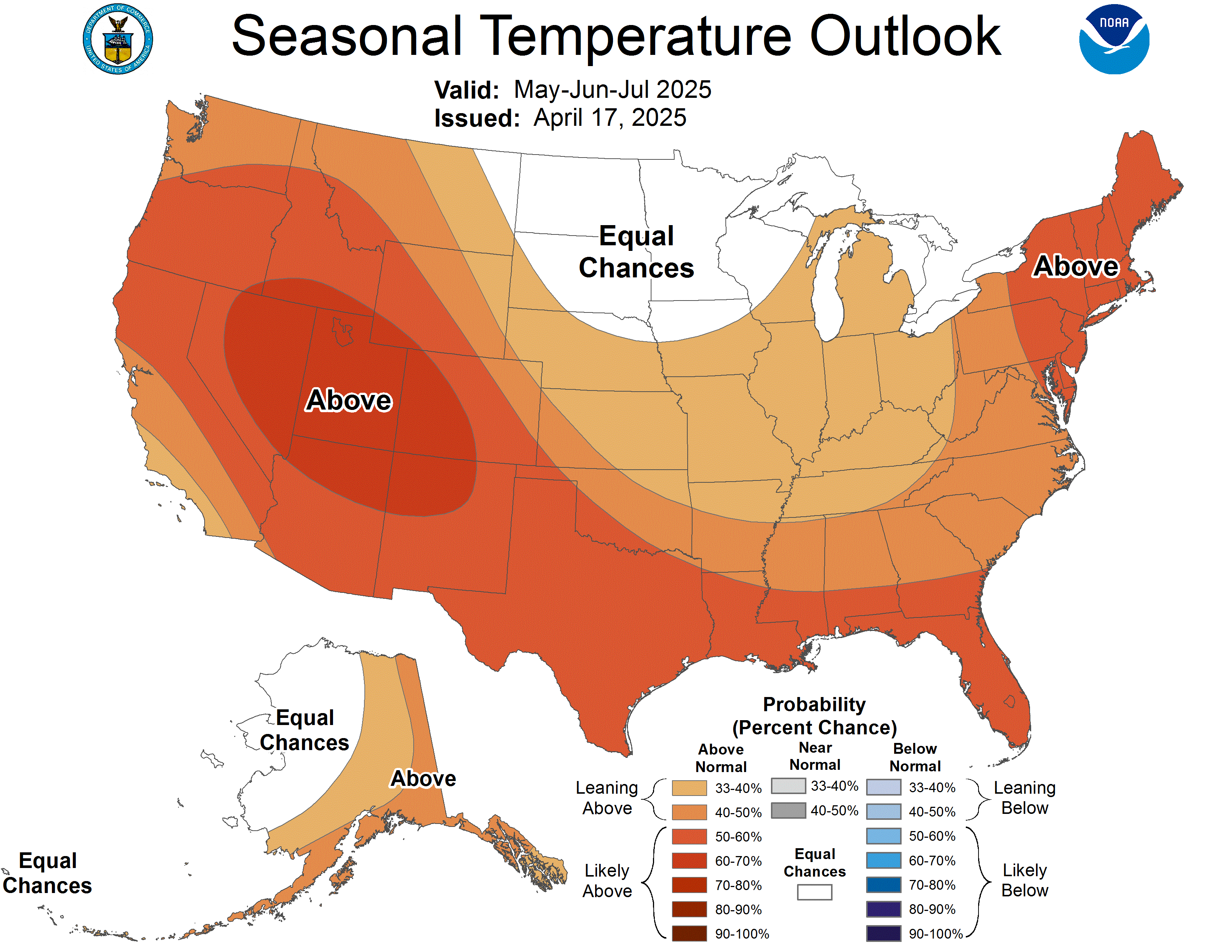
- Canadian national seasonal outlook issued -- Forecasters with Environment Canada issued their outlooks for temperature and precipitation across Canada for the three months of May, June and July 2017, which represents the last month of meteorological spring and the first two months of meteorological summer. The temperature outlook indicates that western sections of Canada, extending from the US-Canadian border northward across British Columbia and the Yukon and Northwest Territories should experience above normal (1981-2010) spring and early summer temperatures. In addition, eastern sections of the Canadian Archipelago that include Baffin and Ellesmere Islands should be warmer than average. Other sections that could be unseasonably warm would over the northern Great Lakes and across several of the Maritime Provinces. Below average temperatures are anticipated across sections of the Prairie Provinces, across Hudson Bay and over Atlantic Canada, especially in Newfoundland and Labrador. Otherwise, the remainder of Canada could have near normal temperatures for these next three months..
The Canadian precipitation outlook for May through July 2017 indicates that sections of southern and eastern Canada extending from the western Great Lakes to Newfoundland could experience above average precipitation. Other areas of northern Canada centered on Nunavut Territory should also be wetter than average. Conversely, a few scattered areas across Arctic Canada could have below average rainfall. Elsewhere, close to average precipitation should be anticipated.
[Note for comparisons and continuity with the three-month seasonal outlooks of temperature and precipitation generated for the continental United States and Alaska by NOAA's Climate Prediction Center, one would need to use Environment Canada's probabilistic forecasts for temperature and precipitation.]
- Forecasting persistent US droughts years in advance may be possible -- Two recent studies conducted by researchers at the University Texas, the University of Hawaii, the National Center for Atmospheric Research and the Lamont Doherty Earth Observatory of Columbia University indicate the possibility of predicting the duration of La Niña events, the cool phase of an alternating climate pattern in the tropical Pacific Ocean that tends to be linked to dry winters in California. The researchers found that the amount of heat discharged in the tropical Pacific and the magnitude of the peak of El Niño prior to La Niña events are related to the likelihood of multiyear La Niña events. Because these factors can be predicted 18 to 24 months in advance, the authors suggest that forecasters may be able to predict future episodes of lingering La Niña and associated drought conditions. [NOAA Climate Program Office News]
CLIMATE AND
HUMAN HEALTH
- "State of the Air 2017" report released -- Just before the start of Air Quality Awareness Week, the American Lung Association released its 17th annual "State of the Air Report" for the United States, which uses data compiled and analyzed by the US Environmental Protection Agency (EPA) obtained from air quality monitors around the nation. The EPA data involve the two most widespread types of pollution - ozone (smog) and particle pollution (PM 2.5, also known as soot). The State of the Air 2017 shows that the nation’s air quality continued to improve between 2013 and 2015 in terms of ozone and year-round particle pollution. However, dangerous spikes in particle pollution were found to be increasing. The majority of the 25 cities across the nation with the worst ozone and year-round particle pollution showed some improvements since last year Unfortunately, too many episodes of unhealthy air were reported. In addition, too many people across the nation live in counties or parishes that have unhealthy levels of either ozone or particle pollution in their communities. These relatively high levels of pollutants put the residents at risk for premature death and other serious health effects such as lung cancer, asthma attacks, cardiovascular damage, and developmental and reproductive harm.
An interactive website permits the public to view the "Report Card: What's the Grade for Your Air?" by entering a state's name. [American Lung Association]
CLIMATE
AND THE BIOSPHERE
- Annual report of National Phenological Database released -- The National Phenological Network recently released their annual report that shows that the number of local phenological projects and active participants in the network increased in 2016, as more than 2.4 million reports were filed during the year, representing a 40 percent increase over the previous year. The USA National Phenology Network monitors the influence of climate on the phenology of plants, animals, and landscapes, which helps serve science and society by promoting a broad understanding of plant and animal phenology and its relationship with environmental change. [National Phenological Network]
- Maps produced of world's ocean ecosystems -- The Group on Earth Observations (GEO), a partnership of more than several hundred national governments and participating organizations, has been involved with the development of a consistent, objective, and complete description of open-ocean environments. Detailed maps have been produced that group the entire global ocean into 37 distinct 3D ecosystems. The resulting ecosystem data and maps are available in a web-based app called the "Ecological Marine Unit Explorer." [USGS News]
CLIMATE
AND SOCIETY
Historical Events:
- 1 May 1854...After 66 hours of steady rain, the Connecticut
River reached a level of nearly twenty-nine feet (28 feet 10.5 inches)
at Hartford, CT (the highest level of record until that time). The
record height was reached in the midst of a great New England flood
that followed sixty-six hours of steady rain. (David Ludlum)
(Intellicast)
- 1 May 1935...Snow, ice and sleet brought winter back to
parts of southeast Minnesota. Minneapolis received three inches of snow
to tie their May record that was established in 1892. (1st-2nd)
(The Weather Channel)
- 1 May 1954...The temperature at Polebridge, MT dipped to 5
degrees below zero to establish a state record for the month of May.
(The Weather Channel)
- 1 May 2003...A record setting 516 tornadoes occurred during the month of May 2003. In particular, during the period May 4-10, 2003, an unprecedented number of tornadoes affected the central and southern United States. During this period, 393 tornadoes occurred across the central and southern U.S. resulting in 39 deaths across 4 states. Six of these tornadoes were classified as violent (F4) on the Fujita Tornado Intensity Scale. (National Weather Service files)
- 2 May 1899...A storm buried Havre, MT under 24.8 inches of snow, an all-time record for that location. The water equivalent of 2.48 inches was a record 24-hour total for the month of May. (The Weather Channel)
- 2 May 2010....Historic rains swept much of Tennessee. Nashville received 13.53" of rain in two days, double the old record. 7.21" of that fell today, making it the wettest day ever seen in Nashville. New records were also set at Nashville for the most rain in 6 hours (5.57") and 12 hours (7.20"). The Cumberland River peaked at 51.9 feet which was the highest since the Flood of '37. (National Weather Service files)
- 4 May 1774...Snow was reported in the Williamsburg Gazette to have fallen in Dumfries, VA. George Washington's weather diary logged at Mount Vernon, that it was a cold day with spits of snow and a hard wind from the northwest. Thomas Jefferson near Charlottesville logged that the Blue Ridge Mountains were covered with snow. The late snow and frost killed most of the fruit crop in the northern part of the state. Farther north, snow fell across Maryland, Pennsylvania, New Jersey and New York. (National Weather Service files)
- 5 May 1987...Unseasonably hot weather prevailed in the western U.S. A dozen cities in California reported record high temperatures for the date. Afternoon highs of 93 degrees at San Francisco, 98 degrees at San Jose, 100 degrees at Sacramento, and 101 degrees at Redding were the highest of record for so early in the season. The high of 94 degrees at Medford, Oregon was also the highest of record for so early in the season.
(National Weather Service files)
- 6 May 1933...Charleston, SC was deluged with 10.57 inches
of rain, an all-time 24-hour record for that location. (The Weather
Channel)
- 6 May 1978...A record late season snowstorm struck
Colorado. Denver checked in with 14 inches for its greatest May
snowstorm on record. (Intellicast)
- 7 May 1964...The temperature at White Mountain 2, located
in California, dipped to 15 degrees below zero to set a low temperature record for May
for the continental U.S. (The Weather Channel)
Return to DataStreme ECS RealTime Climate Portal
Prepared by Edward J. Hopkins, Ph.D., email hopkins@aos.wisc.edu
© Copyright, 2016, The American Meteorological Society.