WEEKLY CLIMATE NEWS
1-5 July 2013
DataStreme Earth Climate Systems will return for Fall 2013 with new Investigations files starting during Preview Week, Monday, 2 September 2013. All the current online website products will continue to be available throughout the summer break period.
ITEMS
OF INTEREST
- Change in seasons -- The beginning of July marks the beginning of the new heating season. Traditionally, meteorologists and climatologists define the heating season to run from 1 July to 30 June of the following year. Heating degree day units are accumulated commencing on 1 July. Likewise, the snow season runs from 1 July through 30 June. Seasonal snowfall totals for next season will be summed from Monday.
- The half-way point -- Midpoint of calendar year 2013 will occur at noon local standard time on Tuesday, 2 July 2013.
- "Dog days" of summer begin -- The "Dog Days" traditionally begin on the third day of July of each year and continue through the eleventh day of August. The hot weather period received its name from Sirius, the brightest visible star in the sky and known as the Dog Star. Sirius rises in the east at the same time as the sun this time of the year. (The Weather Channel)
- Weather in Philadelphia for the 4th of July 1776--This Thursday is the 4th of July or Independence Day. Sean Potter, a consulting meteorologist who has an interest in history, wrote an article two years ago that describes the weather observations made during July 1776 in Philadelphia by Thomas Jefferson who wrote the Declaration of Independence. [Weatherwise Magazine] Have a happy and safe 4th of July! EJH
- Way out there!...The earth reaches aphelion, the point in its annual orbit when it is farthest from the sun this Friday morning (officially at 15Z on 5 July 2013, which is equivalent to 11 AM EDT or 10 AM CDT). At aphelion, the earth-sun distance is 152,089,000 km, or 3.4% greater than the distance at perihelion, the smallest earth-sun distance, which occurred earlier this year on the late evening of 2 January 2013. [US Naval Observatory]
- An early start made to this year's noctilucent cloud season -- Scientists who analyzed data obtained from sensors onboard NASA's AIM (Aeronomy of Ice in the Mesosphere) spacecraft report that noctilucent clouds returned over the polar cap in the Northern Hemisphere in mid-May, marking the earliest start to the noctilucent cloud season since 2007. These noctilucent clouds, or electric blue ice clouds, are found in the high mesosphere during the summer season at altitudes of approximately 85 km. [NASA GSFC]
- High-quality maps of July temperature and precipitation normals across US available -- The PRISM Climate Group at Oregon State University has prepared high-resolution maps depicting the normal maximum temperature, minimum temperature and precipitation totals for May across the 48 coterminous United States for the current 1981-2010 climate normals interval. These maps, with a 800-meter resolution, were produced using the PRISM (Parameter-elevation Regressions on Independent Slopes Model) climate mapping system.
- July weather calendar for a city near you -- The Midwestern Regional Climate Center maintains an interactive website that permits the public to produce a ready to print weather calendar for any given month of the year, such as April, at any of approximately 270 weather stations around the nation. (These stations are NOAA's ThreadEx stations.) The entries for each day of the month includes: Normal maximum temperature, normal minimum temperature, normal daily heating and cooling degree days, normal daily precipitation, record maximum temperature, record minimum temperature, and record daily precipitation; the current normals for 1981-2010.
CURRENT
CLIMATE MONITORING
- Second-quarter 2013 Regional Climate Impacts and Outlooks reports released -- One week ago, NOAA and its partners released a series of eight regional climate outlooks for the second quarter of 2013 that are designed to inform the public of recent climate impacts within their respective regions. Within these regional outlooks, major climate events that occurred during the three months from March through May 2013 were discussed, historical seasonal assessments described and future climate outlooks presented. [NOAA National Climatic Data Center News]
- Critical program reviews of a new polar satellite completed -- Two key program reviews of NOAA's Joint Polar Satellite System (JPSS) were recently completed at NASA's Goddard Space Flight Center that showed preparations for the anticipated launch of the JPSS-1 spacecraft in 2017 remained on schedule and on budget. The JPSS-1 spacecraft would be the second in the series of next generation polar-orbiting weather satellites, following the launch of the initial spacecraft in the JPSS series in October 2011 that has subsequently been named the Suomi National Polar-orbiting Partnership (Suomi NPP) satellite. These polar-orbiting satellites are the result of a joint NOAA and NASA effort designed to provide a continuous flow of global data for monitoring and forecasting environmental phenomena. [NOAA News]
- Review of Canadian national weather and climate for Winter 2012/13 -- Climate scientists with Environment Canada recently reported that the nationwide average temperature during meteorological winter 2012/13 (December through February) was approximately 1.6 Celsius degrees above the 1961-1990 normal, which placed this past winter as the eighteenth warmest winter since nationwide records began in 1948. Labrador and sections of northern Quebec reported winter temperatures that were as much as 4 Celsius degrees above normal. British Columbia, Alberta and southern sections of the Yukon Territory also had above average winter temperatures. Only a small section of the northern Yukon and the western Northwest Territories had a cooler than normal winter.
Winter across Canada was unseasonably dry as the nationwide precipitation for winter 2012/13 was the third lowest since 1948. Except for a region in central Alberta that had above average precipitation totals, most of the western half of Canada was exceedingly dry. On the other hand, eastern Canada had winter precipitation that was close to normal. [Environment Canada]
- SeaSat satellite celebrates an anniversary -- Thirty-five years ago this week, NASA launched the experimental satellite called SeaSat, the first multi-sensor spacecraft dedicated specifically to observing Earth's ocean. Unfortunately, after 106 days of operation, the intended mission ended due to a malfunction. However, during its brief life, the onboard sensors collected sufficient data about the oceans that scientists continue to study. In fact, the Alaska Satellite Facility at the University of Alaska, Fairbanks released processed imagery from SeaSat this past week. The SeaSat satellite can be viewed as a trailblazer because the sensors that were placed upon this satellite have been used successfully on many of the subsequent Earth-sensing satellites. [NASA Jet Propulsion Laboratory]
- An All-Hazards
Monitor -- This Web portal provides the user information from NOAA on
current environmental events that may pose as hazards such as tropical
weather, fire weather, marine weather, severe weather, drought and
floods. [NOAAWatch]
PALEOCLIMATE RECONSTRUCTION
- New website for Cyclone Center launched -- The unique citizen-science project called CycloneCenter.org in which the public helps analyze the intensities of past tropical cyclones has launched a new version of its website. Over 4000 citizen scientists all over the globe have made 210,000 satellite image classifications. CycloneCenter.org is a partnership with NOAA's National Climatic Data Center, the Citizen Science Alliance, the Cooperative Institute for Climate and Satellites and the University of North Carolina in Asheville.
[NOAA National Climatic Data Center News]
CLIMATE FORCING
- Monitoring a smoke plume from space -- Scientists are using sensors on several satellites to monitor the travels of smoke plumes from wildfires. An example demonstrating the use of the multiple sensors is provided by a large plume that was moving across Newfoundland toward the North Atlantic from a large wildfire located in Quebec. One of the images was a true-color image generated from data obtained by the MODIS (Moderate Resolution Imaging Spectroradiometer) on NASA's Aqua satellite that showed the horizontal extent of the plume, while the other image showed the vertical profile of the plume from the CALIOP (Cloud Aerosol Lidar with Orthogonal Polarization) instrument on NASA's CALIPSO (Cloud-Aerosol Lidar and Infrared Pathfinder Satellite Observation) spacecraft. [NASA Earth Observatory]
CLIMATE FORECASTS
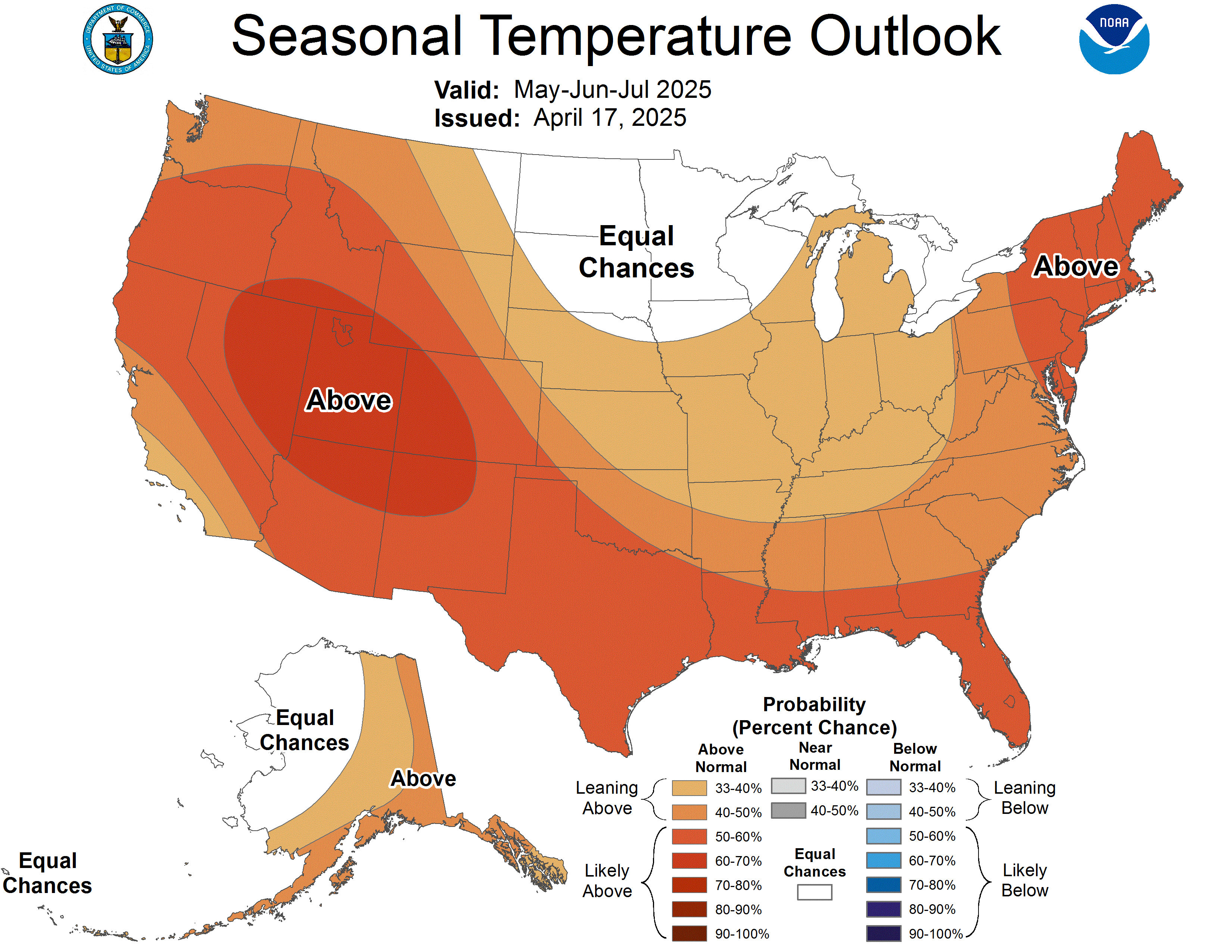
- Canadian national seasonal outlook issued -- Forecasters with Environment Canada issued their outlooks for temperature and precipitation across Canada for July, August and September 2013, which represents the last two months of meteorological summer and the first month of autumn. The temperature outlook indicates that nearly all of Canada would experience above normal (1981-2010) summer temperatures. Only few scattered areas across northern Canada would expected to have below normal summer temperatures.
The Canadian precipitation outlook for summer and early autumn 2013 indicates that below average precipitation could be expected across a wide area of central Canada, extending from coastal British Columbia eastward to northern Quebec. Scattered sections across southern Canada could have above normal precipitation for these three months.
[Note for comparisons and continuity with the three-month seasonal outlooks of temperature and precipitation generated for the continental United States and Alaska by NOAA's Climate Prediction Center, one would need to use Environment Canada's probabilistic forecasts for temperature and precipitation.]
- Two-foot rise in sea level along Maryland shore by 2050 -- A panel of scientific experts from the University of Maryland Center for Environmental Science prepared a report for the Governor that recommended that the State of Maryland should plan for a projected rise in sea level by as much as two feet by 2050 due to anticipated changes in climate. [University of Maryland Center for Environmental Science]
CLIMATE IMPACTS ON THE BIOSPHERE
- Warmer climates may affect microbe survival -- An international research team that included scientists from Arizona State University have found that temperature determines where key soil microbes survive. These scientists warn that projected increases in global temperature over the next 50 years could cause microbes out of the colder deserts in the Southwestern United States. Since these microbes are critical to the formation of topsoil crusts in arid lands, their possible loss would have unknown consequences to soil fertility and erosion across the region. [Arizona State University News]
- Coral reef survival needs major changes -- Researchers from the Carnegie Institution of Science warn that unless deep cuts in carbon dioxide emissions are made, coral reefs around the globe would die because of increasingly inhospitable ocean chemistry conditions by 2100. Coral reefs are very sensitive to changes in ocean chemistry because of increased greenhouse gas emissions, as well as from other factors associated with human activity including coastal pollution, warming waters, overdevelopment and overfishing. [Carnegie Institution of Science]
CLIMATE AND IMPACTS ON HUMAN HEALTH
- Fishing tops list of US lightning death activities -- As part of the just concluded National Lightning Safety Awareness Week, National Weather Service officials announced that over the last seven years, fishing ranked as the leading activity for lightning deaths in the United States. Of the 238 deaths attributed to lightning across the nation since 2006, 26 of the people killed were fishing, followed by camping (15 deaths) and boating (14 deaths). Since the National Weather Service launched its lightning safety campaign, the average annual number of lightning deaths has dropped to 37.
[NOAA News]
- A reminder: "Beat the Heat, Check the Backseat" --The National Weather Service is using the slogan "Beat the Heat, Check the Backseat" to remind people to check for small children in a car seat and to never leave children unattended in a vehicle. Jan Null, a Certified Consulting Meteorologist associated with San Francisco State University, has updated his tabulations of the number of children across the country who have died because of heat stroke deaths in vehicles since 1998. So far in 2013 at least 15 have lost their lives in unattended vehicles, causing the nationwide total since 1998 to rise to 575 children . Additional information including the dynamics of vehicle heating are also included in his updated report. [Golden Gate Weather Services]
CLIMATE AND SOCIETY
- Earthweek -- Diary of the Planet [earthweek.com] Requires Adobe Acrobat Reader.

Historical Events:
- Month of July 1861...The greatest one-month of precipitation ever measured globally (366 inches) was recorded at Cherrapunji, India. Total rainfall for the period 1 August 1860 to 31 July 1861 was the greatest rainfall in one year ever recorded (1041.78 inches). (The Weather Doctor)
- Month of July 1931...The July- August 1931 flood in the Yangtze basin of China affected over 51 million people or one-quarter of China's population. As many as 3.7 million people perished from this great 20th century disaster due to disease, starvation or drowning. (The Weather Doctor)
- 1 July 1911...The high temperature of just 79 degrees at Phoenix, AZ was their lowest daily maximum of record for the month of July. The normal daily high for 1 July is 105 degrees. (The Weather Channel)
- 1 July 1915...Pawtucket, RI received a deluge with 5.1 inches of rain in 24 hours. (Intellicast)
- 1 July 1979...It snowed almost half a foot (5.8 inches) at Stampede Pass, WA, a July record. (The Weather Channel)
- 1 July 1988...Twenty-six cities in the north central and northeastern U.S. reported record low temperatures for the date --an unusual cool spell in what turned out to be one of the hottest summers on record. Lows of 48 degrees at Providence, RI, 48 degrees at Roanoke, VA, 49 degrees at Stratford, CT, and 48 degrees at Wilmington, DE, were records for the month of July. Boston, MA equaled their record for July with a low of 50 degrees. Barre Falls, MA dropped to 34 degrees. Five inches of snow whitened Mount Washington, NH. (The National Weather Summary) (Intellicast)
- 1 July 1987...Lake Charles, LA was drenched with a month's worth of rain during the early morning. More than five inches of rain soaked the city, including 2.68 inches in one hour. (The National Weather Summary)
- 2 July 1908...The temperature at Dumfries, Scotland reached 91 degrees, the highest temperature ever recorded in Scotland. (The Weather Doctor)
- 2 July 1942...The temperature at Portland, OR hit 107 degrees, an all-time record for the city. This record was subsequently reached on three other occasions. (ThreadEx) (Intellicast)
- 2 July 1989...Midland, TX reported an all-time record high of 112 degrees. (The National Weather Summary)
- 2 July 1998...Italy's highest recorded temperature was 108.5 degrees, set at Catania, Italy: (The Weather Doctor)
- 2-6 July 1994...Heavy rains from the remains of Tropical Storm Alberto produced major flooding across northern and central Georgia. Three-day rains exceeded 15 inches at Atlanta. An impressive 21.10 inches of rain fell at Americus, GA on the 6th to establish a 24-hour maximum precipitation record for the Peach State. Numerous road closures and bridge washouts. Thirty people were killed and 50,000 were forced from their homes, as 800,000 acres were flooded. Total damage exceeded $750 million... (NCDC) (Intellicast)
- 3 July 1975...Shangdi, Nei Monggol, China received 401 mm (15.78 inches) of rain, the greatest 1-hour rainfall ever recorded on Earth: (The Weather Doctor)
- 3 July 1966...The northeastern U.S. was in the midst of a sweltering heat wave. The temperature at Philadelphia reached 104 degrees for a second day. Afternoon highs of 102 degrees at Hartford, CT, 105 degrees at Allentown, PA, and 107 degrees at La Guardia Airport in New York City established all-time records for those two locations. (David Ludlum) (The Weather Channel)
- 3 July 1995...The lowest temperature ever recorded in New Zealand was 6.9 degrees below zero at Ophir, New Zealand. (The Weather Doctor)
- 4 July 1911...The northeastern U.S. experienced sweltering 100-degree heat. The temperature soared to 105 degrees at Vernon, VT and North Bridgton, ME, and to 106 degrees at Nashua, NH, to establish all-time records for those three states. Afternoon highs of 104 degrees at Boston, MA, 104 at Albany, NY, and 103 at Portland, ME, were all-time records for those three cities. (The Weather Channel)
- 4 July 1956...A world record for the most rain in one minute was set at Unionville, MD with a downpour of 1.23 inches. (The Weather Channel) (The National Severe Storms Forecast Center)
- 4 July 1989...Independence Day was "hot as a firecracker" across parts of the country. Nineteen cities, mostly in the north central U.S., reported record high temperatures for the date, including Williston, ND with a reading of 107 degrees. In the southwestern U.S., highs of 93 at Alamosa, CO, 114 at Tucson, AZ, and 118 at Phoenix, AZ, equaled all-time records for those locations. (The National Weather Summary)
- 4 July 2007...The temperature at St. George, UT hit an unofficial temperature reading of 118 degrees, which would have topped the state's all-time record of 117 degrees, set in St. George in 1985. (The Weather Doctor)
- 5 July 1925...An immense hailstone weighing 227 grams (0.5 lb) fell at Plumstead in London, England, the heaviest hailstone ever recorded in the United Kingdom. (The Weather Doctor)
- 5 July 1936...The all-time state record high of 120 degrees was set at Gann Valley, SD. (Intellicast)
- 5 July 1937...The temperature at Medicine Lake, MT soared to 117 degrees to establish a state record. (Sandra and TI Richard Sanders - 1987)
Midale and Yellow Grass in Saskatchewan hit 113 degrees to establish an all-time record high for Canada that same day. (The Weather Channel)
- 5 July 1985...The temperature at St. George, UT reached 117 degrees, setting a record high temperature for the Beehive State. (NCDC)
- 5 July 1986...The low temperature at Boise, ID dropped to a crisp 35 degrees, the coldest ever for the month. (Intellicast)
- 5 July 1988...Afternoon and evening thunderstorms spawned eleven tornadoes in Montana and three in North Dakota. Baseball size hail was reported at Shonkin, MT, and wind gusts to 85 mph were reported south of Fordville, ND. Twenty cities in the north central U.S. reported record high temperatures for the date, including Fargo, ND with a reading of 106 degrees. Muskegon, MI equaled their July record with a high of 95 degrees. (The National Weather Summary) (Storm Data)
- 5 July 1989...Moisture from what once was Tropical Storm Allison triggered thunderstorms over the Middle Atlantic Coast Region, which deluged Wilmington, DE with a record 6.83 inches of rain in 24 hours, including 6.37 inches in just six hours. Up to ten inches of rain was reported at Claymont, northeast of Wilmington. July 1989 was thus the wettest month in seventy years for Wilmington, with a total of 12.63 inches of rain. Alamosa, CO reported an all-time record high of 94 degrees, and Pierre, SD hit 113 degrees. Denver, CO reached 101 degrees, topping 100 for the second straight day, only happened once before in 1972 (The National Weather Summary) (Storm Data) (Intellicast)
- 5 July 1993...Heavy rains deluged the Central Plains as one of the greatest floods in U.S. history began to unfold. Twenty-four hour totals included 5.90 inches at Columbia, IA, 5.15 inches at Centralia, KS and 4.80 inches at Haddam, KS. (Intellicast)
- 6 July 1928...A hailstorm at Potter, NE produced a stone that was 5.5 inches in diameter, and seventeen inches in circumference, weighing a pound and a half. At the time, it was the world's largest hailstone. (David Ludlum) (Wikipedia)
- 6 July 1921...The mercury hit 104 degrees at Ville Marie, Quebec, marking Quebec's highest temperature on record. (The Weather Doctor)
- 6 July 1936...Steele, ND reached 121 degrees, the state record. Moorhead, MN reached 114 degrees to set a record high temperature for the Gopher State. (Intellicast) (NCDC).
- 6 July 1988...Thirty-six cities in the north central and northeastern U.S. reported record high temperatures for the date. Afternoon highs of 98 degrees at International Falls, MN and 101 degrees at Flint, MI equaled all-time records. Highs of 96 degrees at Muskegon, MI and 97 degrees at Buffalo, NY were records for July. (The National Weather Summary)
- 6 July 1994...An impressive 21.10 inches of rain fell at Americus, GA to establish a 24-hour maximum precipitation record for the Peach State. (NCDC)
- 7 July 1889...The greatest 20-minute rainfall ever recorded on Earth occurred when 8.1 inches of rain fell on Curtea-de-Arges, Romania. (The Weather Doctor)
- 7 July 1905...The mercury soared to 127 degrees at Parker, AZ to tie the state record established at Fort Mohave on 15 June 1896. (The Weather Channel)
- 7 July 1982...France's hottest day on record occurred at Le Luc near St. Tropez when the high reached 108.9 degrees. (The Weather Doctor)
- 7 July 1988...Thirty-eight cities in the north central and northeastern U.S. reported record high temperatures for the date. Youngstown, OH hit 100 degrees, and for the second day in a row, Flint, MI reached 101 degrees, equaling all-time records for those two cities. (The National Weather Summary)
Return to DataStreme
ECS website
Prepared by Edward J. Hopkins, Ph.D., email hopkins@meteor.wisc.edu
© Copyright, 2013, The American Meteorological Society.