WEEKLY CLIMATE NEWS
4-8 May 2015
DataStreme Earth Climate System will return for Fall 2015 with
new Investigations files starting during Preview Week, Monday, 24 August 2015. All the current online website products will continue to be available throughout the summer break period.
ITEMS
OF INTEREST
- May is National Wetlands Month -- The US Environmental Protection Agency, along with other federal agencies and environmental groups, has designated May as American Wetlands Month in an effort to increase public awareness of the importance of protecting and preserving the nation's wetlands. This year's observance is the 25th annual National Wetlands Month. [EPA-Wetlands]
- Worldwide GLOBE at Night 2015 Campaign resumes -- The fifth in the series of GLOBE at Night citizen-science campaigns for 2015 will begin a 10-night campaign that runs from Saturday 9 May through Monday 18 May. GLOBE at Night is a worldwide, hands-on science and education program designed to encourage citizen-scientists worldwide to record the brightness of their night sky by matching the appearance of a constellation (Leo in the Northern Hemisphere and Crux in the Southern Hemisphere) with the seven magnitude/star charts of progressively fainter stars.
Activity guides are also available. The GLOBE at night program is intended to raise public awareness of the impact of light pollution. In addition to the 9-18 May campaign, the other GLOBE at Night campaigns during the first half of 2015 is on 8-17 June. [GLOBE at Night]
- Land of the Midnight Sun -- Barring clouds, the sun should rise at Barrow, AK early next Monday morning (2:37 AM AKDT on 11 May 2015) after spending 28 minutes below the horizon. The sun should then remain above the local horizon for the next 12 weeks, before going below the horizon for 50 minutes on 2 August 2015 (at 2:09 AM AKDT).
[US Naval Observatory]
- Viewing the ocean color and beauty of our "Blue Marble" -- A beautiful natural-color composite image generated from date collected by the Visible Infrared Imaging Radiometer Suite (VIIRS) onboard the NOAA/NASA Suomi National Polar-orbiting Partnership (Suomi-NPP) spacecraft in early April shows a large area of oceans in the Southern Hemisphere that include the Indian Ocean along with the Atlantic and Southern Oceans. In addition to the view of the expansive ocean waters, clouds are apparent on the image, including Tropical Cyclone Joalane over the Indian Ocean. Additional information is available on how this image was assembled from six orbits completed by the polar orbiting Suomi-NPP satellite. [NASA Earth Observatory]
CLIMATE
FORCING
- Tracking sulfur dioxide emitted from Chilean volcano -- A collection of images obtained from data collected by the Ozone Monitoring Instrument onboard NASA's Aura satellite shows the spread of sulfur dioxide gas across South America and adjacent waters of the South Atlantic Ocean from the recent eruption of Calbuco volcano in southern Chile. In addition to ash emissions, the sulfur dioxide can hydrolyze and form sulfuric acid droplets that could remain in the stratosphere for several years and could possibly cause cooling of the atmosphere across a large area of the planet. A natural color image was also available from the Advanced Land Imager on NASA's Earth Observing-1 satellite. [NASA Earth Observatory]
CLIMATE
FORECASTS
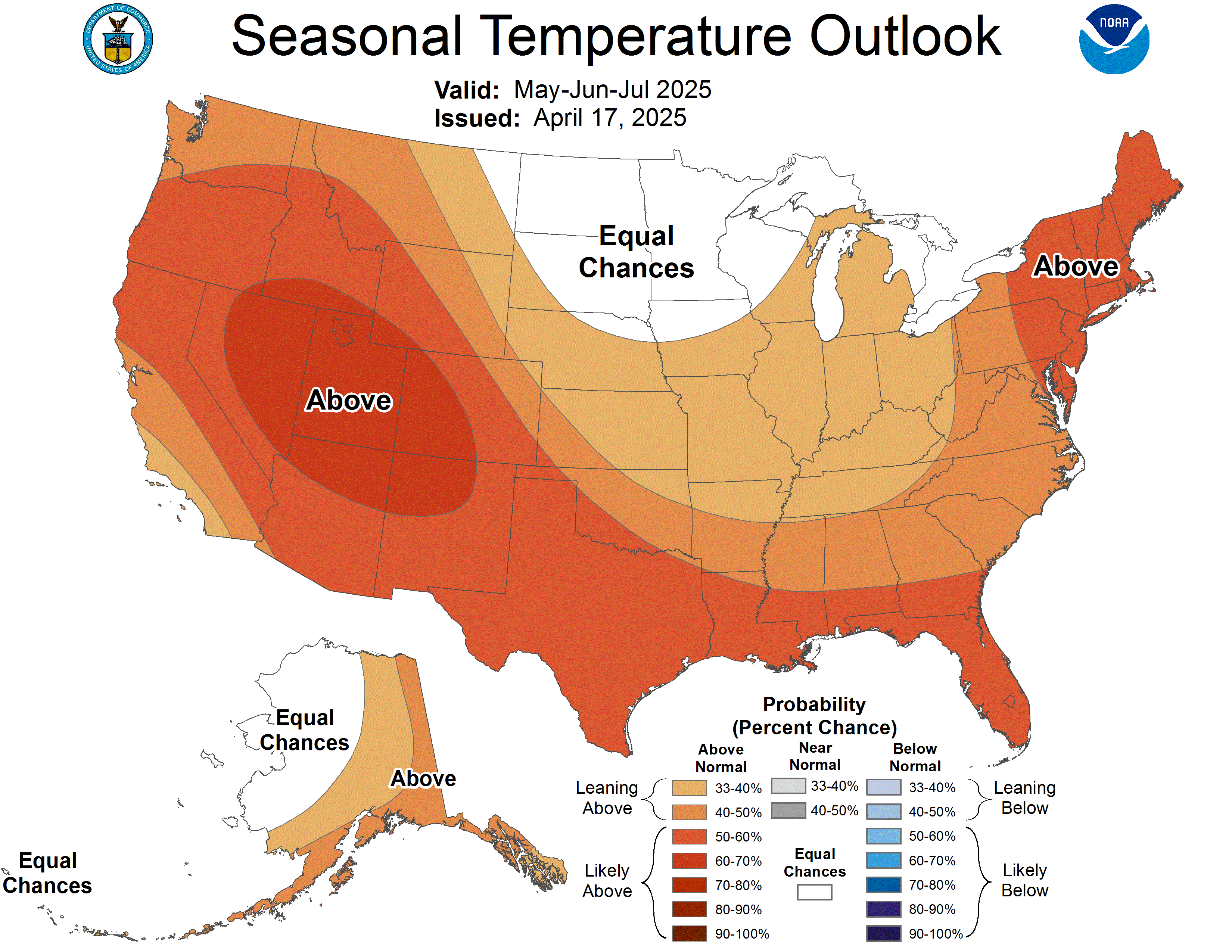
- Canadian national seasonal outlook issued -- Forecasters with Environment Canada issued their outlooks for temperature and precipitation across Canada for the three months of May, June and July 2015, which represents the last month of meteorological spring and the first two months of meteorological summer. The temperature outlook indicates that a large section of Canada, extending from coastal British Columbia eastward to southern Quebec and Nova Scotia would experience above normal (1981-2010) spring and early summer temperatures. On the other hand, a few sections of eastern Canada including northern Newfoundland and Baffin Island would have below average temperatures for the next three months. Elsewhere across Canada, near normal temperatures were anticipated.
The Canadian precipitation outlook for May through July 2015 indicates that a few sections of western Canada extending from coastal British Columbia into the Yukon Territory could experience below average precipitation. Likewise, below average precipitation was also anticipated across the Canadian Archipelago and across Atlantic Canada including several of the Maritime Provinces, eastern Quebec and Labrador. Conversely, the Canadian Rockies in British Columbia and Alberta along with the adjacent western Plains could have above normal precipitation, along with a few smaller scattered areas across the Prairie Provinces and across central Canada.
[Note for comparisons and continuity with the three-month seasonal outlooks of temperature and precipitation generated for the continental United States and Alaska by NOAA's Climate Prediction Center, one would need to use Environment Canada's probabilistic forecasts for temperature and precipitation.]
PALEOCLIMATE
RECONSTRUCTION
- Two-mile long ice core reveals role of ocean current in transmitting climate changes between polar latitudes -- A two-mile long ice core retrieved from the West Antarctic Ice Sheet has been analyzed and provides more than 68,000 years of climate data that indicates a consistent pattern of changes in climate commencing in the Arctic before spreading southward across tropical latitudes to the Antarctic during planet Earth's last glacial period. Rapid climate fluctuations occurred between warm and cold periods and were known as Dansgaard-Oeschger events. Ocean currents were responsible for redistributing heat between the Northern and Southern Hemispheres.
[Desert Research Institute News]
CLIMATE
AND HUMAN HEALTH
- "State of the Air 2015" report released -- Just before the start of Air Quality Awareness Week, the American Lung Association released its 16th annual "State of the Air Report" for the United States, which uses data compiled and analyzed by the US Environmental Protection Agency (EPA) obtained from air quality monitors around the nation. The EPA data involve the two most widespread types of pollution - ozone (smog) and particle pollution (PM 2.5, also known as soot). The State of the Air 2015 shows that progress in improving the nation’s air quality was mixed. Many cities experienced strong improvement and many others suffered worse episodes of unhealthy air. More than four out of ten people had unhealthy air quality in their communities. An interactive website permits the public to view the "Report Card: What's the Grade for Your Air?" by entering either a postal zip code or a state's name. [American Lung Association]
- How warm pleasant weather influences people's mood -- Several studies including those at the University of Michigan and that the University of Vermont shows that pleasant warm weather appears to have a positive affect on human attitude, especially if the people spend some time outside. In addition, being outside in pleasant weather can improve memory and broaden cognitive style. [Huffington Post]
CLIMATE AND THE BIOSPHERE
- Ancient fossils used to identify current marine life at high risk of extinction -- An international team of researchers report that their study of marine fossils over the past 23 million years indicates worldwide patterns of extinction of marine life appear to remain remarkably similar over this time span, with some groups of animals showing similar rates of extinction throughout. In addition, a consistent set of characteristics in these marine animals appears to be associated with elevated extinction risk. The researchers used past global extinction patters to predict which ocean areas and marine organisms currently would be most at risk without additional human-caused threats caused by habitat destruction, overfishing, pollution and ocean acidification. [University of California Berkley News Center]
CLIMATE AND
SOCIETY
- Marshes, reefs and beaches found to enhance coastal resilience -- Scientists from NOAA's National Ocean Service recently reviewed the strengthens and weaknesses of various measures that could be employed to protect the nation's coastal communities from storms, flooding and erosion. They found that the resilience of these communities can be strengthened when they are protected by natural infrastructure such as marshes, reefs, and beaches, or with hybrid approaches, such as a "living shoreline" that represent a combination of natural habitat and built infrastructure. [NOAA News]
- Extreme rainfall analyses can help select an appropriate size culvert -- With the frequency and magnitude of excessive rain events increasing over the recent past because of a changing climate, engineers need to consult historical climate data when they select appropriate sized culverts for the drainage systems in their construction projects involving water flow under roadways. Statistical analyses of extreme rainfall available through NOAA Atlas 14 (Precipitation-Frequency Atlas of the United States)
(provide estimates for the recurrence interval of extreme rainfall amounts. [NOAA Climate.gov News]
CLIMATE AND SOCIETY
- Earthweek -- Diary of the Planet [earthweek.com] Requires Adobe Acrobat Reader.

Historical Events:
- 6 May 1933...Charleston, SC was deluged with 10.57 inches
of rain, an all-time 24-hour record for that location. (The Weather
Channel)
- 6 May 1978...A record late season snowstorm struck
Colorado. Denver checked in with 14 inches for its greatest May
snowstorm on record. (Intellicast)
- 7 May 1964...The temperature at White Mountain 2, located
in California, dipped to 15 degrees below zero to set a record for May
for the continental U.S. (The Weather Channel)
- 10 May 1910...A meteorograph ascent of an instrumented
Weather Bureau kite to 23,835 feet from Mount Weather, VA set the
altitude record for the site. The ascent, which had a kite with
instruments to measure atmospheric conditions aloft, used 10 kites in
tandem and 8.5 miles of kite wire. (Accord's Weather Guide Calendar)
- 10 May 1966...Morning lows of 21 degrees at
Bloomington-Normal and Aurora established an Illinois state record for
the month of May. Snow flurries were reported at Kansas City, MO and
Chicago, IL (The Weather Channel) (Intellicast)
- 10-11 May 1986...Bangkok, Thailand received 15.79 inches of
rain in 24-hours, which was a national record. (The Weather Doctor)
Return to DataStreme
ECS website
Prepared by Edward J. Hopkins, Ph.D., email hopkins@meteor.wisc.edu
© Copyright, 2015, The American Meteorological Society.