WEEKLY CLIMATE NEWS
2-6 May 2016
DataStreme Earth Climate System will return for Fall 2016 with
new Investigations files starting during Preview Week, Monday, 22 August 2016. All the current online website products will continue to be available throughout the summer break period.
ITEMS
OF INTEREST
- Worldwide GLOBE at Night 2016 Campaign is underway -- The fifth in the series of GLOBE at Night citizen-science campaigns for 2016 will continue through Saturday, 8 May. GLOBE at Night is a worldwide, hands-on science and education program designed to encourage citizen-scientists worldwide to record the brightness of their night sky by matching the appearance of a constellation (Leo in the Northern Hemisphere and Crux in the Southern Hemisphere) with the seven magnitude/star charts of progressively fainter stars.
Activity guides are also available. The GLOBE at night program is intended to raise public awareness of the impact of light pollution.
The next series in the 2016 campaign is scheduled for 29 April-8 May 2016. [GLOBE at Night]
- High-quality maps of May temperature and precipitation normals across US available -- The PRISM Climate Group at Oregon State University's website has prepared high-resolution maps depicting the normal maximum, minimum and precipitation totals for May and other months across the 48 coterminous United States for the current 1981-2010 climate normals interval. These maps, with a 800-meter resolution, were produced using the PRISM (Parameter-elevation Regressions on Independent Slopes Model) climate mapping system.
- May weather calendar for a city near you -- The Midwestern Regional Climate Center maintains an interactive website that permits the public to produce a ready to print weather calendar for any given month of the year, such as May, at any of approximately 270 weather stations around the nation. (These stations are NOAA's ThreadEx stations.) The entries for each day of the month includes: Normal maximum temperature, normal minimum temperature, normal daily heating and cooling degree days, normal daily precipitation, record maximum temperature, record minimum temperature, and record daily precipitation; the current normals for 1981-2010.
- May is National Wetlands Month -- The US Environmental Protection Agency (EPA), along with other federal agencies and environmental groups, has designated May as American Wetlands Month in an effort to increase public awareness of the importance of protecting and preserving the nation's wetlands. This year's observance is the 26th annual National Wetlands Month. [EPA-Wetlands]
- "Be Air Aware" -- National Weather Service and the US Environmental Protection Agency have announced that this upcoming week (2-6 May 2016) is Air Quality Awareness Week and they are urging Americans to "Show How You Care About the Air." [NOAA Air Quality] Individual states and localities will have specific Air Quality Awareness Week activities. Air quality curriculum resources, activities and materials are available in Tools for Teachers.
- Kentucky Derby climatology -- With the 142nd running of the Kentucky Derby set for next Saturday (7 May 2016), the National Weather Service's Louisville (KY) Forecast Office has posted a climatology for Derby Day, including the historical weather extremes. [Louisville NWSFO] A climatology for the Longines Kentucky Oaks, a lucrative race for three-year old fillies (female horses) held each year on the day before the Kentucky Derby, is also available.
CLIMATE
MONITORING
- Partnership between NOAA's US Climate Reference Network and the National Park Service is highlighted -- Because 2016 represents the 100th anniversary of the establishment of the National Park Service (NPS), NOAA's National Centers for Environmental Information (NCEI) has been featuring the decade-long collaboration between NCEI's US Climate Reference Network (USCRN) and NPS. As of late last year, 25 USCRN stations, which feature an array of automatic weather instruments measuring temperature, precipitation, soil temperature and other variables, have been deployed in NPS units across all 50 states to monitor the nation's climate for the next 50 years in the relatively undisturbed and pristine conditions that are a feature of the National Parks; additional information on this collaboration is available. During the last week, three USCRN stations that are located in the NPS units across the high Plains were described: TX Panther Junction 2 N at Big Bend National Park, TX; NE Harrison 20 SSE at Agate Fossil Beds National Monument, NE; and ND Medora 7 E at Theodore Roosevelt National Park, ND. [NOAA NCEI News] Note: Earlier, three USCRN Stations in the Southeast in National Parks that are part of the partnership between the USCRN program and NPS were featured: KY Bowling Green 21 NNE at Mammoth Cave National Park, KY; GA Brunswick 23 S at Cumberland Island National Seashore, GA; and FL Everglades City 5 NE at Big Cypress National Preserve, FL. [NOAA NCEI News]
- More information on El Niño and the polar vortex -- A research scientist at the University of Colorado's Cooperative Institute for Research in Environmental Sciences (CIRES) wrote this past week's NOAA's ENSO blog discussing possible connections between the recent strong El Niño event and the stratospheric polar vortex circulation regime that caused much public attention during the previous two winters because of anomalously cold and snowy winters across many sections of the Midwest and Atlantic Coast. She also describes a major "sudden stratospheric warming" event that can occur if the polar vortex breaks down. [NOAA Climate.gov News]
CLIMATE
EDUCATION
- Fact sheets on health impacts of climate change are available -- The US Department of Health and Human Services' Centers for Disease Control (CDC) and the American Public Health Association (APHA) has recently released five fact sheets focusing upon the health impacts of climate changed. These two-page documents are intended for the general public and they may be helpful tools for K-12 students. The documents are:
- Educating to help mitigate ocean acidification -- NOAA's Office of National Marine Sanctuaries and NOAA's Ocean Acidification Program have organized a special outreach session and evening Share-a-Thon to help educators, communicators, and scientists share effective approaches to communicating ocean acidification in conjunction with the 4th Ocean in a High CO2 World Symposium that is being held in Hobart, Tasmania with more than 350 scientists in attendance. Educators and communicators are urged to participate in the Sharing Ocean Acidification Resources for Communicators and Educators (SOARCE) Webinar during the late afternoon or early evening of this coming Friday, 6 May. [NOAA National Marine Sanctuaries News]
CLIMATE
FORECASTS
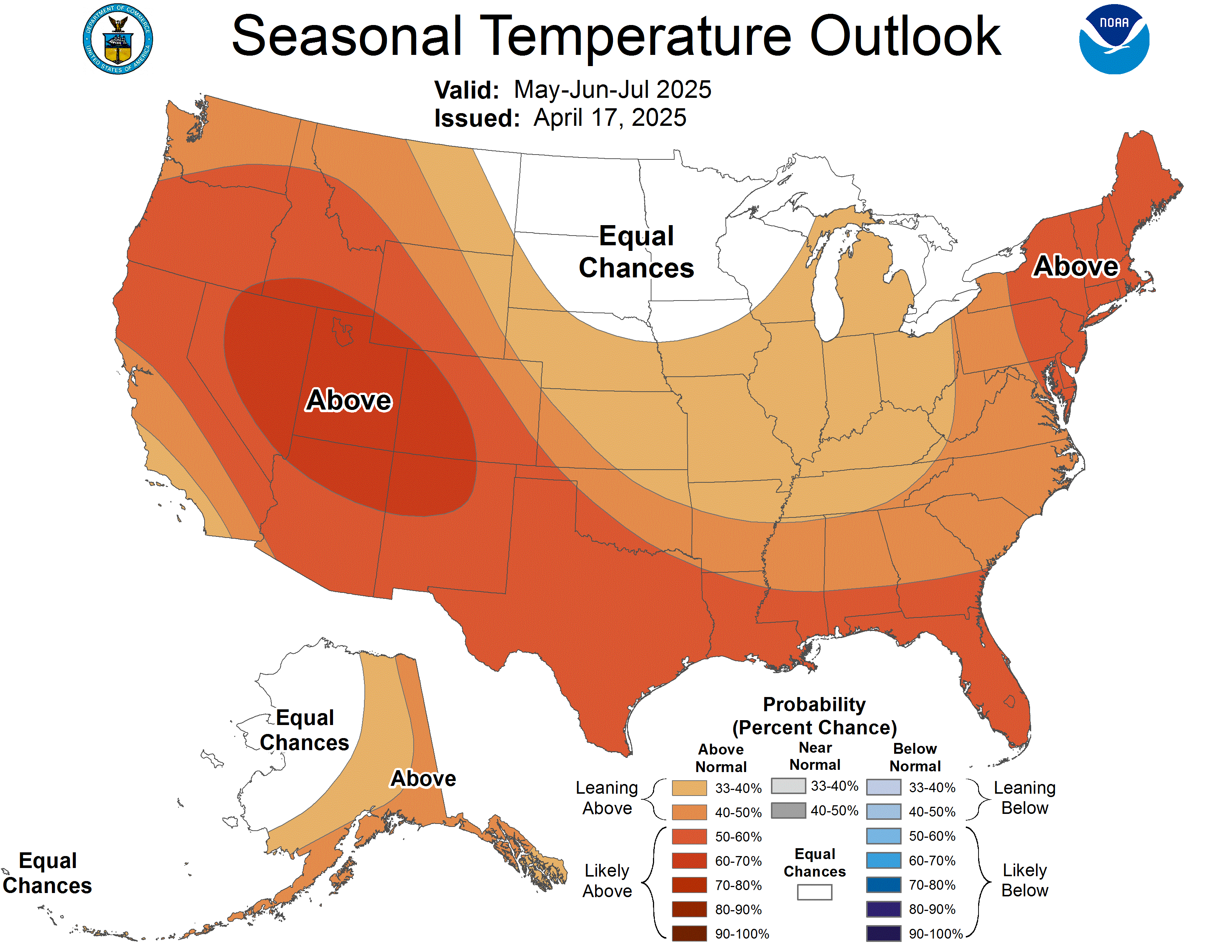
- Canadian national seasonal outlook issued -- Forecasters with Environment Canada issued their outlooks for temperature and precipitation across Canada for the three months of May, June and July 2016, which represents the last month of meteorological spring and the first two months of meteorological summer. The temperature outlook indicates that except for a few areas across northern and eastern Canada, most of the nation should experience above normal (1981-2010) spring and early summer temperatures. Otherwise, sections of the Canadian Archipelago, northern Quebec and Labrador could have near normal temperatures for these next three months. Below average temperatures were not anticipated anywhere across Canada.
The Canadian precipitation outlook for May through July 2016 indicates that sections of western and northern Canada extending from coastal British Columbia and the Yukon Territory eastward across the Northwest and Nunavut Territories could experience above average precipitation. Conversely, a few scattered areas across Arctic Canada and northern Quebec could have below average rainfall. Elsewhere, close to average precipitation should be anticipated.
[Note for comparisons and continuity with the three-month seasonal outlooks of temperature and precipitation generated for the continental United States and Alaska by NOAA's Climate Prediction Center, one would need to use Environment Canada's probabilistic forecasts for temperature and precipitation.] - Loss of oxygen in global ocean could become noticeable within 20 years -- A new study led by scientists from the National Center for Atmospheric Research (NCAR) reports that reductions in the amount of oxygen dissolved in the oceans due to increases in air and water temperature associated with climatic change is currently apparent in some locations around the world and these reductions in dissolved oxygen are expected to become more readily apparent across large sections of the global oceans between 2030 and 2040. The loss of oxygen could have profound effects for marine life. [UCAR/NCAR AtmosNews]
CLIMATE
FORCING
- Amplified "greenness" on satellite imagery due to increased carbon dioxide fertilization -- An international team of researchers used satellite data from 1982 to 2015 to determine the leaf area index, or amount of leaf cover over the planet's vegetated regions. The satellite data were from the MODIS sensors on the NASA satellites and the Advanced Very High Resolution Radiometer instruments on the NOAA satellites. The researchers found a correlation between "greenness" (Earth's vegetation) and increased atmospheric carbon dioxide fertilization over the 33 years. They found that the carbon dioxide fertilization would explain 70 percent of the greening, acknowledging that nitrogen and other factors may be involved in this measured increase in greening. [NASA Goddard Space Flight Center Feature]
- Droughts could turn Amazon basin into a giant carbon pollution source -- An international team of scientists report that their analysis of air samples taken from aircraft over three years indicates drought conditions across South America's Amazon basin in 2010 have caused much of the basin's rainforest ecosystems to have significantly reduced carbon uptake for as much as two years. [NOAA Office of Oceanic & Atmospheric Research News]
- Current prairie fire season on Southern Plains described -- In a blog written by Deke Arndt, Chief of the Climate Monitoring Branch at NOAA's National Centers for Environmental Information, the climate conditions that are contributing to the high prairie fire danger across the Southern Plains are reviewed. In addition, a description is provided of the detection of fire scars in the landscape using satellite images. [NOAA Climate.gov News]
- Monitoring gas flaring pollution across polar latitudes by satellite -- Atmospheric scientists at NASA's Goddard Space Flight Center and their colleagues have been using data collected by satellites such as the NOAA/NASA Suomi NPP satellite to monitor the flaring of water natural gas from industrial oil fields across the Northern Hemisphere. Potentially, this natural gas flaring represents a potential source of the air pollutants nitrogen dioxide and black carbon (or soot) that can be transported into the Arctic. [NASA Goddard Space Flight Center Feature]
PALEOCLIMATE
RECONSTRUCTION
- Lake and river ice records help describe changing climate since 15th century -- Ecologists from the University of Wisconsin-Madison and Ontario's York University along with colleagues from Japan and Finland have been studying long-term lake ice records in Japan and Finland to document variations in climate over the last several centuries. Recently, the team has reconstructed the annual record of the development of ice ridges on the frozen surface of central Japan's Lake Suwa on an annual basis. This lake ice record has been maintained continuously since 1443 by Shinto priests and it appears to be the longest such record in existence. Another long ice chronology record the team has investigated is one that involves the date of the spring ice breakup on the Torne River, Finland since the early 18th century. Since lake and river ice seasonality (dates of ice freeze and breakup) responds sensitively to climatic change and variability, the team is relating the interannual variability and long-term changes in the ice with corresponding variations in climate. [National Geographic]
CLIMATE
AND HUMAN HEALTH
- "State of the Air 2016" report released -- Just before the start of Air Quality Awareness Week, the American Lung Association released its 16th annual "State of the Air Report" for the United States, which uses data compiled and analyzed by the US Environmental Protection Agency (EPA) obtained from air quality monitors around the nation. The EPA data involve the two most widespread types of pollution - ozone (smog) and particle pollution (PM 2.5, also known as soot). The State of the Air 2016 shows that although the nation’s air quality has continued to improve due to lower levels of year-round particle pollution and ozone, slightly more than half of the people across the nation live in counties or parishes that have unhealthy levels of either ozone or particle pollution in their communities. These relatively high levels of pollutants put the residents at risk for premature death and other serious health effects such as lung cancer, asthma attacks, cardiovascular damage, and developmental and reproductive harm.
An interactive website permits the public to view the "Report Card: What's the Grade for Your Air?" by entering a state's name. [American Lung Association]
- Link found between extreme weather events and more asthma hospitalization -- Researchers at the University of Maryland School of Public Health have discovered that extreme heat or heavy rainfall events are related to increased risk of hospitalization for asthma following these events in Maryland. The largest increases in risk appeared during the summer months. Apparently, extreme heat events during summer months may lead to higher concentration of harmful air pollutants such as ozone, which is known to exacerbate asthma. Extreme precipitation events may lead to release of pollen spores, leading to severe asthma attack and subsequent hospitalization. The researchers feel that increases in the frequency of extreme heat and extreme precipitation events associated with projected changing climate conditions could have a significant impact on public health. [University of Maryland Right Now News]
CLIMATE AND
SOCIETY
- Gravity data collected by unmanned aircraft designed to increase nation's resiliency -- NOAA's National Geodetic Survey is conducting a 15-year program called Gravity for the Redefinition for the American Vertical Datum (GRAV-D) that is designed to increase the accuracy of elevation measurements with more precise data obtained through measuring gravity nationwide using aircraft. The goal is to have elevation data that will allow emergency managers an increased ability to prepare for floods, sea level rise and other emergencies, make our coastal communities more resilient, and aid a number of diverse industries such as agriculture, construction, transportation, and urban planning. Recently, NOAA's Unmanned Aircraft Systems Program is working with NOAA's Small Business Innovation Research program to use unmanned aircraft equipped with a gravity measuring device to more efficiently collect gravity data around the nation for the GRAV-D program. A private contractor from northern Virginia has been awarded the contract to test the technology for these flights. [NOAA Office of Oceanic & Atmospheric Research News]
CLIMATE AND SOCIETY
Historical Events:
- 2 May 1899...A storm buried Havre, MT under 24.8 inches of snow, an all-time record for that location. The water equivalent of 2.48 inches was a record 24-hour total for the month of May. (The Weather Channel)
- 2 May 2010....Historic rains swept much of Tennessee. Nashville received 13.53" of rain in two days, double the old record. 7.21" of that fell today, making it the wettest day ever seen in Nashville. New records were also set at Nashville for the most rain in 6 hours (5.57") and 12 hours (7.20"). The Cumberland River peaked at 51.9 feet which was the highest since the Flood of '37. (National Weather Service files)
- 4 May 1774...Snow was reported in the Williamsburg Gazette to have fallen in Dumfries, VA. George Washington's weather diary logged at Mount Vernon, that it was a cold day with spits of snow and a hard wind from the northwest. Thomas Jefferson near Charlottesville logged that the Blue Ridge Mountains were covered with snow. The late snow and frost killed most of the fruit crop in the northern part of the state. Farther north, snow fell across Maryland, Pennsylvania, New Jersey and New York. (National Weather Service files)
- 5 May 1987...Unseasonably hot weather prevailed in the western U.S. A dozen cities in California reported record high temperatures for the date. Afternoon highs of 93 degrees at San Francisco, 98 degrees at San Jose, 100 degrees at Sacramento, and 101 degrees at Redding were the highest of record for so early in the season. The high of 94 degrees at Medford, Oregon was also the highest of record for so early in the season.
(National Weather Service files)
- 6 May 1933...Charleston, SC was deluged with 10.57 inches
of rain, an all-time 24-hour record for that location. (The Weather
Channel)
- 6 May 1978...A record late season snowstorm struck
Colorado. Denver checked in with 14 inches for its greatest May
snowstorm on record. (Intellicast)
- 7 May 1964...The temperature at White Mountain 2, located
in California, dipped to 15 degrees below zero to set a record for May
for the continental U.S. (The Weather Channel)
Return to DataStreme ECS RealTime Climate Portal
Prepared by Edward J. Hopkins, Ph.D., email hopkins@aos.wisc.edu
© Copyright, 2016, The American Meteorological Society.