WEEKLY CLIMATE NEWS
1-5 August 2016
DataStreme Earth Climate System will return for Fall 2016 with
new Investigations files starting during Preview Week, Monday, 22 August 2016. All the current online website products will continue to
be available throughout the summer break period.
ITEMS OF INTEREST
- A celebration -- Monday, 1 August 2016, is the ancient Celtic holiday of Lammas that corresponds to one of the cross quarter days, lying nearly halfway between the summer solstice (20 June 2016) and the autumnal equinox (22 September 2016). This holiday, also known as "loaf-mass day", originally marked the first wheat harvest of the year in the British Isles. [Editor's note: This coming Thursday, 6 August 2016, represents the exact halfway point between the dates of the solstice and equinox. EJH]
- In the Land of the Midnight Sun -- The sun will set at Barrow, AK early Monday morning (2:19 AM AKDT on 1 August 2016), marking the first time in nearly 12 weeks (since 11 May 2016) that the sun has gone below the local horizon. However, the sun will remain below the horizon for 30 minutes before rising at 2:49 AM on Monday. On each day until mid-November, the length of night will increase at Barrow. On the afternoon of 17 November 2016, the sun will set and remain below the horizon for a stretch of two months until late January 2017, when the sun will reappear above the horizon for slightly less than one hour.
- High-quality maps of August temperature and precipitation normals across US available -- The PRISM Climate Group at Oregon State University's website has prepared high-resolution maps depicting the normal maximum, minimum and precipitation totals for August and other months across the 48 coterminous United States for the current 1981-2010 climate normals interval. These maps, with a 800-meter resolution, were produced using the PRISM (Parameter-elevation Regressions on Independent Slopes Model) climate mapping system.
- August weather calendar for a city near you -- The Midwestern Regional Climate Center maintains an interactive website that permits the public to produce a ready to print weather calendar for any given month of the year, such as August, at any of approximately 270 weather stations around the nation. (These stations are NOAA's ThreadEx stations.) The entries for each day of the month includes: Normal maximum temperature, normal minimum temperature, normal daily heating and cooling degree days, normal daily precipitation, record maximum temperature, record minimum temperature, and record daily precipitation; the current normals for 1981-2010.
- Worldwide GLOBE at Night 2016 Campaign is underway -- The eighth in the series of GLOBE at Night citizen-science campaigns for 2016 will continue through Saturday, 6 August. GLOBE at Night is a worldwide, hands-on science and education program designed to encourage citizen-scientists worldwide to record the brightness of their night sky by matching the appearance of a constellation (Cygnus in the Northern Hemisphere and Sagittarius in the Southern Hemisphere) with the seven magnitude/star charts of progressively fainter stars.
Activity guides are also available. The GLOBE at night program is intended to raise public awareness of the impact of light pollution.
The next series in the 2016 campaign is scheduled for 25 August-2 September 2016. [GLOBE at Night]
- Climatology for Rio 2016 Olympics -- The 2016 Summer Olympics, which officially known as the Games of the XXXI Olympiad and unofficially as 2016 Rio Olympics, will begin on Friday, 5 August, and end on Sunday, 21 August, in Rio de Janeiro, Brazil. The 2016 Summer Paralympics, the multi-sport event for athletes with disabilities, will also be held in Rio de Janeiro between 7 September and 18 September. The Organizing Committee of the Olympic and Paralympic Games Rio 2016 has provided a website that contains climate information for the Rio de Janeiro metropolitan area that includes monthly maximum/minimum temperatures, average relative humidity, monthly precipitation totals and number of days with measurable precipitation. A 44-page document was produced by Brazil's National Institute of Meteorology (INMET) that provides additional weather and climate information in greater detail.
CURRENT CLIMATE STATUS
- Gulf of Mexico experiences a record long stretch without a hurricane -- According to meteorologists at Weather Underground, a record has been set involving the lack of hurricane activity in the Gulf of Mexico. As of Saturday (30 July), 1048 consecutive days have elapsed since Hurricane Ingrid made landfall on 16 September 2013, with this "hurricane drought" record breaking the previous record of 1047 days set between 1 October 1929 and 13 August 1932. Although no hurricanes have traveled across the Gulf in nearly three years, tropical storms have, with Tropical Storm Bill in 2015 and Tropical Storms Colin and Danielle in 2016. [Weather Underground News]
- Nation's capital city experiencing a rapid increase of hot nights -- A blog was written by the staff of the Capital Weather Gang that describes the rapid increase in the number of unusually warm nights in Washington, DC over the last 15 years. They note that from 1872 to 2000, only 26 days had minimum temperatures of 80 degrees or higher, while since 2000, an additional 27 days have had overnight lows that failed to fall below 80 degrees. Apparently, the rapid increases in hot nights in the nation's capital are the result of the expanding urbanization that has accentuated the urban "heat island effect" along with the increases in concentrations of greenhouse gases. [Capital Weather Gang/The Washington Post] [Editor's note: The minimum temperature at Washington's Reagan National Airport on Tuesday (27 July) was 80 degrees, which resulted in a string of four consecutive days with minimum temperatures of at least 80 degrees. EJH]
- New "snow year" has begun with a recap of the 2015-16 snow year -- A Beyond the Data blog was posted by a physical scientist at NOAA's National Centers for Environmental Information that not only celebrates the start of the 2016-17 "snow year" in the Northern Hemisphere as of 1 July 2016, but reviews the history of snow mapping and recaps some of the interesting items during the 2015-16 snow year that concluded on 30 June. The meteorological snow year (1 July-30 June) is selected to roughly coincide with the annual minimum in snow cover across the Northern Hemisphere; typically, August has the smallest monthly snow cover extent while January has the largest monthly extent. These statistics are from the archive of maps of weekly and monthly snow cover extent that scientists at NOAA, NASA, and the Rutgers Global Snow Lab have produced since November 1966 when satellite records began. Based upon these records, the recently concluded 2015-16 snow year was assessed in terms of how the hemispheric snow cover for each month ranked in terms of the last 50 years. [NOAA Climate.gov News]
- Report on the state of Lake Tahoe considers effects of a changing climate -- The Tahoe Environmental Research Center associated with the University of California Davis recently released its annual report on Lake Tahoe that runs along the California-Nevada border just to the east of the Sierra Nevada Mountains; the University has been monitoring lake conditions since 1968. This 88-page document entitled "Tahoe: State of the Lake Report 2016" reported that numerous records were broken in 2015 including the lowest amount of snowfall on record during the year and the fastest rate in the rise of the lake's temperature ever. Furthermore, the lake's average surface temperature in 2015 was the highest on record at 53.3 degrees Fahrenheit, while just 6.5 percent of the annual precipitation fell as snow. These record occurrences were the result of four consecutive years of warm and dry conditions. [Tahoe Environmental Research Center/University of California Davis]
CURRENT CLIMATE MONITORING
- Updated "Climate Explorer" tool helps track climate change in each county across contiguous U.S. -- NOAA recently updated its "Climate Explorer" tool, an application built to support the U.S. Climate Resilience Toolkit, that offers downloadable maps, graphs and data tables of observed as temperature, precipitation and related climate variables dating back to 1950 for every county in the 48 contiguous United States, along with corresponding projected information out to 2100. As a result, the public as well business and community decision makers can have easy access to climate in their home counties. [NOAA Climate Program Office News]
CLIMATE FORCING
- Importance of polar oceans seen by marine carbon sinking rates -- Scientists at the University of Washington using a new approach to assessing the fate of marine carbon on a global basis have found that the polar seas export organic carbon contained in plankton to the deep sea where the carbon can remained trapped for centuries. The researchers found that this transport of carbon to the deep polar oceans is approximately five times as efficient as in other parts of the oceans. [University of Washington News]
- Monsoon intensity enhanced by heat absorbed by airborne dust from deserts -- In research conducted at the University of Texas at Austin, changes in the intensity of the rainy summer monsoon season over India appear to be enhanced by variations in ability of airborne mineral dust particles lifted into the air from Middle Eastern deserts to absorb solar energy and heat the atmosphere. Mineral dust originating in the Middle East can strengthen the Indian summer monsoon and increase monsoon rainfall by heating the atmosphere above the Iranian Plateau and the Arabian Sea. [University of Texas News]
CLIMATE FORECASTS
- More intense tropical cyclones could be a result of increased temperatures -- Researchers from Columbia University's Lamont-Doherty Earth Observatory and NASA's Goddard Institute for Space Studies foresee tropical cyclones to become stronger as global temperatures continue to increase, although a trend for stronger tropical cyclones is not readily apparent at present. The scientists feel that the warming effects on tropical cyclones associated with increased concentrations of atmospheric greenhouse gases may be masked by air pollution containing aerosols that would reflect sunlight and cause a cooling of the climate. Climate model simulations were used to provide new calculations of the cancelling effects of aerosols and greenhouse gases on tropical cyclones worldwide. [Lamont-Doherty Earth Observatory News]
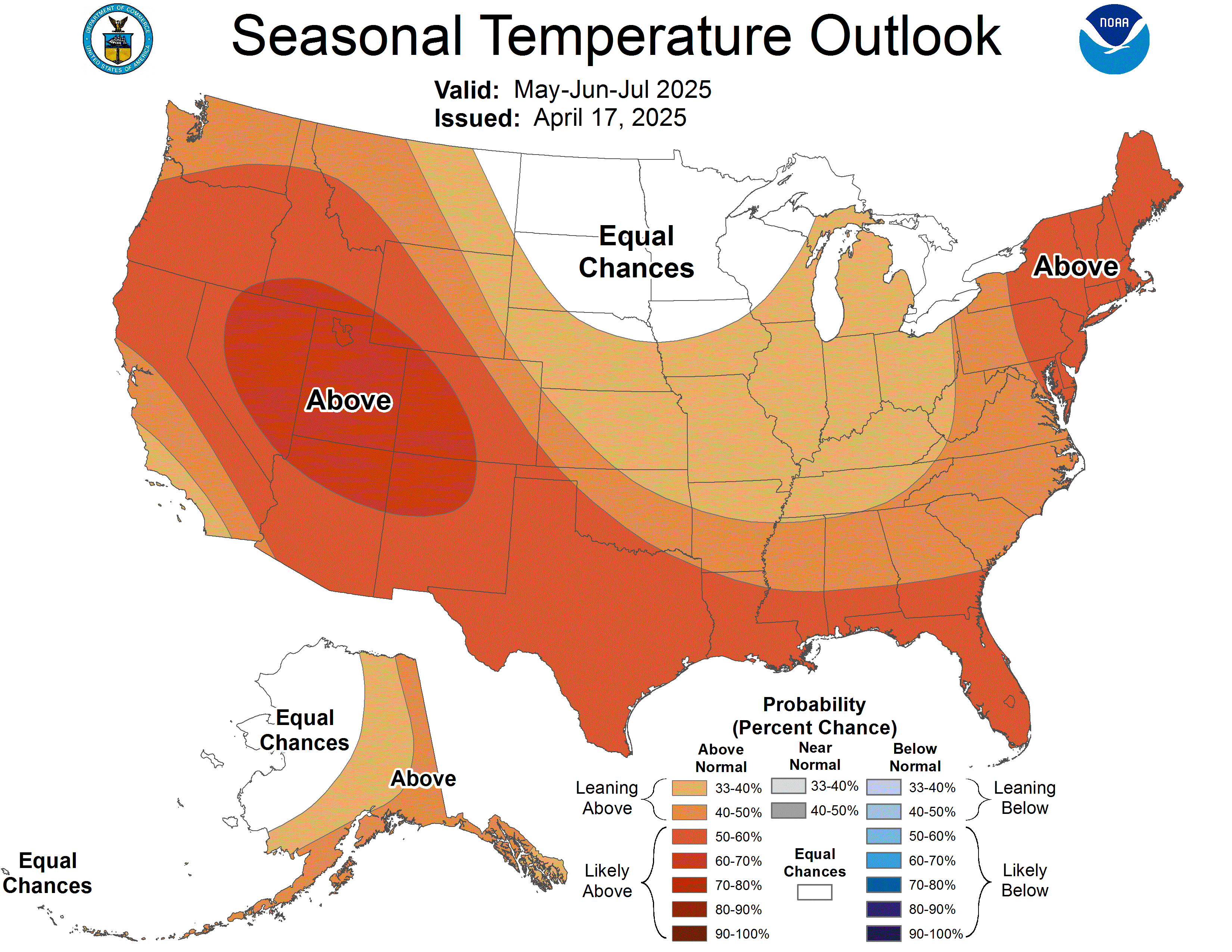
- Canadian national seasonal outlook issued -- Forecasters
with Environment Canada issued their outlooks for temperature and
precipitation across Canada for August, September and October 2016, which
represents the last month of meteorological summer and the first two
months of autumn. The temperature outlook indicates that nearly all of Canada should experience above
normal (1981-2010) summer-early fall temperatures. Only a few scattered areas across
northwestern and northeastern Canada could have normal to below normal late summer-early fall
temperatures.
The Canadian precipitation outlook for late summer and early autumn 2015 indicates that below average
precipitation could be expected across scattered sections of the southern Canadian Rockies and Prairie Provinces along with sections of Ontario to the north and west of Lake Superior. On the other hand, scattered sections across the Canadian Archipelago, the Northwest and Nunavut Territories in northern Canada and sections of Quebec and Labrador in eastern Canada could have above normal
precipitation for these upcoming three months.
[Note for comparisons
and continuity with the three-month seasonal outlooks of temperature and precipitation generated for the continental United States and Alaska by NOAA's
Climate Prediction Center, one would need to use Environment Canada's
probabilistic forecasts for temperature and precipitation.]
CLIMATE IMPACTS ON THE BIOSPHERE
- Climate variations affecting Atlantic cod fishery -- Researchers from the University of California Santa Barbara and Columbia University report that the North Atlantic Oscillation appears to explain approximately 17 percent of the long-term decline in adult Atlantic cod off the New England coast from 1980 through 2013. Overfishing of cod is also a factor in the long-term decline of this fishery. The NAO is a periodic climatic phenomenon that causes changes in water temperatures in the North Atlantic basin. Changing climate may affect the strength and frequency of the NAO. The researchers claim that the NAO can be used as a a potential predictive tool for managing the New England cod fishery. [University of California Santa Barbara News]
- Improvements in Chesapeake Bay water quality may be driven by cleaner air -- Scientists from the University of Maryland's Center of Environmental Science have recently linked improving water quality in streams in the Upper Potomac River Basin feeding into Chesapeake Bay to enforcement of the Clean Air Act that has reduced nitrogen pollution onto the land and streams in the region. For decades, Chesapeake Bay has experienced excessive nutrient pollution and widespread hypoxic (low oxygen) conditions. Nitrogen deposition results mostly from fossil fuel combustion [University of Maryland Center for Environmental Science]
CLIMATE AND SOCIETY
- A national park attempts to preserve history as climate changes -- Resource managers for Mesa Verde National Park in southwestern Colorado are attempting to deal with a variety of extreme weather events such as drought conditions resulting in drought and large temperature swings that can affect the archaeological artifacts in the park because of a changing climate. [National Public Radio News] [Editor's note: Interestingly, Mesa Verde National Park is noted for its well preserved cliff dwellings that document the presence of the Ancestral Pueblo peoples who then left the region over 800 years ago apparently because of changing climate conditions across the Southwest. EJH]
- Earthweek -- Diary of the Planet [earthweek.com]
Historical Events:
- 1 August 1977...Excessive rains at Muduocaidang, China were responsible for establishing two world records, to include 33.07 inches in 6 hours and 55.12 inches in 10 hours. (WMO, NWS)
- 1 August 1985...A nearly stationary thunderstorm deluged Cheyenne, WY with rain and hail. Six inches of rain fell in six hours producing the most damaging flash flood of record for the state; a 24-hour precipitation record for the Cowboy State was also established with 6.06 inches. Two to five feet of hail covered the ground following the storm, which claimed twelve lives and caused 65 million dollars property damage. (Storm Data)
- 1 August 1993...San Francisco, CA hit 98 degrees, the hottest ever recorded for the city in August. (Intellicast)
- 3 August 1898...Philadelphia, PA had one of its worst thunderstorms ever when 5.84 inches fell in just 2 hours. The hydraulic pressure in the city sewers due to the force of the accumulated runoff caused overflows in toilets, basins and sinks to rise to second-floor levels in some cases. (Intellicast) (Accord's Weather Guide Calendar)
- 3 August 1914...Temperature reached an all-time August high of 96 degrees for Calgary, Alberta. (The Weather Doctor)
- 3 August 1970...Hurricane Celia made landfall near Port Aransas on the Texas coast, producing wind gusts to 161 mph at Corpus Christi, and estimated wind gusts of 180 mph at Arkansas Pass. Even at Del Rio, 250 miles inland, Celia produced wind gusts to 89 mph. The hurricane was the most destructive of record along the Texas coast causing 454 million dollars damage as 8950 homes were destroyed on the Coastal Bend. Celia also claimed eleven lives and injured 466 people. (David Ludlum) (The Weather Channel) (Intellicast)
- 3 August 1987...Beckley, WV established an all-time record with an afternoon high of 93 degrees. (The National Weather Summary)
- 3 August 1990...Highest temperature recorded in the United Kingdom prior to 2003 heat-wave was 98.8 degrees at Cheltenham, England: (The Weather Doctor)
- 3 August 1995...South Bend, IN received 4.83 inches of rain in 24 hours to set the city's greatest daily rainfall record. (Intellicast)
- 3 August 2011...Little Rock, AR set their all-time high temperature record of 114 degrees. (National Weather Service files)
- 4 August 1644...The first weather observations made on a regular basis in the U.S. were taken by Reverend John Campanius Holm in Wilmington, DE. (National Weather Service files)
- 4 August 1881...The highest temperature recorded anywhere in Europe was 122 degrees Fahrenheit reported at Seville, Spain. (NCDC)
- 4 August 1930...The temperature at Moorefield, WV soared to 112 degrees to establish a state record, having reached 110 degrees the previous day. This new record for the Mountain State was subsequently tied in July 1936. (The Weather Channel)
- 4 August 1960...The Vostok station in Antarctica recorded a record low temperature of 127 degrees below zero on the Fahrenheit scale, which remained the lowest recorded global temperature until 1983. (The Weather Doctor)
- 4 August 1961...Spokane, WA reached an all-time record high temperature of 108 degrees. Kalispell, MT set an all-time record with a reading of 105 degrees. (The Weather Channel)
- 5 August 1843...A spectacular cloudburst at Chester Creek, near
Philadelphia, PA turned the small creeks and streams entering the Delaware
River into raging torrents. As much as sixteen inches of rain fell in just
three hours at Concord, which still stands as the greatest amount of
precipitation in a three-hour span in the U.S. (David Ludlum) (Intellicast)
- 5 August 1961...The temperature at Ice Harbor Dam, WA soared to 118
degrees to equal the state record established at Wahluke on 24 July 1928. The
afternoon high of 111 degrees at Havre, MT was an all-time record for that
location. (The Weather Channel)
- 5 August 1988...Floods ravaged parts of Sudan during August, the result of
8.27 inches of rain that fell in Khartoum in 13 hours on the 4th and 5th. The previous 24-hour record at Khartoum was 3.46 inches.
More than one million people were made homeless. At least 96 died in Sudan's
worst flooding since 1946. (Accord's Weather Guide Calendar)
- 5 August 1994...Fairbanks, AK soared to 93 degrees for the highest ever
August temperature. (Intellicast)
- 5-6 August 1959...A bucket survey showed that thunderstorms dropped 16.70
inches of rain on parts of Decatur County, IA. The total was accepted as
Iowa's 24-hour rainfall record. (The Weather Channel)
- 6 August 1905...Princeton, IN received 10.50 inches of rain, which
established a 24-hour maximum precipitation record for the Hoosier State.
(NCDC)
- 6 August 1918...Unusually hot weather began to overspread the Atlantic
Coast States, from the Carolinas to southern New England. The temperature
soared to an all-time record high of 106 degrees at Washington, DC, and
Cumberland and Keedysville hit 109 degrees to establish a state record for
Maryland. (David Ludlum)
- 6 August 1947...Sault Ste. Marie, MI hit 98 degrees, equaling the highest
temperature ever recorded at that location. (Intellicast)
- 6 August 1987...Afternoon thunderstorms deluged Milwaukee, WI, breaking
all previous rainfall records for the city. Among the records: 1.10 inches in
5 minutes, 3.06 inches in 1 hour, 5.24 inches in 2 hours, 6.24 in 6 hours and
6.84 inches in 24 hours. Floodwaters were four feet deep at the Milwaukee
County Stadium, and floodwaters filled the basement of the main terminal at
the airport. Flooding caused 5.9 million dollars damage, and claimed the life
of one person. (The National Weather Summary) (Storm Data)
- 7 August 1918...Philadelphia, PA established an all-time record with a
high of 106 degrees. New York City experienced its warmest day and night with
a low of 82 degrees and a high of 102 degrees. Afternoon highs of 108 degrees
at Flemington, NJ and Somerville, NJ established state records for the month
of August. (The Weather Channel) (Sandra and TI Richard Sanders - 1987)
- 7 August 1949...The hottest day on record for Winnipeg, Manitoba occurred
when the temperature reached 105 degrees. (The Weather Doctor)
- 7 August 1969...Cuba's hottest day on record when the temperature reached
101.5 degrees at Guantánamo, Cuba. (The Weather Doctor)
- 7 August 1983...The temperature at Thunder Bay, Ontario reached an
all-time record high of 104 degrees. (The Weather Doctor)
- 7-8 August 1995...Lockington Dam, OH recorded 10.75 inches of rain,
establishing a 24-hour maximum precipitation record for the Buckeye State.
(NCDC)
- 7 August 2004...Iceland's hottest August day on record as the temperature
at Skaftafell, Iceland reached 84.4 degrees. (The Weather Doctor)
Return to DataStreme ECS RealTime Climate Portal
Prepared by Edward J. Hopkins, Ph.D., email hopkins@aos.wisc.edu
© Copyright, 2016, The American Meteorological Society.