Weekly Ocean News
PREVIEW WEEK: 2-6 September 2013
Items
of Interest:
- A change in seasons -- This past Saturday, 31 August
2013, marked the end of Northern Hemisphere's meteorological summer, the
three-month span of June, July and August that meteorologists
frequently use for record keeping processes. Meteorological autumn
(September, October and November) for the Northern Hemisphere started
the following day, 1 September 2013. Meteorologists frequently use
these three-month meteorological seasons for record keeping processes.
Additional information will be presented in the next several weeks
concerning meteorological seasons and the astronomical seasons, such as
the familiar autumn that begins on the autumnal equinox in three weeks
(Sunday, 22 September 2013).
- Ocean charts, units, location and time -- Please
read this week's Supplemental
Information…In Greater Depth for a description of a several
types of oceanographic charts along with the definitions of some units
commonly used in ocean science to locate positions on the Earth's
surface and to identify time.
- Long-term agreement for weather and climate monitoring signed between NOAA and EUMETSAT -- During this past week, the top officials from NOAA and the European Organisation for the Exploitation of Meteorological Satellites (EUMETSAT) signed a long-term cooperative agreement at the European Union (EU) Delegation in Washington, DC, which is designed to ensure the continuation of a 30-year relationship involving space-based weather, water and climate monitoring. [NOAA News]
Ocean in
the News:
- Eye on the tropics -- Although the tropical waters across the North Atlantic and North Pacific
Ocean basins were were relatively warm during the past week, only a few named tropical cyclones (low pressure systems that form over
tropical ocean waters, with near surface maximum sustained winds that
intensify to tropical storm or hurricane force status) were detected:
- In the North Atlantic basin, Tropical Storm Fernand, the sixth named tropical cyclone of the 2013 Atlantic hurricane season, traveled westward across the waters of the Bay of Campeche over the previous weekend and made landfall early Monday morning along the southeastern Mexican coast approximately 25 miles to the north-northeast of Veracruz, Mexico. After landfall, Fernand weakened to a tropical depression and then dissipated by late Monday afternoon. The heavy rainfall accompanying Fernand resulted in mudslides that caused the deaths of at least 13 people in Mexico. Additional information on Tropical Storm Fernand along with satellite images can be found on the NASA Hurricane Page.
- In the eastern North Pacific, the tenth named tropical cyclone of the 2013 eastern Pacific hurricane season formed approximately 130 miles to the southeast of Cabo San Lucas at the southern tip of Mexico's Baja California Peninsula at the midpoint of last week. This relatively small and compact system called Tropical Storm Juliette traveled to the north-northwest, brushing the western coast of Baja California on Thursday. However by Friday, Juliette weakened to become a tropical depression and then a post-tropical low off the coast to the south-southeast of Punta Eugenia, Mexico.
The Baja Peninsula received several inches of rain from Juliette. The NASA Hurricane Page has additional information and satellite imagery on Tropical Storm Juliette and several other areas of low pressure over the eastern North Pacific.
Another named tropical cyclone, identified as Tropical Storm Kiko, developed over this just-completed weekend from a tropical depression that was located approximately 500 miles to the southwest of the Baja California Peninsula. Kiko traveled northward and was beginning to weaken on Sunday, nearly 400 miles off the Baja coast.
This tropical storm should dissipate by Monday.
- In the western North Pacific basin, Tropical Storm Kong-Rey formed at the start of last week over the waters of the Philippine Sea to the east of Luzon, the main island in the Philippines. This tropical storm initially traveled westward and then turned to the north, passing to the east of Luzon and Taiwan. Turning toward the north-northeast late in the week, Tropical Storm Kong-Rey headed across the East China Sea and toward the southern Japanese islands. Forecasts indicated that this tropical storm would weaken as it travels across the Sea of Japan. Heavy rains associated with Kong-Rey were expected to fall over Japan during the first few days of this week. The NASA Hurricane Page has further information on Tropical Storm Kong-Rey.
On Sunday (local time), Tropical Depression 15 formed this past Sunday over the waters of the East China Sea to the west of Okinawa. Some intensification was possible as it would travel to the northeast.
- Wreck of 19th century US Coast Survey steamer located -- Recent inspections of the submerged wreckage of vessel off the New Jersey coast by a NOAA Maritime Heritage diving team have confirmed that this iron-hulled wreck is the USCS Robert J. Walker, which sunk following a collision during a storm in June 1860. This steamer, which was returning to its home port of New York from a hydrographic survey mission, served in the U.S. Coast Survey, a predecessor agency of NOAA's Office of Coast Survey. Twenty sailors died when the Walker sank in rough seas. The confirmation was provided by the dive team as it was making a mission related to Hurricane Sandy. [NOAA News]
- Sea level rise tool available -- NOAA's Ocean Service recently announced that a sea level rise planning tool is available on the Internet that would help governmental officials, planners and the public make planning decisions based upon future rises in sea level along the Middle Atlantic coast near New York City. This sea level rise planning tool was developed following Hurricane Sandy through a partnership between NOAA, FEMA (the Federal Emergency Management Agency), the US Army Corps of Engineers and the US Global Change Research Program. [NOAA Ocean Service News]
- Hurricane Sandy caused substantial erosion to Fire Island's beaches and dunes -- A new US Geological Survey (USGS) study reports that the beaches and dunes on New York State's Fire Island lost more than half their volume as Hurricane Sandy traveled just to the south of this island last October. This report, which is the first to quantify actual changes to the coast by Sandy, noted that the lost sand would leave the island more vulnerable to future storm systems. [USGS Newsroom]
- Extent of this summer's Arctic sea ice may not break record -- Scientists at NASA's Goddard Space claim that while the sea ice covering the Arctic Ocean continues to shrink toward its annual "minimum" that should occur in mid-September, this year's projected late-summer minimum does not appear to be headed for a new record smallest extent that had been previously set on 16 September 2012. [NASA Global Climate Change News]
- New ocean forecast could help predict fish habitat in Pacific Northwest -- University of Washington researchers and federal scientists have developed the first long-term forecast of predict future phytoplankton blooms, ocean temperatures and low-oxygen events that matter for Pacific Northwest fisheries with a lead time of up to six months. This new forecast tool is called the JISAO (Joint Institute for the Study of the Atmosphere and Ocean) Seasonal Coastal Ocean Prediction of the Ecosystem, which is nicknamed J-SCOPE. [University of Washington News]
- Public comment solicited on proposed revisions to the Endangered Species Act -- The US Fish and Wildlife Service and NOAA's National Marine Fisheries Service are requesting public comment on the proposed amendments made by these two federal agencies to regulations governing Incidental Take Statements (ITS) for endangered marine species under the Endangered Species Act (ESA). [NOAA Fisheries Newsroom]
- Considering the implications of rising global sea level -- The feature article in the September 2013 issue of National Geographic, the official magazine of the National Geographic Society, is called "Rising Seas." This 30-page article, authored by Tim Folger, describes how rising sea level associated with climate change and the storm surges associated with storms such as Hurricane Sandy have placed many coastal cities in danger. A discussion is made of various proposed flood control projects. A large poster shows a map of the globe without ice. Graphics from the article are available on the National Geographic website. [National Geographic]
- An All-Hazards Monitor -- This Web
portal provides the user information from NOAA on current environmental
events that may pose as hazards such as tropical weather, drought,
floods, marine weather, tsunamis, rip currents, Harmful Algal Blooms
(HABs) and coral bleaching. [NOAAWatch]
- Earthweek -- Diary of the Planet
[earthweek.com] Requires Adobe Acrobat Reader.
Concept of the Week: Touring the
DataStreme Ocean Website
Welcome to DataStreme Ocean! You are embarking on a study of
the world ocean and the role of the ocean in the Earth system. This
unique teacher enhancement course focuses on the flow and
transformations of energy and water into and out of the ocean, the
internal properties and circulation of the ocean, interactions between
the ocean and the other components of the Earth system, and the
human/societal impacts on and responses to those interactions.
Throughout this learning experience, you will be using the DataStreme
Ocean website to access and interpret a variety of
environmental information, including recent observational data. The
objective of this initial Concept of the Week is to
explore features of the DS Ocean website.
On Monday of each week of the course, we will post the current Weekly Ocean News that includes Ocean in
the News (a summary listing of recent events related to the
ocean), Concept of the Week (an in-depth analysis
of some topic related to the ocean in the Earth system), and Historical
Events (a list of past events such as tsunamis or specific
advances in the understanding of oceanography). When appropriate, a
feature called Supplemental Information-In Greater Depth will be provided on some topic related to the principal theme of the
week.
You will use the DS Ocean website to
access and download the weekly "Current Ocean Studies" (plus supporting
images) that complement Investigations found in your Ocean
Studies Investigations Manual. These materials should be
available Monday morning. Click the appropriate links to download and
print these electronic Current Ocean Studies and answer forms as well
as your Chapter Progress and Investigations Response forms.
The body of the DS Ocean website provides
links to the Earth System, information on Physical & Chemical,
Geological, and Biological aspects of the ocean, Atmosphere/Ocean
Interaction, the Great Lakes, and extras-a glossary of terms, maps,
educational links, and DataStreme Ocean information. Following each section is a link to other sites that
examine the various subsystems of the Earth system. Let's take a quick
tour to become more familiar with the DS Ocean website.
Under Physical & Chemical, click
on Sea
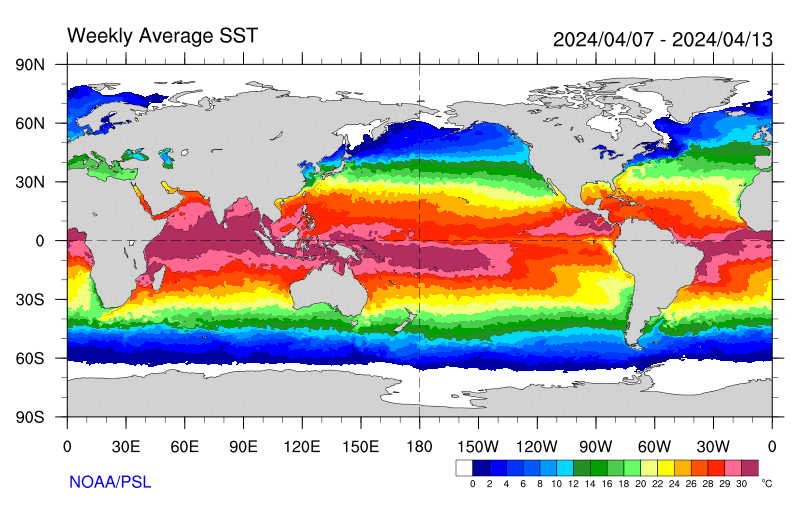
Surface Temperatures. This image uses a color scale
to depict the global pattern of sea surface temperatures (SSTs) (in
degrees Celsius) averaged over a recent 7-day period and based on
measurements by infrared sensors onboard Earth-orbiting satellites.
(Depending on your browser, you may have to place your mouse cursor on
the slide bar to the right and scroll down to view the entire image.)
Compare SSTs in the Northern Hemisphere with those in the Southern
Hemisphere. Return to the DS Ocean website.
Under Geological, click on Current
Earthquake Activity. The USGS Current World
Seismicity page provides a global map of the locations of seismic
(earthquake) events color-coded for the past seven days. The size of
the squares represents the magnitude of recent earthquakes. Note how
earthquakes are concentrated along the margin of the Pacific Ocean.
Details of recent earthquakes can be found by clicking on their map
squares. Return to the DS Ocean website.
The ocean is home to a wide variety of habitats and organisms.
Under Biological, click on Ocean
"Color" (Productivity). This is
a satellite-derived (SeaWiFS) color-coded map of biological
productivity in the surface waters of the world ocean is averaged from
October 1978 to date. Orange and red indicates the highest
productivity, while dark blue and violet indicate the lowest
productivity. Note the vast areas of relatively low productivity over
the central regions of the subtropical ocean basins. Individual months
within this period may be chosen for viewing. Now return to the DS
Ocean website.
Under Atmosphere/Ocean Interaction, click
on TRMM
Tropical Rainfall. The TRMM (Tropical
Rainfall Measuring Mission) page includes color-coded maps of
the Monthly Mean Rainrate (in mm per day) across the tropics for the
last 30 days ending on the present date. Changes in rainfall are linked
to large-scale shifts in the atmosphere/ocean circulation in the
tropics. Now return to the DS Ocean website.
Take a few minutes when you have time to browse the other data
and information sources available via the DS Ocean website. You should "bookmark" ("favorites") this page on your
computer. Return frequently to learn more about the many resources on
the ocean in the Earth system. Bon voyage!
Concept of the Week: Questions
- The latest global sea surface temperature map indicates
that SSTs are generally higher over the [(western)(eastern)] tropical Pacific Ocean.
- The USGS map of Current Earthquake Activity indicates that
earthquakes appear to be more common along the [(east)(west)] coast of North America.
Historical Events
- 2 September 1752...The British Empire adopted the Gregorian
Calendar, nearly two centuries later than most of western Europe
(primarily 1582). To correct the imprecise leap year correction in the
Julian Calendar, 11 days were dropped making the following day 14
September. (Wikipedia) (Today in Science History)
- 3 September 1821...A hurricane made landfall at Long
Island, near the current J.F. Kennedy Airport and then moved through
western Connecticut. The hurricane produced a record high tide at New
York City. (David Ludlum)
- 4 September 1954...Icebreakers, USS Burton Island (AGB-1) and USCG Northwind, completed first transit
of the Northwest Passage through McClure Strait. (Naval Historical
Center)
- 4-6 September 1970...Moisture from Pacific Tropical Storm
Norma led to heavy rain and severe flooding over a three-day span.
Unprecedented rains caused rivers in central Arizona to rise five to
ten feet per hour, sweeping cars and buildings as far as 30 to 40 mi
downstream, leading to the greatest natural disaster of record for
Arizona. Flooding claimed the lives of 23 persons, mainly campers, and
caused millions of dollars in property damage. Water crested 36 feet
above normal near Sunflower. Workman's Creek was deluged with 11.40
inches of rain in 24 hours to establish a 24-hour precipitation record
for the Grand Canyon State. An estimated six inches of rain fell at Bug
Point, UT, setting a 24-hour precipitation record for the Beehive
State. (The Weather Channel) (NCDC)
- 5 September 1987...A tropical storm, which formed off the
South Atlantic coast, was responsible for torrential rains over coastal
regions of South Carolina. Between 30 August and 8 September,
Charleston, SC received 18.44 in. of rain. The heavy rains caused
extensive flooding around the city of Charleston, seriously damaged
cotton crops in the eastern part of the state, and resulted in an
unusually high number of mosquitoes. (Storm Data)
- 5 September 1946...The U.S. Air-Rescue Agency, an
inter-departmental group headed by the Commandant of the Coast Guard
and engaged on the study of improved and standardized rescue and search
methods, was renamed the Search and Rescue Agency. "Search and Rescue
Units" of the Coast Guard were at the same time integrated into the
peace time organization and the whole developed into a system of
constantly alerted communications, coastal lookout, and patrols of
institute instant and systematic search and rescue procedure in case of
disasters." (USCG Historian's Office)
- 5 September 1950...Hurricane Easy produced the greatest
24-hour rainfall in U.S. weather records up to that time. The hurricane
deluged Yankeetown, on the upper west coast of Florida, with 38.70 in.
of rain. This record has since been replaced by 43 in. of rain at
Alvin, TX on 25-26 July 1979. (David Ludlum)
- 6 September 1522...The Magellan expedition completed its
historical circumnavigation of the globe as one of Ferdinand Magellan's
five ships, the Vittoria, arrived at Sanlýcar de
Barrameda in Spain with 17 other crew members and four Indians.
Magellan, who lost his life in April 1521 in the Philippines, set sail
from Spain with 270 seamen on 20 September 1519 in an effort to find a
western sea route to the rich Spice Islands of Indonesia. (The History
Channel)
- 7 September 1934...US Coast Guard (USCG) vessels responded
to a fire aboard the liner Morro Castle six miles
off the New Jersey coast. This disaster, which resulted in the loss of
133 of the 455 passengers and crew, led to a Senate investigation and
subsequent changes in maritime safety regulations. (USCG Historian's
Office)
- 8 September 1900...The greatest weather disaster in U.S.
records occurred when a hurricane struck Galveston, TX. Waves fifteen
feet high washed over the island demolishing or carrying away
buildings, and drowning more than 6000 persons. The hurricane destroyed
more than 3600 houses, and total damage was more than $30 million.
Winds to 120 mph, and a twenty-foot storm surge accompanied the
hurricane. Following the storm, the surf was three hundred feet inland
from the former water line. The hurricane claimed another 1200 lives
outside of the Galveston area. (8th-9th)
(David Ludlum) (The Weather Channel)
Editor's note: The National Oceanic and
Atmospheric Administration (NOAA) posted a webpage commemorating the Galveston, TX hurricane of 1900. This page contains
links to historic photos and excerpts of an eyewitness description of
storm by Isaac Cline, the chief forecaster of the Galveston U.S.
Weather Bureau Office.
Return to DataStreme
Ocean Website
Prepared by DS Ocean Central Staff and Edward J. Hopkins,
Ph.D.,
email hopkins@meteor.wisc.edu
©Copyright, 2013, The American Meteorological Society.