Date Due: Tuesday, 4 October 2000
The total maximum points were 50. Point distribution for each
question noted below.
[Note: Extra points for the optional Weather on
the Web Question added separately.]
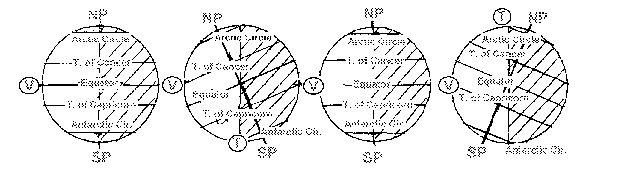
a. Mark and label the North and South Poles.
b. Draw and label the Equator.
c. Draw and label the i.) Tropics of Cancer and Capricorn and ii.) the Arctic and Antarctic Circles.
d. Mark with the letter "V" that latitude where the sun appears to be directly overhead at local solar noon.
e. Mark with the letter "T" that latitude at the edge of the polar night where the sun appears to be just on the local horizon at local solar noon. (Hint: Where is the edge of polar night?)
(20 pts)
21 MARCH 21 JUNE 23 SEPTEMBER 23 DECEMBERSee also satellite images (courtesy of DataStreme and Project Atmosphere, the education initiative of the American Meteorological Society)
21 MARCH 21 JUNE 23 SEPTEMBER 23 DECEMBER
(2 pts)
| 1.97 cal per sq. cm. per min or 1372 Watts per sq.
meter.
These values were provided and discussed in lecture. |
b. A mythical planet has an orbit with an average planet-sun distance exactly half that of the earth's. What would be the solar constant for this mythical planet? [Hint: make use of your answer from above.]
(4 pts)
| The inverse square law means that the planet at one half the distance
would have 4 times (2 squared) the amount of energy per unit area per unit
time.
7.88 cal per sq. cm. per min or 5488 Watts per sq. meter. |
c. What is the planetary albedo of the planet earth?
(2 pts)
| From lecture:
Planetary albedo = 30 - 31 percent . |
a. Which object would radiate more energy?
b. Which object would radiate more of its energy at a shorter wavelength?
(1 pt. each or 2 pts)
| a. A (A consequence of Stefan-Boltzmann law)
b. A (A consequence of Wien's Displacement law) |
a. What is the wind chill equivalent temperature if the ambient air temperature were -5°F and the wind speed were 15 mph?
b. What is the wind chill equivalent temperature if the ambient air temperature remained at -5°F, but the wind speed increased to 30 mph?
c. What has caused the difference between your answers a and b above? Why?
d. To what temperature does your automobile reach in part a? in part b?
(11 pts)
| Note that Table 3.3B (for English units) should be used:
a. -38° F is the wind chill equivalent temperature b. -56° F is the wind chill equivalent temperature c. The increased wind speed causes the difference in the wind chill equivalent temperatures. The convective heat loss from the human body increases with increased winds. A statement about the air being colder is not correct since the ambient air temperature remains the same. d. The temperature of your automobile can only reach the ambient air temperature of -5° F in both cases, and go no lower. The wind-chill equivalent temperature is not relevant here. However, in the second case, the stronger winds would hasten the cooling process, causing the engine block to cool to the ambient at a faster rate. |
a. How much energy is required to entirely melt 1 gram of ice at the ice point?
b. How much energy is required to evaporate 1 gram of liquid water at room temperature?
c. How would the temperature of 1 kilogram of liquid water originally at 20°C change if 5000 calories were used in the heating process (assume no phase transformations)? If a temperature change would take place, indicate the amount of change (and the direction of the temperature change).
[Please show your work and include units!]
(11 pts)
| a. 80 cal (This is the latent heat of melting.)
b. 590 cal (Note: The latent heat of evaporation is a function of temperature, being 590 cal at 20° C and decreasing to 540 cal at 100° C. The reason for this change in latent heat is that at room temperature water molecules are more tightly attracted to one another and would require more energy to break these "hydrogen bonds" of attraction than at higher temperatures when the water molecules are more active.) c. 3 Celisus degree heating Since 1 calorie is the heat needed to raise 1 gram of water 1 Celsius degree, then 3000 calories would raise 1000 grams by 3 Celsius degrees (making the liquid warm from 20° C to 23° C) |
URL Address: aos100/homework/f00hmk01a.html
|
Homework Instruction Page |
Home Page |
Home Page |