As the 2016 agricultural season winds down across northern sections of the nation, moderate to exceptional drought drought continued across the West and expanded into the East. According to the NOAA's National Centers for Environmental Information, approximately seven percent of the contiguous United States was experiencing moderate to exceptional drought conditions by the end of August 2016 after starting the year of 2016 with a three percent areal coverage of these drought conditions across the "Lower 48".
A lack of significant and timely rain over an extended interval often is an indicator of drought conditions. One could inspect the tables of monthly precipitation (in hundredths of an inch) that are furnished by the National Weather Service several days after the conclusion of each month for nearly 250 selected U.S. cities. While many of the cities across the midsection of the United States had above to much above average "normal" (or the averages from the 1981-2010 climatological reference interval) for August 2016, locations along the West Coast (California, Oregon and Washington) and the interior Northwest (Idaho and Nevada) had below normal August precipitation. A few sections along the Atlantic Seaboard also had below average precipitation last month. California along with sections of the Great Basin and the Intermountain West also saw a lack of significant precipitation during the meteorological summer of 2016 (June-August). However, the nation's midsection reported above average summer precipitation totals.
What constitutes a drought? The answer depends upon whom you ask. At least four types of drought can be defined. To the farmer, an agricultural drought represents an extended interval with a serious soil moisture deficiency during critical crop growth periods. A hydrologist would classify a hydrological drought as an extended interval containing abnormally low stream flow, lake levels and ground water reservoirs. Most meteorologists would consider a meteorological drought to occur when the accumulated precipitation is well below a prescribed amount that would depend upon the region or season. A fourth type would be socioeconomic drought, where the shortage of water affects humans, typically in terms of economic activities. Economic goods that may be affected may include water, agricultural food products and hydroelectric power.
Typically, the severity of a drought depends upon the lack of soil moisture, which is influenced by one or more of the following factors to include a lack of precipitation, low atmospheric humidity, high air temperature, strong winds, a lack of clouds and intense sunlight. In addition, the drought severity depends upon its duration and the size of the affected area.
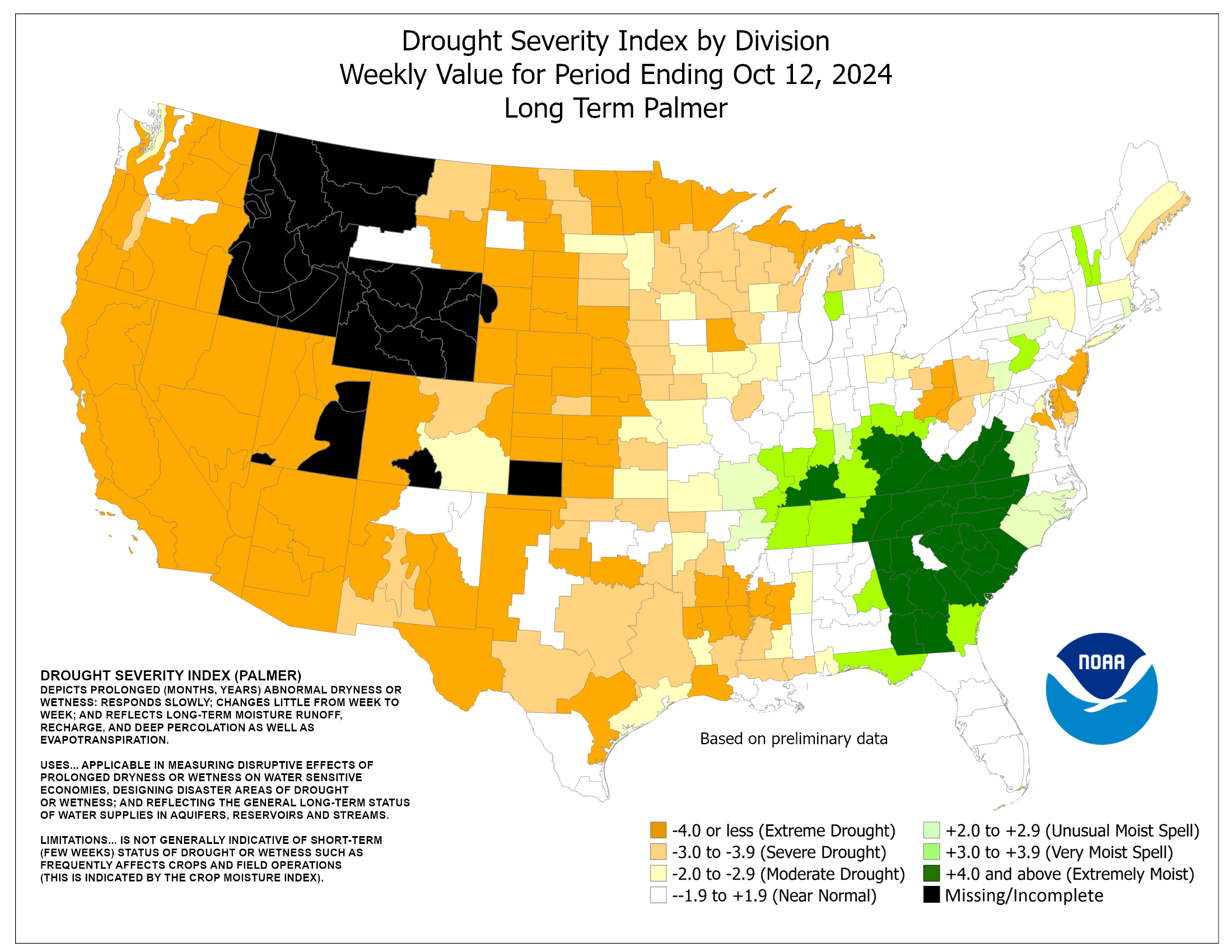
The start of a drought usually is subtle in that few can tell when a spell of dry weather really constitutes the incipient phase of a drought. Similarly, the end of a drought is also difficult to assess, since one rain event does not necessarily "break a drought". The National Weather Service uses several indices to assess the severity of a drought. One of the most frequently used drought indices is the Palmer Drought Severity Index developed by Wayne Palmer in the 1960s. This Palmer Index, with unit-less values ranging from below -4 (severe drought) to above +4 (extremely moist),. incorporates temperature and rainfall information in a formula to determine abnormal dryness or wetness over prolonged time intervals, such as a month to years. The National Weather Service and U.S. Department of Agriculture jointly compute the Drought Index weekly for each of 344 climatological divisions across the United States. A map of the current Drought Index is available that shows those divisions experiencing drought with negative index values and varying shades of red, while those regions with excess precipitation have positive values and varying shades of green.
The most recent map (weekly index values ending 17 September 2016) shows a widespread region of moderate to extreme drought across much of the western third of the nation, primarily in California, interior Oregon, Montana and Wyoming. Moderate to severe drought conditions were also indicated across the East, particularly along the Appalachians running from Georgia northward to western Pennsylvania and across southern New England. On the other hand, the nation's midsection running from the Gulf Coast northward to the upper Mississippi Valley had unusually moist to extremely moist conditions. Near normal soil moisture conditions prevailed over the remainder of the nation.
Beginning in 2000, the National Drought Mitigation Center, a group consisting of several governmental agencies along with the University of Nebraska-Lincoln, has maintained a US Drought Monitor site that provides weekly updates of current drought information and forecasts of the potential for drought across the nation. Their current summary map of drought conditions attempts to improve upon the Palmer Drought Severity Index and synthesize five other indices, together with a certain amount of subjectivity to arrive at six drought severity categories (D0 to D4). They attempt to show the short-term impacts of the drought upon agriculture and wildfire potential and long-term impacts on hydrology and ecology. (A description of the categories used in the drought classification scheme appearing on the National Drought Monitor map is available.) Their most recent map (20 September 2016) shows a large area of exceptional drought stretched across a large section of across southern and central California. Scattered areas of severe to extreme drought stretched across the remainder of the western third of the United States. Farther to the east, a few scattered areas across the southern Appalachians in the Southeast and across western New York States and coastal New England in the Northeast also had severe to extreme drought conditions. Moderate to severe drought was also found across the West and the Atlantic Seaboard. For many areas, the drought had both short-term and long-term impacts. Short-term drought that would typically have durations of less than six months affect agriculture and grasslands, while long-term drought exceeds six months and would affect rivers, lakes and groundwater (or "hydrology"), along with trees and other natural perennial vegetation (or "ecology"). An accompanying narrative entitled "National Drought Summary" also provides a five-day forecast and a 6- to 10-day outlook for precipitation and temperature across the country. This site also includes animated Drought Monitor maps for the prior six and twelve weeks. The Drought Impact Reporter is an interactive tool that permits exploration of the reported drought impacts across the nation. The goal is to help in risk management that could ultimately help shape drought related policy at the state and federal levels.
The US Seasonal Drought Outlook (released on 15 September 2016 by the Climate Prediction Center and valid through December 2016) indicates that the extensive drought conditions would continue across western sections of the nation, primarily across across California, southern Arizona, western Nevada, interior sections of Oregon, central Utah and northeastern Idaho. In the East, drought conditions were expected to continue across sections of New England, Upstate New York, New Jersey and central Pennsylvania. Drought was also expected to continue across sections of the Southeast, where expansion of the drought could affect areas from the lower Mississippi Valley eastward to the southern and central Appalachians. A few sections of the Plains and northern Rockies could see some improvement in drought conditions during the rest of the year, including some areas that could removed from drought listings. The remainder of the nation does not appear to be headed for drought conditions. Note: a Seasonal Drought Outlook Discussion is included describing the forecasters' confidence.
Palmer, W.C., 1988 (12 Jul): The Palmer Drought Index: When and how it was developed. Weekly Weather and Crop Bulletin, 75 (28), 5.
Return to RealTime Climate Portal
Prepared by Edward J. Hopkins, Ph.D., email hopkins@aos.wisc.edu
© Copyright, 2016, The American Meteorological Society.