WEEKLY CLIMATE NEWS
1-5 October
2018
ITEMS
OF INTEREST
- Start of a new water year -- On Monday,
1 October 2018, the new water year of 2019 will begin. As defined by the US
Geological Survey and used by hydrologists in reports dealing with
surface water supply, the "water year" is defined as the 12 months
commencing on 1 October of any given year and ends on 30 September of
the following year. The water year is designated by the calendar year
in which it ends, such that the 2019 water year runs through 30
September 2019.
- High-quality maps of October temperature and precipitation normals across US available -- The PRISM Climate Group at Oregon State University's website has prepared high-resolution maps depicting the normal maximum, minimum and precipitation totals for October across the 48 coterminous United States for the current 1981-2010 climate normals interval. These maps, with a 800-meter resolution, were produced using the PRISM (Parameter-elevation Regressions on Independent Slopes Model) climate mapping system.
- October weather calendar for a city near you -- The Midwestern Regional Climate Center maintains an interactive website that permits the public to produce a ready to print weather calendar for any given month of the year, such as October, at any of approximately 270 weather stations around the nation. (These stations are NOAA's ThreadEx stations.) The entries for each day of the month includes: Normal maximum temperature, normal minimum temperature, normal daily heating and cooling degree days, normal daily precipitation, record maximum temperature, record minimum temperature, and record daily precipitation; the current normals for 1981-2010.
- Worldwide GLOBE at Night 2018 Campaign for October commences -- The tenth in a series of GLOBE at Night citizen-science campaigns for 2018 will commence this Monday (1 October) and continue through Wednesday, 10 October. GLOBE at Night is a worldwide, hands-on science and education program designed to encourage citizen-scientists worldwide to record the brightness of their night sky by matching the appearance of a constellation with the seven magnitude/star charts of progressively fainter stars. These constellations are Pegasus in the Northern Hemisphere and Sagittarius for the Southern Hemisphere. Activity guides are also available. The GLOBE at night program is intended to raise public awareness of the impact of light pollution. The eleventh series in the 2018 campaign is scheduled for 30 October-8 November 2018. [GLOBE at Night]
- First sunrise of spring season at South Pole -- While residents in the Northern Hemisphere are experiencing shorter daylight following the recent passage of the autumnal equinox, a photograph made by a NOAA Corps officer stationed at the agency's South Pole Atmospheric Baseline Observatory captures the first sunrise of this new spring season (for the Southern Hemisphere) at the South Pole. [NOAA News]
- World Space Week is celebrated --
The United Nations General Assembly has declared the week of 4 to 10 October to be "World Space Week" that is designed to "celebrate each year at the international level the contributions of space science and technology to the betterment of the human condition” Since 2007, more than 2,250 events attended by more than 1.3 million people were held in 94 countries to celebrate the benefits of space and excitement about space exploration. The theme for World Space Week 2018 is “Space Unites the World.” [United Nations]
- Albuquerque Balloon Fiesta climatology is available -- The world famous Albuquerque International Balloon Fiesta takes place near the beginning of each October; this year the 47th annual event will start this coming Saturday (6 October) and run through 14 October 2018. This nine-day festival involves as many as 750 hot-air balloons and is held over the Rio Grande Valley in the Albuquerque (NM) metropolitan area at this time of year because of the cool nights, sunny days and the lack of thunderstorm activity. Because of the cool autumn nights, the "Albuquerque Box" weather phenomenon occurs, which features light winds from the north near the surface draining down the Rio Grande Valley, while winds from the south aloft permit the balloons to move up and down in this box like feature so as to hover over a small geographic area. The Albuquerque National Weather Service Forecast Office has posted the Balloon Fiesta Climatology that includes the daily temperature and precipitation data for nearly each year of the event along with a further description of the "Albuquerque Box."
- Visualizing climatology of first seasonal snowfall across the nation -- Several years ago Deke Arndt, Chief of the Climate Monitoring Branch at NOAA's National Centers for Environmental Information (NCEI), wrote a Beyond the Data blog describing the interactive map that can be used to see the date by which the chances for the first measurable snowfall (0.1 inches or more) of the season rise to at least 50% at thousands of locations around the nation. These statistics are based upon the US Climate Normals for the 1981-2010 interval calculated by NCEI. Higher elevations in the western states have probably have seen some snow in month of September, while many areas of the Northern Plains and Northern Great Lakes should likely see first snowfalls during the month of October. Deke also showed data plots that how the first dates of snowfall have changed since 1950 at several stations due to changing climate. [NOAA Climate.gov News] [Editor's Note: A corresponding map of the last snow of the season across the nation is available. EJH]
- Monitoring the drought -- During this
past summer, western sections of the nation continued to experience major drought. See how the drought is monitored and assessed by
reading this week's Supplemental
Information...In Greater Depth.
CLIMATE MONITORING
- Hurricane Florence is nation's second rainiest storm in 70 years -- A meteorologist at NOAA's National Centers for Environmental Information and North Carolina State University, recently determined that an average of more than 17.5 inches of rain associated with Hurricane Florence fell in mid-September over a 14,000 square mile area in the eastern Carolinas. He made his analysis from five weather stations stretching from Fayetteville, NC to Florence, SC. This amount is second to the 25.6 inches of rain that fell across sections of coastal Texas last year. [Phys.Org]
- Sea ice on Arctic Ocean reaches its smallest seasonal extent -- During the last week scientists at NASA's Goddard Space Flight Center and National Snow and Ice Data Center announced that the sea ice cover on the Arctic Ocean appeared to have shrunk to its smallest annual extent on 19 and 23 September 2018. Based on preliminary analysis of data collected by satellite sensors, the Arctic sea ice coverage on these dates was determined to be only 1.77 million square miles, which would represent an area that would tie 2008 and 2010 for the sixth smallest seasonal extent since satellite-based observations began in 1978. (The lowest measured Arctic sea ice extent remains on 17 September 2012, when only 1.31 million square miles of ice covered the Arctic Ocean.) Furthermore, the date (the 23rd) on which this year's minimum extent was reached tied 1997 for the latest date in the year for a minimum during the satellite era. [National Snow & Ice Data Center News] A 3:10-minute video shows an animation of the daily sea ice cover from mid-March through late September 2018, followed by a graphic showing long-term variations of the Arctic sea ice cover. The importance of the recently-launched ICESat-2 satellite is highlighted and the types of sea ice (perennial or old ice and seasonal or young ice) are enumerated. [NASA Earth Science News Team],
A graphic shows that the largest declines in Arctic sea ice cover have occurred in the Beaufort and Chukchi Seas north of Alaska. [NOAA Climate.gov News]
- Estimating how snow across the nation "stacks up"
in an El Niño winter -- A feature was recently written for the NOAA ClimateWatch Magazine describing how the cold season (October-April) snowfall across the 48 contiguous United States during an El Niño winter compares with the accumulations during a typical winter. Two national maps were displayed showing the snowfall differences from average for the ten strongest El Niño winters that occurred between 1950-51 through 2008-09 and for all 21 El Niño winters for this period. These maps show that during a strong El Niño, the northern tier of states have less snow, especially in the northern Rockies and around the Great Lakes, where snowfall totals may be as much as ten inches below average. On the other hand, the southern tier of states would receive more snowfall during a strong El Niño, primarily across the Sierras, the Colorado Plateau, the southern Rockies and the Appalachians. The Sierras could receive ten inches more snow than average. The national pattern of snowfall departures is also found during all 21 El Niño winters, but with smaller departures than in the strong cases. The analysis was done at NOAA's Climate Prediction Center, using satellite-based snow data from the Rutgers Snow Lab. [NOAA Climate.gov News]
CLIMATE
FORECASTS
- Third-quarter 2018 Regional Climate Impacts and Outlooks reports released -- During the last week, NOAA and its partners released a series of ten regional climate overviews for the third quarter of 2018 (June through August) that are designed to inform the public of recent climate impacts within their respective regions. In addition, these reports provide regional future climate outlooks that span the three months of October through December 2017. [NOAA NCEI News]
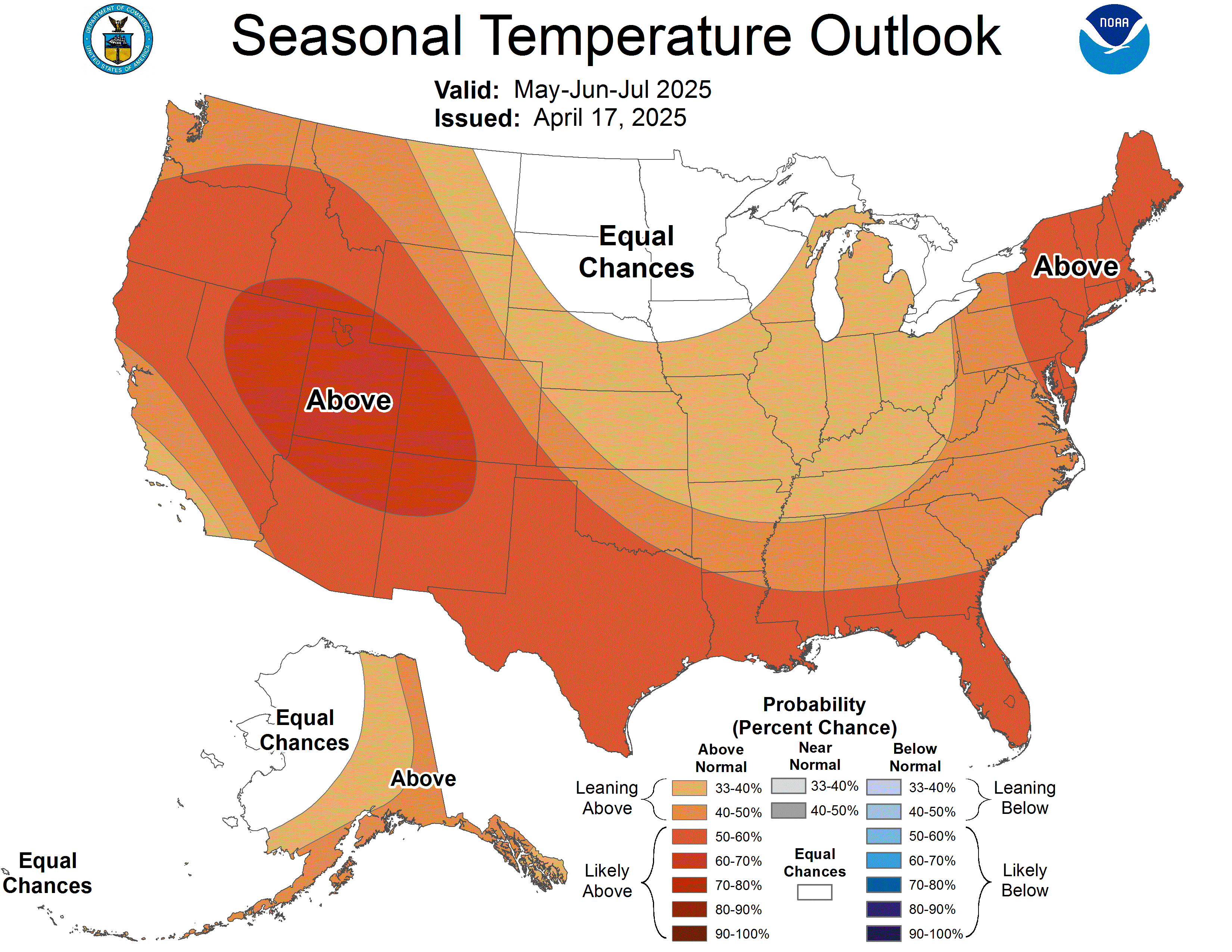
- Canadian national seasonal outlook issued -- Forecasters with Environment Canada issued their outlooks for temperature and precipitation across Canada for October, November and December 2018, which represents the last months of meteorological autumn and the first month of meteorological winter. The temperature outlook indicates that over half of Canada should experience close to normal (1981-2010) temperatures for these three months. However, above average temperatures were forecast for western sections of the country, extending from southern British Columbia northward through the Yukon Territory, as well as southern sections of Canada along the U.S. border, stretching eastward from southern Alberta across the region around the Great Lakes and into the Maritime Provinces and southern Newfoundland. Above average temperatures are also anticipated for sections of the Canadian Archipelago in the Arctic. On the other hand, below average temperatures for the next three months could occur across northern sections of Quebec and Labrador along with southern Baffin Island.
The Canadian precipitation outlook for the remainder of autumn and early winter of 2018 indicates that above average precipitation could be expected across a large section of Canada stretching from British Columbia eastward across the Prairie Provinces, northern Ontario and a large section of Quebec and southern Ontario that lies along the eastern Great Lakes and the upper St. Lawrence River. Some sections of the Arctic Archipelago could see above average precipitation. On the other hand, eastern sections of Canadian Arctic could experience below average precipitation. Elsewhere, near average autumn-early winter precipitation was anticipated.
[Note for comparisons and continuity with the three-month seasonal outlooks of temperature and precipitation generated for the continental United States and Alaska by NOAA's Climate Prediction Center, one would need to use Environment Canada's probabilistic forecasts for temperature and precipitation.]
CLIMATE FORCING
- Frequency of major hurricanes could increase in a warmer Atlantic basin -- Scientists at NOAA's Geophysical Fluid Dynamics Laboratory (GFDL) and colleagues in the U.S. and China recently published their research results that show major hurricanes of category 3 or stronger on the Saffir-Simpson Scale would become more frequent in occurrence with continued warming in the North Atlantic Ocean Basin. The researchers found these results after conducting experiments on GFDL's high-resolution global climate model. They had accurately predicted an active 2017 Atlantic hurricane season in June 2017, which eventually had six major hurricanes. They argued that this active Atlantic hurricane season was caused mainly by pronounced warm sea surface conditions in the tropical North Atlantic, rather than La Niña conditions in the Pacific Ocean. [NOAA NCEI News]
APPLIED CLIMATOLOGY
- Texas rainfall frequency values are increased -- The National Weather Service recently released its updated precipitation frequency analysis across the state of Texas as part of its new publication called NOAA Atlas 14, Volume 11 Precipitation-Frequency Atlas of the United States, Texas. The purpose of the NOAA Atlas 14, which is used by engineers and planners for used infrastructure design and planning activities, is to determine annual exceedance probabilities for precipitation durations ranging from 5 minutes to 60 days and for average recurrence intervals from 1 to 1000 years. This new analysis for Texas reveals significantly higher rainfall frequency values in parts of Texas, especially for such large metropolitan areas as Austin and Houston. Consequently, rainfall amounts have increased that define "100-year events," which are those that on average occur every 100 years or have a one percent chance of happening in any given year. For example, 100-year estimates around Houston, which had experienced historic flooding last year due to Hurricane Harvey, have increased from 13 inches to 18 inches and values previously classified as 100-year events are now much more frequent 25-year events. [NOAA NCEI News]
CLIMATE MODELING
- Impacts of ENSO are changing as Earth's climate warms -- An ENSO blog was recently posted by a meteorologist with NOAA's Climate Prediction Center, in which he interviews the lead author on a scientific paper on how the impacts of ENSO (El Niño/Southern Oscillation) could change as global temperatures are projected to increase in the future. This lead author from the National Center for Atmospheric Research (NCAR), and his colleagues ran multiple simulations on NCAR's Community Earth System Model (CESM) through the year 2100 with slightly modified input data but with the same increase in greenhouse gases on each run. The researchers found that ENSO's impacts upon regional temperature extremes and wildfire probability across many land regions, such as North America, would likely get stronger because of this changing climate. [NOAA NCEI News]
CLIMATE
AND SOCIETY
Concept of the Week: Keeping your cool!
In order to survive, humans need to maintain a nearly constant
internal core temperature that is within several degrees of 98.6
degrees Fahrenheit. Your internal temperature depends upon an energy
balance involving the gain and loss of energy from radiation (incoming
solar versus incoming and outgoing infrared radiation), sensible heat
transfer (conduction and convection), latent heat of evaporation
(respiration and perspiration) and the body's metabolic rate. This heat
transfer depends upon the differences between skin temperature and the
ambient air temperature of the surroundings. In addition, wind and
atmospheric humidity can affect the rate of sensible and latent heat
transfer. Problems arise when either too much or too little heat flows
to or from the body, yielding hypothermia and hyperthermia (heat
stress) conditions, respectively.
When the air temperature increases, heat flow from the body is
often reduced. Heat flow can be increased to maintain stable
temperatures involuntarily by thermoregulatory processes such as
increased perspiration (sweating) and dilation of the blood vessels.
Humans can also act to prevent hyperthermia by selecting lightweight
and light-colored clothes, as well as seeking of shade and well
ventilated locations. Unfortunately, high atmospheric humidity that
often accompanies high summer temperatures also reduces body heat loss
since evaporative cooling by perspiration is suppressed. During the
summer, the National Weather Service alerts the public of potentially
dangerous combinations of high air temperature and atmospheric humidity
levels by calculating the Heat Index.
Statistics kept by the National Weather Service reveals that
heat (along with high humidity) is responsible for the greatest number
of weather-related deaths across the nation during the 10-year period
(2001-2010), with 115 fatalities occurring per year. By comparison, 116
fatalities per annum are caused by tropical cyclones (hurricanes and
tropical storms), 56 deaths per year are associated from tornadoes and
25 deaths annually caused by the cold (low temperatures). (Note: The
large number of fatalities associated with the hurricanes of 2005,
which totaled 1016 deaths in the US due primarily to Hurricane Katrina,
has inflated the annual averages associated with tropical cyclones.)
Furthermore, concern has been raised that during this century, more
frequent and more severe heat waves due to global climate change could
become more common, leading to a greater risk of hyperthermia and,
ultimately, to higher morbidity rates.
Historical Events:
- 1 October 2006...Wichita, KS recorded its hottest October
day ever on the 1st with a 97-degree high temperature. (The Weather
Doctor)
- 2 October 1858...The only tropical cyclone known to produce
hurricane-force (estimated) winds on the California coast hit near San
Diego, CA. Damage to property is considerable. (The Weather Doctor)
- 2 October 1980...The temperature at Blue Canyon, CA soared
to 88 degrees, an October record for that location. (The Weather
Channel)
- 3 October 1912...The longest dry spell of record in the
U.S. commenced as Bagdad, CA went 767 days without rain, ending on 9
November 1914. (David Ludlum)
- 4 October 1969...Denver, CO received 9.6 inches of snow.
October of that year proved to be the coldest and snowiest of record
for Denver, with a total snowfall for the month of 31.2 inches.
(Weather Channel)
- 4-7 October 1972...Remnants of Hurricane Joanne brought
heavy rain and flooding to much of Arizona. It was the first documented
tropical storm to reach the state with its cyclonic circulation intact.
Severe flooding occurred in the Clifton, Duncan and Safford areas. (The
Weather Doctor)
- 4 October 1976...The mean wind speed reached 88.5 mph at
Melfort, Saskatchewan, the province's highest ever sustained wind. (The
Weather Doctor)
- 4 October 1987...A rapidly deepening coastal storm dumped
record snows across eastern New York State and western New England.
Grafton, NY was buried under 22 inches of snow, North Springfield, VT
had 21 inches and Pownal, VT recorded 18 inches. Most of the snow
occurred at higher elevations but even Albany, NY received 6 inches,
their earliest measurable snow in 117 years of records. Damage to trees
was extensive as many trees were still in full leaf. (The National
Weather Summary) (Storm Data) (The Weather Channel) (Intellicast)
In California, high temperatures of 100 degrees at San Francisco, and
108 degrees at Los Angeles and Santa Maria, were October records. San
Luis Obispo was the hot spot in the nation with an afternoon high of
111 degrees. (The National Weather Summary).
- 4 October 1998...As many as 27 tornadoes touched down
across Oklahoma, establishing the national record for tornadoes in any
state on a single October day. (The Weather Doctor)
- 4 October 2005...The Minneapolis-St. Paul (MN)
International Airport received 4.61 inches, breaking the local daily
rainfall record for October. North of the Twin Cities, weather spotters
reported nine inches of rain in the town of Spencer Brook. (The Weather
Doctor)
- 5 October 1917...The temperature at Sentinel, AZ soared to 116 degrees F, the highest October temperature ever in the U.S. (National Weather Service files)
6 October 1952...A trace of snow fell at Nashville, TN, the
earliest ever on record. (Intellicast)
- 6 October 1967...Canada's 24-hour rainfall record was
established at Ucluelet Brynnor Mines on Vancouver Island in British
Columbia with 19.24 in. (Accord Weather Calendar)
- 6 October 1984...The temperature at Honolulu, HI reached 94
degrees to establish an all-time record at that location. (The Weather
Channel)
- 7 October 1981...Seattle, WA received four inches of rain
in 24 hours, a record for the city. (The Weather Channel)
- 7 October 1987...Tucson, AZ hit 101 degrees for the second
day in a row to again equal their record for the month of October. (The
National Weather Summary)
- 7 October 1992...The 2.1 inches of snow that fell at
Concordia, KS was the earliest measurable snow on record at that
station. (Intellicast )
Return to RealTime Climate Portal
Prepared by Edward J. Hopkins, Ph.D., email hopkins@aos.wisc.edu
© Copyright, 2018, The American Meteorological Society.