WEEKLY CLIMATE NEWS
3-7 December 2018
ITEMS
OF INTEREST
- update to early & late December -- fix constellations
- Worldwide GLOBE at Night 2018 Campaign for December commences -- The twelfth in a series of GLOBE at Night citizen-science campaigns for 2018 will commence this Thursday (29 November) and continue through Saturday, 8 December. GLOBE at Night is a worldwide, hands-on science and education program designed to encourage citizen-scientists worldwide to record the brightness of their night sky by matching the appearance of a constellation with the seven magnitude/star charts of progressively fainter stars. These constellations are Perseus in the Northern Hemisphere and Grus for the Southern Hemisphere. Activity guides are also available. The GLOBE at night program is intended to raise public awareness of the impact of light pollution. The first series in the 2019 campaign is scheduled for 29 December-7 January 2019. [GLOBE at Night]
- Worldwide GLOBE at Night 2018 Campaign for December is underway -- The twelfth in a series of GLOBE at Night citizen-science campaigns for 2018 will continue through Saturday, 8 December. GLOBE at Night is a worldwide, hands-on science and education program designed to encourage citizen-scientists worldwide to record the brightness of their night sky by matching the appearance of a constellation with the seven magnitude/star charts of progressively fainter stars. These constellations are Perseus in the Northern Hemisphere and Grus for the Southern Hemisphere. Activity guides are also available. The GLOBE at night program is intended to raise public awareness of the impact of light pollution. The first series in the 2019 campaign is scheduled for 29 December-7 January 2019. [GLOBE at Night]
http://www.bom.gov.au/climate/enso/
Next issue 4 Dec 2018
"El Niño WATCH; chance of El Niño in spring increases to 50%
Forecasters with the Australian Bureau of Meteorology recently issued an updated ENSO forecast from a Southern Hemisphere perspective. They reported that a warming of the tropical Pacific had been detected due to a weakening of the trade winds, which would suggest the onset of El Niño conditions. Furthermore, they felt that with the majority of forecast models indicated a transition to an El Niño. Therefore, they have raised their Bureau's ENSO Outlook to El Niño ALERT, which means that an approximately 70% chance exists for the occurrence of an El Niño in 2018, or roughly triple the normal likelihood. [Australian Government Bureau of Meteorology]
LI> UPDATE IN MID - DEC United Nations climate change conference adjourns -- The twenty-third session of the Conference of the Parties (COP 23) and the thirteenth session of the Conference of the Parties serving as the meeting of the Parties to the Kyoto Protocol (CMP 13) adjourned last Friday (17 November 2017) in Bonn, Germany. Delegates from over 190 countries agreed to a 12-month engagement focusing on "Where are we, where do we want to go and how do we get there?" A list of outcomes and highlights of this 2017 UN Climate Conference was provided. The 24th session of the Conference of the Parties (COP 24) to the UNFCCC will take place from 3-14 December 2018, in Katowice, Slaskie, Poland. [United Nations Framework Convention on Climate Change COP 23] - CHECK -- Annual growth rate of atmospheric carbon dioxide during 2016 continues at record pace -- According to the lead scientist at NOAA's Global Greenhouse Gas Reference Network, the annual growth rate of atmospheric carbon dioxide (CO2) during 2016 as measured at NOAA's Mauna Loa Observatory in Hawaii jumped by three parts per million (ppm). This increase in carbon dioxide during 2016 follows a slightly greater increase (3.05 ppm) in the greenhouse gas in 2015. When considered together, the 6-ppm increase of carbon dioxide during 2015 and 2016 represents the largest increase in atmospheric carbon dioxide during the 59 years of that gas measurements have been made by the observatory at Mauna Loa. [NOAA News] (Editor's Note: The concentrations of atmospheric CO2 at Mauna Loa and other global locations can be tracked on a nearly real-time basis online at the "Trends in Atmospheric Carbon Dioxide" website maintained by NOAA's Earth System Research Laboratory. EJH)
- UPDATE -- Second year of tornado research program commences in Southeastern US -- Earlier this month NOAA's National Severe Storms Laboratory launched the second year of its VORTEX-SE (or Verification of the Origins of Rotation in Tornadoes EXperiment-Southeast), a research program designed to determine how environmental factors and terrain across the Southeastern States affect tornadoes in that region. VORTEX-SE will also look at how the public learns of the threats posed by tornadic thunderstorms and how they respond to protect their lives and property. As many as 40 physical and social science researchers from 20 research organizations will participate in VORTEX-SE, which will run through 8 May. [NOAA News]
See https://www.nssl.noaa.gov/projects/vortexse/ and https://www.nssl.noaa.gov/projects/vortexse/supported-2018/ and https://blog.nssl.noaa.gov/vortexse/
- List of world weather records that produce highest mortality established -- The World Meteorological Organization (WMO) recently announced that its official "WMO Archive of Weather and Climate Extremes" has been expanded from temperature and weather records to tabulate and document "world records" for the highest mortality associated with tropical cyclones, lightning, tornadoes, and hailstorms. The highest mortality associated with a tropical cyclone is an estimated 300,000 people killed directly as result of the passage of a tropical cyclone through Bangladesh (at time of incident, East Pakistan) of 12-13 November, 1970. [WMO Press Release]
- CHECK -- Field campaign targets snow science in support of nation's water supply -- The first aircraft flights have been completed in western Colorado as part of the NASA-led SnowEx research campaign that is designed to improve remote-sensing measurements of the amount of snow that is on the ground at any given time and how much liquid water equivalent contained in that snow. The amount of water in snow plays a huge role in water availability for drinking water, agriculture, and hydropower. Nearly 100 scientists from universities and governmental agencies in the US, Canada and Europe will be participating in SnowEx, a multi-year project. The researchers will use five aircraft with a total of 10 different sensors in addition to ground-based equipment as part of the SnowEx campaign. Data acquired from the SnowEx campaign will be archived at the National Snow and Ice Data Center in Boulder, CO and will be available to anyone at no cost. [NASA Goddard Space Flight Center Feature]
Check https://nsidc.org/data/snowex
- for NOAA hurricane forecasts --
A meteorologist with NOAA's Climate Prediction Center wrote an article for the ClimateWatch Magazine that examines some of the background information that his fellow forecasters used to make their 2017 hurricane season outlook for the North Atlantic. [NOAA Climate.gov News]
- Check for Annual report of the NOAA Climate Program Office for 2017 released -- During the past week NOAA's Climate Program Office (CPO) released its 54-page 2016 annual report that provides an overview of its activities and accomplishments made by this office in climate and ocean observation, research, modeling, and decision support activities for society. [NOAA Climate Program Office News]
Forecasters with the Australian Bureau of Meteorology recently issued an updated ENSO forecast from a Southern Hemisphere perspective. They reported that the tropical Pacific had warmed during the last two weeks, with sea surface temperatures reaching the El Niño levels. However, some of the atmospheric indicators still suggested neutral conditions. However, the most of international forecast models indicated additional warming of the Pacific, which suggests El Niño conditions would be maintained until March 2019. Therefore, they have maintained their Bureau's ENSO Outlook as an El Niño ALERT, which means that an approximately 70% chance exists for the occurrence of an El Niño for the next few months, or roughly triple the normal likelihood. [Australian Government Bureau of Meteorology]
/// - Celebrate World Soil Day -- This Wednesday, 5 December 2018, has been declared to be World Soil Day, an event that is annually held on the 5th of December "to celebrate the importance of soil as a critical component of the natural system and as a vital contributor to human wellbeing" as made in a resolution by the International Union of Soil Sciences (IUSS). This year's theme for World Soil Day is "Be the solution to soil pollution," since soil is a finite natural resource.
[Food and Agricultural Organization of UN - World Soil Day]
CURRENT
CLIMATE STATUS
- Mount Agung volcano on Bali erupts -- After weeks of seismic activity, the Mount Agung volcano on the Indonesian island of Bali erupted at the start of last week, with volcanic ash and condensate being carried aloft. This volcanic ash posed a hazard to aircraft and resulted in the closing of the Bali airport. [The Sun]
[World Meteorological Organization News]
Images produced by data collected by the Ozone Mapper Profiler Suite (OMPS) on the NASA/NOAA Suomi-NPP satellite early this week show sulfur dioxide emanating from the recent Mount Agung stratovolcano following the explosive eruption last weekend. [NASA Earth Observatory]
Sulfur dioxide carried upward into the stratosphere can react with water and form shiny sulfuric acid droplets that reflect solar radiation, thereby reducing surface heating and causing a lowering of the surface temperatures as occurred following Mount Agung's last major eruption in 1963. That eruption resulted in a reduction in global temperatures by as much as 0.2 Celsius degrees during the following year. [Vox Media]
- Additional summaries of 2017 hurricane seasons in North Atlantic basins -- At the end of the official 2017 hurricane season in the North Atlantic, eastern North Pacific and central North Pacific basins last Thursday (30 November 2017), NOAA scientists issued their preliminary assessment of this hurricane season in the Atlantic basin. They reported that the Atlantic basin experienced an extremely active season, not only in terms of the number of named tropical cyclones (tropical storms and hurricanes), but also upon the magnitude of a parameter noted as the "Accumulated Cyclone Energy" index, which measures the combined intensity and duration of the storms during the season. The scientists also noted that investments in research and forecasting during recent years have paid dividends in more accurate predictions of tropical cyclone tracks in 2017. A four-and-a-half-minute video was made of the 2017 hurricane season using an animation of satellite images obtained from the NOAA GOES-East satellite. [NOAA News]
The forecast team at Colorado State University released their summary of the tropical cyclone activity in the North Atlantic basin during 2017 along with a verification of their long-range seasonal and two-week forecasts. [Tropical Meteorological Project] - Satellites reveal changes in the size of Africa's Lake Chad -- Images obtained by NASA's Landsat 1 satellite in 1973, the agency's Landsat 8 satellite in 2017, the CIA's Corona strategic reconnaissance satellite in 1963 and by an astronaut on the International Space Station in 2015 reveal changes in the areal size of Lake Chad, located in Africa's Sahel. The size of the lake is dependent upon the inflow of water from the highly variable rainfall totals associated with the rainy season (July through September) of the West African Monsoon. Lake Chad, a relatively shallow lake that provides fresh water for more than 30 million people, has undergone large changes in size, not only over the last half century, but over the last 10,000 years. [NASA Earth Observatory]
CLIMATE
AND THE BIOSPHERE
- More boreal forest wildfires sparked by lightning strikes in northern Alaska and Canada -- Using data collected from MODIS sensors on NASA's Terra and Aqua satellites, the Alaska Large Fire Database and the lightning detection network, a team of scientists has found that wildfires across the boreal forests in Alaska and northern Canada have been increasing in frequency and in areal size over the last several decades. More lightning discharges due to increasing unstable atmospheric conditions caused by a warming climate appears to be responsible for igniting many of the wildfires. In addition, earlier spring thaws have been leading to longer fire seasons. [NASA Earth Observatory]
CLIMATE
AND HUMAN HEALTH
- Connections between extreme weather events and human health explored -- Researchers from NOAA's National Centers for Environmental Information (NCEI), the Cooperative Institute for Climate and Satellites–North Carolina, the Centers for Disease Control and Prevention, and Florida State University have recently published a paper that explores the interconnections between extreme weather and climate events and human health on both short-term and long-term scales. However, important gaps in knowledge about the health impacts of extreme events still exist. The paper also highlights ways that research into these connections can help build resilience. [NOAA NCEI News]
CLIMATE
FORECASTS
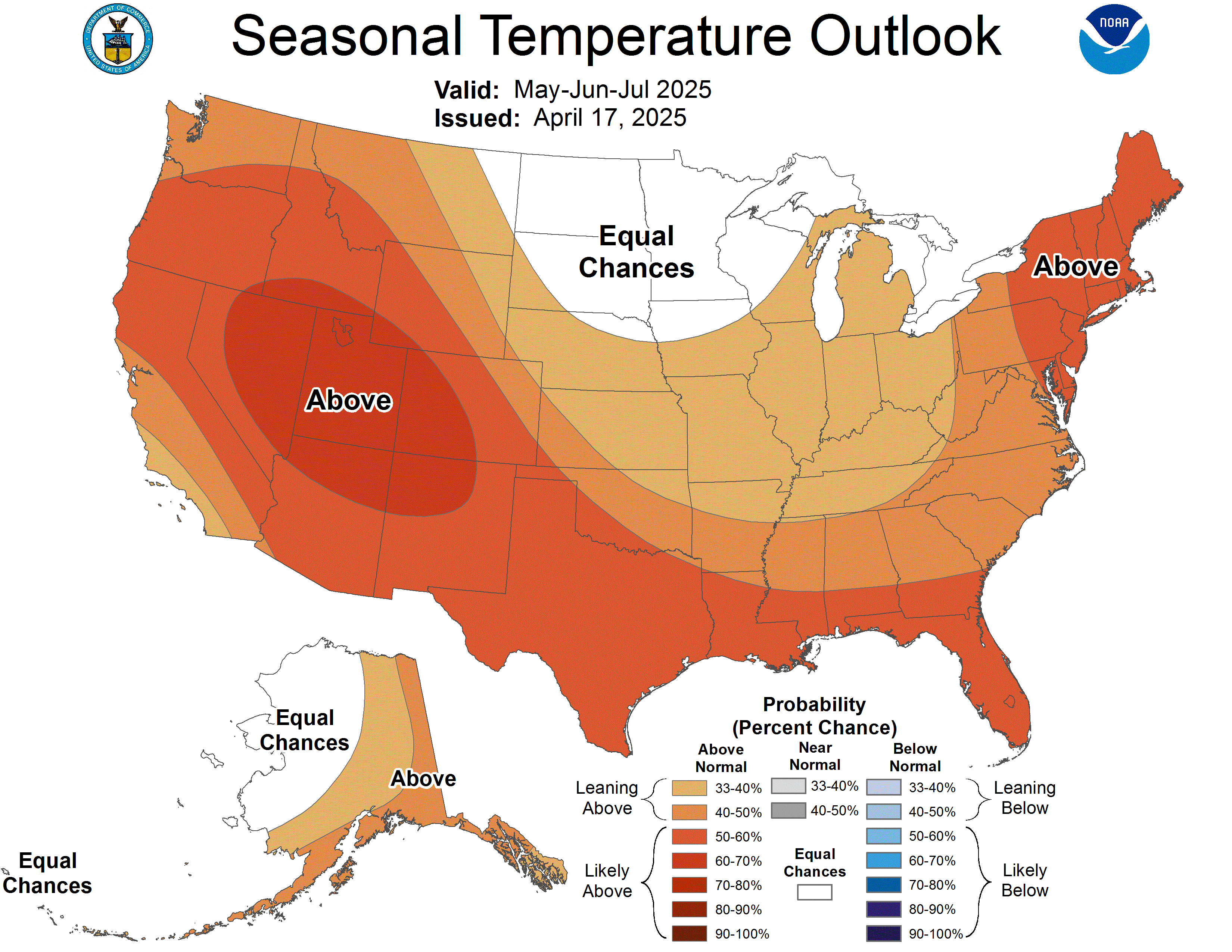
- Canadian national seasonal outlook issued -- Forecasters with Environment Canada issued their outlooks for temperature and precipitation across Canada for December 2017 through February 2018, which represents meteorological winter. The temperature outlook indicates that the northern Canada running from the coast of the Yukon Territory eastward and northward to Nunavut's Ellesmere Island could experience above normal (1981-2010) temperatures for these three months. Above average winter temperatures are possible across southeastern Canada, running from the sections of Ontario along the Great Lakes to the Maritime Provinces. Elsewhere, average temperatures could be anticipated from British Columbia eastward across the Prairie Provinces and northern sections of Ontario and Quebec to Labrador.
The Canadian precipitation outlook for the 2017-18 winter season indicates that above average precipitation was to be anticipated across scattered areas of southern Canada. Only a few small areas in the southern Yukon Territory of western Canada could have below average precipitation. Near-average winter precipitation was expected across wide areas of the nation.
[Note for comparisons and continuity with the three-month seasonal outlooks of temperature and precipitation generated for the continental United States and Alaska by NOAA's Climate Prediction Center, one would need to use Environment Canada's probabilistic forecasts for temperature and precipitation.]
PALEOCLIMATE RECONSTRUCTION
CLIMATE
AND THE BIOSPHERE
CLIMATE AND HUMAN HEALTH
////
CLIMATE IMPACTS ON THE BIOSPHERE
CURRENT
CLIMATE STATUS
CURRENT
CLIMATE MONITORING
CLIMATE FORCING
CLIMATE MODELING
CLIMATE AND THE BIOSPHERE
CLIMATE
AND HUMAN HEALTH
CLIMATE AND HUMAN HEALTH
APPLIED CLIMATOLOGY
PALEOCLIMATE
RECONSTRUCTION
CLIMATE
EDUCATION
COMPARATIVE PLANETOLOGY
CLIMATE AND HUMAN HEALTH
CLIMATE
AND SOCIETY
Historical Events:
- 3-10 December 1926...Record rain fell on Yuma, AZ over a
one-week period. On the 4th 1.10 inches of rain
fell, and by the 10th a total of 4.43 inches had
fallen, to set an all-time December monthly record. The mean annual
precipitation for Yuma is only 3.38 inches. (Accord Weather Guide
Calendar)
- 3 December 1982...Big Fork, AR received 14.06 inches of
rain, setting a 24-hour maximum precipitation record for the state.
(NCDC)
- 4 December 1982...The temperature in New York City's
Central Park reached 72 degrees to establish a record high for
December. The month as a whole was also the warmest of record. (The
Weather Channel)
- 5 December 1941...The temperature at Enosburg Falls soared
to 72 degrees to establish a state record for Vermont for the month of
December. (The Weather Channel)
- 6 December 1950...Duluth, MN had their greatest 24-hour
snowfall when 25.4 inches fell. (Intellicast)
- 7 December 1966...ATS-1 satellite (Applications Technology Satellite) was successfully launched from Cape Canaveral, FL. This satellite, which was placed in a geosynchronous orbit, had the first spin-scan camera designed by Professor Verner Suomi of the University of Wisconsin-Madison designed to monitor cloud patterns on Earth on a nearly continuous basis. (Fritz Hasler, NASA)
- 8 December 1938...The temperature at La Mesa, CA soared to
108 degrees to set a U.S. record for the month of December. Los Angeles
reached 91 degrees, the only time a 90-degree reading was reached in
December in that city's history. (The Weather Channel) (Intellicast)
/////
- 10 December 1919...A 28-inch snowfall for 24 hours at Bend,
OR set a new 24-hour snowfall record for the state. (Intellicast)
- 10 December 1946...The temperature at New York City soared
to 70 degrees, the highest ever for a December day. (David Ludlum)
(Intellicast)
- 11 December 1905...The highest recorded temperature in South America was 120 degrees set in Rivadavia, Argentina. (National Weather Service files)
- 11 December 1944...Toronto, Canada, received a record one-day snowfall of 19 inches. (National Weather Service files)
- 10 December 1949...The barometric pressure at Las Vegas, NV
reached a record low reading of 29.17 inches (987.8 millibars). (The
Weather Channel)
- 10 December 1995...Intense lake effect snow squalls buried
Buffalo, NY under 37.9 inches in 24 hours, the city's greatest 24-hour
snowfall and biggest snowstorm ever. Watertown, NY recorded 39 inches
in just 12 hours and had 4 inches of snow an hour each hour for six
consecutive hours. (Intellicast)
Return to RealTime Climate Portal
Prepared by Edward J. Hopkins, Ph.D., email hopkins@aos.wisc.edu
© Copyright, 2018, The American Meteorological Society.