WEEKLY CLIMATE NEWS
4-8 March 2013
This is Break Week for the Spring 2013 offering of
the DataStreme Earth Climate Studies course. This Weekly
Climate News contains new information items and historical
data, but the Concept of the Week is repeated from Week 6.
ITEMS
OF INTEREST
- Becoming AWARE -- NOAA's National Weather Service and its partner, the Federal Emergency Management Agency (FEMA) are currently observing "National Severe Weather Preparedness Week" that will run through this coming Saturday (9 March). The theme for this year's National Severe Weather Preparedness Week is "Be a Force of Nature." The NOAA "Weather-Ready Nation" website (http://www.nws.noaa.gov/com/weatherreadynation/force.html), contains links that allow the public to "Be a Force of Nature" in their communities through Tweet, a blog post, or a presentation.
- High-quality maps of March temperature and precipitation normals across US available -- The PRISM Climate Group at Oregon State University has prepared high-resolution maps depicting March's normal maximum temperature, minimum temperature and precipitation totals across the 48 coterminous United States for the current 1981-2010 climate normals interval. These maps, with a 800-meter resolution, were produced using the PRISM (Parameter-elevation Regressions on Independent Slopes Model) climate mapping system.
- March weather calendar for a city near you -- The Midwestern Regional Climate Center maintains an interactive website that permits the public to produce a ready to print weather calendar for any given month of the year, such as March, at any of approximately 270 weather stations around the nation. (These stations are NOAA's ThreadEx stations.) The entries for each day of the month includes: Normal maximum temperature, normal minimum temperature, normal daily heating and cooling degree days, normal daily precipitation, record maximum temperature, record minimum temperature, and record daily precipitation; the current normals for 1981-2010.
- Participate in third campaign of Worldwide GLOBE at Night 2013 -- The third in a series of GLOBE at Night citizen-science campaigns for 2013 began Sunday (3 March begin next Thursday (31 January) and continue into the following week, running through 9 February. GLOBE at Night is a worldwide, hands-on science and education program designed to encourage citizen-scientists worldwide to record the brightness of their night sky by matching the appearance of a constellation (Orion or Leo in the northern hemisphere, and Orion and Crux in the southern hemisphere) with seven star charts of progressively fainter stars. In addition to this campaign and the two previously held in early January and early February, the two additional GLOBE at Night campaigns will be in 2013: 31 March-9 April and 29 April-8 May.
Check the GLOBE at Night website for additional information on this week's activities plus a Teacher
Information Page and activity packet.
- Viewing
atmospheric circulation in three-dimensions --
Read this week's Supplemental
Information.. In Greater Depth for information concerning
the average circulation in the lower and upper troposphere.
- Anatomy of a pothole shown on video -- A video produced by the Utah Department of Transportation shows how potholes are created in pavements and sub-grade material during winter due to heavy snow or rain followed by numerous freeze-thaw cycles. [Earth Gauge]
CURRENT
CLIMATE MONITORING
- Second phase of air quality campaign in California concludes -- At the end of February, the second phase of the five-year NASA's DISCOVER-AQ (an acronym for Deriving Information on Surface conditions from Column and Vertically Resolved Observations Relevant to Air Quality) research campaign was completed in the San Joaquin Valley of Central California. This recently concluded phase included an intense flight and ground-based air quality research campaign designed to study air pollution in the boundary layer of the lower atmosphere where people live and is meant to improve the ability of satellites to diagnose surface air quality. The California series of flights is one of four DISCOVER-AQ field studies. The first phase of DISCOVER-AQ was conducted in July 2011 over the Baltimore, MD-Washington, DC metropolitan area, a third phase will be held later in 2013 around the Houston area, while a fourth location will be chosen for 2014. [NASA Langley Research Center]
- New Aquarius satellite detects shifts in ocean salinity -- A team of scientists have created an animated sequence of images obtained from NASA's Aquarius instrument onboard NASA/Space Agency of Argentina's Aquarius satellite that shows seasonal changes in the salinity (or salt content) of the surface layers of the world's oceans over this first full year that the instrument has been operative after its launch in 2011. This global view of the salinity variations are needed for climate studies. [NASA's Earth Science News Team]
- New access site unveiled for monitoring nation's rivers -- The US Geological Survey (USGS) recently unveiled its latest system called "WaterNow" that allows the public to access current streamflow, groundwater levels, water quality and lake levels from the thousands of USGS gages using their mobile phones or email. WaterNow will complement the data available on the Internet at "USGS Water Data for the Nation" using a web browser. [USGS Newsroom]
- An All-Hazards Monitor -- This Web portal provides the user information from NOAA
on
current environmental events that may pose as hazards such as tropical
weather, fire weather, marine weather, severe weather, drought and
floods. [NOAAWatch]
- Global and US Hazards/Climate Extremes -- A review and analysis of the global impacts of various
weather-related events, including drought, floods and storms during the
current month. [NCDC]
CLIMATE
FORCING
- Recent global temperature increases diminished by volcanic aerosols -- Researchers from the University of Colorado, Boulder and colleagues have determined that aerosols that been produced from volcanic emissions rather than those from human generated pollutants appear responsible for the smaller than anticipated increases in global temperature between 2000 and 2010. Volcanoes spew sulfur dioxide into the stratosphere (altitudes between 12 and 20 miles), where it undergoes chemical reactions to form sulfuric acid droplets that are highly reflective of sunlight. The researchers used two sophisticated computer models in their analysis. [University of Colorado, Boulder]
- Airborne dust and biological particles from Africa and Asia influence California precipitation -- A field study called the CalWater field campaign conducted in the Sierra Nevada Mountains of California to assess the impacts of aerosols on clouds and precipitation in this mountain range has found that dust and microorganisms transported by winds from Africa's Sahara desert and from Asia appear to help to spur the precipitation. Instruments known as aerosol time-of-flight mass spectrometers (ATOFMS) and sensors onboard NASA's Cloud-Aerosol Lidar and Infrared Pathfinder Satellite Observation (CALIPSO) satellite helped track these aerosols that traveled on high altitude winds. The CalWater field campaign was conducted by researchers at Scripps Institution of Oceanography at University of California, San Diego and NOAA's Earth System Research Laboratory. [Scripps Institution of Oceanography News]
CLIMATE
AND THE BIOSPHERE
- Satellites find decreased vegetation across Eastern United States -- Scientists at NASA's Ames Research Center report that their analysis of Enhanced Vegetation Index (EVI) data from the MODIS sensor on NASA's Terra satellite indicates a decline in the density of green forest cover during summers across four regions in the Eastern United States (the Upper Great Lakes, southern Appalachian, mid-Atlantic, and southeastern Coastal Plain) from 2000 to 2010. These researchers claim that increased temperatures and changes in local and regional precipitation patterns have altered the growth of these large forest areas. [NASA Ames Research]
CLIMATE
AND HUMANS
- Future losses of labor capacity estimated due to a future warmer climate .-- A researcher with the NOAA Geophysical Fluid Dynamics Laboratory and his colleagues published a study in which they conclude that labor capacity losses associated with heat stress would double globally by 2050 in due to projected increases in global temperature. They warn that the impact would be felt most by those working outdoors and in hot environments especially in tropical and midlatitude regions. A new metric was devised using existing occupational health and safety thresholds to quantify a healthy, acclimated individual's capacity to safely perform sustained labor under environmental heat stress. [NOAA News]
CLIMATE
FORECASTS
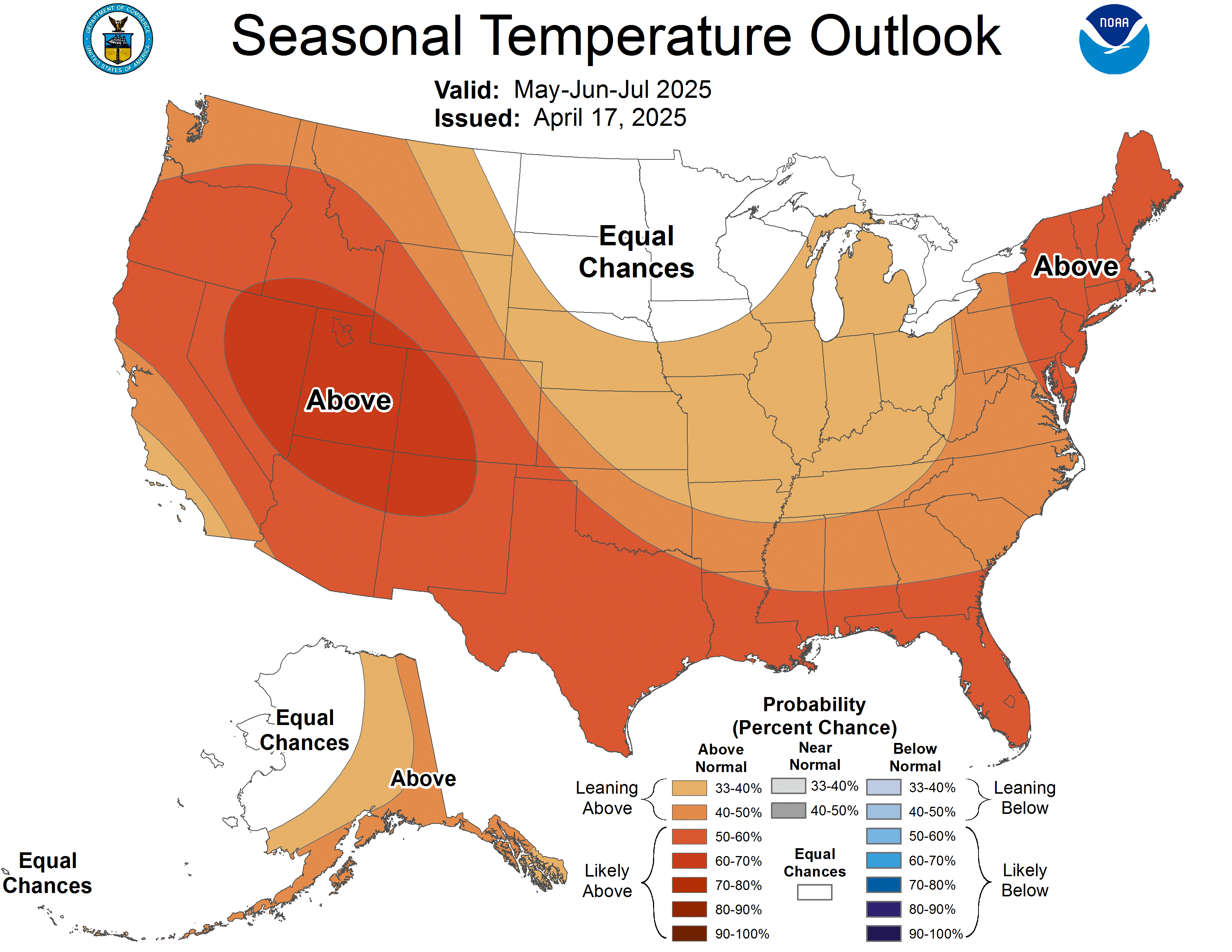
- Canadian national seasonal outlook issued -- Forecasters with Environment Canada issued their outlooks for temperature and precipitation across Canada for meteorological spring, the three months of March through May 2013. The temperature outlook indicates that eastern Canada, along with areas around the Great Lakes and the southern Prairie Provinces would experience above normal (1981-2010) spring temperatures. Below average spring temperatures were envisioned along the Alcan border in the western Yukon Territory. Elsewhere across Canada, near normal spring temperatures were anticipated.
The Canadian precipitation outlook for Spring 2013 indicates that sections of southeastern Canada extending from the Great Lakes across the St. Lawrence Valley to the Maritime Provinces could experience below average spring precipitation. On the other hand, a large area of central Canada, extending from western British Columbia across the northern Prairie Provinces and into Nunavut and northern Labrador could have above normal precipitation.
[Note for comparisons and continuity with the three-month seasonal outlooks of temperature and precipitation generated for the continental United States and Alaska by NOAA's Climate Prediction Center, one would need to use Environment Canada's probabilistic forecasts for temperature and precipitation.]
CLIMATE
AND SOCIETY
- Website for human dimensions of climate change -- An interagency effort within the US federal government
that included NOAA, the Bureau of Land Management and the US Forest
Service, has resulted in a website called HD.gov (for
HumanDimensions.gov) that provides users, such as natural resource
managers, with information on the human dimensions on a variety of
topics of interest such as climate change. [HD.gov]
- Earthweek
-- Diary of the Planet [earthweek.com] Requires Adobe Acrobat Reader.

This Concept of the Week is repeated from Week 6.
Concept of the Week: Tropospheric
westerly winds, north and south
The theoretical existence of upper tropospheric jet stream
winds were not confirmed until being encountered by World War II bomber
pilots when heading west into strong headwinds at altitudes of
approximately 30,000 feet (10,000 m). Wind speeds sometimes exceeded
170 mph causing their relatively slow, heavily laden aircraft to almost
stand still. Subsequently, westerly jet stream winds were found to
encircle the planet in midlatitudes of both hemispheres above regions
of strong temperature contrasts.
The explanation for these winds involves atmospheric mass
distributions and forces on a rotating planet. Air in tropical
latitudes is warmed, rises and then flows poleward, both north and
south. On a rotating planet, moving air is deflected by the Coriolis
effect, to the right in the Northern Hemisphere (and left in the
Southern). The greater the temperature differences between warm lower
and cold higher latitudes, the stronger the air motions and the faster
the jet streams. The vertical temperature patterns result in the
highest wind speeds near the top of the troposphere.
So Northern Hemisphere air headed northward, deflected to the
right ends up headed east, a "westerly wind." In the Southern
Hemisphere, southward moving air, deflected left will also go east, as
a westerly wind. These "rivers" of strong upper-level winds steer
surface weather systems as they move generally eastward across
midlatitudes. They also provide boosts for jet aircraft headed eastward
with them, but need to be avoided for going west! Of course, the full
story is complex as land (especially mountains) and water surfaces
interact with the heating of the air and eddies form in the turbulent
flows, so jet streams wander. And with them go the storms and the
weather patterns that form our short-term climate.
Concept of the Week: Questions
(Place your responses on the Chapter Progress Response Form
provided in the Study Guide.)
- The Northern Hemisphere jet stream winds would be directed
such that cold air is [(to the left),(to
the right),(directly ahead)]
of their forward motion.
- In the Southern Hemisphere, the jet stream winds to be
directed generally toward the [(south),
(east), (west)].
Historical Events:
- 4 March 1953...Snow was reported on the island of Oahu in
Hawaii. (The Weather Channel)
- 4-5 March 1899...Tropical Cyclone Mahina (the Bathurst Bay
Hurricane) crossed Australia's Great Barrier Reef and generated
produced the highest storm surge ever recorded: 13 m (42.6 ft) surge in
Bathurst Bay. The Australian pearling fleet was destroyed, over 100
shipwrecks reported and 307 people killed. Minimum central pressure
barometric pressure fell to an unofficial reading of estimated at 914
millibars (26.90 inches of mercury). (Accord's Weather Calendar) (The
Weather Doctor)
- 5 March 1960...The greatest March snowstorm of record in
eastern Massachusetts began to abate. The storm produced record 24-hour
snowfall totals of 27.2 inches at Blue Hill Observatory, 17.7 inches at
Worcester, and 16.6 inches at Boston. (The Weather Channel)
- 5 March 2000...The Twin Cities of Minneapolis and St. Paul,
MN established a new record for the fewest number of days between
70-degree Fahrenheit temperature reading from the last date in the
autumn to the first date in the spring, with only 113 days passed. The
previous record was 131 days, while the average has been 175 days. (The
Weather Doctor)
- 6 March 1900...A chinook wind blowing down the slopes of
the Rockies through Havre, MT raised the temperature 31 degrees in just
three minutes. (The Weather Channel)
- 6 March 1954...Florida received its greatest modern-day
snowfall of record, with 4.0 inches at the Milton Experimental Station.
Pensacola, FL equaled their 24-hour record with 2.1 inches of snow.
(The Weather Channel)
- 6 March 1962...Forty-two inches of snow fell at Big
Meadows, located in the mountains of Virginia, for a state record as
part of the Great Atlantic Coast Storm of 1962. (Intellicast)
- 6 March 1971...The temperature at Palteau Rosa, Italy fell
to 30.2 degrees below zero Fahrenheit, Italy's lowest temperature on
record. (The Weather Doctor)
- 7 March 1932...A severe coastal storm set barometric
pressure records from Virginia to New England. Block Island, RI
reported a barometric pressure reading of 955.0 millibars (28.20 inches
of mercury). (David Ludlum)
- 7 March 1996...6.5 inches of snow fell at Boston, MA on
this date to bring its seasonal total to 96.4 inches -- the city's
snowiest winter in 105 years of record keeping. The old record was 96.3
inches set in the 1993-94 winter season. Now all major cities along
this East Coast had broken their seasonal snowfall records in the
1995-96 winter season. (Intellicast)
- 7 March 2000...The temperature at Duluth, MN reached 70
degrees, which was the earliest that a 70-degree reading was reported
in Duluth; the previous earliest date was 22 March 1945 when the
temperature reached 72 degrees. (Accord's Weather Guide Calendar)
- 7 March 1999...Moncton, New Brunswick, Canada's snowiest
major city set a new record for a one-day snowfall of 45.7 inches, but
prior to that date the winter's total had been a meager (for the city)
46 inches of snow. (The Weather Doctor)
- 8 March 1971...A snowstorm dropped 10 to 20 inches of new
snow across Vermont to raise snow depths to record levels. A snow cover
of 116 inches was measured on the ground on top of Mount Mansfield, the
second highest snow depth ever recorded on the mountain up to the time.
The town of Orange measured 88 inches on the ground for a new state
low-elevation snow depth record. (Intellicast)
- 8 March 1992...In the first 8 days of March, Las Vegas, NV
recorded 1.87 inches of rain, setting a new monthly record for rainfall
in March. The previous record was 1.83 inches set in 1973.
(Intellicast)
- 8 March 1994...A major snowstorm buried sections of
Oklahoma, Missouri, and Arkansas. Ozark Beach, MO recorded 19 inches of
snow, while Harrison, AR checked in with 18 inches. Tulsa, OK had 12.9
of snow, for its greatest single storm snowfall ever. (Intellicast)
- 8 March 1996...Elkins, WV received 2.1 inches of snow on
this day to bring its seasonal snowfall to 125.8 inches -- its snowiest
winter on record. (Intellicast)
- 9 March 1911...Aibonito, Puerto Rico had temperature of 40
degrees Fahrenheit, the lowest temperature recorded on that island.
(The Weather Doctor)
- 9 March 1943...The temperature at Lac Frontiere, ME fell to
40 degrees below zero, the lowest reading ever in March in New England.
(Intellicast)
- 9 March 1956...A whopping 367 inches of snow was measured
on the ground at the Rainier Paradise Ranger Station in Washington. The
snow depth was a state record and the second highest total of record
for the continental U.S. (The Weather Channel)
- 10 March 1912...The barometric pressure reached 990.9
millibars (29.26 inches) at Los Angeles, CA, and 997.7 millibars (29.46
inches) at San Diego, CA, setting all-time records for those two
locations. (David Ludlum)
- 10 March 1922...Dodge City, KS reported an all-time record
24-hour total of 17.5 inches of snow. (The Weather Channel)
- 10-11 March 1972, The temperature at Chicago, IL rose from
15 degrees on the 10th to 73 degrees on the 11th. The 58-Fahrenheit
degree temperature rise tied the largest day-to-day rise on record. The
city experienced a similar jump in temperature in February 1887. (The
Weather Doctor)
Return to DataStreme
ECS website
Prepared by Edward J. Hopkins, Ph.D., email hopkins@meteor.wisc.edu
© Copyright, 2013, The American Meteorological Society.