So how has this winter been treating you? For most areas of the nation, a familiar gauge used to assess a winter's severity is the amount of fuel that we need to use to keep our homes warm over the winter. In other words, many of us will inquire as to how the winter of 2012-2013 has affected our pocket books when considering space heating. This question becomes more serious if fuel prices increase.
For comparison purposes, we may try to remember how temperatures this winter compare with last winter or to some long-term average. One could inspect the tables of monthly average temperature (in degrees Fahrenheit) that are furnished by the National Weather Service a few days after the end of each month for approximately 250 selected U.S. cities. January 2013 was relatively warm across all but the western third of the nation. Some locations across sections of the Southeast had January temperatures that were as much as 8 Fahrenheit degrees above the 30-year normal temperatures for 1981-2010, while temperatures at some stations in the western Great Basin were as more than 10 Fahrenheit degrees below normal.
However, another way of comparison can be made through monitoring the heating degree-day units that have accumulated for these stations, which serve as more quantitative indicators that gauge the amount of energy required for space heating. The heating degree-day units for each station on each day of the month are by determining the difference the station's daily average temperature (the arithmetic average of the day's maximum and minimum temperature, or the sum of these two temperature readings, which are divided by two) and a base temperature of 65 degrees Fahrenheit. If the day's average temperature were below 65 degrees Fahrenheit, the arithmetic difference in Fahrenheit degrees would represent the number of heating degree day units accumulated for that day, but if the average temperature were at or above 65 degrees, zero heating degree day units are accumulated. A running summation of the number of heating degree day units are made at each station for the entire month, or for the "heating year" extending from 1 July to 30 June of the following calendar year.
During the first several days of each new month, the Climate Prediction Center of the National Weather Service compiles heating degree data for the previous month and posts these data for approximately 360 selected cities around the country. These monthly and seasonal values are compared with the corresponding values for last year to date and for the "normals" representing the 30-year averages for the current 1981-2010 climatological reference interval.
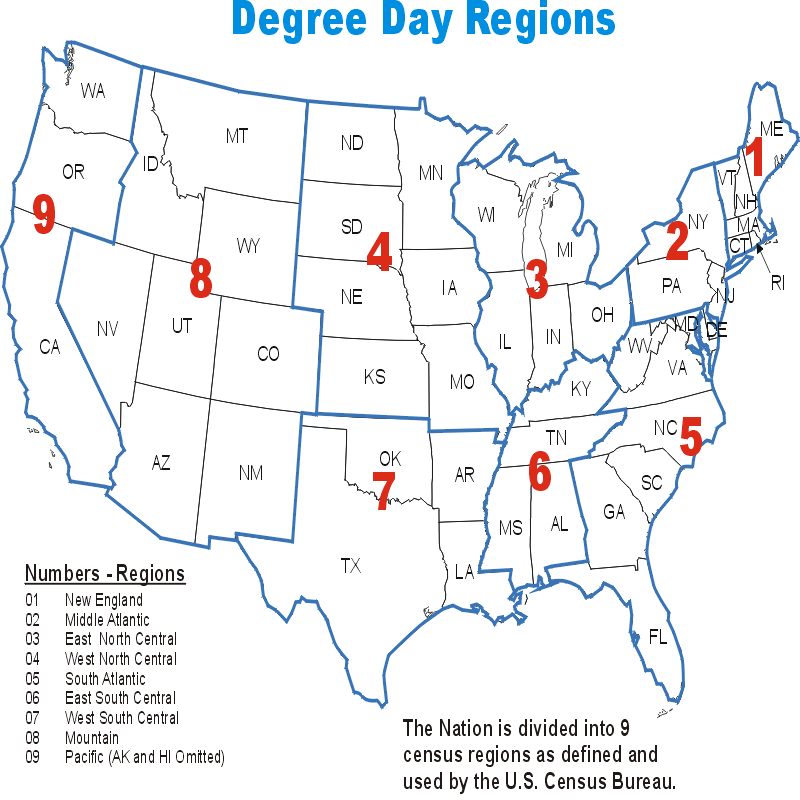
The climatologists at the Climate Analysis Center have also prepared a corresponding list of population weighted heating degree-day units for each state. These latter statistics, which are weighted according each state's population (2000 Census), are used to show more accurately the temperature-related energy consumption on the state, regional, and national levels based upon population density. Statistics are also generated that involve weighting the states in regions and the regions in the country by the number of residential customers heating with gas, oil, or electricity. [Note: A map is available that identifies the location of the degree day regions used by CPC.]
In the monthly tables prepared by the Climate Prediction Center, the number of heating degree-day units accumulated for the month appears in the column marked "Monthly Total." Adjoining columns display the comparisons between this year and the "normals", as well as with last year. Specifically, the arithmetic differences between the month totals from this year and the "normals" representing the 30-year averages for the current 1981-2010 climatological reference interval appear in the column marked "Month. Dev. from Norm." The difference between the given month this year and the same month last year appear in the column "Month. Dev. from L. YR." Similar columns show the comparisons between the total number of heating degree day units accumulated over the current heating season that started on 1 July and the corresponding values for normals to date and last season to date. Percentage differences are also presented.
Inspection of the most recent tables of the number of heating degree-day units accumulated between last July and the end of January 2013 indicates that essentially all of the coterminous United States needed less energy for space heating over the entire heating season to date as compared with the 1981-2010 normals. Some of the largest cumulative departures from normal in terms of percentages occurred in the South Atlantic and South Central States. Nationwide, the number of heating degree-day units accumulated from July 2012 through 31 January 2013 was nine percent percent below "normal." While the West had a cold January with more heating degree-day units accumulated than normal during that month, the increases were less than the lower than average accumulations in the previous months. While the coterminous United States have experienced fewer accumulated heating degree-day units compared to the 30-year normals, essentially the entire nation had more than last heating season. During that previous 2011-2012 heating season, the three-month meteorological winter average temperature across the entire coterminous United States was within the top three since comprehensive national climate records began in 1895, meaning that the accumulated heating degree-day units would be relatively small.
Corresponding sets of cooling degree-day units for selected cities and for population-weighted regions were compiled. Cooling degree-day units represent the positive departure of the daily average temperature from the base temperature of 65 degrees Fahrenheit. The arrangement of these monthly tables is similar to that for the corresponding heating degree-day units. How these cooling degree statistics translate into a change in the cost of your utility bill that is not as clear-cut as the cost relationship with the cumulative heating degree-day units. Other factors, such as the atmospheric humidity levels, the amount of sunshine and your life style may also significantly influence your decision to run your air conditioner.
Since the cooling season only started on 1 January and most locales across the nation have not experienced daily average temperatures above 65 degrees, analysis of these cooling degree-day statistics would be somewhat premature. Nevertheless, several areas that included Florida in the South Atlantic States and the western portion of the South Central States that included Texas had more accumulated fewer cooling degree-day units during January than normal. Furthermore, the accumulated cooling-degree day units for these regions were more than one year ago.
Ultimately, the "bottom line" has been that for most residents across the country, the demand for energy to heat homes to date has been below the long-term average. Consequently, the pocketbook has not been severely strained in most areas - assuming that monetary inflation or other non-weather-related price increases are not taken into account.
Return to DataStreme ECS website
Prepared by Edward J. Hopkins, Ph.D., email hopkins@meteor.wisc.edu
©Copyright, 2013, The American Meteorological Society.