WEEKLY CLIMATE NEWS
6-10 May 2013
DataStreme Earth Climate Systems will return for Fall 2013 with new Investigations files starting during Preview Week, Monday, 2 September 2013. All the current online website products will continue to be available throughout the summer break period.
ITEMS
OF INTEREST
- May is National Wetlands Month -- The US Environmental Protection Agency, along with other federal agencies and environmental groups, has designated May as American Wetlands Month in an effort to increase public awareness of the importance of protecting and preserving the nation's wetlands. This year's observance is the 23rd annual National Wetlands Month. [EPA-Wetlands]
- Land of the Midnight Sun -- Barring clouds, the sun should rise at Barrow, AK early Friday morning (2:54 AM AKDT on 10 May 2013) after spending 62 minutes below the horizon. The sun should then remain above the local horizon for the next 12 weeks, before going below the horizon for one hour and 14 minutes on 2 August 2013 (at 1:57 AM AKDT).
- May snow records across Midwest fall with late season snowstorm -- A late season snowstorm moved slowly across the Midwest over the first three days of May. Snowfall totals ranged from 12 to 18 inches across some locations. All-time state snowfall records for the month of May were set in Iowa, Minnesota and Wisconsin. Farther to the south, Arkansas received three inches of snow, which represents the first ever measurable snow in May. [Climate Central] Editor's Note:The list of the new 1-day, 2-day and 3-day snowfall records will become available once they are verified by State Climate Extremes Committee consisting of National Weather Service personnel and state climatologists. EJH
CURRENT
CLIMATE STATUS
- World Meteorological Organization confirms 2012 was 9th warmest since 1850 -- During the last week, the World Meteorological Organization (WMO) released its "Statement on the Status of the Global Climate" noting that despite the cooling effect of a La Nina event early in the year, 2012 was the ninth-warmest since sufficiently reliable global climate records began in 1850. 2012. The global land and ocean surface temperature during January-December 2012 was estimated to be 0.45 Celsius degrees (0.83 Fahrenheit degrees) above the 1961-1990 average of 14.0 degrees C. Furthermore, 2012 was the 27th consecutive year that global surface temperatures (land and ocean) were above the 1961–1990 average. The report also notes a record loss of Arctic sea ice in August and September 2012. [World Meteorological Organization Media Center]
CURRENT
CLIMATE MONITORING
- Operation IceBridge concludes for season -- Late last week, NASA's Operation IceBridge was concluded for another season. This season's IceBridge mission began in mid-March, with scientists flying aboard NASA's flying laboratory and collecting data on Arctic ice ranging from sea ice to tidewater glaciers to ice caps. IceBridge is a six-year mission operated by NASA to help scientists bridge the gap in polar observations between the failure of NASA's Ice, Cloud and Land Elevation Satellite (ICESat) in 2009 and ICESat-2, planned for launch in early 2016. [NASA Earth Observatory]
- Measuring Western snowpack enters a new era -- .... NASA's Jet Propulsion Laboratory and the California Department of Water Resources recently launched a new three-year Airborne Snow Observatory mission to create the first maps of the entire snowpack of two major mountain watersheds in the Tuolumne River Basin in California's Sierra Nevada and monthly flights over Colorado's Uncompahgre River Basin. Data collected by a scanning lidar system and an imaging spectrometer mounted on an aircraft will be used to estimate the amount of water that will flow out of the basins as the snow melts. Ultimately, the data-gathering technology used in this mission could improve water management for 1.5 billion people worldwide who rely on snowmelt for their water supply. [NASA Jet Propulsion Laboratory]
- Instrument package designed to assess space weather is being readied -- Scientists and engineers at the University of Colorado's Laboratory for Atmospheric and Space Physics are preparing a set of instruments called the Extreme Ultraviolet and X-ray Irradiance Sensors, or EXIS, that will be placed onboard NOAA's next generation Geostationary Operational Environmental Satellites, or GOES-R, in 2015. These sensors will measure energy output from the sun that can affect satellite operations, telecommunications, GPS navigation and power grids on Earth. [NOAA News] [University of Colorado, Boulder News]
- Buckets are important to climate science -- NOAA's National Climatic Data Center (NCDC) has posted an article that describes the importance of buckets that were used by scientists and sailors for more than a century to measure the temperatures of the top layers of the world's oceans from onboard ships. The method of taking the temperature of the sea water collected in the bucket has now been replaced by other techniques including satellite surveillance to determine the sea-surface temperatures, which are important in monitoring the global climate, ecosystems and the prediction of El Niño and La Niña events. A link to the International Comprehensive Ocean-Atmosphere Dataset is provided. [NOAA NCDC News]
- Change-- An insight into the preparation of the weekly US Drought Monitor -- During the last several years, the media, the public and policy-makers on the local, state and federal level have turned to the US Drought Monitor (USDM) to monitor and assess the severity of the drought across the nation. Often, great anticipation greets the release of this map each Thursday morning, as the classification of a drought category in a certain area may have important economic ramifications for that region. The national map, along with an accompanying narrative, is produced by a scientist from the U.S. Department of Agriculture, the National Oceanic and Atmospheric Administration, the National Drought Mitigation Center at the University of Nebraska-Lincoln or the Western Regional Climate Center who serves as the weekly author on a rotating basis. A sequence of well-defined steps that spans the week is involved in the preparation of the USDM. [NCDC News]
Editor's Note: An earlier article in this series describes the history and function of the US drought monitoring program. [NCDC News] EJH
- Remotely controlled rover to explore Greenland ice cap -- Scientists at NASA's Goddard Space Flight Center have begun testing NASA's newest rover prototype on the highest sections of the Greenland ice sheet for the next month. This autonomously controlled, solar-powered robotic vehicle is called GROVER, which stands for both Greenland Rover and Goddard Remotely Operated Vehicle for Exploration and Research. A radar unit on GROVER will collect measurements of snow and ice thickness that will help scientists determine how snow accumulates on the massive ice sheet over time. Another robotic rover named Cool Robot, developed at Dartmouth College will join GROVER in June. [NASA Headquarters]
- An All-Hazards
Monitor -- This Web portal provides the user information from NOAA on
current environmental events that may pose as hazards such as tropical
weather, fire weather, marine weather, severe weather, drought and
floods. [NOAAWatch]
- Global and US Hazards/Climate Extremes -- A review and analysis of the global impacts of various
weather-related events, including drought, floods and storms during the
current month. [NCDC]
CLIMATE FORECASTS
- Increasing global temperatures could cause changes in global precipitation patterns -- Scientists at NASA's Goddard Space Flight Center and their colleagues have conducted computer simulations of the climate over 140 years as produced from 14 climate models. Analysis of the output from these simulations indicate that projected increased global temperatures due to emissions of greenhouse gases will change the precipitation patterns across the globe, with some wet regions across the equatorial Pacific and in the Asian monsoon regions potentially receiving increased heavy precipitation, while some arid land areas outside the tropics could become drier. [NASA Goddard Space Flight Center]
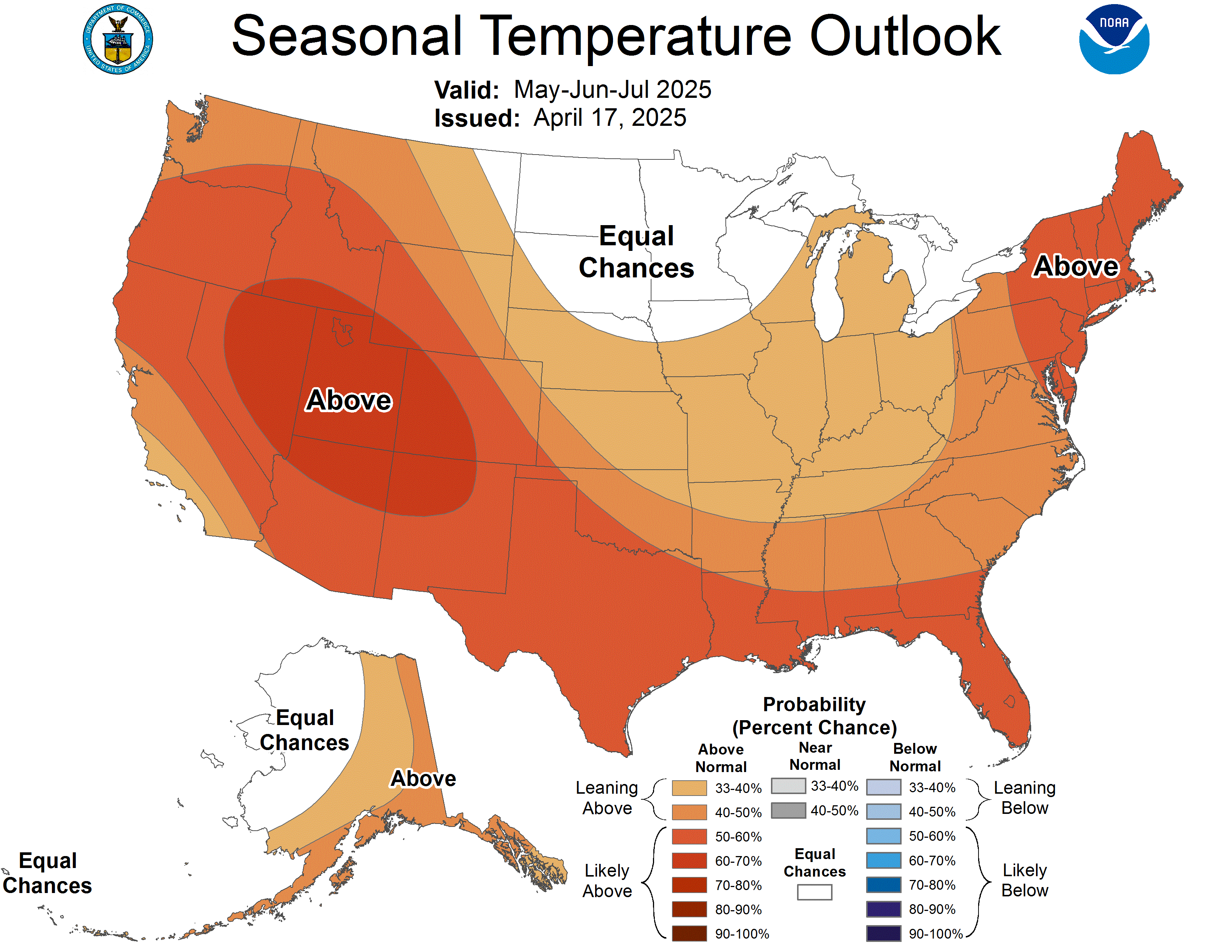
- Canadian national seasonal outlook issued -- Forecasters with Environment Canada issued their outlooks for temperature and precipitation across Canada for the three months of May, June and July of 2013, which represents the last month of meteorological spring and the first two months of meteorological summer. The temperature outlook indicates that eastern Canada, and the southern Prairie Provinces along with most of British Columbia would experience above normal (1981-2010) temperatures. Only a northwestern Canada, primarily over the Yukon and Northwest Territories, would have below average temperatures for the next three months. Elsewhere across Canada, near normal late spring and early summer temperatures were anticipated.
The Canadian precipitation outlook for May through July 2013 indicates that sections of southern Canada extending from British Columbia eastward to the Great Lakes and the Maritime Provinces could experience below average precipitation. On the other hand, scattered sections of northern Canada could have above normal precipitation for these three months.
[Note for comparisons and continuity with the three-month seasonal outlooks of temperature and precipitation generated for the continental United States and Alaska by NOAA's Climate Prediction Center, one would need to use Environment Canada's probabilistic forecasts for temperature and precipitation.]
CLIMATE AND SOCIETY
- Website for human dimensions of climate change -- An interagency effort within the US federal government that included NOAA, the Bureau of Land Management and the US Forest Service, has resulted in a website called HD.gov (for HumanDimensions.gov) that provides users, such as natural resource managers, with information on the human dimensions on a variety of topics of interest such as climate change. [HD.gov]
COMPARATIVE PLANETOLOGY
- Space probe views large hurricane on Saturn -- Scientists from NASA's Jet Propulsion Laboratory have recently released high-resolution images of a large spinning vortex in Saturn's northern polar region that resembles a hurricane on Earth. The images were obtained from NASA's Cassini spacecraft and show an eye with a diameter of 1250 miles that was surrounded by clouds circulating at speeds of approximately 330 mph. When the images were made, Saturn was entering the northern hemisphere's spring. [NASA Jet Propulsion Laboratory]
- Earthweek -- Diary of the Planet [earthweek.com] Requires Adobe Acrobat Reader.

Historical Events:
- 6 May 1933...Charleston, SC was deluged with 10.57 inches of rain, an all-time 24-hour record for that location. (The Weather Channel)
- 6 May 1978...A record late season snowstorm struck Colorado. Denver checked in with 14 inches for its greatest May snowstorm on record. (Intellicast)
- 7 May 1964...The temperature at White Mountain 2, located in California, dipped to 15 degrees below zero to set a record for May for the continental U.S. (The Weather Channel)
- 10 May 1910...A meteorograph ascent of an instrumented Weather Bureau kite to 23,835 feet from Mount Weather, VA set the altitude record for the site. The ascent, which had a kite with instruments to measure atmospheric conditions aloft, used 10 kites in tandem and 8.5 miles of kite wire. (Accord's Weather Guide Calendar)
- 10 May 1966...Morning lows of 21 degrees at Bloomington-Normal and Aurora established an Illinois state record for the month of May. Snow flurries were reported at Kansas City, MO and Chicago, IL (The Weather Channel) (Intellicast)
- 10-11 May 1986...Bangkok, Thailand received 15.79 inches of rain in 24-hours, which was a national record. (The Weather Doctor)
- 11 May 1966...The 1.6 inch-snow at Chicago, IL was their latest measurable snow of record. Previously the record was 3.7 inches on the 1stand 2nd of May set in 1940. (The Weather Channel)
- 11 May 2003...A total of 4.63 inches of rain fell at Nashville, TN, breaking the previous 24-hour record for the month. (The Weather Doctor)
- 12 May 1916...Plumb Point, Jamaica reported 17.80 inches of rain in 15 minutes, which set a world record. (The Weather Doctor)
Return to DataStreme
ECS website
Prepared by Edward J. Hopkins, Ph.D., email hopkins@meteor.wisc.edu
© Copyright, 2013, The American Meteorological Society.