Weekly Water News
WES PREVIEW WEEK: 16-20 January 2006
Water in the News:
- (Thurs.) A clash of interests occurs with river diversion
proposal -- Plans at diverting the Sao Francisco River, Brazil's third
largest river, to help alleviate the impact of a long-term drought have drawn
criticism from a variety of groups. [ENN]
- (Thurs.) Deep-rooted vegetation exert a significant impact on
climate -- Scientists at the University of California, Berkeley report that
their study of the Amazonian forest indicates that deep-rooted trees transfer
and redistribute water in the soil and atmosphere in complex ways, resulting in
a greater impact upon the regional climate than previously thought. [EurekAlert!]
- (Thurs.) Glacial fluctuations in western North America studied
-- A researcher at the University of Alberta and colleagues from other
universities have reported that their study of the fluctuations in the glaciers
located in Pacific North America occurring during the first millennium AD
indicate a greater variability in regional climate than previously thought. [EurekAlert!]
- (Tues.) A top view of an Australian "hurricane" --
An image obtained last week from the MODIS (Moderate Resolution Imaging
Spectroradiometer) sensor onboard NASA's orbiting Terra satellite captures a
view of Tropical Cyclone Clare off the Pilbara coast of West Australia; this
tropical cyclone is the Indian Ocean counterpart of a hurricane. [NASA
Earth Observatory]
- (Tues.) Water woes continue in Arizona -- Since few storms
have moved across the interior Southwest during this winter, Arizona has
received little precipitation and could experience its driest winter season in
several centuries. The lack of meaningful precipitation has caused agricultural
and water supply concerns. [USA
Today]
- (Tues.) Deployment of artificial reefs is an involved process
-- While artificial fishing reefs have been deployed in the Gulf of Mexico
for several decades to provide a habitat for fish, newer environmental concerns
and regulations necessitate increased efforts in using appropriate materials.
[ENN]
- (Tues.) Maine to regulate cruise ship wastewater discharge --
The Maine Department of Environmental Protection has implemented a permit
system that requires that wastewater discharges from cruise ships within three
miles of the Maine coast to be as clean as wastewater treated onshore. [US
Water News Online]
- Monitoring lake levels from space -- Comparison of photographs of
Egypt's Toshka Lakes region taken by NASA astronauts onboard the International
Space Station in 2005 with those on the Space Shuttle in 2001 dramatically show
a decrease in lake level. [NASA
Earth Observatory]
- Too much water in Washington State -- A persistent stormy weather
pattern has brought precipitation to the Pacific Northwest from off the eastern
Pacific Ocean on a daily basis for the last three weeks.
- Late last week, Washington State's governor and emergency management
officials inspected the mudslides and washouts across western sections of the
state that were caused by the rain. [USA
Today]
- Media attention has focused on the last four weeks when measurable rain
(0.01 inches or greater) has fallen every day on the Seattle-Tacoma
metropolitan area. While the record of consecutive days with measurable
precipitation is 33 at Seattle, a cooperative weather observer on Hawaii's Oahu
Island has recorded 247 consecutive days in 1993 and 1994. [USA
Today]
- As of Saturday, the Seattle-Tacoma metropolitan area had received 27
consecutive days of measurable rain, approaching the record of 33 consecutive
days set in 1953. The runoff is contaminated with chemicals that could cause an
environmental hazard to the areas around Puget Sound. [KOMO-TV]
- Record snow in Japan causes increased avalanche dangers -- A cold
wind cross the Sea of Japan from interior Asia has brought heavy snowfall and
cold air to sections of central and northern Japan. However, as temperatures
rise, the chance of avalanches increases. As of late last week, more than 80
people have died as a result of the record-setting snowfall. [USA
Today]
- Brazilian wetlands threatened -- A recent study by Conservation
International-Brazil claims that the current growth of cattle ranches and farms
in western Brazil could destroy the Pantanal within 50 years, which represent
the world's largest freshwater wetlands. [ENN]
- Updates on a major toxic spill -- The explosion at a chemical plant
in northeast China late in November 2005 resulted in a substantial spill of
toxic benzene into the Songhua River that flows into neighboring Russia. Recent
updates include:
- China will make $3.3 billion available to cleanup the toxic contaminants
that poisoned the Songhua River, with the goal of making the water drinkable by
2010. [ENN]
- Local officials in the Chinese city of Harbin are promoting the famous
annual ice festival that contains gigantic ice sculptures made from ice taken
from the Songhua River. [USA
Today]
- Substitute bottled water have same chemicals as tap water -- Trace
amounts of the chemicals used to make Teflon were found in bottled water
distributed to residents in southeastern Ohio as a substitute for tap water
after the same chemical had been found in the region's tap water. [ENN]
- Massive freshwater flood into ocean could have affected climate --
Researchers at the Goddard Institute for Space Studies have been using
atmosphere-ocean coupled climate models to study the climatic response to the
large pulse of freshwater that flooded into the North Atlantic from interior
North America approximately 8000 years ago, which appears to have resulted in
an abrupt change in the oceanic circulation pattern that caused the documented
change in climate. [EurekAlert!]
The change in the circulation in the North Atlantic caused by the freshwater
appears to have been responsible for a three-century cooling that resulted in a
lowering of the average temperatures by 7 Celsius degrees in Greenland and one
Celsius degree in Europe. [The New Scientist]
- Global and US Hazards/Climate Extremes -- A review and analysis of
the global impacts of various weather-related events, including drought, floods
and storms during the current month. [NCDC]
- Global Water News Watch -- Other water news sources can be obtained
through the SAHRA Project at the University of Arizona [SAHRA Project]
- Earthweek -- Diary of the Planet [earthweek.com] Requires
Adobe Acrobat Reader.

Concept of the Week: Touring the WES website
Welcome to DataStreme Water in the Earth System (WES)! You are embarking on
a unique teacher-enhancement experience that focuses on water and energy flow
in the global water cycle from an Earth system perspective. Throughout this
learning experience, you will be accessing the
DataStreme WES
website frequently to obtain and interpret a variety of environmental
information, including the latest observational data. The objective of this
initial Concept of the Week is to explore features of the DataStreme
WES website.
On Monday of each week of the course, we will post the current Weekly
Water News that includes Water in the News(a summary listing of
current events related to water), Concept of the Week (an in-depth
analysis of some topic related to water in the Earth system), and Historical
Events (a list of past hydrologic events such as major floods). When
appropriate, Supplemental Information will be provided on some topic
related to the principal theme of the week.
You will use the DataStreme WES website to access and download the
second part of weekly Investigations A & B (plus supporting images) that
begin in your DataStreme WES Investigations Manual. These materials
should be available by noon (Eastern Time) on Tuesday and Thursday. Click the
appropriate buttons to download and print these electronic components of the
investigations as well as your Chapter Progress and Investigations Response
forms.
The body of the DataStreme WES website provides links to the Earth
System, Atmospheric, Oceanic (Inland Seas), and Terrestrial Information, and
extras--glossaries of terms, maps, educational links, and WES information.
Following each section is a link to other sites that examine the various
subsystems of the Earth system. Let's take a quick tour to become more familiar
with the WES website.
Under Atmospheric Information, click on
Water vapor
(WV) Satellite. This is the latest satellite depiction of atmospheric
water vapor at altitudes generally between 3000 and 7000 m (10,000 to 24,000
ft). Press your "back" button and then click on
Latest
WV Animation to view the movement of water vapor and clouds in the
atmosphere. Although water vapor is an invisible gas, satellite technology
makes it possible for us to "see" and follow the flow of water vapor
in the atmosphere as part of the global water cycle. Bright white blotches are
clouds; black indicates areas of very little or no water vapor and, at the
other extreme, milky white signals a relatively high concentration of water
vapor. Use the "back" button on your viewer to return to the
DataStreme WES website.
The flow and transformations of energy are fundamental aspects of the global
water cycle. Heat flows within the Earth system from where it is warmer to
where it is colder. In this regard, it is useful to monitor temperatures
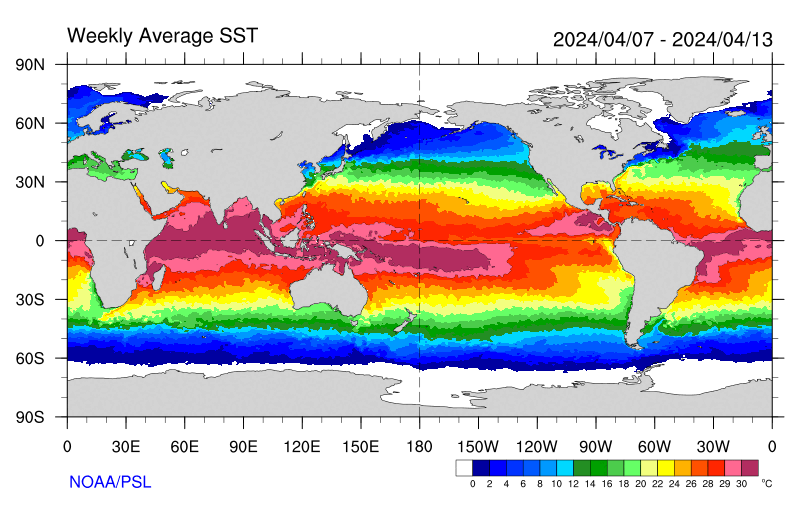
remotely, by satellite. For a global view of the satellite-derived pattern of
sea-surface temperatures, click on
Sea Surface
Temperatures under Oceanic (and Inland Seas) Information.
Note that the color scale at the bottom is in degrees Celsius and temperatures
are averaged over a 7-day period. (Depending on your browser, you may have to
place your mouse cursor on the slide bar to the right and scroll down to view
the entire image.) Return to the DataStreme WES website.
As part of the global water cycle, precipitation that reaches the ground
vaporizes back into the atmosphere, runs off into rivers and streams, seeps
into the ground, or is stored in lakes or glaciers. Under Terrestrial
Information, click on
River
Flood Conditions for the recent status of river levels monitored at
various gauging stations around the nation. Note that in the Map Legend, river
stage heights are compared to flood stage values. Now return to the
DataStreme WES website.
Extras include color photographs arranged by week (chapter) to
supplement your study of the DataStreme WES textbook. For example, click on
Chapter 1
and then click on the first thumbnail for an enlarged image with the caption,
"Water in Three Phases."
Take a few minutes when you have time to browse the other data and
information sources available via the DataStreme WES website. You may
want to "bookmark" this page on your computer. Return frequently to
get into the flow of DataStreme WES!
Concept of the Week: Questions
- The latest WV Animation indicates that clouds and water vapor generally
move from [(west to east)(east to west)] across the
nation.
- In the tropical Pacific, the highest sea-surface temperatures occur in the
[(western)(eastern)] portion of the ocean basin.
Historical Events
- 16 January 1831...A great snowstorm raged from Georgia to Maine. Snowfall
totals greater than 30 inches were reported from Pennsylvania across southern
New England. (David Ludlum)
- 16-17 January 1987...A winter storm spread snow from the Southern Rockies
into the Middle Mississippi Valley and southwestern sections of the Great Lakes
Region. A total of 61 inches of snow was reported at Rye CO and wind gusts to
100 mph in Utah. As the storm moved across the southern Plains, Tulia, TX
received 16 inches of snow, up to 14 inches were reported in western Oklahoma
and 12 inches fell at Wellington, KS. The storm also produced freezing rain
across Texas and Oklahoma. (National Weather Summary) (Storm Data)
- 16 January 1988...A small storm in the western U.S. produced a foot of snow
and wind gusts to 70 mph in the Lake Tahoe Basin of Nevada. Showers and
thunderstorms produced 2.28 inches of rain at Brownsville TX, their third
highest total for any day in January. (National Weather Summary) (Storm Data)
- 16 January 1990...Heavy snow fell across the Prince Williams Sound area and
the Susitna Valley of southern Alaska. Valdez was buried under 64.9 inches of
snow in less than two days, including a record 47.5 inches in 24 hours. Up to
44 inches of snow was reported in the Susitna Valley. The heavy snow blocked
roads, closed schools, and sank half a dozen vessels in the harbor. (Storm
Data)
- 17 January 1972...A single storm unloaded 77.5 inches of snow at Summit, MT
to establish a state record. (The Weather Channel)
- 18-22 January 1978...The Atlantic's first-ever January subtropical storm
with tropical characteristics since records began in 1871 organized 1500 miles
east-northeast of Puerto Rico. The storm finally dissipated on the 22nd
approximately 200 miles north of Puerto Rico. (Accord's Weather Calendar)
- 19 January 1996...The tug Scandia and its barge, the North
Cape, ran aground on the shore of Rhode Island, spilling 828,000 gallons of
oil, resulting in the worst spill in that state's history. The Coast Guard
rescued the entire crew, pumped off 1.5 million gallons of oil and conducted
skimming operations. (USCG Historian's Office)
- 20 January 1493...Streets in Florence, Italy were blocked by snow and
violent winds as a blizzard struck the city. (The Weather Doctor)
- 20 January 1606...As many as 2000 people died around the Severn Estuary in
England as the result of severe flooding. (The Weather Doctor)
- 21 January 1863...A severe coastal storm dropped heavy rain on the
Fredericksburg area of Virginia. It disrupted a Union Army offensive in an ill
famed "mud march." (David Ludlum)
- 21 January 1880...Memphis, TN began construction of the first independent
municipal sewage system in the U.S. (Today in Science)
- 22-23 January 1943...Hoegees Camp, at an elevation of 2760 feet in the San
Gabriel Mountains of southern California, received 26.12 inches of
precipitation in a 24-hour span, setting the Golden State's 24-hour
precipitation record. (Accord's Weather Calendar)
Return to DataStreme WES website
Prepared by WES Central Staff and Edward J. Hopkins, Ph.D.,
email hopkins@meteor.wisc.edu
© Copyright, 2006, The American Meteorological Society.