Weekly Water News
DATASTREME WES WEEK ONE: 23-27 January 2006
Water in the News:
- (Thurs.) New software to may help protect drinking water --
A computer program called ICWater developed at the US Forest Service's Pacific
Northwest Research Station is designed to help incident commanders from various
federal agencies to access information from a variety of sources and make
decisions meant to protect the nation's drinking water from chemical or
biological contaminants following accidental or intentional acts. [EurekAlert!]
- (Thurs.) Seeking help advised in water crises -- The editors
of a book to be published by the United Nations University Press argue that
water management could be improved if governments got their citizens more
involved in the problem-solving and decision-making aspects of the management
process. [EurekAlert!]
- (Thurs.) Changes documented in African lakes -- NASA has
released a pair of satellite images taken of the wetlands of Tunisia nearly
four years apart that show changes in the lake level and the aquatic vegetation
of Ichkeul National Park, a World Heritage site, due to the construction of
dams on the lake's tributaries. [NASA
Earth Observatory]
- (Tues.) Monitoring glaciers from space -- Sensors onboard
several of NASA's orbiting satellites have provided detailed data on glaciers
to permit assessment:
- A sequence of images obtained from the Advanced Spaceborne Thermal Emission
and Reflection Radiometer onboard NASA's Terra satellite over a two-year span
shows the retreat of the Helheim Glacier in Greenland. [NASA
Earth Observatory]
- Two images made with different contrasts of the Byrd Glacier in Antarctica
shows crevasses on the glacier's surface. These images are part of the 260
detailed images of Antarctica made by the Moderate Resolution Imaging
Spectroradiometer (MODIS) sensors onboard NASA's orbiting Terra and Aqua
satellites that have been archived in The MODIS Mosaic of Antarctica. [NASA
Earth Observatory]
- (Tues.) Too little ice for fishing -- The unseasonably warm
stretch of weather across much of the nation during the last month has meant
that the ice has either not formed or is too thin on northern-tier states. Not
all of Lake Champlain, located between Vermont and New York State, has frozen
over, meaning businesses that count on ice fishing and other cold weather
sports could be hurt financially. [USA
Today]
- (Tues.) Hazard mitigation could be cost-effective -- A
researcher at Pennsylvania State University who led a team for the National
Institute of Building Sciences claims that for every dollar spent to mitigate
the effects associated with such natural hazards such as hurricanes and
flooding, four dollars would not be needed in the future to repair the damages
or compensate for losses from subsequent disasters. [EurekAlert!]
- (Tues.) Desert conditions continue across the Southwest --
The current persistent weather pattern has brought meager amounts of
precipitation to the Southwest. Flagstaff, AZ has only recently received the
first measurable snow (0.1 inches or greater) of the season, marking the latest
date of such an occurrence on record. In Phoenix, no measurable rain (0.01
inches or greater) has fallen since 18 October 2005, resulting in a stretch of
95 days without measurable precipitation, exceeded only by a 101-day record in
1999. [USA
Today]
- Sea surface height changes could signal La Niña conditions --
Measurements of the sea surface height to within centimeters obtained from
the US-French Jason satellite have shown a gradual cooling of the eastern
equatorial Pacific late last year, consistent with the development of a weak La
Niña episode. A La Niña is an anomalous atmospheric and oceanic
circulation regime that can affect the weather around the planet. [NASA
Earth Observatory]
- Geosynchronous satellite to be moved -- Last week, the U.S.
National Oceanic and Atmospheric Administration (NOAA), the Argentina
Comisión Nacional de Activades Espaciales and the World Meteorological
Organization announced that NOAA's Geostationary Operational Environmental
Satellite (GOES)-10 will be repositioned in October pending the launch of
GOES-N in order to provide satellite coverage over South America. [NOAA News]
- Wilma was a record setter -- Scientists with the National Hurricane
Center released their report of Hurricane Wilma early last week, which adjusted
the strength of last fall's Hurricane Wilma. Although Wilma appears to have
made landfall slightly weaker than previously thought, the scientists
determined that it was the most powerful hurricane that has been recorded in
the North Atlantic basin in over 150 years, based on the lowest minimum central
pressure (882 millibars or 26.04 inches of mercury) and strongest maximum
sustained wind speeds (185 mph). [USA
Today] The complete Wilma
report from
the National Hurricane Center is available in pdf format.
- Oregon is becoming soggy -- A persistent weather pattern has
brought a series of storms to the Pacific Northwest, with Oregon receiving
flooding rain, high winds and high surf. Oregon's governor has declared
disaster in 24 counties of his state because of floods, mudslides and strong
winds. The exact cause for the weather pattern has been the source of debate.
[USA
Today]
- A review of December -- Scientists at the National Climatic Data
Center reviewed the temperature and precipitation patterns across the nation
and the world during the recently concluded month of December 2005. They report
that since much of the nation experienced a month that had extremes, ranging
from a record cold start to record warmth at the end of the month, the
nationwide average temperature for the month was nearly identical to the
long-term average temperature, spanning a 111-year period of record. California
and Nevada experienced much above average statewide December temperatures,
while the Pacific Northwest and the southeastern quadrant of the nation
reported below average temperatures for the month. While precipitation for the
month was close to the 1895-2004 average when averaged nationwide, the West
Coast states, the northern Plains and some of the states along the Eastern
Seaboard experienced precipitation amounts that were above to much above
average. However, the southern Plains and the interior Southwest had below
average precipitation totals, with Arizona and Arkansas having their driest
December on record. Expanding to a global view, the scientists determined that
December 2005 appears to be the ninth warmest on record for global average
temperatures that extends back to 1880. [NOAA News]
- Balloons to help study clouds -- A scientists from 10 countries
participating in the Tropical Warm Pool International Cloud Experiment in
Darwin, Australia will release 1000 weather balloons during the next month in
an effort to study the generation and dissipation of cirrus-type clouds in the
tropics that form at altitudes higher than 20,000 ft. [ENN]
- TIGER Innovators Project fosters water management -- Five
international partnerships have been developed as part of the European Space
Agency's TIGER Innovators Project that would use data obtained by the agency's
satellites to help water resource management in Africa. [ESA]
- Project begins to restore river water -- A $29 million project has
commenced to send water into California's Owens River and surrounding wetlands
that had essentially dried up during the last century when an aqueduct was
built to divert river water for use by the Los Angeles metropolitan area. [US Water
News Online]
- Future impact of landslides studied -- In a meeting last week,
scientists from the International Consortium on Landslides, United Nations
University, Kyoto University and UNESCO warned that increased rainfall
intensity associated with increased numbers and intensities of storms due to
climate change could contribute to more and deadlier landslides. [EurekAlert!]
- Anthropogenic haze affects the water cycle -- Scientists at the
Pacific Northwest National Laboratory who have been studying the 50-year cloud
record in China report that while the number of cloudy days appears to have
declined, the increased amount of haze generated by human activity has reduced
the sunshine. The reduced sunshine due to the haze appears to have contributed
to lower evaporation rates at the Earth's surface. [EurekAlert!]
- Global and US Hazards/Climate Extremes -- A review and analysis of
the global impacts of various weather-related events, including drought, floods
and storms during the current month. [NCDC]
- Global Water News Watch -- Other water news sources can be obtained
through the SAHRA Project at the University of Arizona [SAHRA Project]
- Earthweek -- Diary of the Planet [earthweek.com] Requires
Adobe Acrobat Reader.

Concept of the Week: Touring the WES Homepage
NOTE: This Concept for the Week is a repeat of that which appeared in
last week's Weekly Water News.
Welcome to DataStreme Water in the Earth System (WES)! You are embarking on
a unique teacher-enhancement experience that focuses on water and energy flow
in the global water cycle from an Earth system perspective. Throughout this
learning experience, you will be accessing the
DataStreme WES
website frequently to obtain and interpret a variety of environmental
information, including the latest observational data. The objective of this
initial Concept of the Week is to explore features of the DataStreme
WES website.
On Monday of each week of the course, we will post the current Weekly
Water News that includes Water in the News (a summary listing of
current events related to water), Concept of the Week (an in-depth
analysis of some topic related to water in the Earth system), and Historical
Events (a list of past hydrologic events such as major floods). When
appropriate, Supplemental Information will be provided on some topic
related to the principal theme of the week.
You will use the DataStreme WES website to access and download the
second part of weekly Investigations A & B (plus supporting images) that
begin in your DataStreme WES Investigations Manual. These materials
should be available by noon (Eastern Time) on Tuesday and Thursday. Click the
appropriate buttons to download and print these electronic components of the
investigations as well as your Chapter Progress and Investigations Response
forms.
The body of the DataStreme WES website provides links to the Earth
System, Atmospheric, Oceanic (Inland Seas), and Terrestrial Information, and
extras--glossaries of terms, maps, educational links, and WES information.
Following each section is a link to other sites that examine the various
subsystems of the Earth system. Let's take a quick tour to become more familiar
with the WES website.
Under Atmospheric Information, click on
Water vapor
(WV) Satellite. This is the latest satellite depiction of atmospheric
water vapor at altitudes generally between 3000 and 7000 m (10,000 to 24,000
ft). Press your "back" button and then click on
Latest
WV Animation to view the movement of water vapor and clouds in the
atmosphere. Although water vapor is an invisible gas, satellite technology
makes it possible for us to "see" and follow the flow of water vapor
in the atmosphere as part of the global water cycle. Bright white blotches are
clouds; black indicates areas of very little or no water vapor and, at the
other extreme, milky white signals a relatively high concentration of water
vapor. Use the "back" button on your viewer to return to the
DataStreme WES website.
The flow and transformations of energy are fundamental aspects of the global
water cycle. Heat flows within the Earth system from where it is warmer to
where it is colder. In this regard, it is useful to monitor temperatures
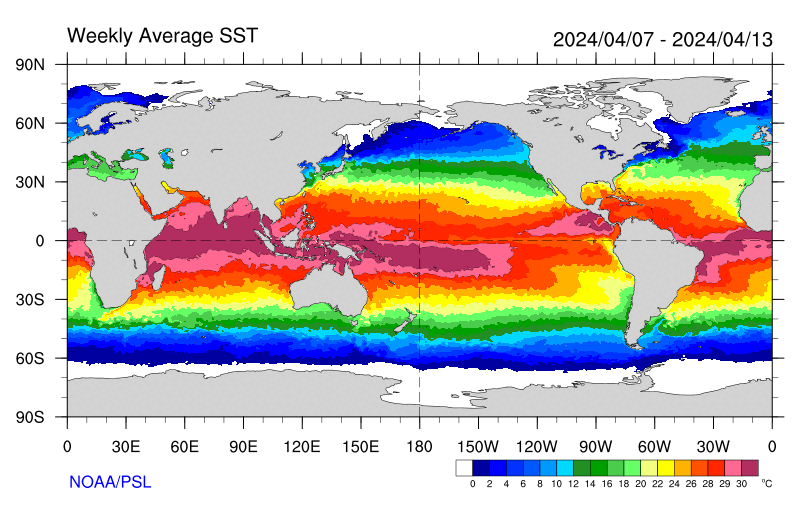
remotely, by satellite. For a global view of the satellite-derived pattern of
sea-surface temperatures, click on
Sea Surface
Temperatures under Oceanic (and Inland Seas) Information.
Note that the color scale at the bottom is in degrees Celsius and temperatures
are averaged over a 7-day period. (Depending on your browser, you may have to
place your mouse cursor on the slide bar to the right and scroll down to view
the entire image.) Return to the DataStreme WES website.
As part of the global water cycle, precipitation that reaches the ground
vaporizes back into the atmosphere, runs off into rivers and streams, seeps
into the ground, or is stored in lakes or glaciers. Under Terrestrial
Information, click on
River
Flood Conditions for the recent status of river levels monitored at
various gauging stations around the nation. Note that in the Map Legend, river
stage heights are compared to flood stage values. Now return to the
DataStreme WES website.
Extras include color photographs arranged by week (chapter) to
supplement your study of the DataStreme WES textbook. For example, click on
Chapter 1
and then click on the first thumbnail for an enlarged image with the caption,
"Water in Three Phases."
Take a few minutes when you have time to browse the other data and
information sources available via the WES website. You may want to
"bookmark" this page on your computer. Return frequently to get into
the flow of DataStreme WES!
Concept of the Week: Questions
- The latest WV Animation indicates that clouds and water vapor generally
move from [(west to east)(east to west)] across the
nation.
- In the tropical Pacific, the highest sea-surface temperatures occur in the
[(western)(eastern)] portion of the ocean basin.
Historical Events
- 24 January 1881...Freezing rain over three days coated trees, fences,
telegraph wires and buildings at Pictou, Nova Scotia. Lumberjacks remained
close to camp for fear of falling trees and branches. (The Weather Doctor)
- 24 January 1956...Thirty-eight inches of rain deluged the Kilauea Sugar
Plantation of Hawaii in 24 hours, including twelve inches in just one hour. The
38.00 inches remains the Aloha State's 24-hour maximum precipitation record.
(David Ludlum)
- 25 January 1945...Grand Rapids MI became the first US city to fluoridate
its water.
- 25 January 1965...Alta, UT was in the midst of a storm that left the town
buried under 105 inches of snow establishing a record for the state. (David
Ludlum)
- 25 January 1987...The second major storm in three days hit the Eastern
Seaboard producing up to 15 inches of snow in Virginia, Maryland and Delaware.
Up to 30 inches of snow covered the ground in Virginia following the two
storms. (National Weather Summary) (Storm Data)
- 26 January 1937...Flooding occurred along the Ohio River from Pittsburgh,
PA to Cairo, IL. The river was 80 feet above flood stage at Cincinnati, Ohio.
(Intellicast)
- 26 January 1983...The California coast was battered by a storm, which
produced record high tides, thirty-two foot waves, and mudslides, causing
millions of dollars in damage. The storm then moved east and dumped four feet
of snow on Lake Tahoe. (22nd-29th) (The Weather Channel)
- 27 January 1966...Oswego NY was in the midst of a five-day lake effect
storm that left the town buried under 102 inches of snow. (David Ludlum)
- 28 January 1883...Snowflakes "larger than milkpans" reportedly
fell at Fort Keogh near Miles City, MT. The snowflakes, measuring 15 inches
across and 8 inches in thickness, made patches of white on the fields within an
area of several square miles. (Accord's Weather Guide Calendar)
- 28 January 1969...A series of storms that battered Southern California from
the 18th to the 28th led to $125 million damage in the
Los Angeles Basin, along with approximately 9 storm and traffic-related deaths
in California. Twenty feet of water covered Sherman Island, a region that
contains more than 10,000 dike-protected agricultural acres, when a dike
failed. (Accord's Weather Guide Calendar)
- 28 January 1971...A waterspout swept into Hawaii's Kailua Bay, then into
the business and hotel district of Kailua-Kona, destroying or severely damaging
a number of buildings including 40 apartment units and collapsing a 6-story
hotel under construction. Amazingly, only four people were injured. (Accord's
Weather Guide Calendar)
- 29-30 January 1966...A hurricane that struck Samoa was responsible for 50
deaths, destroyed more than one-third of the homes and damaged the remainder.
As many as 50,000 people were left homeless. Swains Island was leveled by the
hurricane. Winds gusted to 100 mph at Pago Pago. (Accord's Weather Guide
Calendar)
- 29 January 1983...A series of Pacific coast storms finally came to an end.
The storms, attributed in part to the anomalous ocean-atmosphere phenomenon,
"El Niño," produced ocean swells 15 to 20 feet high that
ravaged the beaches of southern California. Much of the damage was to homes of
movie stars in the exclusive Malibu Colony. (The Weather Channel)
- 29 January 1993...Africa's worst weather-related disaster during 1993
occurred as rains produced floods across the southeast lowlands of Kenya. A
railroad bridge across the swollen Ngai Nedithya River collapsed as a train
crossed, causing 104 deaths. (Accord's Weather Guide Calendar)
Return to DataStreme WES website
Prepared by WES Central Staff and Edward J. Hopkins, Ph.D.,
email hopkins@meteor.wisc.edu
© Copyright, 2006, The American Meteorological Society.