Weekly Water News
DATASTREME WES WEEK ONE: 22-26 January 2007
Water in the News:
- (Thurs.) Keeping tabs on an active volcano -- An image
obtained from the ASTER (Advanced Spaceborne Thermal Emission and Reflection
Radiometer) sensor on NASA’s Terra satellite reveals the heat emitted from
the Karymsky volcano and associated steam plume on Russia's Kamchatka Peninsula
in December 2006. [NASA
Earth Observatory]
- (Thurs.) Mud flood displaces villagers -- A fissure in East
Java has been spewing water and mud creating a flood that displaced thousands
of Indonesian villagers. British scientists believe the fissure was caused by
oil drilling. The Indonesian government denies that claim. [BBC News]
- (Thurs.) A sobering view of the Big Easy -- A photograph
taken by an astronaut on the International Space Station shows a view of the
New Orleans (LA) metropolitan area and neighboring Lake Pontchartrain that
could pose a problem for the Big Easy, which is slowly subsiding below sea
level. In 2005, Hurricane Katrina showed the vulnerability of this city. [NASA
Earth Observatory]
- (Thurs.) Earth appears as speck from Saturn -- An image
created from several sensors onboard the Cassini spacecraft that passed the
Planet Saturn last fall shows Planet Earth as a mere speck. [NASA
Earth Observatory]
- (Thurs.) Coordinating time with GPS and the Web --
International cooperation in time coordination across the North and South
American continents has been created through the time and frequency network of
the Inter-American Metrology System (Sistema Interamericano de Metrologia),
which began operation in 2005 as a low cost system employing GPS satellites and
the Internet. [EurekAlert!]
- (Tues.) 2006 Atlantic hurricane season near "normal" --
NASA and NOAA meteorologists and hurricane specialists are continuing
their research into explaining why the activity during the recently-concluded
2006 hurricane season in the North Atlantic basin turned out to be near the
long term average after they had forecasted another above average season. These
researchers are utilizing a wide variety of environmental data, such as sea
surface temperatures, tropical rainfall rates, atmospheric dust loading and
winds at various atmospheric levels, collected by instruments on the fleet of
NASA and NOAA satellites. [NASA
Earth Observatory] More images and other links appear on a separate NASA
Mission site. [NASA]
- (Tues.) Runoff into Big Mo reservoirs during 2006 well below
average -- The US Army Corps of Engineers reported that the continued
drought across the northern Plains has meant that runoff into the Corp's system
of Missouri River reservoirs in Montana and the Dakotas has been less than
three-quarters of what is considered normal. [US Water
News Online]
- (Tues.) Bombarding effect of raindrops on soil erosion studied --
A research team including scientists from Arizona State University and
Vanderbilt University has been running controlled experiments involving
raindrops hitting soil. These experiments include high-speed photography that
captures the splattering of the soil upon impact of the raindrops. [EurekAlert!]
- (Tues.) Skin affected by winter dryness -- Dermatologists
claim that many Americans suffer from dry and irritated skin during the winter
because of warm and dry indoor environments along with the use of harsh soaps
and even a variety of medications, such those used for hypertension or
depression. They also caution that despite low sun angles and short daylight
duration, sunscreens should still be used to prevent skin cancer, age spots and
wrinkling. [USA
Today]
- (Tues.) Evidence of climatic change found in Arctic mud --
Geologists from the University at Buffalo who have reconstructed past climates
from Arctic mud cores on Canada's Baffin Island have found that the temperature
signal in the Arctic has a greater amplitude during the last 10,000 years than
comparable records elsewhere. [University
at Buffalo]
- Winter storm cripples nation's midsection -- A major winter storm
moved across the US last week bringing a variety of weather, including snow,
ice pellets (or sleet), freezing rain and torrential rain. While warm air was
brought northward ahead of the eastward moving system, unseasonably cold air
was brought southward behind the storm. By the end of the week, at least 66
deaths in nine states were attributed to the storm and many customers remained
without electricity. [USA
Today] An image generated by the MODIS (Moderate Resolution Imaging
Spectroradiometer) sensor on NASA's Aqua satellite shows the snow cover across
the country along with clouds associated with the storm. [NASA
Earth Observatory] A similar image was obtained early last week from the
MODIS instrument on NASA's Terra satellite. [NOAA OSEI]
- Deadly storm hits Europe -- At least 47 people were killed last week
in Europe as a powerful winter storm moved across "the Continent."
[USA
Today] A visible image obtained late last week from the MODIS sensor
onboard NASA's Aqua satellite shows the cloud shield associated with this
system across Europe, along with peak near-surface wind gust observations
obtained at weather stations across the affected region. [NOAA
OSEI]
- Glacial sediments seen entering Gulf of Alaska -- An image obtained
recently from the MODIS instrument on NASA's Aqua satellite reveals a variety
of colors in the near surface waters of the Gulf of Alaska, including the
swirling plume of glacial sediments that was carried into the Gulf from the
Copper River in southeast Alaska. [NASA
Earth Observatory]
- Deadly Brazilian flooding monitored from space -- Researchers at
the NASA Goddard Space Flight Center have been collecting data from the
Agency's Tropical Rainfall Measuring Mission (TRMM) satellite and analyzing the
data using Goddard's Multi-satellite Precipitation Analysis program to monitor
the torrential rains along the coast of Brazil during the first half of January
2007 that resulted in at least 50 fatalities in southeastern Brazil due to
flooding and mudslides. [NASA
Earth Observatory]
- Could El Niño be fading? -- The director of NOAA's National
Centers for Environmental Prediction recently reported that the current
atmospheric conditions that scientists have identified as an "El
Niño pattern" appear to be fading and that some of its impacts upon
the weather across North American may be abating. However, climate scientists
caution that this assessment needs more study. [USA
Today]
- Selecting a homeport for nation's ocean exploration ship -- As part
of an environmental assessment process, National Oceanic and Atmospheric
Administration (NOAA) officials are evaluating Rhode Island's Quonset
Point/Davisville as the homeport for the Okeanos Explorer, the
nation’s first federal ship dedicated solely to ocean exploration. [NOAA News]
- Fish-kill mystery unraveled -- Researchers at the NOAA Hollings
Marine Laboratory have discovered that an algae species that is usually
inoffensive can suddenly produce a lethal toxin which is linked to mass fish
kills in coastal waters along the East Coast. [EurekAlert!]
These results provide some vindication for a researcher at North Carolina State
University who had earlier claimed that a toxic marine microbe was responsible
for the fish kill. [US Water
News Online]
- Station relocation impacts a city's climate record -- A
climatologist with California State University, Los Angeles and a colleague at
NASA's Jet Propulsion Laboratory have been assessing the discontinuity in the
climate record due to the relocation of the official Downtown Los Angeles (CA)
climate station from the Civic Center location to the University of Southern
California in July 1999. Although the relocation covered a horizontal distance
of nearly four miles and a 90-foot change in elevation, these researchers found
that the move has resulted in climate records that are cooler, drier and less
extreme at USC than at the previous Civic Center location. They conclude that
such a move, like those in many other locales, would bias long-term climate
studies. (Editor's Note: One of the study's co-authors, Dr. Steve
LaDochy, is a valued and long-time associate of the AMS Education Initiative.
EJH) [NASA
Earth Observatory]
- Offshore wind power farms supported -- A survey of Delaware
residents conducted by researchers at the University of Delaware indicates that
the construction of offshore wind power farms to serve as a future energy
source for the state is favored by a majority of respondents. [University of
Delaware]
- Global and US Hazards/Climate Extremes -- A review and analysis of
the global impacts of various weather-related events, including drought, floods
and storms during the current month. [NCDC]
- Global Water News Watch -- Other water news sources can be obtained
through the SAHRA Project at the University of Arizona [SAHRA Project]
- Earthweek -- Diary of the Planet [earthweek.com] Requires
Adobe Acrobat Reader.

Concept of the Week: Touring the DataStreme WES Homepage
NOTE: This Concept for the Week is a repeat of that which appeared in
last week's Weekly Water News.
Welcome to DataStreme Water in the Earth System (WES)! You are embarking on
a unique teacher-enhancement experience that focuses on water and energy flow
in the global water cycle from an Earth system perspective. Throughout this
learning experience, you will be accessing the
DataStreme WES
website frequently to obtain and interpret a variety of environmental
information, including the latest observational data. The objective of this
initial Concept of the Week is to explore features of the DataStreme
WES website.
On Monday of each week of the course, we will post the current Weekly
Water News that includes Water in the News (a summary listing of
current events related to water), Concept of the Week (an in-depth
analysis of some topic related to water in the Earth system), and Historical
Events (a list of past hydrologic events such as major floods). When
appropriate, Supplemental Information will be provided on some topic
related to the principal theme of the week.
You will use the DataStreme WES website to access and download the
second part of weekly Investigations A & B (plus supporting images) that
begin in your DataStreme WES Investigations Manual. These materials
should be available by noon (Eastern Time) on Tuesday and Thursday. Click the
appropriate buttons to download and print these electronic components of the
investigations as well as your Chapter Progress and Investigations Response
forms.
The body of the DataStreme WES website provides links to the Earth
System, Atmospheric, Oceanic (Inland Seas), and Terrestrial Information, and
extras--glossaries of terms, maps, educational links, and WES information.
Following each section is a link to other sites that examine the various
subsystems of the Earth system. Let's take a quick tour to become more familiar
with the WES website.
Under Atmospheric Information, click on
Water vapor
(WV) Satellite. This is the latest satellite depiction of atmospheric
water vapor at altitudes generally between 3000 and 7000 m (10,000 to 24,000
ft). Press your "back" button and then click on
Latest
WV Animation to view the movement of water vapor and clouds in the
atmosphere. Although water vapor is an invisible gas, satellite technology
makes it possible for us to "see" and follow the flow of water vapor
in the atmosphere as part of the global water cycle. Bright white blotches are
clouds; black indicates areas of very little or no water vapor and, at the
other extreme, milky white signals a relatively high concentration of water
vapor. Use the "back" button on your viewer to return to the
DataStreme WES website.
The flow and transformations of energy are fundamental aspects of the global
water cycle. Heat flows within the Earth system from warmer to colder regions.
In this regard, it is useful to monitor temperatures remotely, by satellite.
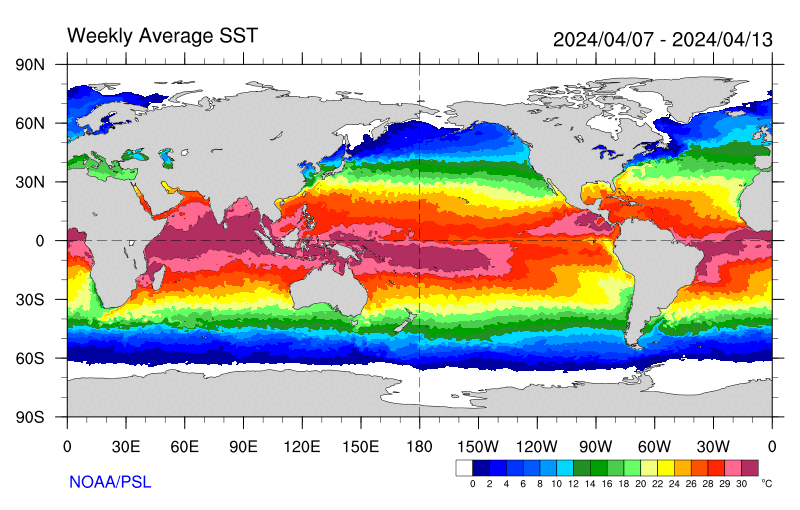
For a global view of the satellite-derived pattern of sea-surface temperatures,
click on Sea
Surface Temperatures under Oceanic (and Inland Seas)
Information. Note that the color scale at the bottom is in degrees Celsius
and temperatures are averaged over a 7-day period. (Depending on your browser,
you may have to place your mouse cursor on the slide bar to the right and
scroll down to view the entire image.) Return to the DataStreme WES
website.
As part of the global water cycle, precipitation that reaches the ground
vaporizes back into the atmosphere, runs off into rivers and streams, seeps
into the ground, or is stored in lakes or glaciers. Under Terrestrial
Information, click on National Streamflow for the
recent status of streamflow monitored at various US Geological Survey gauging
stations around the nation. Note that in the Map Legend, the current streamflow
is compared to the percentiles of daily streamflow for the given day of the
year based upon a historic data set for the station stretching back at least 30
years. Now return to the DataStreme WES website.
Extras include color photographs arranged by week (chapter) to
supplement your study of the DataStreme WES textbook. For example, click on
Chapter 1
and then click on the first thumbnail for an enlarged image with the caption,
"Water in Three Phases."
Take a few minutes when you have time to browse the other data and
information sources available via the DataStreme WES website. You may
want to "bookmark" this page on your computer. Return frequently to
get into the flow of DataStreme WES!
Concept of the Week: Questions
- The latest WV Animation indicates that clouds and water vapor generally
move from [(west to east)(east to west)] across the
nation.
- In the tropical Pacific, the highest sea-surface temperatures occur in the
[(western)(eastern)] portion of the ocean basin.
Historical Events
- 22-23 January 1943...Hoegees Camp, at an elevation of 2760 feet in the San
Gabriel Mountains of southern California, received 26.12 inches of
precipitation in a 24-hour span, setting the Golden State's 24-hour
precipitation record. (Accord's Weather Guide Calendar)
- 24 January 1881...Freezing rain over three days coated trees, fences,
telegraph wires and buildings at Pictou, Nova Scotia. Lumberjacks remained
close to camp for fear of falling trees and branches. (The Weather Doctor)
- 24 January 1956...Thirty-eight inches of rain deluged the Kilauea Sugar
Plantation of Hawaii in 24 hours, including twelve inches in just one hour. The
38.00 inches remains the Aloha State's 24-hour maximum precipitation record.
(David Ludlum)
- 25 January 1945...Grand Rapids MI became the first US city to fluoridate
its water.
- 25 January 1965...Alta, UT was in the midst of a storm that left the town
buried under 105 inches of snow establishing a record for the state. (David
Ludlum)
- 25 January 1987...The second major storm in three days hit the Eastern
Seaboard producing up to 15 inches of snow in Virginia, Maryland and Delaware.
Up to 30 inches of snow covered the ground in Virginia following the two
storms. (National Weather Summary) (Storm Data)
- 26 January 1937...Flooding occurred along the Ohio River from Pittsburgh,
PA to Cairo, IL. The river was 80 feet above flood stage at Cincinnati, Ohio.
(Intellicast)
- 26 January 1983...The California coast was battered by a storm, which
produced record high tides, thirty-two foot waves, and mudslides, causing
millions of dollars in damage. The storm then moved east and dumped four feet
of snow on Lake Tahoe. (22nd-29th) (The Weather Channel)
- 27 January 1966...Oswego NY was in the midst of a five-day lake effect
storm that left the town buried under 102 inches of snow. (David Ludlum)
- 28 January 1883...Snowflakes "larger than milkpans" reportedly
fell at Fort Keogh near Miles City, MT. The snowflakes, measuring 15 inches
across and 8 inches in thickness, made patches of white on the fields within an
area of several square miles. (Accord's Weather Guide Calendar)
- 28 January 1969...A series of storms that battered Southern California from
the 18th to the 28th led to $125 million damage in the
Los Angeles Basin, along with approximately 9 storm and traffic-related deaths
in California. Twenty feet of water covered Sherman Island, a region that
contains more than 10,000 dike-protected agricultural acres, when a dike
failed. (Accord's Weather Guide Calendar)
- 28 January 1971...A waterspout swept into Hawaii's Kailua Bay, then into
the business and hotel district of Kailua-Kona, destroying or severely damaging
a number of buildings including 40 apartment units and collapsing a 6-story
hotel under construction. Amazingly, only four people were injured. (Accord's
Weather Guide Calendar)
Return to DataStreme WES website
Prepared by WES Central Staff and Edward J. Hopkins, Ph.D.,
email hopkins@meteor.wisc.edu
© Copyright, 2007, The American Meteorological Society.