Weekly Water News
DATASTREME WES WEEK ONE: 21-25 January 2008
Water in the News:
- (Thurs.) Tsunami research highlighted -- Researchers at
NASA's Jet Propulsion Laboratory studying tsunamis have discovered a new method
involving the use of NASA's network of global positioning system (GPS)
stations that they claim will significantly improve existing tsunami warning
systems. [NASA
Earth Observatory]
- (Thurs.) Martian ice clouds affect the Red Planet's surface --
Scientists studying the data collected by the OMEGA Visible and Infrared
Mineralogical Mapping Spectrometer and SPICAM Ultraviolet and Infrared
Atmospheric Spectrometer instruments on the European Space Agency’s Mars
Express have shown that clouds composed of water ice and carbon dioxide ice in
the Martian atmosphere are sufficiently dense to cast a shadow upon the
surface, thereby affecting the surface energy budget. [ESA]
- (Thurs.) Water demands in Tarheel State studied -- State
environmental leaders in North Carolina have been studying the increased
demands placed upon the states limited water resources by a rapidly expanding
population. [US Water
News Online]
- (Tues.) Turbidity seen in Persian Gulf waters from space --
An image obtained last November from the Moderate Resolution Imaging
Spectroradiometer (MODIS) on NASA’s Aqua satellite shows swirls of cloudy
tan, blue and green along the coast of the Persian Gulf, which contrast with
the otherwise deep blue waters of the Gulf. The cloudy water were
produced by sediments that had runoff from the surrounding land or having been
churned up by surface winds. [NASA
Earth Observatory]
- (Thurs.) A space-age view of an interesting historic lake --
An image made from NASA's Landsat 7 satellite shows Mono Lake and the
surrounding area in California, just to the east of the Sierras.
One of the interesting features of this lake, which is located in a
volcanically active region, is the tufa towers formed along the shore from
chemical reactions involving calcium carbonate. [NASA
Earth Observatory]
- Grant applications for K-12 Environmental Literacy Project are invited
-- NOAA's Office of Education is currently accepting applications for
environmental literacy projects designed to promote changes in K-12
education. Required pre-proposals need to be submitted by 20 February
2008. [NOAA
News]
- (Tues.) Lakes under Antarctic ice sheet studied -- Scientists
from the United Kingdom recently described their initial efforts at
exploring the lakes including Lake Ellsworth in west Antarctica that are
located under Antarctica's ice sheet. [EurekAlert!]
- (Tues.) West Antarctica ice is diminishing -- Using satellite
data, researchers at the United Kingdom's University of Bristol claim that West
Antarctica has been losing increasing amounts of ice mass during the last
decade, as glaciers are moving faster toward the oceans.. [EurekAlert!]
- (Tues.) Greenland experiences extreme ice melt --An
international team of scientists from the United Kingdom, Belgium, Denmark
and the United States using long-term meteorological and glaciological
records has shown that recent summers have been warm and they have been
responsible for massive melting of the Greenland ice sheet. [University of
Sheffield]
- (Tues.) Alaskan glacier accelerates due to internal plumbing
-- A study conducted by the University of Colorado at Boulder indicates
that the flow of Alaska's Kennicott Glacier has accelerated because melt water
and floodwater has percolated through the glacier, affecting the glacier's
interior plumbing. [EurekAlert!]
- (Tues.) Protecting salmon from sea lions-- The NOAA
Fisheries Service is soliciting public comment on four alternatives that have
been proposed to deter California sea lions from consuming the salmon and
steelhead that congregate below the Bonneville Dam as the fish attempt to swim
farther upstream to spawn. [NOAA
News]
- Eye on the Tropics -- In the South Pacific basin, a tropical
cyclone (an organized low pressure system that forms in the tropics) developed
late last week to the northeast of Australia. This system
intensified to become Tropical Cyclone Funa, a category 3 tropical cyclone (on
the Saffir-Simpson Scale) before curving initially to the south and then
to the southwest. As of late Sunday (local time) Funa was beginning to
weaken as it was located to the north of Auckland, New Zealand. An image
from the Japanese MTSAT satellite shows the clouds surrounding Tropical Cyclone
Funa late last week This image shows the typical swirl of
clouds surrounding any tropical cyclone (such as a hurricane) organized around
a distinct clear eye. Note that this cloud swirl for a southern
hemisphere system is in the opposite direction of the clouds found in
typically seen in a northern hemisphere cyclone. [NOAA OSEI]
- Small tropical cyclones can relieve a drought-- Researchers at the
University of Georgia have analyzed precipitation data collected by instruments
onboard NASA's Tropical Rainfall Measuring Mission (TRMM) satellite and have
concluded that even weak tropical cyclones, including tropical depressions,
tropical storms and hurricanes, can contribute a significant portion of the
region's annual precipitation. They argue that the lack of tropical
cyclones making landfall across the Southeast during 2006 and 2007 has
been in part responsible for the current exceptional drought and that several
tropical systems could alleviate the current record Southeast
drought. [NASA
Earth Observatory]
- Snow and clouds across the Northeast --An image obtained from
sensors on the NOAA-17 satellite shows the clouds and snow cover across the
Northeast and adjacent waters of the North Atlantic associated with a winter
storm that traveled along the coast early last week. The bands of clouds that
appear to stream toward the southeast (lower right portion of the image) were
clouds that developed as cold air streamed from eastern North America over the
warm waters of the North Atlantic. [NOAA
OSEI]
- Weather satellites help rescue people --NOAA polar-orbiting and
geosynchronous satellites that monitor the daily weather also serve as part of
the international Search and Rescue Satellite-Aided Tracking System
(COSPAS-SARSAT) along with Russia’s Cospas spacecraft. These
satellites helped rescue over 350 people across the United States and
surrounding waters during 2007. [NOAA
News]
- Lake Superior level may be on the rebound -- The International Lake
Superior Board of Control recently reported that the level of Lake Superior
dropped only two inches during December 2007, marking a lower than average
December decrease, raising the possibility that lake levels on this lake could
be stabilizing or even increasing after levels had dropped to record levels
earlier in the year. Above average precipitation across the lake basin
appears to be contributing to the reduced decrease. [US Water
News Online]
- Closing the books on December -- The National Climate Data Center in
Asheville, NC has posted a listing of some of the notable extremes in
temperature, precipitation, snowfall and other weather elements across the
nation for the recently concluded month of December 2007. This site may be
updated when additional information becomes available. [NOAA
NCDC]
- An update on the 2007 temperature records --Scientists at NOAA's
National Climatic Data Center recent reported that based upon preliminary data,
the year 2007 was the tenth warmest across the coterminous United States since
sufficiently dense and reliable climatic records commenced in 1895. These
scientists also found that their analysis of the weather data from around the
word indicates 2007 was the fifth warmest year globally since 1880.
Specifically, they determined that the global land surface temperature
was warmest on record while the global ocean temperature was ninth warmest of
the 128-year record. [NOAA
News] Using temperature data from the conventional land-based weather
station network, ships and satellites, climatologists at NASA's Goddard
Institute for Space Studies have used a separate averaging technique and they
report that 2007 tied 1998 as being the planet's second warmest year. [NASA]
- Global and US Hazards/Climate Extremes -- A review and analysis of
the global impacts of various weather-related events, including drought, floods
and storms during the current month. [NCDC]
- Global Water News Watch -- Other water news sources can be obtained
through the SAHRA Project at the University of Arizona [SAHRA Project]
- Earthweek -- Diary of the Planet [earthweek.com] Requires
Adobe Acrobat Reader.

Concept of the Week: Touring the DataStreme WES Homepage
NOTE: This Concept for the Week is a repeat of that which appeared in
last week's Weekly Water News.
Welcome to DataStreme Water in the Earth System (WES)! You are embarking on
a unique teacher-enhancement experience that focuses on water and energy flow
in the global water cycle from an Earth system perspective. Throughout this
learning experience, you will be accessing the
DataStreme WES
website frequently to obtain and interpret a variety of environmental
information, including the latest observational data. The objective of this
initial Concept of the Week is to explore features of the DataStreme
WES website.
On Monday of each week of the course, we will post the current Weekly
Water News that includes Water in the News (a summary listing of
current events related to water), Concept of the Week (an in-depth
analysis of some topic related to water in the Earth system), and Historical
Events (a list of past hydrologic events such as major floods). When
appropriate, Supplemental Information will be provided on some topic
related to the principal theme of the week.
You will use the DataStreme WES website to access and download the
second part of weekly Investigations A & B (plus supporting images) that
begin in your DataStreme WES Investigations Manual. These materials
should be available by noon (Eastern Time) on Tuesday and Thursday. Click the
appropriate buttons to download and print these electronic components of the
investigations as well as your Chapter Progress and Investigations Response
forms.
The body of the DataStreme WES website provides links to the Earth
System, Atmospheric, Oceanic (and Inland Seas), and Terrestrial Information,
and extras--glossaries of terms, maps, educational links, and WES information.
Following each section is a link to other sites that examine the various
subsystems of the Earth system. Let's take a quick tour to become more familiar
with the WES website.
Under Atmospheric Information, click on
Water vapor
(WV) Satellite. This is the latest satellite depiction of atmospheric
water vapor at altitudes generally between 3000 and 7000 m (10,000 to 24,000
ft). Press your "back" button and then click on
Latest
WV Animation to view the movement of water vapor and clouds in the
atmosphere. Although water vapor is an invisible gas, satellite technology
makes it possible for us to "see" and follow the flow of water vapor
in the atmosphere as part of the global water cycle. Bright white blotches are
clouds; black indicates areas of very little or no water vapor and, at the
other extreme, milky white signals a relatively high concentration of water
vapor. Use the "back" button on your viewer to return to the
DataStreme WES website.
The flow and transformations of energy are fundamental aspects of the global
water cycle. Heat flows within the Earth system from where it is warmer to
where it is colder. In this regard, it is useful to monitor temperatures
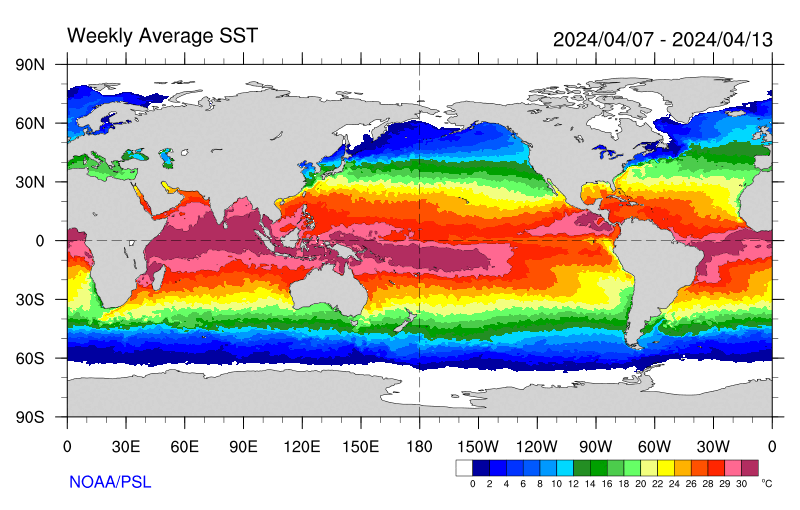
remotely, by satellite. For a global view of the satellite-derived pattern of
sea-surface temperatures, click on
Sea Surface
Temperatures under Oceanic (and Inland Seas) Information.
Note that the color scale at the bottom is in degrees Celsius and temperatures
are averaged over a 7-day period. (Depending on your browser, you may have to
place your mouse cursor on the slide bar to the right and scroll down to view
the entire image.) Return to the DataStreme WES website.
As part of the global water cycle, precipitation that reaches the ground
vaporizes back into the atmosphere, runs off into rivers and streams, seeps
into the ground, or is stored in lakes or glaciers. Under Terrestrial
Information, click on River
Flood Conditions for the recent status of river levels monitored at
various gauging stations around the nation. Note that in the Map Legend, river
stages are rated from "no flooding" to "major flooding"
using a color code. Now return to the DataStreme WES website.
Extras include color photographs arranged by week (chapter) to
supplement your study of the DataStreme WES textbook. For example, click on
Chapter 1
and then click on the first thumbnail for an enlarged image with the caption,
"Water in Three Phases."
Take a few minutes when you have time to browse the other data and
information sources available via the DataStreme WES website. You may
want to "bookmark" this page on your computer. Return frequently to
get into the flow of DataStreme WES!
Concept of the Week: Questions
- The latest WV Animation indicates that clouds and water vapor generally
move from [(west to east)(east to west)]
across the nation.
- In the tropical Pacific, the highest sea-surface temperatures occur in the
[(western)(eastern)] portion of the ocean
basin.
Historical Events
- 21 January 1863...A severe coastal storm dropped heavy rain on the
Fredericksburg area of Virginia. It disrupted a Union Army offensive in an ill
famed "mud march." (David Ludlum)
- 21 January 1880...Memphis, TN began construction of the first independent
municipal sewage system in the U.S. (Today in Science History)
- 22-23 January 1943...Hoegees Camp, at an elevation of 2760 feet in the San
Gabriel Mountains of southern California, received 26.12 inches of
precipitation in a 24-hour span, setting the Golden State's 24-hour
precipitation record. (Accord's Weather Guide Calendar)
- 24 January 1881...Freezing rain over three days coated trees, fences,
telegraph wires and buildings at Pictou, Nova Scotia. Lumberjacks remained
close to camp for fear of falling trees and branches. (The Weather Doctor)
- 24 January 1956...Thirty-eight inches of rain deluged the Kilauea Sugar
Plantation of Hawaii in 24 hours, including twelve inches in just one hour. The
38.00 inches remains the Aloha State's 24-hour maximum precipitation record.
(David Ludlum)
- 25 January 1945...Grand Rapids MI became the first US city to fluoridate
its water.
- 25 January 1965...Alta, UT was in the midst of a storm that left the town
buried under 105 inches of snow establishing a record for the state. (David
Ludlum)
- 25 January 1987...The second major storm in three days hit the Eastern
Seaboard producing up to 15 inches of snow in Virginia, Maryland and Delaware.
Up to 30 inches of snow covered the ground in Virginia following the two
storms. (National Weather Summary) (Storm Data)
- 26 January 1937...Flooding occurred along the Ohio River from Pittsburgh,
PA to Cairo, IL. The river was 80 feet above flood stage at Cincinnati, Ohio.
(Intellicast)
- 26 January 1983...The California coast was battered by a storm, which
produced record high tides, thirty-two foot waves, and mudslides, causing
millions of dollars in damage. The storm then moved east and dumped four feet
of snow on Lake Tahoe. (22nd-29th) (The Weather Channel)
- 27 January 1966...Oswego NY was in the midst of a five-day lake effect
storm that left the town buried under 102 inches of snow. (David Ludlum)
Return to DataStreme WES website
Prepared by WES Central Staff and Edward J. Hopkins, Ph.D.,
email hopkins@meteor.wisc.edu
© Copyright, 2008, The American Meteorological Society.