Weekly Ocean News
WEEK ONE: 9-13 September 2013
Items
of Interest:
- Approaching the peak in the Atlantic hurricane
season -- The historic or statistical annual peak in the
Atlantic hurricane season will occur this week (9-13 September), as
determined as the date during the entire season with most frequent
number of named tropical cyclones (tropical storms and hurricanes),
based upon over 100 years of record. This date corresponds closely with
the time of peak sea-surface temperatures across those sections of the
North Atlantic considered hurricane-breeding areas. [NWS
National Hurricane Center] [Note: So far
this Atlantic hurricane season, which commenced on 1 June 2013, no hurricanes have formed from any of the seven named tropical cyclones that reached tropical storm status. If no Atlantic hurricane forms before Wednesday, 11 September, a record would be reached for the latest occurring hurricane in the Atlantic. EJH]
- Ocean charts, units, location and time -- Please
read this week's Supplemental
Information…In Greater Depth for a description of a several
types of oceanographic charts along with the definitions of some units
commonly used in ocean science to locate positions on the Earth's
surface and to identify time.
- September is National Preparedness Month -- The month of September has been declared National Preparedness Month (NPM), which is aims to educate and empower Americans to prepare for and respond to all types of emergencies, including natural disasters. The Federal Emergency Management Administration (FEMA), which has provided a toolkit of marketing materials to help promote the month, is the lead on this campaign that was originally launched in 2004. NOAA's National Weather Service is working with FEMA to communicate the importance of emergency preparedness as a key component of its Weather-Ready Nation campaign. [NOAA Weather Ready Nation]
- Evidence of human-caused climate change may have been in half of extreme weather and climate events in 2012 -- A report titled "Explaining Extreme Events of 2012 from a Climate Perspective" was released this week by the Bulletin of the American Meteorological Society that indicates human influences as having had an impact on 12 extreme weather and climate events during 2012. As many as 18 different research teams from around the world contributed to this peer-reviewed report that examined the causes of these 12 extreme events that occurred on five continents and in the Arctic during 2012. While the report shows that the effects of natural weather and climate fluctuations played a key role in the intensity and evolution of the 2012 extreme events, the analyses revealed compelling evidence that human-caused climate change also contributed to the extreme event through the emission of heat-trapping gases.
[NOAA News]
Ocean in
the News:
REPORTS FROM THE FIELD --
A request: If you have some ocean-related
experience that you would like to share with other DataStreme Ocean
participants, please send them to the email address appearing at the
bottom of this document for possible inclusion in a News file. Thank
you. EJH
Concept of the Week: Touring the
DataStreme Ocean Website
NOTE: This Concept for the Week is a repeat of that
which appeared in last week's Weekly Ocean News.
Welcome to DataStreme Ocean! You are embarking on a study of
the world ocean and the role of the ocean in the Earth system. This
unique teacher enhancement course focuses on the flow and
transformations of energy and water into and out of the ocean, the
internal properties and circulation of the ocean, interactions between
the ocean and the other components of the Earth system, and the
human/societal impacts on and responses to those interactions.
Throughout this learning experience, you will be using the DataStreme
Ocean website to access and interpret a variety of
environmental information, including recent observational data. The
objective of this initial Concept of the Week is to
explore features of the DS Ocean website.
On Monday of each week of the course, we will post the current Weekly Ocean News that includes Ocean in
the News (a summary listing of recent events related to the
ocean), Concept of the Week (an in-depth analysis
of some topic related to the ocean in the Earth system), and Historical
Events (a list of past events such as tsunamis or specific
advances in the understanding of oceanography). When appropriate, a
feature called Supplemental Information-In Greater Depth will be provided on some topic related to the principal theme of the
week.
You will use the DS Ocean website to
access and download the weekly "Current Ocean Studies" (plus supporting
images) that complement Investigations found in your Ocean
Studies Investigations Manual. These materials should be
available Monday morning. Click the appropriate links to download and
print these electronic Current Ocean Studies and answer forms as well
as your Chapter Progress and Investigations Response forms.
The body of the DS Ocean website provides
links to the Earth System, information on Physical & Chemical,
Geological, and Biological aspects of the ocean, Atmosphere/Ocean
Interaction, the Great Lakes, and extras-a glossary of terms, maps,
educational links, and DataStreme Ocean information. Following each section is a link to other sites that
examine the various subsystems of the Earth system. Let's take a quick
tour to become more familiar with the DS Ocean website.
Under Physical & Chemical, click
on Sea
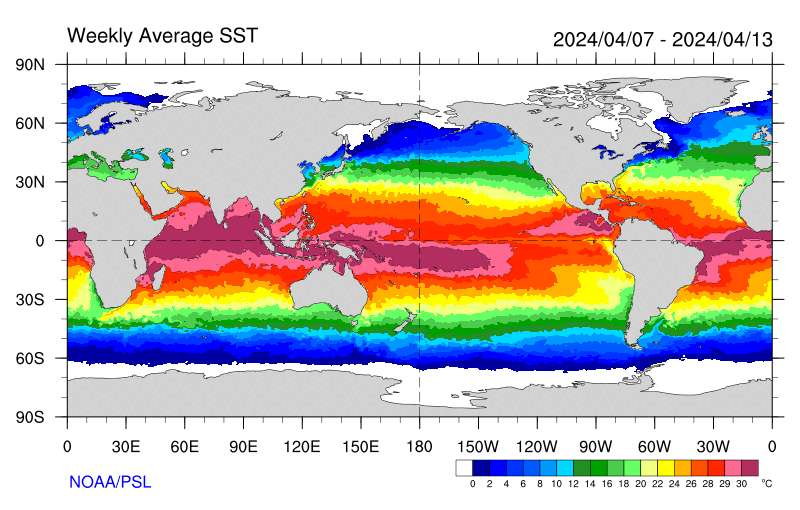
Surface Temperatures. This image uses a color scale
to depict the global pattern of sea surface temperatures (SSTs) (in
degrees Celsius) averaged over a recent 7-day period and based on
measurements by infrared sensors onboard Earth-orbiting satellites.
(Depending on your browser, you may have to place your mouse cursor on
the slide bar to the right and scroll down to view the entire image.)
Compare SSTs in the Northern Hemisphere with those in the Southern
Hemisphere. Return to the DS Ocean website.
Under Geological, click on Current
Earthquake Activity. The USGS Current World
Seismicity page provides a global map of the locations of seismic
(earthquake) events color-coded for the past seven days. The size of
the squares represents the magnitude of recent earthquakes. Note how
earthquakes are concentrated along the margin of the Pacific Ocean.
Details of recent earthquakes can be found by clicking on their map
squares. Return to the DS Ocean website.
The ocean is home to a wide variety of habitats and organisms.
Under Biological, click on Ocean
"Color" (Productivity). This is
a satellite-derived (SeaWiFS) color-coded map of biological
productivity in the surface waters of the world ocean is averaged from
October 1978 to date. Orange and red indicates the highest
productivity, while dark blue and violet indicate the lowest
productivity. Note the vast areas of relatively low productivity over
the central regions of the subtropical ocean basins. Individual months
within this period may be chosen for viewing. Now return to the DS
Ocean website.
Under Atmosphere/Ocean Interaction, click
on TRMM
Tropical Rainfall. The TRMM (Tropical
Rainfall Measuring Mission) page includes color-coded maps of
the Monthly Mean Rainrate (in mm per day) across the tropics for the
last 30 days ending on the present date. Changes in rainfall are linked
to large-scale shifts in the atmosphere/ocean circulation in the
tropics. Now return to the DS Ocean website.
Take a few minutes when you have time to browse the other data
and information sources available via the DS Ocean website. You should "bookmark" ("favorites") this page on your
computer. Return frequently to learn more about the many resources on
the ocean in the Earth system. Bon voyage!
Concept of the Week: Questions
- The latest global sea surface temperature map indicates
that SSTs are generally higher over the [(western)(eastern)] tropical Pacific Ocean.
- The USGS map of Current Earthquake Activity indicates that
earthquakes appear to be more common along the [(east)(west)] coast of North America.
Historical Events
- 9 September 1945 - A "computer bug" is first identified and
named by LT Grace Murray Hopper while she was on Navy active duty in
1945. It was found in the Mark II Aiken Relay Calculator at Harvard
University. The operators affixed the moth to the computer log, where
it still resides, with the entry: "First actual case of bug being
found." They "debugged" the computer, first introducing the term.
(Naval History Center)
- 10 September 1919...A hurricane struck the Florida Keys
drowning more than 500 persons. (David Ludlum)
- 10 September 1965...Hurricane Betsy slammed Louisiana with
wind gusting to 130 mph at Houma, resulting in 58 deaths and over
17,500 injured. The storm surge and flooding from torrential rains made
Betsy the first billion-dollar hurricane with losses exceeding $1.4
billion.
- 11 September 1961...Very large and slow moving Hurricane
Carla made landfall near Port Lavaca, TX. Carla battered the central
Texas coast with wind gusts to 175 mph, and up to 16 inches of rain,
and spawned a vicious tornado (F4 on the Fujita tornado intensity
scale) which swept across Galveston Island killing eight persons and
destroying 200 buildings. A storm surge of up to 18.5 feet inundated
coastal areas and Bay City was deluged with 17.1 inches of rain. The
hurricane claimed 45 lives, and caused $300 million in damage. The
remnants of Carla produced heavy rain in the Lower Missouri Valley and
southern sections of the Upper Great Lakes Region. (David Ludlum)
(Storm Data) (Intellicast)
- 11 September 1992...Hurricane Iniki, the third most
damaging hurricane in US history, hit the Hawaiian Islands of Kauai and
Oahu. Six people died as a result of the hurricane.
- 12 September 1775...The Independence Hurricane
caught many fishing boats on the Grand Banks off Newfoundland killing
4000 seamen, most from Britain and Ireland. (The Weather Doctor)
- 12 September 1857...The S.S. Central America
sank while in the midst of a hurricane off the North Carolina coast
after beginning to take on water the previous day (11th).
Approximately 400 people onboard were lost, the greatest single loss
from a commercial ship due to a hurricane. (Accord Weather Calendar)
- 12 September 1960...Hurricane Donna made landfall on
central Long Island and then tracked across New England. Wind gusts
reached 140 mph at the Blue Hills Observatory in Milton, MA and 130 mph
at Block Island, RI. MacDowell Dam in New Hampshire recorded 7.25
inches of rain. Although a record tide of 6.1 feet occurred at the
Battery in New York City, elsewhere fortunately the storm did not make
landfall at the high tides so its effects were minimized. This was the
first hurricane to affect every point along the East Coast from Key
West, FL to Caribou, ME. (Intellicast)
- 12 September 1979...Hurricane Frederick smashed into the
Mobile Bay area of Alabama packing 132-mph winds. Wind gusts to 145 mph
were reported as the eye of the hurricane moved over Dauphin Island,
AL, just west of Mobile. Frederick produced a fifteen-foot storm surge
near the mouth of Mobile Bay. Winds gusted to hurricane force at
Meridian, MS although the city is 140 miles inland. The hurricane was
responsible for five fatalities and was the costliest in U.S. history
to date causing $2.3 billion in damage. (David Ludlum) (The Weather
Channel)
- 13-16 September 2004...Hurricane Ivan affected coastal
Alabama and the western Florida Panhandle, with landfall near Gulf
Shores, AL early on the 16th. Before breaking loose of its mooring, a
buoy just south of the Alabama coastal waters reported a peak wave
height of 52 feet on the 15th. (Accord Weather Guide Calendar)
- 14 September 1716...The Boston Light, the first lighthouse
in America, was first lighted just before sunset. This light was
located on Little Brewster Island to mark the entrance to Boston Harbor
and guide ships past treacherous rocks. This original light was blown
up by the British in 1776, rebuilt in 1783, and is currently the last
staffed station in the U.S. (Today in Science History)
- 15 September 1752...A great hurricane produced a tide
(storm surge )along the South Carolina coast that nearly inundated
downtown Charleston. However, just before the surge reached the city, a
shift in the wind caused the water level to drop five feet in ten
minutes. (David Ludlum)
Return to DataStreme
Ocean Website
Prepared by DS Ocean Central Staff and Edward J. Hopkins,
Ph.D.,
email hopkins@meteor.wisc.edu
© Copyright, 2013, The American Meteorological Society.