Weekly Ocean News
PREVIEW WEEK: 25-29 August 2014
Items
of Interest:
- Viewing the eastern side of the "Blue Marble" -- True color images made by the Visible Infrared Imaging Radiometer Suite (VIIRS) onboard the NASA/NOAA Suomi NPP (National Polar-orbiting Partnership) satellite show a view of the Eastern Hemisphere, which many people in the United States rarely see. These images include a single image from late March 2014 and an animated sequence of images running from late January through July. [NASA Earth Observatory]
- Free admission into the National Parks -- This Monday 25 August 2014 has been designated by the National Park Service as fee-free day in honor of its 98th Birthday. This fee waiver will cover entrance and commercial tour fees in many of the national parks and monuments administered by the Park Service. [National Park Service Birthday]
- Ocean charts, units, location and time -- Please
read this week's Supplemental
Information…In Greater Depth for a description of a several
types of oceanographic charts along with the definitions of some units
commonly used in ocean science to locate positions on the Earth's
surface and to identify time.
- A change in seasons -- This coming Sunday, 31 August
2014, marks the end of Northern Hemisphere's meteorological summer, the
three-month span of June, July and August that meteorologists
frequently use for record keeping processes. Meteorological autumn
(September, October and November) for the Northern Hemisphere starts
the following day, 1 September 2014.
Additional information will be presented in the next several weeks
concerning meteorological seasons and the astronomical seasons, such as
the familiar autumn that begins on the autumnal equinox in three weeks
on Monday, 22 September 2014.
Ocean in
the News:
- Eye on the Tropics -- During the last week most of the active weather across the tropical oceans was confined to the eastern North Pacific, with three named tropical cyclones (low pressure systems that form over
tropical ocean waters, with near surface maximum sustained winds that
intensify to tropical storm or hurricane force status). Some activity developed by late week over the tropical North Atlantic.
- In the eastern North Pacific, Tropical Karina, which had been a hurricane briefly during the previous week, continued to travel westward during the early part of this past week. However, by late in the week, Karina reversed direction and headed toward the east. As it moved east, Karina intensified to become a hurricane for a second time over this past weekend. By Sunday, Hurricane Karina weakened to form a tropical storm as it was located approximately 1500 miles to the west of the southern tip of Mexico's Baja California Peninsula. Tropical Storm Karina should weaken to a tropical depression as it continues toward the east early this week. The NASA Hurricane Page has satellite images and additional information on former Hurricane Karina.
Another named tropical cyclone formed in the eastern North Pacific early last week as
Tropical Storm Lowell intensified from a tropical depression approximately 700 miles to the southwest of Baja California. Eventually this tropical storm intensified to briefly become a weak hurricane by the second half of last week as Lowell traveled toward the northwest. Lowell was the eighth hurricane of 2014 in the eastern Pacific. Over this past weekend, Lowell weakened and became a remnant low. .More information along with satellite images on former Hurricane Lowell are available on the NASA Hurricane Page. appear on
Late in the week Tropical Storm Marie formed from a tropical depression nearly 300 miles to the south-southwest of Acapulco, Mexico. Over the weekend, Marie traveled toward the northwest and intensified to become a major category 5 hurricane (on the Saffir-Simpson Scale) as
maximum sustained surface winds reached 160 mph as this hurricane was approximately 500 miles to the south-southwest of Baja California. Marie was sixth eastern Pacific hurricane of 2014 to reach major status, considered to be category 3 or higher. Current forecasts indicate that Hurricane Marie should continue traveling toward the west-northwest or northwest and weaken to a tropical storm by late this upcoming week. The NASA Hurricane Page has more information on Hurricane Marie.
- In the North Atlantic basin, a tropical depression formed over this past weekend over the Turks and Caicos and then intensified as it traveled to the northwest to become Tropical Storm Cristobal, the third named tropical cyclone of 2014 in the Atlantic basin By Sunday afternoon, Tropical Storm Cristobal was located over the Bahamas. Forecasts indicate that Cristobal would travel generally northward across the northern Bahamas at the start of this week, possibly intensifying to a hurricane.
- Significant land cover changes found in US coastal regions -- The National Oceanic and Atmospheric Administration (NOAA) recently released an updated nationwide analysis called the "Land Cover Atlas" that shows that nearly 65,000 square miles of coast regions experienced substantial changes in land cover between 1996 and 2011, with coastal areas accounting for approximately 43 percent of all land cover changes across the 48 contiguous United States in a five-year span from 2001 to 2006. [NOAA News]
- Improvements to tropical cyclone forecasts using GPS -- Researchers from the National Center for Atmospheric Research (NCAR) and from Taiwan have found that the COSMIC microsatellite system, which uses a technology known as GPS (Global Positioning System) radio occultation, can significantly improve predictions of tropical cyclones. The Formosa Satellite Mission 3 (FORMOSAT-3) Constellation Observing System for Meteorology, Ionosphere, and Climate (COSMIC) satellite constellation with six microsatellites that were launched in 2006 uses GPS signals to monitor the atmosphere in three dimensions, leading to improved global weather monitoring, especially in data-sparse regions, such as over oceans. [NCAR/UCAR AtmosNews]
- Disaster Relief Appropriations Act of 2013 helps improve hurricane and severe weather forecasting -- Several research projects and other projects sponsored by NOAA designed to improve hurricane forecasting were launched this summer due in part to funding from the Disaster Relief Appropriations Act of 2013, which was passed by Congress and signed by President Obama following the Hurricane Sandy disaster. NOAA received $309.7 million to provide technical assistance to those states with coastal and fishery impacts from Sandy and to improve weather forecasting and weather research and predictive capability to help future preparation, response and recovery from similar events. [NOAA Office of Oceanic and Atmospheric Research News]
- Global temperature and ice cover for July 2014 reviewed -- Scientists at the NOAA National Climatic Data Center
recently reported on their analysis of preliminary weather data collected during the month of July 2014:
- The combined global land and ocean surface temperature for July
2014 was the fourth highest for any July since sufficiently detailed global climate records
began in 1880. This global temperature was nearly 61.6 degrees Fahrenheit, or 1.14 Fahrenheit degrees above the 20th
century (1901-2000) average.
When considered separately,
the average land temperature for June 2014 was the tenth highest for any July since
1880, while the temperature over the oceans was tied with July 2009 for the highest for
any July. Ocean temperatures dropped slightly across the
central and eastern equatorial Pacific Ocean during July from the previous month, indicating neither El Niño or La Niña conditions were present across this region during the month.
- The researchers at the National Snow and Ice Data Center noted the areal extent of the Arctic sea ice
for July 2014 was
the fourth smallest for any July since satellite surveillance began in 1979. On the
other hand, the extent of the Antarctic sea ice was the largest July ice
extent in the 37-year record. [NOAA/NCDC
State of the Climate]
- A global map of Selected Significant Climate Anomalies and Events for July 2014 is available from NCDC.
- "Global warming hiatus" may be linked to depths of the Atlantic Ocean -- Researchers at the University of Washington report that the small increases in the average global surface temperatures during the last decade following a span of rapid warming during the late 20th century appears to be due a naturally occurring cyclic process where the surface heat is transported deep into the northern and southern waters of the Atlantic Ocean by a slow-moving current in the Atlantic. Apparently, this current increased in speed during the early 21st century. The researchers used data collected from deep-sea observations obtained from Argo floats and older oceanographic expeditions. Hence, cyclic changes in the deep ocean current driven by salinity (or salt concentration of seawater) would explain the so-called "global warming hiatus" where excess surface heat is drawn downward causing the subsurface warming of the Atlantic despite increases in the concentrations of atmospheric greenhouses that would result in increased receipt of energy at the surface. Similar cyclic occurrences of cooling were found between 1945 and 1975. [University of Washington News]
- Force of Gulf Stream influenced by Fram Strait sea ice over last 30,000 years -- Scientists at Germany's Alfred Wegener Institute, Helmholtz Centre for Polar and Marine Research have concluded from their analysis of seafloor deposits that the force of the Gulf Stream in the North Atlantic over the last 30,000 years has been significantly influenced by the amount of sea ice in the Fram Strait during the time span. Specifically, when large quantities of sea ice from the Arctic Ocean drifted through the Fram Strait located between Greenland and the Norwegian archipelago of Svalbard and into the North Atlantic, the heat transport of the Gulf Stream declined especially around 17,600 years ago and again about 12,800 years ago. [ Alfred Wegener Institute News]
- Marine protected areas may be unable to help in recovery of overfished reefs -- Researchers from the Georgia Institute of Technology (Georgia Tech) warn that marine protected areas may not be capable of providing sufficient assistance to overfished reefs recover. Based upon their research in Fiji, they claim that young corals and fish can detect the smell of damaged habitats, with the smell causing the coral larvae and fish to avoid settling in damaged reefs. [Georgia Tech News]
- An All-Hazards Monitor -- This Web
portal provides the user information from NOAA on current environmental
events that may pose as hazards such as tropical weather, drought,
floods, marine weather, tsunamis, rip currents, Harmful Algal Blooms
(HABs) and coral bleaching. [NOAAWatch]
- Earthweek -- Diary of the Planet
[earthweek.com] Requires Adobe Acrobat Reader.
Concept of the Week: Touring the
DataStreme Ocean Website
Welcome to DataStreme Ocean! You are embarking on a study of
the world ocean and the role of the ocean in the Earth system. This
unique teacher enhancement course focuses on the flow and
transformations of energy and water into and out of the ocean, the
internal properties and circulation of the ocean, interactions between
the ocean and the other components of the Earth system, and the
human/societal impacts on and responses to those interactions.
Throughout this learning experience, you will be using the DataStreme
Ocean website to access and interpret a variety of
environmental information, including recent observational data. The
objective of this initial Concept of the Week is to
explore features of the DS Ocean website.
On Monday of each week of the course, we will post the current Weekly Ocean News that includes Ocean in
the News (a summary listing of recent events related to the
ocean), Concept of the Week (an in-depth analysis
of some topic related to the ocean in the Earth system), and Historical
Events (a list of past events such as tsunamis or specific
advances in the understanding of oceanography). When appropriate, a
feature called Supplemental Information-In Greater Depth will be provided on some topic related to the principal theme of the
week.
You will use the DS Ocean website to
access and download the weekly "Current Ocean Studies" (plus supporting
images) that complement Investigations found in your Ocean
Studies Investigations Manual. These materials should be
available Monday morning. Click the appropriate links to download and
print these electronic Current Ocean Studies and answer forms as well
as your Chapter Progress and Investigations Response forms.
The body of the DS Ocean website provides
links to the Earth System, information on Physical & Chemical,
Geological, and Biological aspects of the ocean, Atmosphere/Ocean
Interaction, the Great Lakes, and extras-a glossary of terms, maps,
educational links, and DataStreme Ocean information. Following each section is a link to other sites that
examine the various subsystems of the Earth system. Let's take a quick
tour to become more familiar with the DS Ocean website.
Under Physical & Chemical, click
on Sea
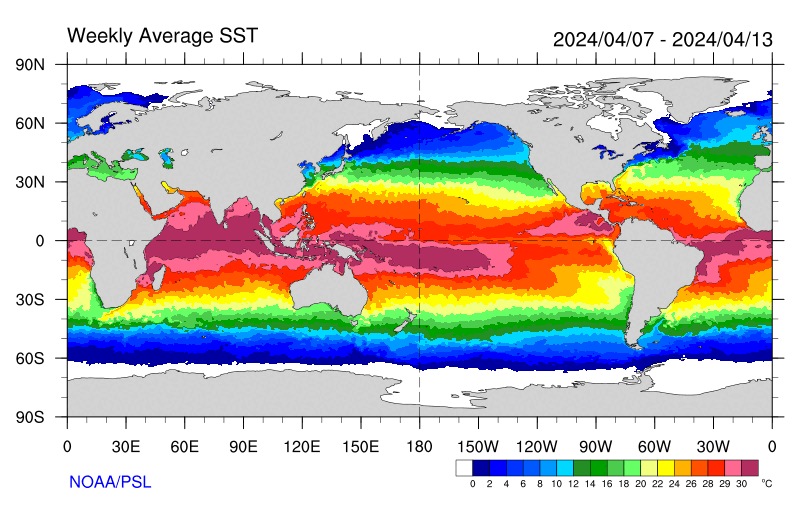
Surface Temperatures. This image uses a color scale
to depict the global pattern of sea surface temperatures (SSTs) (in
degrees Celsius) averaged over a recent 7-day period and based on
measurements by infrared sensors onboard Earth-orbiting satellites.
(Depending on your browser, you may have to place your mouse cursor on
the slide bar to the right and scroll down to view the entire image.)
Compare SSTs in the Northern Hemisphere with those in the Southern
Hemisphere. Return to the DS Ocean website.
Under Geological, click on Current
Earthquake Activity. The USGS Current World
Seismicity page provides a global map of the locations of seismic
(earthquake) events color-coded for the past seven days. The size of
the squares represents the magnitude of recent earthquakes. Note how
earthquakes are concentrated along the margin of the Pacific Ocean.
Details of recent earthquakes can be found by clicking on their map
squares. Return to the DS Ocean website.
The ocean is home to a wide variety of habitats and organisms.
Under Biological, click on Ocean
"Color" (Productivity). This is
a satellite-derived (SeaWiFS) color-coded map of biological
productivity in the surface waters of the world ocean is averaged from
October 1978 to date. Orange and red indicates the highest
productivity, while dark blue and violet indicate the lowest
productivity. Note the vast areas of relatively low productivity over
the central regions of the subtropical ocean basins. Individual months
within this period may be chosen for viewing. Now return to the DS
Ocean website.
Under Atmosphere/Ocean Interaction, click
on TRMM
Tropical Rainfall. The TRMM (Tropical
Rainfall Measuring Mission) page includes color-coded maps of
the Monthly Mean Rainrate (in mm per day) across the tropics for the
last 30 days ending on the present date. Changes in rainfall are linked
to large-scale shifts in the atmosphere/ocean circulation in the
tropics. Now return to the DS Ocean website.
Take a few minutes when you have time to browse the other data
and information sources available via the DS Ocean website. You should "bookmark" ("favorites") this page on your
computer. Return frequently to learn more about the many resources on
the ocean in the Earth system. Bon voyage!
Concept of the Week: Questions
- The latest global sea surface temperature map indicates
that SSTs are generally higher over the [(western)(eastern)] tropical Pacific Ocean.
- The USGS map of Current Earthquake Activity indicates that
earthquakes appear to be more common along the [(east)(west)] coast of North America.
Historical Events
- 25 August 1885...A severe hurricane struck South Carolina causing $1.3 million damage at Charleston. (David Ludlum)
- 25 August 1927...The August Gale, a hurricane, raged across the East Coast, crossing the Cabot Strait between Nova Scotia and Newfoundland during the early morning hours. Hundreds of small boats in Newfoundland ports are among the storm's victims. (The Weather Doctor)
- 25 August-7 September 1979...Hurricane David crossed the island of Dominica on the 29th, with winds to 145 mph. Roseau, the capital, was devastated. Fifty-six people were killed on Dominica and 60,000 of the island's 80,000 residents were made homeless. About three-quarters of the coconut and banana crop were destroyed. The central pressure in David fell to 924 mb (27.28 in.) on the 30th as it moved south of Puerto Rico. At that time, highest sustained winds reached 173 mph. On the 31st, winds of 150 mph from Hurricane David brought over $1 billion in damage to Santo Domingo, Dominican Republic, killing over 1200. (The Weather Doctor) (Accord's Weather Guide Calendar)
- 26 August 1883... Krakatau (or Krakatoa) Volcano exploded in the East Indies. The explosion was heard more than 2500 miles away, and every barograph around the world recorded the passage of the air wave, up to seven times. Giant waves, 125 feet high and traveling 300 mph, devastated everything in their path, hurling ashore coral blocks weighing up to 900 tons, and killing more than 36,000 persons. Volcanic ash was carried around the globe in thirteen days producing blue and green suns in the tropics, and then vivid red sunsets in higher latitudes. The temperature of the Earth was lowered one degree for the next two years, finally recovering to normal by 1888. (David Ludlum)
- 26 August 1949...A hurricane made landfall at Delray Beach, FL. Winds reached 153 mph at the Jupiter Lighthouse before the anemometer failed. The hurricane caused $45 million damage to crops, and caught the Georgia and South Carolina coast resulting in another $2 million in damage. (David Ludlum)
- 26 August 1992...Hurricane Andrew made its second landfall along the Louisiana coast near Burns Point, as a category 3 hurricane on the Saffir-Simpson Scale. Morgan City recorded wind gusts of 108 mph. Hammond was deluged with nearly a foot of rain. Total additional damage was estimated at $1.8 billion. Andrew, which had made its initial US landfall in South Florida on the 24th, was the most costly natural disaster in US history, with total damage reaching up to $30 billion. Additionally, record hurricane evacuation of 2.4 million people took place in Florida and Louisiana. (Intellicast) (Accord's Weather Guide Calendar)
- 27 August 1881...As many as 335 people were lost in the
Georgia Hurricane, especially severe at Savannah and Charleston, SC.
(Intellicast)
- 27 August 1883...The after effects caused by the Krakatau
explosion in Indonesia, including large tsunami waves of up to 300
feet, killed 36,000 people. The tsunami waves were powerful enough to
cross the Indian Ocean and travel beyond Cape Horn. The most powerful
blast was the most violent known in human history, was loud enough to
be heard in Australia, and the shock wave was registered by barometers
England. The huge amount of volcanic dust thrust high into the
stratosphere eventually traveled around the world. The dust blocked
sunlight causing temperature drops and chaotic weather patterns for
several years afterward. (Wikipedia) (Today in Science History)
- 27 August 1893...The first of three great hurricanes that
year struck South Carolina drowning more than 1000 persons in a storm
surge at Charleston. Landfall was just south of Savannah, GA where
sustained winds hit 120 mph. (David Ludlum)
- 27 August 1964...Hurricane Cleo battered Miami and the
South Florida area, marking the first direct hit for Miami in fourteen
years. Sustained winds of 100 mph gusted to 135 mph, and the hurricane
caused $125 million in damage. (David Ludlum)
- 27 August 1995...Remains of Tropical Storm Jerry unloaded
12.32 inches of rain in 24 hours in Greer, SC, a record for 24 hours,
for a rain event and for August. At Antreville, 17.00 inches fell in 24
hours, setting a 24-hour rainfall record for the Palmetto State.
(Intellicast)
- 28 August 1965...CDR Scott Carpenter, USN, and nine
aquanauts entered SeaLab II, 205 ft. below Southern California's waters
to conduct underwater living and working tests. (Naval Historical
Center)
- 28 August 1988...Tropical Storm Chris spawned a tornado
near Manning, SC, which killed one person, and spawned three tornadoes
in North Carolina. Chris produced one to two foot tides, and three to
six inch rains, over coastal South Carolina. (The National Weather
Summary) (Storm Data)
- 28-30 August 1839...A hurricane moved from Cape Hatteras,
NC to offshore New England. An unusual feature of the hurricane was the
snow it helped produce, which whitened the Catskill Mountains of New
York State. Considerable snow was also reported at Salem, NY. (The
Weather Channel)
- 28 August 1965...CDR Scott Carpenter, USN, and nine
aquanauts entered SeaLab II, 205 ft. below Southern California's waters
to conduct underwater living and working tests. (Naval Historical
Center)
- 28 August 1988...Tropical Storm Chris spawned a tornado
near Manning, SC, which killed one person, and spawned three tornadoes
in North Carolina. Chris produced one to two foot tides, and three to
six inch rains, over coastal South Carolina. (The National Weather
Summary) (Storm Data)
- 29 August 1583...The Delight was
wrecked on Sable Island, Nova Scotia during a heavy gale, blinding rain
and thick fog. This was Canada's first recorded marine disaster, taking
85 lives. (The Weather Doctor)
- 29 August 1979...Winds associated with Hurricane David
reached 145 mph as the hurricane crossed the island of Dominica. The
capital city, Roseau, was devastated, with 56 fatalities and 60,000 out
of a population of 80,000 left homeless. About three-quarters of the
coconut and banana crops were destroyed. (Accord's Weather Guide
Calendar)
- 29 August 1988...The remnants of Tropical Storm Chris
drenched eastern Pennsylvania with up to five and a half inches of
rain, and produced high winds that gusted to 90 mph, severely damaging
a hundred boats in Anne Arundel County, MD. (The National Weather
Summary) (Storm Data)
- 29 August 2005...Hurricane Katrina, the costliest and one
of the five deadliest hurricanes in US history, made landfall along the
Louisiana Gulf Coast southeast of New Orleans as a category 3 on the
Saffir-Simpson Scale after reaching category 5 status. Massive
destruction was reported in coastal Mississippi and in New Orleans. As
many as 1833 people reportedly died from Katrina in the US. (National
Hurricane Center)
- 30 August 1913...The US Navy tested the Sperry gyroscopic
stabilizer (automatic pilot). (Naval Historical Center)
- 30 August 1942...A hurricane weakened in moving 160 miles
across south Texas from landfall at Matagorda to San Antonio, winds
still gusting from 50 to 70 mph at San Antonio for more than five
hours. Seventy of 75 planes were damaged at the city airport. Many
trees were destroyed, but the famed Alamo's walls withstood the storm.
(Accord's Weather Guide Calendar)
- 31 August 1842...The U.S. Naval Observatory was authorized
by an act of Congress. (Today in Science History)
Return to DataStreme
Ocean Website
Prepared by DS Ocean Central Staff and Edward J. Hopkins,
Ph.D.,
email hopkins@meteor.wisc.edu
©Copyright, 2014, The American Meteorological Society.