Weekly Ocean News
WEEK ONE: 1-5 September 2014
Items
of Interest:
- Ocean charts, units, location and time -- Please
read this week's Supplemental
Information…In Greater Depth for a description of a several
types of oceanographic charts along with the definitions of some units
commonly used in ocean science to locate positions on the Earth's
surface and to identify time.
- September is National Preparedness Month -- The month of September has been declared National Preparedness Month (NPM), which is aims to educate and empower Americans to prepare for and respond to all types of emergencies, including natural disasters. The Federal Emergency Management Administration (FEMA), which has provided a toolkit of marketing materials to help promote the month, is the lead on this campaign that was originally launched in 2004. NOAA's National Weather Service is working with FEMA to communicate the importance of emergency preparedness as a key component of its Weather-Ready Nation campaign. [NOAA Weather Ready Nation]
Ocean in
the News:
REPORTS FROM THE FIELD --
A request: If you have some ocean-related
experience that you would like to share with other DataStreme Ocean
participants, please send them to the email address appearing at the
bottom of this document for possible inclusion in a News file. Thank
you. EJH
Concept of the Week: Touring the
DataStreme Ocean Website
NOTE: This Concept for the Week is a repeat of that
which appeared in last week's Weekly Ocean News.
Welcome to DataStreme Ocean! You are embarking on a study of
the world ocean and the role of the ocean in the Earth system. This
unique teacher enhancement course focuses on the flow and
transformations of energy and water into and out of the ocean, the
internal properties and circulation of the ocean, interactions between
the ocean and the other components of the Earth system, and the
human/societal impacts on and responses to those interactions.
Throughout this learning experience, you will be using the DataStreme
Ocean website to access and interpret a variety of
environmental information, including recent observational data. The
objective of this initial Concept of the Week is to
explore features of the DS Ocean website.
On Monday of each week of the course, we will post the current Weekly Ocean News that includes Ocean in
the News (a summary listing of recent events related to the
ocean), Concept of the Week (an in-depth analysis
of some topic related to the ocean in the Earth system), and Historical
Events (a list of past events such as tsunamis or specific
advances in the understanding of oceanography). When appropriate, a
feature called Supplemental Information-In Greater Depth will be provided on some topic related to the principal theme of the
week.
You will use the DS Ocean website to
access and download the weekly "Current Ocean Studies" (plus supporting
images) that complement Investigations found in your Ocean
Studies Investigations Manual. These materials should be
available Monday morning. Click the appropriate links to download and
print these electronic Current Ocean Studies and answer forms as well
as your Chapter Progress and Investigations Response forms.
The body of the DS Ocean website provides
links to the Earth System, information on Physical & Chemical,
Geological, and Biological aspects of the ocean, Atmosphere/Ocean
Interaction, the Great Lakes, and extras-a glossary of terms, maps,
educational links, and DataStreme Ocean information. Following each section is a link to other sites that
examine the various subsystems of the Earth system. Let's take a quick
tour to become more familiar with the DS Ocean website.
Under Physical & Chemical, click
on Sea
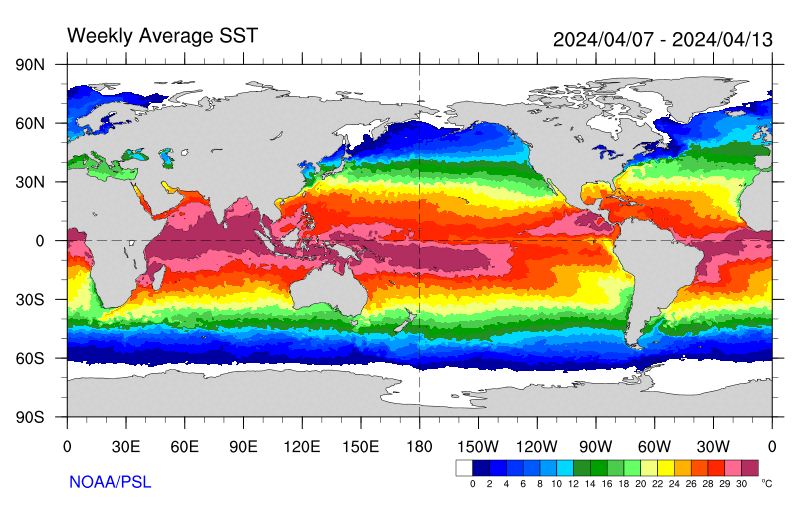
Surface Temperatures. This image uses a color scale
to depict the global pattern of sea surface temperatures (SSTs) (in
degrees Celsius) averaged over a recent 7-day period and based on
measurements by infrared sensors onboard Earth-orbiting satellites.
(Depending on your browser, you may have to place your mouse cursor on
the slide bar to the right and scroll down to view the entire image.)
Compare SSTs in the Northern Hemisphere with those in the Southern
Hemisphere. Return to the DS Ocean website.
Under Geological, click on Current
Earthquake Activity. The USGS Current World
Seismicity page provides a global map of the locations of seismic
(earthquake) events color-coded for the past seven days. The size of
the squares represents the magnitude of recent earthquakes. Note how
earthquakes are concentrated along the margin of the Pacific Ocean.
Details of recent earthquakes can be found by clicking on their map
squares. Return to the DS Ocean website.
The ocean is home to a wide variety of habitats and organisms.
Under Biological, click on Ocean
"Color" (Productivity). This is
a satellite-derived (SeaWiFS) color-coded map of biological
productivity in the surface waters of the world ocean is averaged from
October 1978 to date. Orange and red indicates the highest
productivity, while dark blue and violet indicate the lowest
productivity. Note the vast areas of relatively low productivity over
the central regions of the subtropical ocean basins. Individual months
within this period may be chosen for viewing. Now return to the DS
Ocean website.
Under Atmosphere/Ocean Interaction, click
on TRMM
Tropical Rainfall. The TRMM (Tropical
Rainfall Measuring Mission) page includes color-coded maps of
the Monthly Mean Rainrate (in mm per day) across the tropics for the
last 30 days ending on the present date. Changes in rainfall are linked
to large-scale shifts in the atmosphere/ocean circulation in the
tropics. Now return to the DS Ocean website.
Take a few minutes when you have time to browse the other data
and information sources available via the DS Ocean website. You should "bookmark" ("favorites") this page on your
computer. Return frequently to learn more about the many resources on
the ocean in the Earth system. Bon voyage!
Concept of the Week: Questions
- The latest global sea surface temperature map indicates
that SSTs are generally higher over the [(western)(eastern)] tropical Pacific Ocean.
- The USGS map of Current Earthquake Activity indicates that
earthquakes appear to be more common along the [(east)(west)] coast of North America.
Historical Events
- 1 September 1858...The first transatlantic cable failed
after less than one month of service. (Today in Science History)
- 1-2 September 1935...Perhaps the most intense hurricane
ever to hit the U.S. struck the Florida Keys with sustained winds of
over 155 mph with gusts exceeding 200 mph. On the 1st,
the "Labor Day Hurricane" formed rapidly over the Bahama Islands and
intensified into a Category 5 hurricane (on the Saffir Simpson Scale)
with sustained winds of over 155 mph and gusts exceeding 200 mph. On
the next day, this hurricane generated a 15-foot tide and waves 30-ft
high, as it became the first known Category 5 hurricane to hit the U.S.
Mainland. More than 400 persons perished in the storm on that Labor
Day, including many World War I veterans building a bridge from the
Keys to the mainland. The barometric pressure at Matecumbe Bay, FL hit
a record low for the U.S. at 26.35 inches of mercury (or 892
millibars). (David Ludlum) (The Weather Doctor)
- 1 September 1974...Navy Lieutenant Judy Neuffer became the
first woman to pilot a plane through the eye of a hurricane. (Northern
Indiana NWSFO)
- 1 September 1985...A joint French-American expedition
headed by the American explorer, Robert D. Ballard, located the wreck
of the sunken liner RMS Titanic on the floor of the
North Atlantic using an experimental and unmanned submersible craft Argo.
The wreckage of the Titanic, which sank in April 1912 on its maiden
voyage after colliding with an iceberg, was found at a depth of about
13,000 feet and approximately 400 miles west of Newfoundland. (The
History Channel)
- 2 September 1752...The British Empire adopted the Gregorian
Calendar, nearly two centuries later than most of western Europe
(primarily 1582). To correct the imprecise leap year correction in the
Julian Calendar, 11 days were dropped making the following day 14
September. (Wikipedia) (Today in Science History)
- 3 September 1821...A hurricane made landfall at Long
Island, near the current J.F. Kennedy Airport and then moved through
western Connecticut. The hurricane produced a record high tide at New
York City. (David Ludlum)
- 4 September 1954...Icebreakers, USS Burton Island (AGB-1) and USCG Northwind, completed first transit
of the Northwest Passage through McClure Strait. (Naval Historical
Center)
- 4-6 September 1970...Moisture from Pacific Tropical Storm
Norma led to heavy rain and severe flooding over a three-day span.
Unprecedented rains caused rivers in central Arizona to rise five to
ten feet per hour, sweeping cars and buildings as far as 30 to 40 mi
downstream, leading to the greatest natural disaster of record for
Arizona. Flooding claimed the lives of 23 persons, mainly campers, and
caused millions of dollars in property damage. Water crested 36 feet
above normal near Sunflower. Workman's Creek was deluged with 11.40
inches of rain in 24 hours to establish a 24-hour precipitation record
for the Grand Canyon State. An estimated six inches of rain fell at Bug
Point, UT, setting a 24-hour precipitation record for the Beehive
State. (The Weather Channel) (NCDC)
- 5 September 1987...A tropical storm, which formed off the
South Atlantic coast, was responsible for torrential rains over coastal
regions of South Carolina. Between 30 August and 8 September,
Charleston, SC received 18.44 in. of rain. The heavy rains caused
extensive flooding around the city of Charleston, seriously damaged
cotton crops in the eastern part of the state, and resulted in an
unusually high number of mosquitoes. (Storm Data)
- 5 September 1946...The U.S. Air-Rescue Agency, an
inter-departmental group headed by the Commandant of the Coast Guard
and engaged on the study of improved and standardized rescue and search
methods, was renamed the Search and Rescue Agency. "Search and Rescue
Units" of the Coast Guard were at the same time integrated into the
peace time organization and the whole developed into a system of
constantly alerted communications, coastal lookout, and patrols of
institute instant and systematic search and rescue procedure in case of
disasters." (USCG Historian's Office)
- 5 September 1950...Hurricane Easy produced the greatest
24-hour rainfall in U.S. weather records up to that time. The hurricane
deluged Yankeetown, on the upper west coast of Florida, with 38.70 in.
of rain. This record has since been replaced by 43 in. of rain at
Alvin, TX on 25-26 July 1979. (David Ludlum)
- 6 September 1522...The Magellan expedition completed its
historical circumnavigation of the globe as one of Ferdinand Magellan's
five ships, the Vittoria, arrived at Sanlýcar de
Barrameda in Spain with 17 other crew members and four Indians.
Magellan, who lost his life in April 1521 in the Philippines, set sail
from Spain with 270 seamen on 20 September 1519 in an effort to find a
western sea route to the rich Spice Islands of Indonesia. (The History
Channel)
- 7 September 1934...US Coast Guard (USCG) vessels responded
to a fire aboard the liner Morro Castle six miles
off the New Jersey coast. This disaster, which resulted in the loss of
133 of the 455 passengers and crew, led to a Senate investigation and
subsequent changes in maritime safety regulations. (USCG Historian's
Office)
Return to DataStreme
Ocean Website
Prepared by DS Ocean Central Staff and Edward J. Hopkins,
Ph.D.,
email hopkins@meteor.wisc.edu
© Copyright, 2014, The American Meteorological Society.