Weekly Ocean News
27-31 August 2018
Items
of Interest:
- (new) Hurricane Harvey slammed upper Texas Gulf Coast one year ago -- The upper Texas and Louisiana Gulf Coasts were subjected to strong winds and torrential rains during the last week of August 2017 as Hurricane Harvey made landfall as a category 4 hurricane (on the Saffir-Simpson Scale) near Rockport, TX late on 25 August, accompanied by maximum sustained surface winds of 130 mph. After making landfall, Harvey weakened to a tropical storm that traveled slowly to the northeast along the Texas coast before moving offshore on the 28th. Harvey returned onshore the next day near the mouth of the Sabine River, the boundary between Texas and Louisiana. Harvey became a remnant low over the lower Mississippi Valley on 1 September. The Houston, Beaumont, and Port Arthur metropolitan areas of Texas were especially hard hit as the slow-moving tropical cyclone was responsible for rainfall totals over a five-day span that exceeded three feet. These rainfall totals, which were responsible for catastrophic flooding especially in Houston, may surpass the 5-day and tropical storm related precipitation totals for the contiguous United States. At least 70 fatalities in the U.S. have been attributed to Harvey. [National Weather Service Houston Weather Office]
- World Water Week is being held this week -- Aa week-long global water conference, designated as "World Water Week", is being held this week (26-31 August 2018) in Stockholm, Sweden. The focus of this annual conference that is organized by the Stockholm International Water Institute is global water issues. This year's World Water Week will address the theme "Water, ecosystems and human development."
- A change in seasons -- This Friday, 31 August 2018, marks the end of Northern Hemisphere's meteorological summer, the
three-month span of June, July and August that meteorologists frequently use for record keeping processes. Meteorological autumn
(September, October and November) for the Northern Hemisphere starts the following day, 1 September 2018.
Additional information will be presented in the next several weeks concerning meteorological seasons and the astronomical seasons, such as
the familiar autumn season that begins on the autumnal equinox in three weeks on Saturday, 22 September 2018.
- Ocean charts, units, location and time -- Please
read this week's Supplemental
Information…In Greater Depth for a description of a several
types of oceanographic charts along with the definitions of some units
commonly used in ocean science to locate positions on the Earth's
surface and to identify time.
- Worldwide GLOBE at Night 2018 Campaign for September commences -- The ninth in a series of GLOBE at Night citizen-science campaigns for 2018 will commence this Saturday (1 September) and continue through Monday, 10 September. GLOBE at Night is a worldwide, hands-on science and education program designed to encourage citizen-scientists worldwide to record the brightness of their night sky by matching the appearance of a constellation with the seven magnitude/star charts of progressively fainter stars. These constellations are Cygnus in the Northern Hemisphere and Sagittarius for the Southern Hemisphere. Activity guides are also available. The GLOBE at night program is intended to raise public awareness of the impact of light pollution. The ninth series in the 2018 campaign is scheduled for 1-10 October 2018. [GLOBE at Night]
- September is National Preparedness Month -- The upcoming month of September has been declared National Preparedness Month (NPM), which is aims to educate and empower Americans to prepare for and respond to all types of emergencies, including natural disasters. NPM is managed and sponsored by the Federal Emergency Management Administration's (FEMA) Ready Campaign in conjunction with the Ad Council, A toolkit of marketing materials is provided to help promote the month and represents the lead on this campaign that was originally launched in 2004. The overarching theme for 2017 NPM is "Disasters Don’t Plan Ahead. You Can.," with an emphasis on preparedness for youth, older adults, and people with disabilities and others with access and functional needs.
Week 1 of the 2017 NPM starts at the end of the upcoming week (1- 9 September) with the theme of "Make a Plan for Yourself, Family and Friends."
[FEMA's Ready.gov]
Ocean in
the News:
- Eye on the tropics -- Several named tropical cyclones (low pressure systems that form over tropical ocean waters, with near surface maximum sustained winds that intensify to tropical storm- or hurricane-force status) were found in the eastern and western Pacific Ocean basins of the Northern Hemisphere during the past week:
- In the central North Pacific basin, Hurricane Lane was traveling toward the west at the start of last week. As of early Monday morning (local time), Hurricane Lane was a category 3 hurricane (on the Saffir-Simpson Scale) that was located approximately 675 miles to the east-southeast of Hilo, on Hawaii's Big Island. Over the next day, Lane began to intensify as it continued toward the west, becoming a category 4 hurricane late Monday morning and then to a category 5 hurricane on Tuesday evening as maximum sustained surface winds were found to have reached 160 mph according to Air Force Reserve aircraft. Consequently, Hurricane Lane became the sixth category 5 hurricane since 1959 to move across the central Pacific basin. At that time the center of Lane was located approximately 605 miles to the south-southeast of Kailua-Kona, on the western coast of the Big Island. By early Wednesday, Lane was beginning to weaken as it curved toward the northwest. However, Lane slowed as its center approached some of the western islands in the Hawaiian Island chain. Torrential rains on the eastern side of Lane brought catastrophic flooding to sections of the Big Island on Thursday and Friday. A storm surge, together with large breaking surf, accompanied this category 3 hurricane, which finally weakened to a tropical storm by late Friday afternoon as it was located approximately 130 miles to the south-southwest of the capital city of Honolulu on the island of Oahu. On Saturday morning, Tropical Storm Lane turned toward the west before reaching the western islands. In the predawn hours of Sunday, Lane was downgraded to a tropical depression as maximum sustained surface winds surrounding the system had fallen to 35 mph. As of late Sunday afternoon, Tropical Depression Lane was continuing to move away from the main Hawaiian Islands, as it was located approximately 415 miles to the west-southwest of Honolulu. Lane was forecast to curve toward the northwest on Monday and lose its tropical characteristics as it should transition into a midlatitude storm by Tuesday. The NASA Hurricane Page has additional information and satellite images for Hurricane Lane.
- In the eastern North Pacific basin, a tropical depression formed in the predawn hours of Sunday morning approximately 1140 miles to the west-southwest of Cabo San Lucas at the southern tip of Mexico's Baja California Peninsula. Moving toward the west, this tropical depression became Tropical Storm Miriam, the eastern Pacific's thirteenth named tropical cyclone of 2018 following sunrise. By Sunday evening, Tropical Storm Miriam was continuing its travels toward the west, as it was located 1335 miles to the west-southwest of Cabo San Lucas. Miriam is expected to intensify into a hurricane by late Monday afternoon as it was projected to continue its travel toward the west.
- In the western North Pacific basin:
- Typhoon Soulik was moving toward the west-northwest passing approximately 75 miles to the west of Iwo To, Japan at the start of last week. Soulik intensified to become a category 3 typhoon on the Saffir-Simpson scale. After passing the Ryukyu Islands early last Wednesday, Soulik gradually weakened due to cooler surface waters. On Thursday night, Soulik made landfall on the southwestern side of the Korean Peninsula. More information and satellite images on Typhoon Soulik can be found on the
NASA Hurricane Page.
- Tropical Storm Cimaron was traveling toward the northwest over the waters approximately 450 miles to the east of Saipan at the start of last week. Cimaron intensified to a category 3 typhoon before making an initial landfall over the southern part of Tokushima Prefecture, on the eastern end of Japan's Shikoku Island and then made a second landfall over Hyogo Prefecture on Honshu Island. The NASA Hurricane Page has satellite images and additional information on Typhoon Cimaron.
- A tropical depression identified as Tropical Depression 24W formed over the South China Sea near Taiwan during the middle part of last week. This depression initially traveled toward the northeast making an initial landfall on Taiwan. Traveling northward over Taiwan, this system made an abrupt turn toward the west, making landfall on the southeastern coast of mainland China in Fujian Province late Sunday (local time).
- Seasonal and yearly changes in surface water pH monitored in Gulf of Mexico and Caribbean to protect marine life -- In light of increases in ocean acidity in the world’s oceans over the last several decades, NOAA scientists have been developing methods to monitor and visualize the monthly and annual changes in the pH of the surface waters of the Gulf of Mexico and Caribbean. (pH is a scale of acidity of a solution that ranges from a value of zero indicating extremely acidic to 14, which is extremely alkaline or basic; a value of seven is neutral.) A series of maps showing the pH of the surface water in the basin have been produced on a monthly basis and animated. Additional maps that show ocean carbon chemistry, including the basin's buffering capacity and the relative concentration of calcium carbonate materials have been produced. [NOAA Climate.gov News]
- Global temperature and ice cover for July 2018 reviewed -- Scientists at the NOAA National Centers for Environmental Information (NCEI) recently reported on their analysis of preliminary weather data collected during the month of July 2018:
- The combined global land and ocean surface temperature for July 2018 was the fourth highest for any July since sufficiently detailed global climate records began in 1880. This July 2018 global combined temperature was 1.35 Fahrenheit degrees above the 20th century (1901-2000) average of 60.4 degrees Fahrenheit. For comparison, the warmest July on record, as represented by the largest temperature anomaly (arithmetic difference between observed and average temperatures) for the month, was set only two years ago, when the global land and ocean surface temperature for July 2016 was 1.58 Fahrenheit degrees above the 20th century average. When considered separately, the average air temperature over the world oceans for July 2018 was the sixth highest for any July since 1880, while the temperature over the globe's land surfaces was the fifth highest July reading on record.
- The researchers at the National Snow and Ice Data Center noted the areal extent of the Arctic sea ice
for July 2018 was the ninth smallest for any July since satellite surveillance began in 1979. The extent of the Antarctic sea ice was the eighth smallest July ice extent in the 40-year record. [NOAA/NCEI
State of the Climate]
- A global map of Selected Significant Climate Anomalies and Events for July 2018 is available from NCEI.
- ENSO forecasts help predict high-tide flooding along the U.S. coasts -- The Director of the Cooperative Institute for Marine and Atmospheric Studies (CIMAS) and of the Center for Computational Science Climate and Environmental Hazards Program at the University of Miami posted a guest ENSO blog on NOAA Climate's ClimateWatch Magazine detailing how ENSO forecasts can be used to help predict high-tide flooding along the nation's coasts. (ENSO is an abbreviation for El Niño-Southern Oscillation, which refers to quasi-cyclic multi-year events that include a warm phase called El Niño with warm waters in the eastern and central equatorial Pacific and the cold phase La Niña.) ENSO has been known to impact temperature and precipitation patterns over large sections of the globe, including the United States. Seasonal patterns of temperature and precipitation anomalies (differences from long-term climate averages) across the nation are driven to a certain extent by ENSO. Therefore, three-month outlooks of temperature produced by NOAA's Climate Prediction Center need forecasts of anticipated ENSO conditions. Furthermore, ENSO conditions also can influence the sea level, which may have major implications as the sea level continues to rise in the future. Therefore, determining the risk for tidal flooding in the nation's coastal communities along the Atlantic, Pacific and Gulf of Mexico need to consider the impacts associated with El Niño and La Niña conditions. [NOAA Climate.gov News]
- Ocean uptake of human-generated carbon in 2017 -- One of the key points in the State of the Climate in 2017 recently released by the American Meteorological Society was the increased annual uptake in human-generated carbon in 2017. Carbon dioxide and other gases are constantly being exchanged between the ocean and the atmosphere. According to the report, the ocean absorbed a net 2.6 billion tonnes (petagrams) of carbon from human activities, which is 36% higher than the 2005-2015 average of 1.9 billion tonnes. [ NOAA Climate.gov News]
- Website helps visualize weather and climate data -- NOAA's National Centers for Environmental Information (NCEI) has released "Weather and Climate Toolkit" (or WCT), a free, platform independent software that allows the public to visualize and obtain weather and climate data that have been archived by NCEI. These data include traditional weather observations from surface observation networks as well as radar, satellite and model data. The WCT provides tools for background maps and animations. A "Weather and Climate Toolkit Tutorial" is also available that provides additional instructions for using WCT. [NOAA NCEI News]
- Wind technology advancements help drive down wind energy prices -- The U.S. Department of Energy recently released its 98-page 2017 Wind Technologies Market Report, which is an annual overview of trends in the U.S. wind power market for the calendar year of 2017. This report, which was prepared by the agency's Lawrence Berkeley National Laboratory, indicate wind energy prices across the nation are at all-time lows as wind turbines grow larger. [Lawrence Berkeley National Laboratory News]
- The internet could drown with rising sea level -- A computer sciences professor and a climate scientist at the University of Wisconsin-Madison warn that the internet is in danger of drowning within the next two decades because of rising sea levels associated with a changing climate. According to their research, critical infrastructure across the U.S., in the form of cables buried in coastal areas and power stations that control the internet, may be compromised in 15 years due to rising sea water levels. They used sea-level rise models to map future sea level rise, which was then superimposed upon maps showing the nation's internet infrastructure. [National Geographic]
- An All-Hazards Monitor -- This Web portal provides the user information from NOAA's National Weather Service, FAA and FEMA on
current environmental events that may pose as hazards such as tropical
weather, fire weather, marine weather, severe weather, drought and
floods. [NOAA/NWS Daily Briefing]
-
Earthweek -- Diary of the Planet
[earthweek.com]
Concept of the Week: Touring the
AMS Ocean Studies RealTime Ocean Portal
You are embarking on a study of
the world ocean and the role of the ocean in the Earth system. This
unique teacher enhancement course focuses on the flow and
transformations of energy and water into and out of the ocean, the
internal properties and circulation of the ocean, interactions between
the ocean and the other components of the Earth system, and the
human/societal impacts on and responses to those interactions.
Throughout this learning experience, you will be using the RealTime Ocean Portal to access and interpret a variety of
environmental information, including recent observational data. The
objective of this initial Concept of the Week is to
explore features of the RealTime Ocean Portal website.
On Monday of each week of the course, we will post the current Weekly Ocean News that includes Ocean in
the News (a summary listing of recent events related to the
ocean), Concept of the Week (an in-depth analysis
of some topic related to the ocean in the Earth system), and Historical
Events (a list of past events such as tsunamis or specific
advances in the understanding of oceanography). When appropriate, a
feature called Supplemental Information-In Greater Depth will be provided on some topic related to the principal theme of the
week.
You will use the RealTime Ocean Portal to
access and download the weekly "Current Ocean Studies" that complement Investigations found in your Ocean
Studies Investigations Manual. These materials should be
available Monday morning. Click the appropriate links to download and
print these electronic Current Ocean Studies and answer forms as well
as your Chapter Progress and Investigations Response forms.
The body of the RealTime Ocean Portal provides
links to the Earth System, information on Physical & Chemical,
Geological, and Biological aspects of the ocean, Atmosphere/Ocean
Interaction, the Great Lakes, and extras-a glossary of terms, maps and
educational links. Following each section is a link to other sites that
examine the various subsystems of the Earth system. Let's take a quick
tour to become more familiar with the RealTime Ocean Portal.
Under Physical & Chemical, click
on Sea
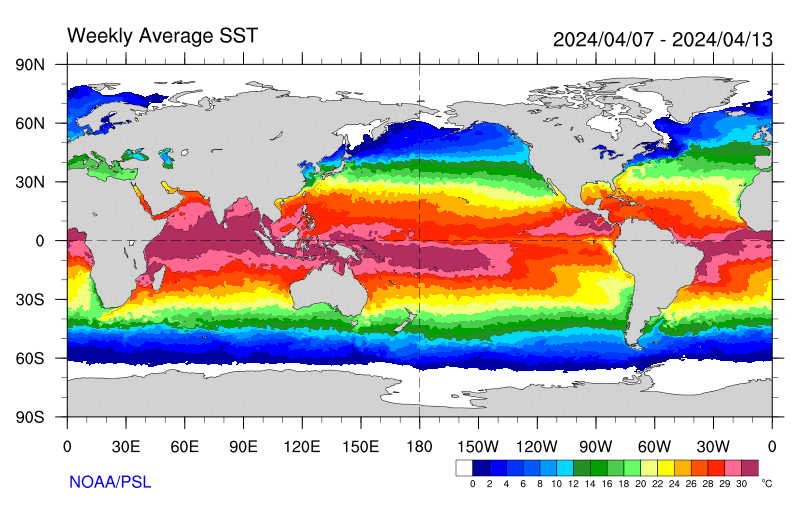
Surface Temperatures. This image uses a color scale
to depict the global pattern of sea surface temperatures (SSTs) (in
degrees Celsius) averaged over a recent 7-day period and based on
measurements by infrared sensors onboard Earth-orbiting satellites.
(Depending on your browser, you may have to place your mouse cursor on
the slide bar to the right and scroll down to view the entire image.)
Compare SSTs in the Northern Hemisphere with those in the Southern
Hemisphere. Return to the RealTime Ocean Portal.
Under Geological, click on Current
Earthquake Activity. The USGS Current World
Seismicity page provides a global map of the locations of seismic
(earthquake) events color-coded for the past seven days. The size of
the squares represents the magnitude of recent earthquakes. Note how
earthquakes are concentrated along the margin of the Pacific Ocean.
Details of recent earthquakes can be found by clicking on their map
squares. Return to the RealTime Ocean Portal.
The ocean is home to a wide variety of habitats and organisms.
Under Biological, click on Ocean
"Color" (Productivity). This is
a satellite-derived (SeaWiFS) color-coded map of biological
productivity in the surface waters of the world ocean is averaged from
October 1978 to date. Orange and red indicates the highest
productivity, while dark blue and violet indicate the lowest
productivity. Note the vast areas of relatively low productivity over
the central regions of the subtropical ocean basins. Individual months
within this period may be chosen for viewing. Now return to the RealTime Ocean Portal.
Under Atmosphere/Ocean Interaction, click
on TRMM/GPM
Tropical Rainfall. The TRMM/GPM (Tropical
Rainfall Measuring Mission) page includes color-coded maps of
the Monthly Mean Rainrate (in mm per day) across the tropics for the
last 30 days ending on the present date. Changes in rainfall are linked
to large-scale shifts in the atmosphere/ocean circulation in the
tropics. Now return to the RealTime Ocean Portal.
Take a few minutes when you have time to browse the other data
and information sources available via the RealTime Ocean Portal. Return frequently to learn more about the many resources on
the ocean in the Earth system. Bon voyage!
Historical Events
- 27 August 1881...A Category 3 hurricane made landfall near Savannah, GA and is estimated to have killed about 700 people. (National Weather Service files)
- 27 August 1883...The after effects caused by the Krakatau
explosion in Indonesia, including large tsunami waves of up to 300
feet, killed 36,000 people. The tsunami waves were powerful enough to
cross the Indian Ocean and travel beyond Cape Horn. The most powerful
blast was the most violent known in human history, was loud enough to
be heard in Australia, and the shock wave was registered by barometers
England. The huge amount of volcanic dust thrust high into the
stratosphere eventually traveled around the world. The dust blocked
sunlight causing temperature drops and chaotic weather patterns for
several years afterward. (Wikipedia) (Today in Science History)
- 27 August 1893...The first of three great hurricanes that
year struck South Carolina drowning more than 1000 persons in a storm
surge at Charleston. This Category 3 (possibly Category 4) hurricane on the Saffir-Simpson Scale slammed into Savannah, GA with a 16-foot storm surge. Landfall was just south of Savannah, GA where sustained winds hit 120 mph. (David Ludlum) (National Weather Service files)
- 27 August 1964...Hurricane Cleo battered Miami and the
South Florida area, marking the first direct hit for Miami in fourteen
years. Sustained winds of 100 mph gusted to 135 mph, and the hurricane
caused $125 million in damage. (David Ludlum)
- 27 August 1971...Tropical Storm Doria swept directly over New York City, flooding subways in the Big Apple. (National Weather Service files)
- 27 August 1995...Remains of Tropical Storm Jerry unloaded
12.32 inches of rain in 24 hours in Greer, SC, a record for 24 hours,
for a rain event and for August. At Antreville, 17.00 inches fell in 24
hours, setting a 24-hour rainfall record for the Palmetto State.
(Intellicast)
- 27 August 2005...Hurricane Katrina reached Category 3 intensity in the Gulf of Mexico about 335 miles south-southeast of the mouth of the Mississippi River with maximum sustained winds of 115 mph. (National Weather Service files)
- 28-30 August 1839...A hurricane moved from Cape Hatteras,
NC to offshore New England. An unusual feature of the hurricane was the
snow it helped produce, which whitened the Catskill Mountains of New
York State. Considerable snow was also reported at Salem, NY. (The
Weather Channel)
- 28 August 1937...A devastating cyclone hit Hong Kong, killing 11,000. (National Weather Service files)
- 28 August 1965...CDR Scott Carpenter, USN, and nine
aquanauts entered SeaLab II, 205 ft. below Southern California's waters
to conduct underwater living and working tests. (Naval Historical
Center)
- 28 August 1988...Tropical Storm Chris spawned a tornado
near Manning, SC, which killed one person, and spawned three tornadoes
in North Carolina. Chris produced one to two-foot tides, and three to
six-inch rains, over coastal South Carolina. (The National Weather
Summary) (Storm Data)
- 28 August 2005...Hurricane Katrina attained category 5 status (on the Saffir-Simpson Scale) on the morning of the 28th and reached its peak strength at 1 PM CDT that day, with maximum sustained winds of 175 mph and a minimum central pressure of 902 millibars (or 26.6 inches of mercury). (National Weather Service files)
- 28 August 2011...After striking eastern North Carolina on the 27th as a category 1 hurricane (on the Saffir-Simpson Scale), Hurricane Irene weakened to a tropical storm as it moved into New York State and New England. Widespread flooding occurred from New Jersey through New York to Vermont, with 14 river flooding records broken in the Empire State alone. Ten thousand flights were canceled and several interstates were closed. Forty people lost their lives. (National Weather Service files)
- 29 August 1583...The Delight was
wrecked on Sable Island, Nova Scotia during a heavy gale, blinding rain
and thick fog. This was Canada's first recorded marine disaster, taking
85 lives. (The Weather Doctor)
- 29 August 1979...Winds associated with Hurricane David
reached 145 mph as the hurricane crossed the island of Dominica. The
capital city, Roseau, was devastated, with 56 fatalities and 60,000 out
of a population of 80,000 left homeless. About three-quarters of the
coconut and banana crops were destroyed. (Accord's Weather Guide
Calendar)
- 29 August 1988...The remnants of Tropical Storm Chris
drenched eastern Pennsylvania with up to five and a half inches of
rain, and produced high winds that gusted to 90 mph, severely damaging
a hundred boats in Anne Arundel County, MD. (The National Weather
Summary) (Storm Data)
- 29 August 1994...Hurricane John, also known as Typhoon John, lasted 30 days as it affected both the northeast and northwest Pacific basins making it the longest lasting tropical cyclone. It formed in the northeast Pacific, reached hurricane force there, moved across the Dateline and was renamed Typhoon John, and then finally recurved back across the dateline and renamed Hurricane John again. (National Weather Service files)
- 29 August 2005...Hurricane Katrina, the costliest and one
of the five deadliest hurricanes in US history, made landfall along the
Louisiana Gulf Coast southeast of New Orleans as a category 3 on the
Saffir-Simpson Scale after reaching category 5 status earlier. Massive
destruction was reported in coastal Mississippi and in New Orleans. As
many as 1833 people reportedly died from Katrina in the US. (National
Hurricane Center)
- 30 August 1913...The US Navy tested the Sperry gyroscopic
stabilizer (automatic pilot). (Naval Historical Center)
- 30 August 1942...A hurricane weakened in moving 160 miles
across south Texas from landfall at Matagorda to San Antonio, winds
still gusting from 50 to 70 mph at San Antonio for more than five
hours. Seventy of 75 planes were damaged at the city airport. Many
trees were destroyed, but the famed Alamo's walls withstood the storm.
(Accord's Weather Guide Calendar)
- 31 August 1842...The U.S. Naval Observatory was authorized
by an act of Congress. (Today in Science History)
- 31 August 1954...Hurricane Carol swept across eastern New England killing 60 persons and causing $450 million damage. It was the first of three hurricanes to affect New England that year. (National Weather Service files)
- 31 August 1979...Category 5 Hurricane David destroyed 70% of the Dominican Republic and took the lives of 2,000 of her citizens. The storm would go on to strike the U.S. and produce torrential rains up the entire length of the East Coast. (National Weather Service files)
- 1 September 1858...The first transatlantic cable failed
after less than one month of service. (Today in Science History)
- 1-2 September 1935...Perhaps the most intense hurricane
ever to hit the U.S. struck the Florida Keys with sustained winds of
over 155 mph with gusts exceeding 200 mph. On the 1st,
the "Labor Day Hurricane" formed rapidly over the Bahama Islands and
intensified into a Category 5 hurricane (on the Saffir Simpson Scale)
with sustained winds of over 155 mph and gusts exceeding 200 mph. On
the next day, this hurricane generated a 15-foot tide and waves 30-ft
high, as it became the first known Category 5 hurricane to hit the U.S.
Mainland. More than 400 persons perished in the storm on that Labor
Day, including many World War I veterans building a bridge from the
Keys to the mainland. The barometric pressure at Matecumbe Bay, FL hit
a record low for the U.S. at 26.35 inches of mercury (or 892
millibars). (David Ludlum) (The Weather Doctor)
- 1 September 1974...Navy Lieutenant Judy Neuffer became the
first woman to pilot a plane through the eye of a hurricane. (Northern
Indiana NWSFO)
- 1 September 1985...A joint French-American expedition
headed by the American explorer, Robert D. Ballard, located the wreck
of the sunken liner RMS Titanic on the floor of the
North Atlantic using an experimental and unmanned submersible craft Argo.
The wreckage of the Titanic, which sank in April 1912 on its maiden
voyage after colliding with an iceberg, was found at a depth of about
13,000 feet and approximately 400 miles west of Newfoundland. (The
History Channel)
- 1 September 2002...Typhoon Rusa was the most powerful typhoon to hit South Korea in over 40 years as 132 people were reported dead or missing. Winds gusted up to 127 mph and up to 36 inches of rain fell in eastern and southern South Korea. (National Weather Service files)
- 2 September 1752...The British Empire adopted the Gregorian
Calendar, nearly two centuries later than most of western Europe
(primarily 1582). To correct the imprecise leap year correction in the
Julian Calendar, 11 days were dropped making the following day 14
September. (Wikipedia) (Today in Science History)
- 2 September 1775...The 1775 Newfoundland hurricane, also known as the "Independence Hurricane", was a hurricane that hit the Colony of Newfoundland in September 1775. It is believed to have killed at least 4,000 people, making it one of the deadliest Atlantic hurricanes of all time. The death toll in Virginia and North Carolina was 163 lives. (National Weather Service files)
- 2 September 1935...The 1935 Labor Day Hurricane, one of the most intense hurricanes to ever hit the U.S., struck the Florida Keys, packing 200-mph winds and killing between 408 to 600 people. The hurricane produced a 15-foot tide and storm surge waves 30 feet high. The barometric pressure at Matecumbe Bay, FL hit a United States record low of 26.35 inches of mercury (892.4 mb). (National Weather Service files)
Return to RealTime Ocean Portal
Prepared by AMS Ocean Studies Central Staff and Edward J. Hopkins,
Ph.D.,
email hopkins@aos.wisc.edu
© Copyright, 2018, The American Meteorological Society.