Paleoceanography is the reconstruction and study of past environmental conditions of the ocean utilizing a variety of information sources—especially analysis of deep-sea sediment cores. These sources are biological, physical, chemical, and geological data extracted from organic and inorganic particles that accumulate on the ocean floor. Many of these data sources provide information on the ocean temperature at the time of death of an organism. Combined with dating methods such as radiocarbon dating, the sequence of Earth's magnetic reversals as recorded in spreading ocean crust, and glacial ice cores from polar regions, paleooceanographers are able to construct a time series of the past environmental conditions including changes in climate.
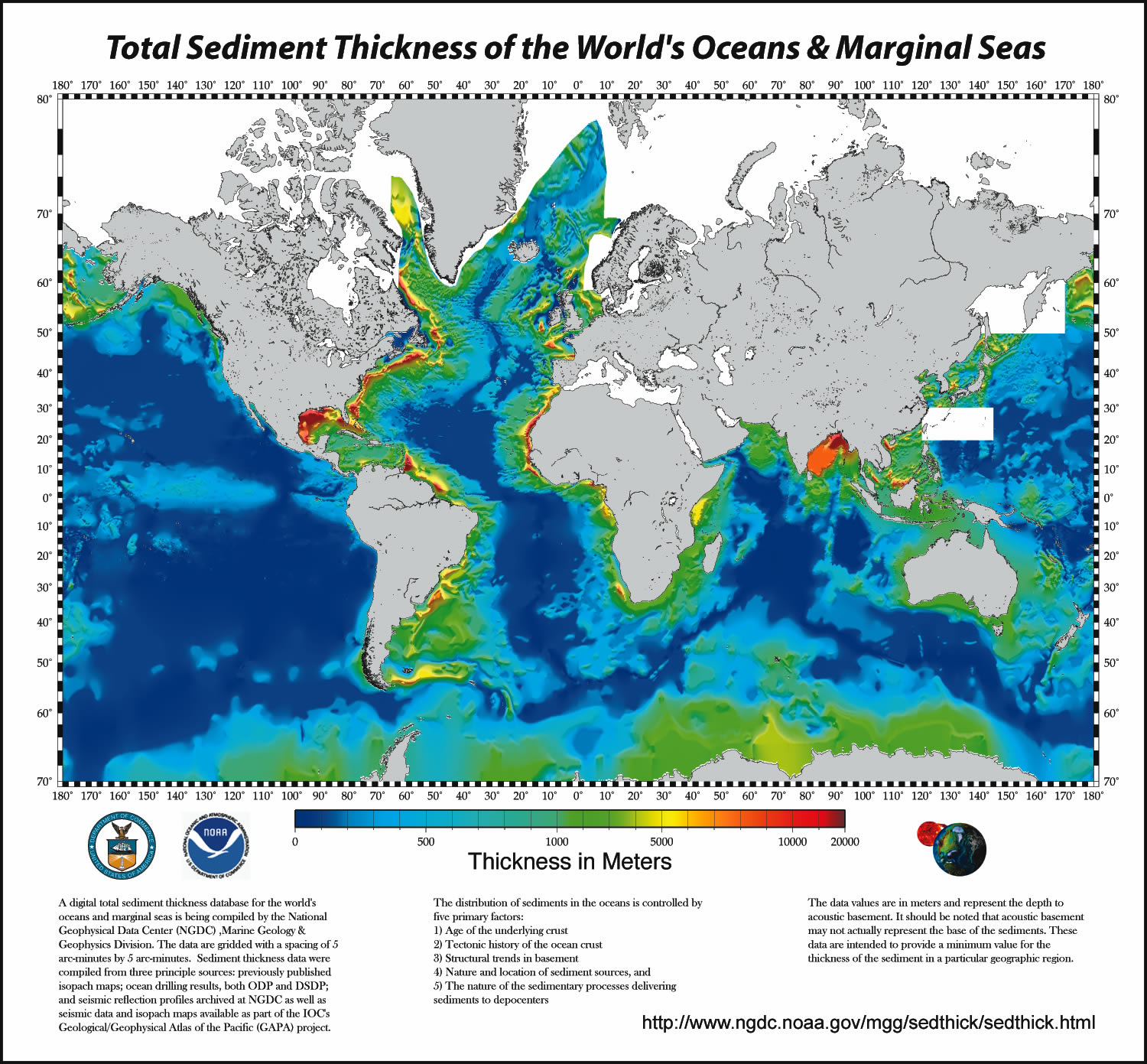
Over tens of thousands of years, many layers of siliceous and calcareous ooze and other particles accumulate from hundreds to thousands of meters over much of the world's ocean bottom. Approximately 75% of the ocean bottom is covered with hundreds of meters of sediment, while 20% of the bottom is covered with more than one thousand meters of sediment. The rest is bare crust. A link from the DataStreme Ocean Homepage entitled Sediment Thickness provides a map of the total sediment thickness of the world's oceans.
Scientists try to match marine sediments in one area with those in other locations, and then correlate these environmental time series to events that happened on land including climatic episodes such as the glacial/interglacial fluctuations of the Pleistocene ice age. In this way, the timing, duration, and sometimes the magnitude of changes, in ocean temperature and circulation can be reconstructed over tens to hundreds of thousands of years. These marine sediment records are obtained by driving coring tubes into the ocean bottom. The longer the length of core, the more time the core covers. Sea bottom corers are either of the gravity or piston type. Sedimentary records are also obtained by drilling into the sea floor.
Methods of age-determination are key to correlating events from sediment cores obtained from different parts of the ocean. The record of reversals in Earth's magnetic field is a valuable tool in correlating events because variations in the magnetic field affect the entire planet simultaneously. This chronology is based on radiometric dating of minerals crystallized in lava flows on land, as well as on the ocean bottom. Radiocarbon dating is useful for determining the time of death of organisms younger than about 70,000 years. Violent volcanic eruptions can produce an ash cloud that is carried by the winds around the world before finally settling to the Earth's land, ice, and water surfaces. A thin layer of volcanic ash in a sediment core serves as an index for correlation with other sedimentary records from elsewhere in the ocean and on the continents.
The shell or skeletal remains of organisms contained in sediment cores are useful in interpreting past environmental conditions. Certain organisms live only in the tropics or temperate or polar regions, which means that they are sensitive to temperature, an important climatic parameter. Few marine organisms inhabit all three (tropics, temperate and polar) regions, so that seldom does one find the same organism in all the cores from all over the world ocean dating from the same time. Another valuable method of reconstructing past variations in climate is chemical analysis of the oxygen isotope ratio in shells (Chapter 12). In this way, scientists have been able to reconstruct the fluctuations of the planet's glacial ice cover over the past 600,000 years from deep-sea cores. Finally, the direction in which certain shells coil varies with water temperature. While few of these indicators reveal precise water temperatures, they enable scientists to distinguish cold and warm episodes.
While cores of sediment extracted from the seafloor are a rich source of information on marine, terrestrial, and atmospheric conditions of the past, many factors can impact the integrity of the core record so that interpretation of sediment cores must be carried out with considerable care and skill. Among the concerns is rate of sedimentation, timing of events, and proper interpretation of the environmental conditions indicated by the organic and inorganic components of the core. Furthermore, not only do conditions in the ocean change, but also the location of the seafloor changes with movement of tectonic plates.
In an undisturbed core, the most recent (youngest) sediment is at the top of the core and the oldest sediment is at the bottom. If a layer of volcanic ash or shells were present within the core and if these can be dated by radiometric means (e.g., radiocarbon dating), then sediments above the dated layer are younger than the sediments below the dated layer. Then, the dated layer and the sediments above and below can be reliably placed in the sedimentary record and compared with other terrestrial and ocean cores and records from around the world. However, the actions of sediment-burrowing organisms can disturb the orderly time-sequence of a sediment core. This process, known as bioturbation, is discussed in Chapter 10.
The thickness of a sediment layer depends on the rate and length of time of sedimentation. Deep-sea sediments typically accumulate very slowly—often less than 1 cm per 1000 years (about the rate that dust settles on a table in a house). Hence, at a rate of 0.25 cm per 1000 years, a 5-m (16.4-ft) core represents an environmental record spanning 2 million years. Cores collected at sea by gravity corers are typically 2 to 3 m (6.5 to 10 ft) long, but can be as long as 18 m (60 ft) using piston corers. At a sedimentation rate of 0.25 cm per 1000 years, an 18 m core represents 7 million years; at 1 cm per 1000 years, 1.8 million years; and at 5 cm per 1000 years, 0.4 million years. The entire Pleistocene Ice Age lasted from 1.7 million to 10,500 years ago so that it is entirely possible that a single deep-sea core could cover the entire period. Furthermore, the Ocean Drilling Program (ODP) has conducted deep-sea drilling in some places to at least 5000 m (16,400 ft) below the sea floor with the oldest sediments dating from the Triassic Period of the Mesozoic Era, about 227 million years ago. Complicating matters, however, are variations in rates of sedimentation (perhaps including episodes when sedimentation ceased entirely), and compaction of sediments (more at the bottom of the sediment core and less at the top).
Return to DSOcean Homepage
URL: DSOcean/supl.html
Prepared by H. J. Niebauer, Joseph M. Moran and Edward J. Hopkins, Ph.D., email hopkins@meteor.wisc.edu
© Copyright, 2004, The American Meteorological Society.