Weekly Ocean News
DATASTREME OCEAN PREVIEW WEEK: 16-20 January 2006
Ocean in the News:
- (Thurs.) Retrieving ancient history from beneath Chesapeake Bay
-- Scientists are beginning to study the cores extracted from over a
one-mile deep boring into the rocks and sediments of an impact crater zone
alongside Chesapeake Bay, the nation's largest estuary. These cores should
provide information on the history of this coastal and continental shelf region
during the last 35 million years. [EurekAlert!]
- (Thurs.) Rare right whales spotted off Texas coast -- An
endangered Northern right whale and her calf were spotted off the Corpus
Christi ship channel recently. The whales normally winter off Georgia and
Florida leading to a mystery in their location. [CNN]
- (Tues.) Whale breeding affected by atmospheric and ocean
circulation changes -- An international team of scientists report that
breeding success of right whales in the South Atlantic Ocean appear to be
associated with El Niño events, anomalous changes in the large-scale
atmospheric and oceanic circulation patterns that are typified by abnormally
warm equatorial waters in the eastern Pacific. [EurekAlert!]
- (Tues.) Deployment of artificial reefs is an involved process
-- While artificial fishing reefs have been deployed in the Gulf of Mexico
for several decades to provide a habitat for fish, newer environmental concerns
and regulations necessitate increased efforts in using appropriate materials.
[ENN]
- Looking to the Pacific to forecast spring weather in US -- Last
week, scientists at the Climate Prediction Center reported that a recent
cooling in the equatorial waters of the eastern Pacific Ocean has resulted in a
weak version of an event called La Niña, which could signal the
development of an atmospheric and oceanic circulation pattern that could
persist up to six months and possibly affect the weather regimes across the US.
[NOAA News]
- A top view of an Australian "hurricane" -- An image
obtained last week from the MODIS (Moderate Resolution Imaging
Spectroradiometer) sensor onboard NASA's orbiting Terra satellite captures a
view of Tropical Cyclone Clare off the Pilbara coast of West Australia; this
tropical cyclone is the Indian Ocean counterpart of a hurricane. [NASA
Earth Observatory]
- Submarine oil and gas reserve environments studied -- University of
Liverpool scientists are collaborating with several large multinational oil
companies in studying the transport and deposition of sand in deep submarine
channels to determine the nature of oil and gas reserves that become buried in
these channels. [EurekAlert!]
- Maine to regulate cruise ship wastewater discharge -- The Maine
Department of Environmental Protection has implemented a permit system that
requires that wastewater discharges from cruise ships within three miles of the
Maine coast to be as clean as wastewater treated onshore. [US Water
News Online]
- Massive freshwater flood into ocean could have affected climate --
Researchers at the Goddard Institute for Space Studies have been using
atmosphere-ocean coupled climate models to study the climatic response to the
large pulse of freshwater that flooded into the North Atlantic from interior
North America approximately 8000 years ago, which appears to have resulted in
an abrupt change in the oceanic circulation pattern that caused the documented
change in climate. [EurekAlert!]
The change in the circulation in the North Atlantic caused by the freshwater
appears to have been responsible for a three-century cooling that resulted in a
lowering of the average temperatures by 7 Celsius degrees in Greenland and one
Celsius degree in Europe. [The New Scientist]
- Global and US Hazards/Climate Extremes -- A review and analysis of
the global impacts of various weather-related events, including drought,
floods, and storms during the current month. [NCDC]
- Earthweek -- Diary of the Planet [earthweek.com] Requires
Adobe Acrobat Reader.

Concept of the Week: Touring the DataStreme Ocean Website
Welcome to DataStreme Ocean! You are embarking on a study of the world ocean
and the role of the ocean in the Earth system. This unique teacher enhancement
course focuses on the flow and transformations of energy and water into and out
of the ocean, the internal properties and circulation of the ocean,
interactions between the ocean and the other components of the Earth system,
and the human/societal impacts on and responses to those interactions.
Throughout this learning experience, you will be using the
DataStreme
Ocean website to access and interpret a variety of environmental
information, including recent observational data. The objective of this initial
Concept of the Week is to explore features of the DS Ocean
website.
On Monday of each week of the course, we will post the current Weekly
Ocean News that includes Ocean in the News (a summary listing of
recent events related to the ocean), Concept of the Week (an in-depth
analysis of some topic related to the ocean in the Earth system), and
Historical Events (a list of past events such as tsunamis or specific
advances in the understanding of oceanography). When appropriate,
Supplemental Information will be provided on some topic related to the
principal theme of the week.
You will use the DS Ocean website to access and download the second
part of weekly Investigations A & B (plus supporting images) that begin in
your DataStreme Ocean Investigations Manual. These materials should be
available by noon (Eastern Time) on Tuesday and Thursday. Click the appropriate
links to download and print these electronic components of the investigations
as well as your Chapter Progress and Investigations Response forms.
The body of the DS Ocean website provides links to the Earth System,
information on Physical & Chemical, Geological, and Biological aspects of
the ocean, Atmosphere/Ocean Interaction, the Great Lakes, and extras--a
glossary of terms, maps, educational links, and DataStreme Ocean
information. Following each section is a link to other sites that examine the
various subsystems of the Earth system. Let's take a quick tour to become more
familiar with the DS Ocean website.
Under Physical & Chemical, click on
Sea Surface
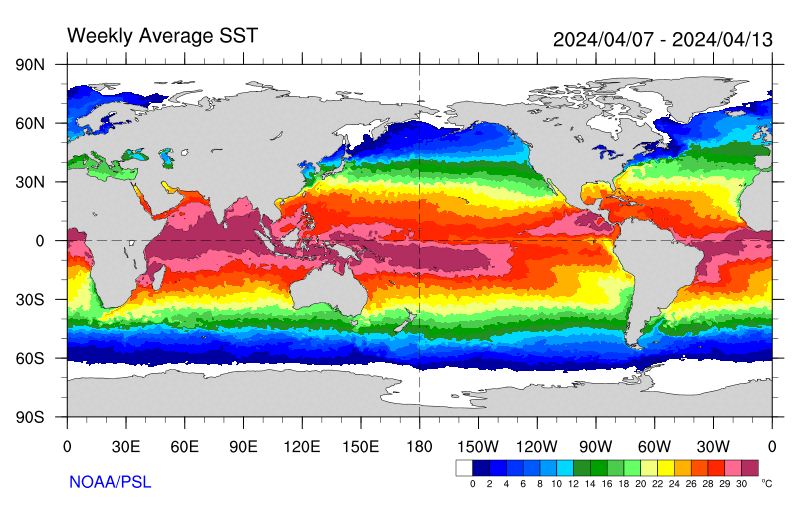
Temperatures. This image uses a color scale to depict the global
pattern of sea surface temperatures (SSTs) (in degrees Celsius) averaged over a
recent 7-day period and based on measurements by infrared sensors onboard
Earth-orbiting satellites. (Depending on your browser, you may have to place
your mouse cursor on the slide bar to the right and scroll down to view the
entire image.) Compare SSTs in the Northern Hemisphere with those in the
Southern Hemisphere. Return to the DS Ocean website.
Under Geological, click on
Current Earthquake
Activity. (Note: This may load slowly.) The USGS Current World
Seismicity page provides a global map of the locations of seismic (earthquake)
events color-coded for the last week or 30 days. The diameters of the circles
represent the magnitude of the most recent earthquakes. Note how earthquakes
are concentrated along the margin of the Pacific Ocean. Details of recent
earthquakes can be found by clicking on their map circles and are given in
Current Earthquakes for the U.S. and World. Return to the DS
Ocean website.
The ocean is home to a wide variety of habitats and organisms. Under
Biological, click on
Ocean
"Color" (Productivity). This is a satellite-derived
(SeaWiFS) color-coded map of biological productivity in the surface waters of
the world ocean averaged for the year 2004 to date. Orange and red indicates
the highest productivity and dark blue and violet indicate the lowest
productivity. Note the vast areas of relatively low productivity over the
central regions of the subtropical ocean basins. Now return to the DS
Ocean website.
Under Atmosphere/Ocean Interaction, click on
TRMM
Tropical Rainfall. The TRMM (Tropical Rainfall Measuring
Mission) page includes color-coded maps of the Monthly Mean Rainrate (in mm
per day) across the tropics. Click on "July" for example. Changes in
rainfall are linked to large-scale shifts in the atmosphere/ocean circulation
in the tropics. Now return to the DS Ocean website.
Take a few minutes when you have time to browse the other data and
information sources available via the DS Ocean website. You should
"bookmark" ("favorites") this page on your computer. Return
frequently to learn more about the many resources on the ocean in the Earth
system. Bon voyage!
Concept of the Week: Questions
- The latest global sea surface temperature map indicates that SSTs are
generally higher over the
[(western)(eastern)] tropical
Pacific Ocean.
- The USGS map of Current Earthquake Activity indicates that earthquakes
appear to be more common along the
[(east)(west)] coast of North
America.
Historical Events
- 17 January 1773...HMS Resolution, commanded by English explorer
Captain James Cook, became the first ship to cross the Antarctic Circle
(66º 33' S). {Wikipedia]
- 17 January 1779... The English explorer Captain James Cook made his last
notation in ship's log Discovery. He was killed less than one month
later on Hawaii's Big Island.
- 18 January 1778...The English explorer Captain James Cook sailed past the
island of Oahu, thereby becoming the first European to see the Hawaiian
Islands, which he called the "Sandwich Islands." (The History
Channel)
- 18-22 January 1978...The Atlantic's first-ever January subtropical storm
with tropical characteristics since records began in 1871 organized 1500 miles
east-northeast of Puerto Rico. The storm finally dissipated on the 22nd
approximately 200 miles north of Puerto Rico. (Accord's Weather Calendar)
- 19 January 1840...LT Charles Wilkes, USN was the first American to sight
the eastern Antarctic coast, claiming this portion of the continent for the
United States. The group that he led explored a 1500-mile stretch of the coast
of eastern Antarctica, which later became known as Wilkes Land. (Naval
Historical Center)
- 19 January 1946...Staged jointly by the USCG and USN, the first public
demonstration of LORAN was held at Floyd Bennett Field in New York. (USCG
Historian's Office)
- 19 January 1996...The tug Scandia and its barge, the North
Cape, ran aground on the shore of Rhode Island, spilling 828,000 gallons of
oil, the worst spill in that state's history. The Coast Guard rescued the
entire crew, pumped off 1.5 million gallons of oil and conducted skimming
operations. (USCG Historian's Office)
- 20 January 1606...As many as 2000 people died around the Severn Estuary in
England as the result of severe flooding. (The Weather Doctor)
- 20 January 1850...The Investigator, which was the first ship
to effect a Northwest Passage, left England.
- 20 January 1914...The International Ice Patrol Convention was signed. (USCG
Historian's Office)
- 20 January 1986...The United Kingdom and France announced plans to
construct the Channel Tunnel, a railway tunnel underneath the English Channel,
also known as the "Chunnel." (Wipikedia)
- 21 January 1881...The light was first shown at Tillamook Lighthouse,
located 19 miles south of the Columbia River entrance on the Oregon coast.
(USCG Historian's Office)
- 21 January 1941...The first commercial extraction of magnesium from
seawater was made at Freeport, TX.
- 21 January 1954...The first nuclear powered submarine, the USS Nautilus,
was launched on the Thames River in Groton, CT, representing a landmark in the
history of naval engineering and submersible craft. First Lady Mamie Eisenhower
christened the vessel, which sailed beneath the Arctic icepack to the North
Pole in 1958. (Today in Science)
Return to DataStreme Ocean Website
Prepared by DS Ocean Central Staff and Edward J. Hopkins, Ph.D.,
email hopkins@meteor.wisc.edu
© Copyright, 2006, The American Meteorological Society.