Weekly Ocean News
DATASTREME OCEAN WEEK ONE: 22-26 January 2007
Ocean in the News:
- (Thurs.) Estuarine health could be affected by pesticide --
Researchers at the NOAA National Centers for Coastal Ocean Science have
identified potential adverse effects that atrazine, a commonly used herbicide,
could have upon phytoplankton, which would also affect estuarine health because
of their position near the bottom of the aquatic food chain. [NOAA News]
- (Thurs.) "Fossil" shark filmed swimming off Japan
-- A frilled shark, known primarily from fossil remains, was seen and
filmed swimming near the surface in Awashima Marine Park in Shizuoka, south of
Tokyo. The shark usually inhabits waters of 600 to 1000 meters. The shark was
weakened and subsequently died. [CNN]
- (Thurs.) Antarctic seafloor fauna discovered -- A remotely
operated submersible vehicle recently discovered a variety of living organisms
on the ocean floor off Antarctica as part of the current Polarstern
expedition conducted by the Alfred Wegener Institute for Polar and Marine
Research. [EurekAlert!]
- (Thurs.) A sobering view of the Big Easy -- A photograph
taken by an astronaut on the International Space Station shows a view of the
New Orleans (LA) metropolitan area and neighboring Lake Pontchartrain that
could pose a problem for the Big Easy, which is slowly subsiding below sea
level. In 2005, Hurricane Katrina showed the vulnerability of this city. [NASA
Earth Observatory]
- (Thurs.) Coordinating time with GPS and the Web --
International cooperation in time coordination across the North and South
American continents has been created through the time and frequency network of
the Inter-American Metrology System (Sistema Interamericano de Metrologia),
which began operation in 2005 as a low cost system employing GPS satellites and
the Internet. [EurekAlert!]
- (Tues.) 2006 Atlantic hurricane season near "normal" --
NASA and NOAA meteorologists and hurricane specialists are continuing
their research into explaining why the activity during the recently-concluded
2006 hurricane season in the North Atlantic basin turned out to be near the
long term average after they had forecasted another above average season. These
researchers are utilizing a wide variety of environmental data, such as sea
surface temperatures, tropical rainfall rates, atmospheric dust loading and
winds at various atmospheric levels, collected by instruments on the fleet of
NASA and NOAA satellites. [NASA
Earth Observatory] More images and other links appear on a separate NASA
Mission site. [NASA]
- (Tues.) Could El Niño be fading? -- The director of
NOAA's National Centers for Environmental Prediction recently reported that the
current atmospheric conditions that scientists have identified as an "El
Niño pattern" appear to be fading and that some of its impacts upon
the weather across North American may be abating. However, climate scientists
caution that this assessment needs more study. [USA
Today]
- (Tues.) Studying a major asteroid impact crater -- A
geologist at the University of Alaska-Fairbanks has been studying the coring
made into an impact crater on Mexico's Yucatan Peninsula, created by a giant
asteroid that hit Earth's surface approximately 65 million yeas ago, resulting
in a thick dust cloud, a massive tsunami and the release of carbon gases that
ultimately affected the world's climate and led to the demise of the dinosaurs.
[EurekAlert!]
- (Tues.) Evidence of climatic change found in Arctic mud --
Geologists from the University at Buffalo who have reconstructed past climates
from Arctic mud cores on Canada's Baffin Island have found that the temperature
signal in the Arctic has a greater amplitude during the last 10,000 years than
comparable records elsewhere. [University
at Buffalo]
- Selecting a homeport for nation's ocean exploration ship -- As part
of an environmental assessment process, National Oceanic and Atmospheric
Administration (NOAA) officials are evaluating Rhode Island's Quonset
Point/Davisville as the homeport for the Okeanos Explorer, the
nation’s first federal ship dedicated solely to ocean exploration. [NOAA News]
- Glacial sediments seen entering Gulf of Alaska -- An image obtained
recently from the MODIS (Moderate Resolution Imaging Spectroradiometer)
instrument on NASA's Aqua satellite reveals a variety of colors in the near
surface waters of the Gulf of Alaska, including the swirling plume of glacial
sediments that was carried into the Gulf from the Copper River in southeast
Alaska. [NASA
Earth Observatory]
- Fish-kill mystery unraveled -- Researchers at the NOAA Hollings
Marine Laboratory have discovered that an algae species that is usually
inoffensive can suddenly produce a lethal toxin which is linked to mass fish
kills in coastal waters along the East Coast. [EurekAlert!]
These results provide some vindication for a researcher at North Carolina State
University who had earlier claimed that a toxic marine microbe was responsible
for the fish kill. [US Water
News Online]
- Offshore wind power farms supported -- A survey of Delaware
residents conducted by researchers at the University of Delaware indicates that
the construction of offshore wind power farms to serve as a future energy
source for the state is favored by a majority of respondents. [University of
Delaware]
- Global and US Hazards/Climate Extremes -- A review and analysis of
the global impacts of various weather-related events, including drought,
floods, and storms during the current month. [NCDC]
- Earthweek -- Diary of the Planet [earthweek.com] Requires
Adobe Acrobat Reader.

Concept of the Week: Touring the DataStreme Ocean Website
NOTE: This Concept for the Week is a repeat of that which appeared in
last week's Weekly Ocean News.
Welcome to DataStreme Ocean! You are embarking on a study of
the world ocean and the role of the ocean in the Earth system. This unique
teacher enhancement course focuses on the flow and transformations of energy
and water into and out of the ocean, the internal properties and circulation of
the ocean, interactions between the ocean and the other components of the Earth
system, and the human/societal impacts on and responses to those interactions.
Throughout this learning experience, you will be using the
DataStreme
Ocean website to access and interpret a variety of environmental
information, including recent observational data. The objective of this initial
Concept of the Week is to explore features of the DS Ocean
website.
On Monday of each week of the course, we will post the current Weekly
Ocean News that includes Ocean in the News (a summary listing of
recent events related to the ocean), Concept of the Week (an in-depth
analysis of some topic related to the ocean in the Earth system), and
Historical Events (a list of past events such as tsunamis or specific
advances in the understanding of oceanography). When appropriate,
Supplemental Information will be provided on some topic related to the
principal theme of the week.
You will use the DS Ocean website to access and download the second
part of weekly Investigations A & B (plus supporting images) that begin in
your DataStreme Ocean Investigations Manual. These materials should be
available by noon (Eastern Time) on Tuesday and Thursday. Click the appropriate
links to download and print these electronic components of the investigations
as well as your Chapter Progress and Investigations Response forms.
The body of the DS Ocean website provides links to the Earth System,
information on Physical & Chemical, Geological, and Biological aspects of
the ocean, Atmosphere/Ocean Interaction, the Great Lakes, and extras--a
glossary of terms, maps, educational links, and DataStreme Ocean
information. Following each section is a link to other sites that examine the
various subsystems of the Earth system. Let's take a quick tour to become more
familiar with the DS Ocean website.
Under Physical & Chemical, click on
Sea Surface
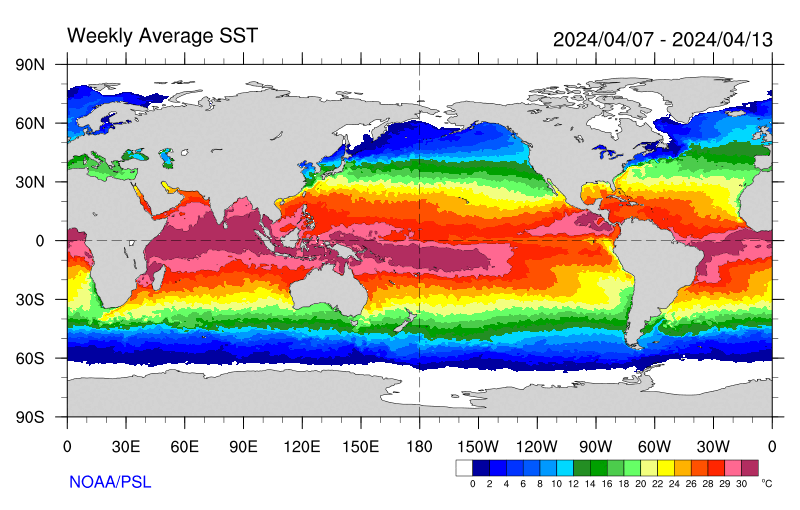
Temperatures. This image uses a color scale to depict the global
pattern of sea surface temperatures (SSTs) (in degrees Celsius) averaged over a
recent 7-day period and based on measurements by infrared sensors onboard
Earth-orbiting satellites. (Depending on your browser, you may have to place
your mouse cursor on the slide bar to the right and scroll down to view the
entire image.) Compare SSTs in the Northern Hemisphere with those in the
Southern Hemisphere. Return to the DS Ocean website.
Under Geological, click on
Current Earthquake
Activity. (Note: The contents of this link may load slowly.) The USGS
Current World Seismicity page provides a global map of the locations of seismic
(earthquake) events color-coded up to the last week. The size of the yellow
squares represent the magnitude of the most recent earthquakes. Note how
earthquakes are concentrated along the margin of the Pacific Ocean. Details of
recent earthquakes can be found by clicking on their map squares. Return to the
DS Ocean website.
The ocean is home to a wide variety of habitats and organisms. Under
Biological, click on
Ocean
"Color" (Productivity). This satellite-derived
(SeaWiFS) color-coded map of biological productivity in the surface waters of
the world ocean is averaged from October 1978 to date. Orange and red indicates
the highest productivity, while dark blue and violet indicate the lowest
productivity. Note the vast areas of relatively low productivity over the
central regions of the subtropical ocean basins. Individual months within this
period may be chosen for viewing. Now return to the DS Ocean website.
Under Atmosphere/Ocean Interaction, click on
TRMM
Tropical Rainfall. Under Atmosphere/Ocean Interaction, click on
TRMM Tropical Rainfall. The TRMM (Tropical Rainfall Measuring
Mission) page includes links to color-coded maps of the Monthly Mean
Rainrate (in mm per day) across the tropics for the last 30 days ending on the
present date, along with an anomaly map displaying the differences between the
recent 30-day averages and the corresponding multi-year averages. Changes in
rainfall are linked to large-scale shifts in the atmosphere/ocean circulation
in the tropics. Now return to the DS Ocean website.
Take a few minutes when you have time to browse the other data and
information sources available via the DS Ocean website. You should
"bookmark" ("favorites") this page on your computer. Return
frequently to learn more about the many resources on the ocean in the Earth
system. Bon voyage!
Concept of the Week: Questions
- The latest global sea surface temperature map indicates that SSTs are
generally higher over the
[(western)(eastern)] tropical Pacific Ocean.
- The USGS map of Current Earthquake Activity indicates that earthquakes
appear to be more common along the
[(east)(west)] coast of North America.
Historical Events
- 26 January 1700...The Cascadia Earthquake (magnitude 9) took place off the
coast of British Columbia, as evidenced by Japanese records. Landslides and a
tsunami destroyed many Native American villages along the coasts of Washington,
Oregon and British Columbia, including Vancouver Island. Japanese written
history tells of a massive tsunami striking fishing villages the next day along
the coast of Honshu, killing hundreds. (Wikipedia) (Today in Science History)
- 26 January 1983...The California coast was battered by a storm, which
produced record high tides, thirty-two foot waves, and mudslides, causing
millions of dollars in damage. The storm then moved east and dumped four feet
of snow on Lake Tahoe. (22nd-29th) (The Weather Channel)
- 28 January 1946...Canada's greatest sailing ship, Bluenose,
foundered on a Haitian reef; all hands were saved. Her likeness remains on the
Canadian ten-cent coin. (Wikipedia)
- 28 January 1969...A series of storms that battered Southern California from
the 18th to the 28th led to $125 million damage in the
Los Angeles Basin, along with approximately 9 storm and traffic-related deaths
in California. Twenty feet of water covered Sherman Island, a region that
contains more than 10,000 dike-protected agricultural acres, when a dike
failed. (Accord's Weather Guide Calendar)
- 28 January 1971...A waterspout swept into Hawaii's Kailua Bay, then into
the business and hotel district of Kailua-Kona, destroying or severely damaging
a number of buildings including 40 apartment units and collapsing a 6-story
hotel under construction. Amazingly, only four people were injured. (Accord's
Weather Guide Calendar)
Return to DataStreme Ocean Website
Prepared by DS Ocean Central Staff and Edward J. Hopkins, Ph.D.,
email hopkins@meteor.wisc.edu
© Copyright, 2007, The American Meteorological Society.