Weekly Ocean News
DATASTREME OCEAN PREVIEW WEEK: 14-18 January 2008
Ocean in the News:
- (Thurs.) Algae bloom seen off New Zealand coast -- A MODIS
image obtained from NASA's Terra satellite during the first week of January
shows a large iridescent green colored seawater off New Zealand's South Island
due to a phytoplankton bloom, or an explosive growth in the number of algae
that developed in the nutrient-rich Pacific Ocean. [NASA
Earth Observatory]
- (Thurs.) Downsized fisheries envisioned -- A marine ecologist
at the University of Southern California recently warned that projected
increases in the temperatures of the world's oceans could cause a reduction in
the Bering Sea fishery, one of the most productive fisheries, by the end of the
century. [EurekAlert!]
- (Tues.) La Niña is expected to continue -- Forecasters
with NOAA's Climate Prediction Center recently claimed that the atmospheric and
oceanic conditions associated with what is called a La Niña event should
continue into spring, resulting in the possibility of above average
precipitation across the northern Rockies, but dry conditions across the
Southeast. A La Niña event typically includes sufficiently strong winds
from the east across the equatorial Pacific to result in below average sea
surface temperatures. [USA
Today]
- (Tues.) Thin new ice replaces older Arctic sea ice -- Using
satellite data that commenced in 1982, researchers at the University of
Colorado at Boulder found that during the record summer of 2007, thin sea ice
has replaced the thicker multi seasonal ice cover. Thin ice could cause a more
rapid summer melt across the basin. [EurekAlert!]
- Eye on the Tropics -- A tropical cyclone (low pressure system that
forms over a tropical ocean basin) developed late last week over the South
Pacific near Fiji. This system, identified as Tropical Cyclone Elisa, moved to
the southeast and weakened after one day, with maximum sustained surface winds
reaching 45 mph. An image from the sensors on the Japanese MTSAT satellite
shows the clouds surrounding this storm system. [NOAA
OSEI] [Editor's note: Since this cyclone is in the southern
hemisphere, the swirl of clouds that serve as tracers of the winds appears to
be clockwise, which is opposite the cloud swirls and winds surrounding northern
hemisphere systems. EJH]
In the western North Pacific basin, the first tropical depression of the year
formed over the South China Sea west of the Philippines on Sunday (local time).
This low pressure system was identified as Tropical Depression-1W and was
moving westward.
Tropical Cyclone Helen traveled across the Gulf of Carpentaria last weekend and
brought torrential rain to northern Australia. An image generated by the NASA
Goddard Space Flight Center's Multi- satellite Precipitation Analysis from data
collected by the Tropical Rainfall Measuring Mission (TRMM) satellite shows the
rainfall pattern across the coastal region from Western Australia to the York
Peninsula. [NASA
Earth Observatory]
- Caution should be exercised in iron fertilization efforts --
Scientists from the US, Japan, New Zealand, India and Europe warned that more
additional experiments were needed to assess the effectiveness of iron
fertilization of ocean waters as a means of reducing the release of carbon
compounds in the atmosphere. Uncertainty remains in how this carbon offset
effort could affect the marine ecosystem. [EurekAlert!]
- Good news for white marlin -- Officials with NOAA's Fisheries
Service recently announced that the highly prized Atlantic white marlin has
shown some population increase and does not appear to be in danger of
extinction; therefore, this fish species should not be listed as threatened or
endangered under the Endangered Species Act. [NOAA
News]
- Caribbean coral reefs impacted by human activity -- A researcher at
Dalhousie University in Halifax, NS recently warned that increased human
activity around the coral reefs in the Caribbean has significantly degraded the
reefs. [EurekAlert!]
- Race to study melting tropical glaciers -- The noted glaciologist
Lonnie Thompson of Ohio State University and his wife Ellen Mosley-Thompson, a
climatologist, have been attempting to obtain ice cores from rapidly melting
tropical glaciers at many far-flung locations, such as on New Guinea, Tibet and
in east Africa, in an effort to determine the climate history from these ice
cores. They are hoping to document the history of El Niño events
associated with anomalous atmospheric and oceanic circulation regimes. [USA
Today]
- New theories developed for vent dynamics below ocean floor --
Seismologists have been collecting data from below the floor of the North
Pacific Ocean off the Mexican coast to create a new model of the
hydrothermal-vent system that helps produce "black smoker " vents.
[EurekAlert!]
- Global and US Hazards/Climate Extremes -- A review and analysis of
the global impacts of various weather-related events, including drought,
floods, and storms during the current month. [NCDC]
- Earthweek -- Diary of the Planet [earthweek.com] Requires
Adobe Acrobat Reader.

Concept of the Week: Touring the DataStreme Ocean Website
Welcome to DataStreme Ocean! You are embarking on a study of the world ocean
and the role of the ocean in the Earth system. This unique teacher enhancement
course focuses on the flow and transformations of energy and water into and out
of the ocean, the internal properties and circulation of the ocean,
interactions between the ocean and the other components of the Earth system,
and the human/societal impacts on and responses to those interactions.
Throughout this learning experience, you will be using the
DataStreme
Ocean website to access and interpret a variety of environmental
information, including recent observational data. The objective of this initial
Concept of the Week is to explore features of the DS Ocean
website.
On Monday of each week of the course, we will post the current Weekly
Ocean News that includes Ocean in the News (a summary listing of
recent events related to the ocean), Concept of the Week (an in-depth
analysis of some topic related to the ocean in the Earth system), and
Historical Events (a list of past events such as tsunamis or specific
advances in the understanding of oceanography). When appropriate,
Supplemental Information will be provided on some topic related to the
principal theme of the week.
You will use the DS Ocean website to access and download the second
part of weekly Investigations "Current Ocean Studies" (plus
supporting images) that begin in your Online Ocean Studies Investigations
Manual. These materials should be available by noon (Eastern Time) on
Tuesday and Thursday. Click the appropriate links to download and print these
electronic components of the investigations as well as your Chapter Progress
and Investigations Response forms.
The body of the DS Ocean website provides links to the Earth System,
information on Physical & Chemical, Geological, and Biological aspects of
the ocean, Atmosphere/Ocean Interaction, the Great Lakes, and extras–a
glossary of terms, maps, educational links, and DataStreme Ocean
information. Following each section is a link to other sites that examine the
various subsystems of the Earth system. Let's take a quick tour to become more
familiar with the DS Ocean website.
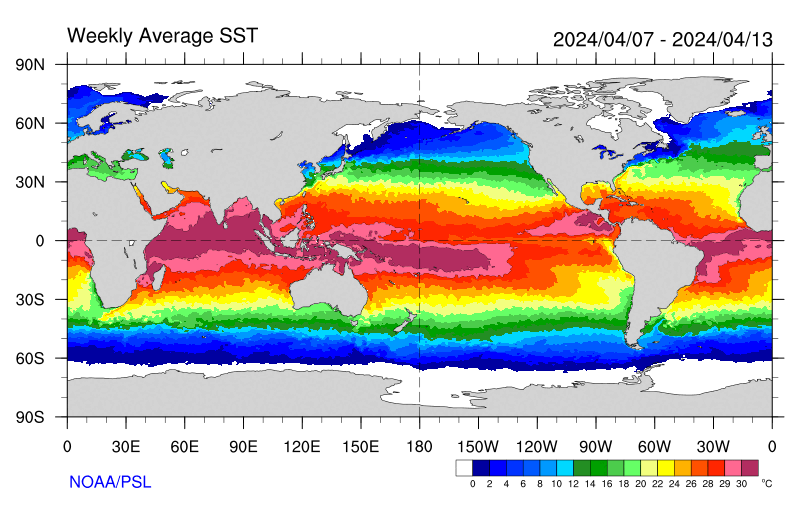
Under Physical & Chemical, click on
Sea Surface
Temperatures. This image uses a color scale to depict the global
pattern of sea surface temperatures (SSTs) (in degrees Celsius) averaged over a
recent 7-day period and based on measurements by infrared sensors onboard
Earth-orbiting satellites. (Depending on your browser, you may have to place
your mouse cursor on the slide bar to the right and scroll down to view the
entire image.) Compare SSTs in the Northern Hemisphere with those in the
Southern Hemisphere. Return to the DS Ocean website.
Under Geological, click on
Current Earthquake
Activity. The USGS Current World Seismicity page provides a global map
of the locations of seismic (earthquake) events color-coded for the past seven
days. The size of the squares represents the magnitude of recent earthquakes.
Note how earthquakes are concentrated along the margin of the Pacific Ocean.
Details of recent earthquakes can be found by clicking on their map squares.
Return to the DS Ocean website.
The ocean is home to a wide variety of habitats and organisms. Under
Biological, click on
Ocean
"Color" (Productivity). This is a satellite-derived
(SeaWiFS) color-coded map of biological productivity in the surface waters of
the world ocean is averaged from October 1978 to date. Orange and red indicates
the highest productivity, while dark blue and violet indicate the lowest
productivity. Note the vast areas of relatively low productivity over the
central regions of the subtropical ocean basins. Individual months within this
period may be chosen for viewing. Now return to the DS Ocean website.
Under Atmosphere/Ocean Interaction, click on
TRMM
Tropical Rainfall. The TRMM (Tropical Rainfall Measuring
Mission) page includes color-coded maps of the Monthly Mean Rainrate (in mm
per day) across the tropics for the last 30 days ending on the present date.
Changes in rainfall are linked to large-scale shifts in the atmosphere/ocean
circulation in the tropics. Now return to the DS Ocean website.
Take a few minutes when you have time to browse the other data and
information sources available via the DS Ocean website. You should
"bookmark" ("favorites") this page on your computer. Return
frequently to learn more about the many resources on the ocean in the Earth
system. Bon voyage!
Concept of the Week: Questions
- The latest global sea surface temperature map indicates that SSTs are
generally higher over the
[(western)(eastern)] tropical Pacific Ocean.
- The USGS map of Current Earthquake Activity indicates that earthquakes
appear to be more common along the
[(east)(west)] coast of North America.
Historical Events
- 15 January 1833...HMS Beagle anchored at Goeree Tierra del Fuego.
- 17 January 1773...HMS Resolution, commanded by English explorer
Captain James Cook, became the first ship to cross the Antarctic Circle
(66º 33' S). (Wikipedia)
- 17 January 1779...The English explorer Captain James Cook made his last
notation in ship's log Discovery. He was killed less than one month
later on Hawaii's Big Island.
- 18 January 1778...The English explorer Captain James Cook sailed past the
island of Oahu, thereby becoming the first European to see the Hawaiian
Islands, which he called the "Sandwich Islands." (The History
Channel)
- 18-22 January 1978...The Atlantic's first-ever January subtropical storm
with tropical characteristics since records began in 1871 organized 1500 miles
east-northeast of Puerto Rico. The storm finally dissipated on the 22nd
approximately 200 miles north of Puerto Rico. (Accord's Weather Guide Calendar)
- 19 January 1840...LT Charles Wilkes, USN was the first American to sight
the eastern Antarctic coast, claiming this portion of the continent for the
United States. The group that he led explored a 1500-mile stretch of the coast
of eastern Antarctica, which later became known as Wilkes Land. (Naval
Historical Center)
- 19 January 1946...Staged jointly by the USCG and USN, the first public
demonstration of LORAN was held at Floyd Bennett Field in New York. (USCG
Historian's Office)
- 19 January 1996...The tug Scandia and its barge, the North
Cape, ran aground on the shore of Rhode Island, spilling 828,000 gallons of
oil, the worst spill in that state's history. The Coast Guard rescued the
entire crew, pumped off 1.5 million gallons of oil and conducted skimming
operations. (USCG Historian's Office)
- 20 January 1606...As many as 2000 people died around the Severn Estuary in
England as the result of severe flooding. (The Weather Doctor)
- 20 January 1850...The Investigator, which was the first ship to
effect a Northwest Passage, left England.
- 20 January 1914...The International Ice Patrol Convention was signed. (USCG
Historian's Office)
- 20 January 1986...The United Kingdom and France announced plans to
construct the Channel Tunnel, a railway tunnel underneath the English Channel,
also known as the "Chunnel." (Wikipedia)
Return to DataStreme Ocean Website
Prepared by DS Ocean Central Staff and Edward J. Hopkins, Ph.D.,
email hopkins@meteor.wisc.edu
© Copyright, 2008, The American Meteorological Society.