Weekly Ocean News
DATASTREME OCEAN WEEK ONE: 21-25 January 2008
Ocean in the News:
- (Thurs.) Small tropical cyclones can relieve a drought--
Researchers at the University of Georgia have analyzed precipitation data
collected by instruments onboard NASA's Tropical Rainfall Measuring Mission
(TRMM) satellite and have concluded that even weak tropical cyclones, including
tropical depressions, tropical storms and hurricanes, can contribute a
significant portion of the region's annual precipitation. They argue that
the lack of tropical cyclones making landfall across the Southeast during
2006 and 2007 has been in part responsible for the current exceptional drought
and that several tropical systems could alleviate the current record Southeast
drought. [NASA
Earth Observatory]
- (Thurs.) Avoiding seabirds -- NOAA is promoting new
measures that protect seabirds from being unintentionally snared by fishing
lines and other fishing gear in the open waters of the Atlantic and Pacific
Oceans. [NOAA
News]
- (Thurs.) An artificial reef becomes a maritime home --
Researchers report that the Jane Yarn, a research vessel at
Gray’s Reef National Marine Sanctuary that was sunk last year with the
intention of becoming an artificial reef off the Georgia reef has
successfully become a home to numerous marine fish and invertebrate
species. [NOAA
News]
- (Thurs.) Tsunami research highlighted -- Researchers at
NASA's Jet Propulsion Laboratory studying tsunamis have discovered a new method
involving the use of NASA's network of global positioning system (GPS)
stations that they claim will significantly improve existing tsunami warning
systems. [NASA
Earth Observatory]
- Grant applications for K-12 Environmental Literacy Project are invited
-- NOAA's Office of Education is currently accepting applications for
environmental literacy projects designed to promote changes in K-12
education. Required pre-proposals need to be submitted by 20 February
2008. [NOAA
News]
- (Tues.) An update on the 2007 temperature records
--Scientists at NOAA's National Climatic Data Center recent reported that
based upon preliminary data, the year 2007 was the tenth warmest across the
coterminous United States since sufficiently dense and reliable climatic
records commenced in 1895. These scientists also found that their
analysis of the weather data from around the word indicates 2007 was the fifth
warmest year globally since 1880. Specifically, they determined
that the global land surface temperature was warmest on record while the global
ocean temperature was ninth warmest of the 128-year record. [NOAA
News] Using temperature data from the conventional land-based weather
station network, ships and satellites, climatologists at NASA's Goddard
Institute for Space Studies have used a separate averaging technique and they
report that 2007 tied 1998 as being the planet's second warmest year. [NASA]
- (Tues.) The Big Island viewed as a coral haven -- As part of
NOAA's Coral Reef Conservation Program, new corral reef maps of the Hawaiian
Islands have been released showing that the waters surrounding the Big Island
of Hawaii have the largest percentage of live coral of all the main islands in
the Aloha State. [NOAA
News]
- (Tues.) West Antarctica ice is lost ---Using satellite data,
researchers at the United Kingdom's University of Bristol claim that West
Antarctica has been losing increasing amounts of ice mass during the last
decade, as glaciers are moving faster toward the oceans.. [EurekAlert!]
- (Tues.) Turbidity seen in Persian Gulf waters from space --
An image obtained last November from the Moderate Resolution Imaging
Spectroradiometer (MODIS) on NASA’s Aqua satellite shows swirls of cloudy
tan, blue and green along the coast of the Persian Gulf, which contrast with
the otherwise deep blue waters of the Gulf. The cloudy water were
produced by sediments that had runoff from the surrounding land or having been
churned up by surface winds. [NASA
Earth Observatory]
- (Tues.) Learning how baby fish find a home -- Researchers at
the University of Miami's Rosenstiel School of Marine and Atmospheric
Science recently described their research into how baby fish, primarily coral
reef fish larvae, are able to locate homes in the reef habitat that is
surrounded by a large expanse of open ocean. [EurekAlert!]
- Eye on the Tropics -- In the South Pacific basin, a tropical
cyclone (an organized low pressure system that forms in the tropics) developed
late last week to the northeast of Australia. This system
intensified to become Tropical Cyclone Funa, a category 3 tropical cyclone (on
the Saffir-Simpson Scale) before curving initially to the south and then
to the southwest. As of late Sunday (local time) Funa was beginning to
weaken as it was located to the north of Auckland, New Zealand. An image
from the Japanese MTSAT satellite shows the clouds surrounding Tropical Cyclone
Funa late last week This image shows the typical swirl of clouds
surrounding any tropical cyclone (such as a hurricane) organized around a
distinct clear eye. Note that this cloud swirl for a southern hemisphere
system is in the opposite direction of the clouds found in typically seen
in a northern hemisphere cyclone. [NOAA OSEI]
- Weather satellites help rescue people --NOAA polar-orbiting and
geosynchronous satellites that monitor the daily weather also serve as part of
the international Search and Rescue Satellite-Aided Tracking System
(COSPAS-SARSAT) along with Russia’s Cospas spacecraft. These
satellites helped rescue over 350 people across the United States and
surrounding waters during 2007. [NOAA
News]
- Deep sea populations influenced by climate -- Researchers at
Spain's Institut de Ciències del Mar have described the
interactions that involve climatically modulated processes affecting deep-sea
ecosystems. [EurekAlert!]
- A new business joins the Dolphin SMART Program -- Officials with
NOAA’s Florida Keys National Marine Sanctuary recently announced that a
third charter operator has been accepted into joined the Dolphin SMART program
that is designed to help protect wild dolphins in the Florida Keys. [NOAA
News]
- New research report focuses upon the porpoise -- Biologists from
NOAA’s Fisheries Service have joined their colleagues from an
international research team in warning that a porpoise species, the vaquita,
appears to be near extinction as the number of vaquita has fallen to an
alarming low level. [NOAA
News]
- Protecting salmon from sea lions-- The NOAA Fisheries Service is
soliciting public comment on four alternatives that have been proposed to deter
California sea lions from consuming the salmon and steelhead that congregate
below the Bonneville Dam as the fish attempt to swim farther upstream to
spawn. [NOAA
News]
- Lake Superior level may be on the rebound -- The International Lake
Superior Board of Control recently reported that the level of Lake Superior
dropped only two inches during December 2007, marking a lower than average
December decrease, raising the possibility that lake levels on this lake could
be stabilizing or even increasing after levels had dropped to record levels
earlier in the year. Above average precipitation across the lake basin
appears to be contributing to the reduced decrease. [US Water
News Online]
- Global and US Hazards/Climate Extremes -- A review and analysis of
the global impacts of various weather-related events, including drought,
floods, and storms during the current month. [NCDC]
- Earthweek -- Diary of the Planet [earthweek.com] Requires
Adobe Acrobat Reader.

Concept of the Week: Touring the DataStreme Ocean Website
NOTE: This Concept for the Week is a repeat of that which appeared in
last week's Weekly Ocean News.
Welcome to DataStreme Ocean! You are embarking on a study of the world ocean
and the role of the ocean in the Earth system. This unique teacher enhancement
course focuses on the flow and transformations of energy and water into and out
of the ocean, the internal properties and circulation of the ocean,
interactions between the ocean and the other components of the Earth system,
and the human/societal impacts on and responses to those interactions.
Throughout this learning experience, you will be using the
DataStreme
Ocean website to access and interpret a variety of environmental
information, including recent observational data. The objective of this initial
Concept of the Week is to explore features of the DS Ocean
website.
On Monday of each week of the course, we will post the current Weekly
Ocean News that includes Ocean in the News (a summary listing of
recent events related to the ocean), Concept of the Week (an in-depth
analysis of some topic related to the ocean in the Earth system), and
Historical Events (a list of past events such as tsunamis or specific
advances in the understanding of oceanography). When appropriate,
Supplemental Information will be provided on some topic related to the
principal theme of the week.
You will use the DS Ocean website to access and download the second
part of weekly Investigations "Current Ocean Studies" (plus
supporting images) that begin in your Online Ocean Studies Investigations
Manual. These materials should be available by noon (Eastern Time) on
Tuesday and Thursday. Click the appropriate links to download and print these
electronic components of the investigations as well as your Chapter Progress
and Investigations Response forms.
The body of the DS Ocean website provides links to the Earth System,
information on Physical & Chemical, Geological, and Biological aspects of
the ocean, Atmosphere/Ocean Interaction, the Great Lakes, and extras–a
glossary of terms, maps, educational links, and DataStreme Ocean
information. Following each section is a link to other sites that examine the
various subsystems of the Earth system. Let's take a quick tour to become more
familiar with the DS Ocean website.
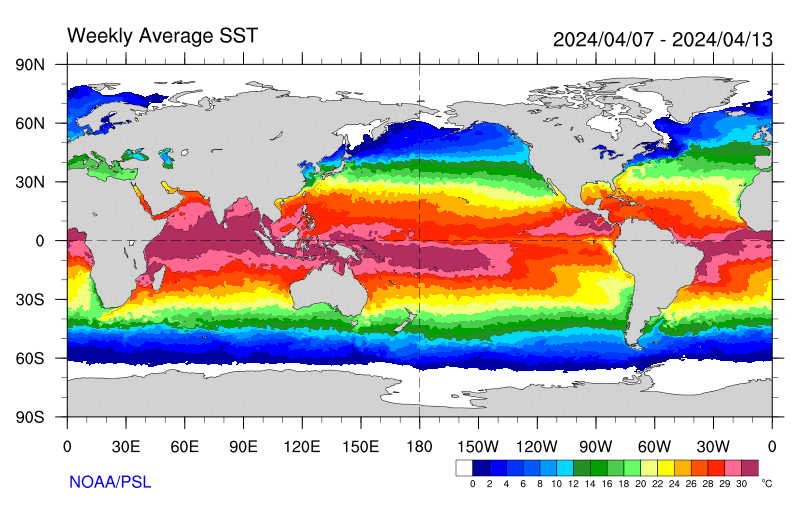
Under Physical & Chemical, click on
Sea Surface
Temperatures. This image uses a color scale to depict the global
pattern of sea surface temperatures (SSTs) (in degrees Celsius) averaged over a
recent 7-day period and based on measurements by infrared sensors onboard
Earth-orbiting satellites. (Depending on your browser, you may have to place
your mouse cursor on the slide bar to the right and scroll down to view the
entire image.) Compare SSTs in the Northern Hemisphere with those in the
Southern Hemisphere. Return to the DS Ocean website.
Under Geological, click on
Current Earthquake
Activity. The USGS Current World Seismicity page provides a global map
of the locations of seismic (earthquake) events color-coded for the past seven
days. The size of the squares represents the magnitude of recent earthquakes.
Note how earthquakes are concentrated along the margin of the Pacific Ocean.
Details of recent earthquakes can be found by clicking on their map squares.
Return to the DS Ocean website.
The ocean is home to a wide variety of habitats and organisms. Under
Biological, click on
Ocean
"Color" (Productivity). This is a satellite-derived
(SeaWiFS) color-coded map of biological productivity in the surface waters of
the world ocean is averaged from October 1978 to date. Orange and red indicates
the highest productivity, while dark blue and violet indicate the lowest
productivity. Note the vast areas of relatively low productivity over the
central regions of the subtropical ocean basins. Individual months within this
period may be chosen for viewing. Now return to the DS Ocean website.
Under Atmosphere/Ocean Interaction, click on
TRMM
Tropical Rainfall. The TRMM (Tropical Rainfall Measuring
Mission) page includes color-coded maps of the Monthly Mean Rainrate (in mm
per day) across the tropics for the last 30 days ending on the present date.
Changes in rainfall are linked to large-scale shifts in the atmosphere/ocean
circulation in the tropics. Now return to the DS Ocean website.
Take a few minutes when you have time to browse the other data and
information sources available via the DS Ocean website. You should
"bookmark" ("favorites") this page on your computer. Return
frequently to learn more about the many resources on the ocean in the Earth
system. Bon voyage!
Concept of the Week: Questions
- The latest global sea surface temperature map indicates that SSTs are
generally higher over the
[(western)(eastern)] tropical Pacific Ocean.
- The USGS map of Current Earthquake Activity indicates that earthquakes
appear to be more common along the
[(east)(west)] coast of North America.
Historical Events
- 21 January 1881...The light was first shown at Tillamook Lighthouse,
located 19 miles south of the Columbia River entrance on the Oregon coast.
(USCG Historian's Office)
- 21 January 1941...The first commercial extraction of magnesium from
seawater was made at Freeport, TX.
- 21 January 1954...The first nuclear powered submarine, the USS Nautilus,
was launched on the Thames River in Groton, CT, representing a landmark in the
history of naval engineering and submersible craft. First Lady Mamie Eisenhower
christened the vessel, which sailed beneath the Arctic icepack to the North
Pole in 1958. (Today in Science History)
- 26 January 1700...The Cascadia Earthquake (magnitude 9) took place off the
coast of British Columbia, as evidenced by Japanese records. Landslides and a
tsunami destroyed many Native American villages along the coasts of Washington,
Oregon and British Columbia, including Vancouver Island. Japanese written
history tells of a massive tsunami striking fishing villages the next day along
the coast of Honshu, killing hundreds. (Wikipedia) (Today in Science History)
- 26 January 1983...The California coast was battered by a storm, which
produced record high tides, thirty-two foot waves, and mudslides, causing
millions of dollars in damage. The storm then moved east and dumped four feet
of snow on Lake Tahoe. (22nd-29th) (The Weather Channel)
Return to DataStreme Ocean Website
Prepared by DS Ocean Central Staff and Edward J. Hopkins, Ph.D.,
email hopkins@meteor.wisc.edu
© Copyright, 2008, The American Meteorological Society.