Weekly Ocean News
DATASTREME OCEAN PREVIEW WEEK: 25-29 January 2010
Items of Interest:
- Earth scientists in the news -- During the last two weeks, several
scientists who specialize in meteorology and oceanography have been noted for
their accomplishments:
- Tim Liu, a senior research scientists with NASA's Jet Propulsion Laboratory
received the 2010 Verner E. Suomi Award from the American Meteorological
Society for his "research in space-borne measurements of air-sea
interactions and the water cycle, and for inspiring progress through
interdisciplinary science team leadership." This award is named for the
late Verner E. Suomi of the Space Science and Engineering Center at the
University of Wisconsin-Madison, who has been called the father of satellite
meteorology. [NASA
JPL]
- Michael C. Coniglio and Pamela L. Heinselman, research scientists at the
NOAA National Severe Storms Laboratory have been awarded the prestigious 2009
Presidential Early Career Award for Scientists and Engineers (PECASE) at a
recent ceremony at the White House for their work on improving tornado
forecasting and new radar systems. [NOAA
Weather Partners]
Josh Willis, an oceanographer from NASA's Jet Propulsion Laboratory, received
the 2009 Presidential Early Career Award for Scientists and Engineers at the
White House in mid January for his work in using data collected by satellites
and at sea to study the impact of global warming on the oceans. [NASA JPL]
- Dr. Margaret "Peggy" LeMone, a senior scientist at the National
Center for Atmospheric Research (NCAR) began a one-year term as president of
the American Meteorological Society at the society's annual meeting last week.
She is a noted atmospheric scientist, with expertise in cloud physics. [NCAR/UCAR]
Editor's note: Dr. LeMone has been associated with the AMS Education
Program for many years. EJH
Ocean in the News:
- Eye on the tropics --- Several tropical cyclones (low-pressure
system that forms over a tropical ocean basin) were detected over the tropical
Pacific and South Indian Oceans during the last week:
In the South Indian Ocean basin, a tropical cyclone formed at midweek between
Indonesia and Australia and traveled to the south-southeast toward Australia.
This system, which had maximum sustained winds that reached 70 mph, was
identified as Tropical Storm Magda. By the end of the workweek, this storm had
made landfall along the northwestern coast of Australia and dissipated.
Additional information concerning Tropical Storm Magda along with satellite
imagery can be found in the
NASA
Hurricane Page.
In the South Pacific basin, Tropical Cyclone Olga formed late last week over
the waters of the Coral Sea east of Australia. Olga, with winds of
tropical-storm strength, moved westward and made landfall along the coast of
Australia's Queensland on Sunday.
In the western North Pacific basin, the first tropical depression of the year
formed early last week over the waters of the South China Sea. This tropical
low-pressure system, identified as Tropical Depression 1-W, moved westward to
make landfall over Viet Nam, followed by dissipation over Cambodia. Additional
information and satellite imagery about this tropical depression can be found
on the
NASA
Hurricane Page.
- Construction begins on Gulf Coast disaster response center -- The
NOAA Administrator, Dr. Jane Lubchenco, and regional partners participated last
week in the groundbreaking ceremony marking the start in the construction of
NOAA's Gulf of Mexico Disaster Response Center in Mobile, AL, which will house
the regional home to the agency's Office of Response and Restoration. [NOAA
News]
- Measures taken to improve fisheries law enforcement -- In response
to a Commerce Department Inspector General review, the NOAA Administrator, Dr.
Jane Lubchenco, recently directed NOAA�s enforcement and legal
offices to take steps to promote more transparent law enforcement, ensure
fairness in penalties, and improve communication with commercial and
recreational fishers. [NOAA
News]
- Measures approved to protect marine mammals from naval exercises --
NOAA's Fisheries Service recently issued a letter of authorization and
regulations to the US Navy that are designed to protect marine mammals while
conducting naval exercises off the Gulf of Mexico coast, which would involve
the generation of sound waves by sonar and explosive detonation. [NOAA
News]
- Tsunamis could signal their presence by cable -- A researcher with
the NOAA's Cooperative Institute for Research in Environmental Science at the
University of Colorado and colleagues in Switzerland and India report that the
presence of tsunamis may be determined from the electric signals that the
propagating tsunami waves send through the ocean and are sensed by the vast
network of communication cables placed on the seabed. [NOAA
News]
- Global weather and climate for December 2009 and the calendar year
reviewed -- Scientists at NOAA's National Climatic Data Center reported
that based upon their preliminary analysis of worldwide land and ocean surface
temperature data collected for the month of December 2009, the month's globally
averaged ocean surface temperature was the second highest December temperature
since sufficiently detailed world-wide climate records began in 1880. Only
December 1997 had a higher December ocean temperature. While the globally
averaged land surface temperature for December 2009 was above the 20th century
average, the month's land surface temperature was the lowest since December
2002. Combined, the globally averaged land and ocean surface temperature for
the month was the eighth highest December reading since 1880. Although Arctic
sea ice cover was the fourth smallest for any December since 1979 (the
beginning of satellite surveillance), the Northern Hemisphere snow cover was
the second largest and the North American snow cover the largest since
satellite records began in 1967.
Preliminary analysis of worldwide combined land and ocean surface temperatures
for the recently-concluded calendar year of 2009 by scientists at
NOAA�s National Climatic Data Center (NCDC) indicates that
2009 tied with 2006 for the fifth warmest year since 1880. The scientists also
note that the year's ocean surface temperatures were tied for fourth highest,
while the global land surface temperature for 2009 tied for seventh highest.
[NOAA
News]
Because of a slightly different methodology used in averaging global surface
temperatures, scientists at NASA's Goddard Institute for Space Studies report
that 2009 was globally the second warmest since 1880. Furthermore, 2009 was the
warmest on record for the Southern Hemisphere. These NASA scientists also noted
that the decade (2000-2009) was the warmest in the 130-year instrumental
record. [NASA
GSFC] An interview with Dr. Gavin Schmidt, a climate researcher at NASA's
Goddard Institute for Space Studies, answers five questions that were posed
concerning the global temperature record since 1880. [NASA
JPL]
Two large-scale global maps show the temperature anomalies (differences between
observed and long-term average temperatures) for 2009 and for the 2000-09
decade. These maps illustrate just how much higher the temperatures were in
2009 and the decade (2000-2009) compared to average temperatures recorded
between 1951 and 1980. [NASA Earth
Observatory]
- Ocean bubbles affect climate, light and sound -- A researcher at the
University of Rhode Island has been analyzing the size range and numbers of
ocean bubbles in an attempt to determine the role that these bubbles play in
the transfer of carbon dioxide, oxygen and other gases between the atmosphere
and ocean depths. The bubbles also affect transmission of light and sound in
the ocean. She believes that her research should help other scientists create
more accurate climate models. [EurekAlert!]
- An All-Hazards Monitor -- This Web portal provides the user
information from NOAA on current environmental events that may pose as hazards
such as tropical weather, drought, floods, marine weather, tsunamis, rip
currents, Harmful Algal Blooms (HABs) and coral bleaching. [NOAAWatch]
- Global and US Hazards/Climate Extremes -- A review and analysis of
the global impacts of various weather-related events, to include drought,
floods and storms during the current month. [NCDC]
- Earthweek -- Diary of the Planet [earthweek.com] Requires
Adobe Acrobat Reader.

Concept of the Week: Touring the DataStreme Ocean Website
Welcome to DataStreme Ocean! You are embarking on a study of the world ocean
and the role of the ocean in the Earth system. This unique teacher enhancement
course focuses on the flow and transformations of energy and water into and out
of the ocean, the internal properties and circulation of the ocean,
interactions between the ocean and the other components of the Earth system,
and the human/societal impacts on and responses to those interactions.
Throughout this learning experience, you will be using the
DataStreme
Ocean website to access and interpret a variety of environmental
information, including recent observational data. The objective of this initial
Concept of the Week is to explore features of the DS Ocean
website.
On Monday of each week of the course, we will post the current Weekly
Ocean News that includes Ocean in the News (a summary listing of
recent events related to the ocean), Concept of the Week (an in-depth
analysis of some topic related to the ocean in the Earth system), and
Historical Events (a list of past events such as tsunamis or specific
advances in the understanding of oceanography). When appropriate,
Supplemental Information will be provided on some topic related to the
principal theme of the week.
You will use the DS Ocean Studies website to access and download the
"Current Ocean Studies" (plus supporting images) that complement your
Ocean Studies Investigations Manual. These materials should also be
available by noon (Eastern Time) on Monday. Click the appropriate links to
download and print these electronic components of the investigations as well as
your Chapter, Investigations and Current Ocean Studies Response forms.
The body of the DS Ocean website provides links to the Earth System,
information on Physical & Chemical, Geological, and Biological aspects of
the ocean, Atmosphere/Ocean Interaction, the Great Lakes, and extras—a
glossary of terms, maps, educational links, and DataStreme Ocean
information. Following each section is a link to other sites that examine the
various subsystems of the Earth system. Let's take a quick tour to become more
familiar with the DS Ocean website.
Under Physical & Chemical, click on
Sea Surface
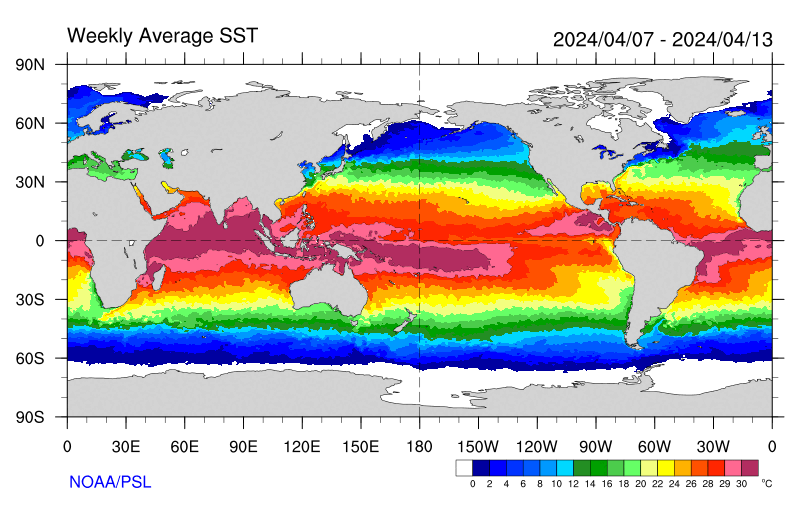
Temperatures. This image uses a color scale to depict the global
pattern of sea surface temperatures (SSTs) (in degrees Celsius) averaged over a
recent 7-day period and based on measurements by infrared sensors onboard
Earth-orbiting satellites. (Depending on your browser, you may have to place
your mouse cursor on the slide bar to the right and scroll down to view the
entire image.) Compare SSTs in the Northern Hemisphere with those in the
Southern Hemisphere. Return to the DS Ocean website.
Under Geological, click on
Current Earthquake
Activity. The USGS Current World Seismicity page provides a global map
of the locations of seismic (earthquake) events color-coded for the past seven
days. The size of the squares represents the magnitude of recent earthquakes.
Note how earthquakes are concentrated along the margin of the Pacific Ocean.
Details of recent earthquakes can be found by clicking on their map squares.
Return to the DS Ocean website.
The ocean is home to a wide variety of habitats and organisms. Under
Biological, click on
Ocean
"Color" (Productivity). This is a satellite-derived
(SeaWiFS) color-coded map of biological productivity in the surface waters of
the world ocean is averaged from October 1978 to date. Orange and red indicates
the highest productivity, while dark blue and violet indicate the lowest
productivity. Note the vast areas of relatively low productivity over the
central regions of the subtropical ocean basins. Individual months within this
period may be chosen for viewing. Now return to the DS Ocean website.
Under Atmosphere/Ocean Interaction, click on
TRMM
Tropical Rainfall. The TRMM (Tropical Rainfall Measuring
Mission) page includes color-coded maps of the Monthly Mean Rainrate (in mm
per day) across the tropics for the last 30 days ending on the present date.
Changes in rainfall are linked to large-scale shifts in the atmosphere/ocean
circulation in the tropics. Now return to the DS Ocean website.
Take a few minutes when you have time to browse the other data and
information sources available via the DS Ocean website. You should
"bookmark" ("favorites") this page on your computer. Return
frequently to learn more about the many resources on the ocean in the Earth
system. Bon voyage!
Concept of the Week: Questions
- The latest global sea surface temperature map indicates that SSTs are
generally higher over the
[(western)(eastern)] tropical Pacific Ocean.
- The USGS map of Current Earthquake Activity indicates that earthquakes
appear to be more common along the
[(east)(west)] coast of North America.
Historical Events
- 26 January 1700...The Cascadia Earthquake (magnitude 9) took place off the
coast of British Columbia, as evidenced by Japanese records. Landslides and a
tsunami destroyed many Native American villages along the coasts of Washington,
Oregon and British Columbia, including Vancouver Island. Japanese written
history tells of a massive tsunami striking fishing villages the next day along
the coast of Honshu, killing hundreds. (Wikipedia) (Today in Science History)
- 26 January 1983...The California coast was battered by a storm, which
produced record high tides, thirty-two foot waves, and mudslides, causing
millions of dollars in damage. The storm then moved east and dumped four feet
of snow on Lake Tahoe. (22nd-29th) (The Weather Channel)
- 28 January 1946...Canada's greatest sailing ship, Bluenose,
foundered on a Haitian reef; all hands were saved. Her likeness remains on the
Canadian ten-cent coin. (Wikipedia)
- 28 January 1969...A series of storms that battered Southern California from
the 18th to the 28th led to $125 million damage in the
Los Angeles Basin, along with approximately 9 storm and traffic-related deaths
in California. Twenty feet of water covered Sherman Island, a region that
contains more than 10,000 dike-protected agricultural acres, when a dike
failed. (Accord's Weather Guide Calendar)
- 28 January 1971...A waterspout swept into Hawaii's Kailua Bay, then into
the business and hotel district of Kailua-Kona, destroying or severely damaging
a number of buildings including 40 apartment units and collapsing a 6-story
hotel under construction. Amazingly, only four people were injured. (Accord's
Weather Guide Calendar)
- 29-30 January 1966...A hurricane that struck Samoa was responsible for 50
deaths, destroyed more than one-third of the homes and damaged the remainder.
As many as 50,000 people were left homeless. Swains Island was leveled by the
hurricane. Winds gusted to 100 mph at Pago Pago. (Accord's Weather Guide
Calendar)
- 29 January 1983...A series of Pacific coast storms finally came to an end.
The storms, attributed in part to the anomalous ocean-atmosphere phenomenon,
"El Niño," produced ocean swells 15 to 20 feet high that
ravaged the beaches of southern California. Much of the damage was to homes of
movie stars in the exclusive Malibu Colony. (The Weather Channel)
- 30 January 1790...The Original, the first boat specialized as a lifeboat to
rescue people from stormy seas was tested on the River Tyne. This 30-foot long
self-righting craft went out to shipwrecks for 40 years, saving hundreds of
lives. William Wouldhave and Lionel Lukin both claimed to be the inventor of
the first lifeboat. (Wikipedia) (Today in Science History)
- 30 January 1997...Surf up to 12 feet, with sets to 15 feet, pounded the
north and west shores of Hawaii. A wave swept eight people into the ocean at
Keane Point on Maui. Four tourists who were taking pictures of the waves
drowned. (Accord's Weather Guide Calendar)
Return to DataStreme Ocean Website
Prepared by DS Ocean Central Staff and Edward J. Hopkins, Ph.D.,
email hopkins@meteor.wisc.edu
© Copyright, 2010, The American Meteorological Society.