WEEKLY OCEAN NEWS
22-26 April 2013
DataStreme Ocean will return for Fall 2013 with new
Investigations files starting during Preview Week, Monday, 2 September
2013. All the current online website products will continue to be
available throughout the summer break period.
Items of Interest:
- Celebrate Earth Day --This Monday (22
April 2013) marks the 43rd Earth Day, first proposed by the late Senator
Gaylord Nelson of Wisconsin in 1970 as a teach-in to heighten awareness
of the environment. The Nelson Institute for Environmental Studies at
the University of Wisconsin-Madison has posted a website called "Gaylord Nelson and Earth Day: The Making of the Modern
Environmental Movement" that highlights Senator Nelson and his idea
became Earth Day. Several governmental websites provides links to various activities and resources planned for this
week, including a website maintained by the US Environmental Protection Agency (EPA). NOAA has a Earth Day 2013
website that describes how this agency honors Earth through its mission
to "observe, predict, protect our changing planet." In addition to
information on nearly 100 public events around the nation, this site
also has a link where the official 2013 Earth Day poster and computer
screen wallpaper can be downloaded.
- National Park Week -- The US Department of the Interior's National Park Service has designated the week commencing this week (20-28 April 2013) as National Park Week.
The focus for this year's observance is "Did You Know?" In observance
of this event, free entry can be made to any of the 401 national parks
in the system beginning on Monday (22 April) and running through Friday
(26 April). [National Park Service Fee Free Days]
- National Science Bowl set for next weekend -- The
US Department of Energy (DOE) National Science Bowl®, a nationwide
academic competition for middle and high school students will be held
this coming weekend (25-29 April 2013) in Washington, DC. This event
will test students' knowledge in all areas of science and is meant to
encourage high school students to excel in science and math and to
pursue careers in those fields. [DOE Office of Science]
Ocean in the News:
- Eye on the tropics -- The weather across the
tropical waters of both the Northern or Southern Hemispheres was
relatively tranquil the last week. At the start of the week Tropical
Cyclone Imelda weakened as it traveled to the south-southeast across
the waters of the central South Indian Ocean, passing nearly 500 miles
to the east of La Reunion Island. After briefly becoming a category 2
tropical cyclone on the Saffir-Simpson Scale near the end of the
previous week, Imelda weakened to a tropical storm and then lost its
tropical characteristics as it moved south over cooler waters during
the first half of this past week. The NASA Hurricane Page has satellite images and additional information on Tropical Cyclone Imelda.
-
- Getting the scoop on bivalve mollusks --
Learn about bivalve mollusks such as clams, oysters, mussels and
scallops that play important roles in aquatic and marine ecosystems by
filtering the water and serving as habitat and prey for a variety of
sea life. In addition, they have considerable economic value as seafood
NOAA estimated commercial bivalve mollusk harvesting at about $1
billion annually in the United States harvest was estimated at 153.6
million pounds. [NOAA News]
- Report addresses effects of climate change on marine sanctuary in Pacific Northwest --
NOAA's Olympic Coast National Marine Sanctuary recently issued a report
that details the potential effects of climate change upon this
sanctuary that is located along the coastal waters of Washington. The
report used observations and scientifically based projection to
identify how climate change could affect ecosystems within the
sanctuary and adjacent coastal areas along the Olympic Peninsula. New
management recommendations for the sanctuary were also made. [NOAA National Marine Sanctuaries]
- See NOAA science at the new San Francisco Exploratorium --
A set of exhibits has recently opened at the famous San Francisco (CA)
Exploratorium that showcases the various areas of atmospheric and
oceanic science undertaken by NOAA scientists. An Outdoor Gallery will
feature a new rain chamber exhibit called "Remote Rains" and NOAA
research vessels will dock alongside the Exploration. The new "Wired
Pier" will have instruments that will collect and contribute data to
the Integrated Ocean Observing System (IOOS). [NOAA Research]
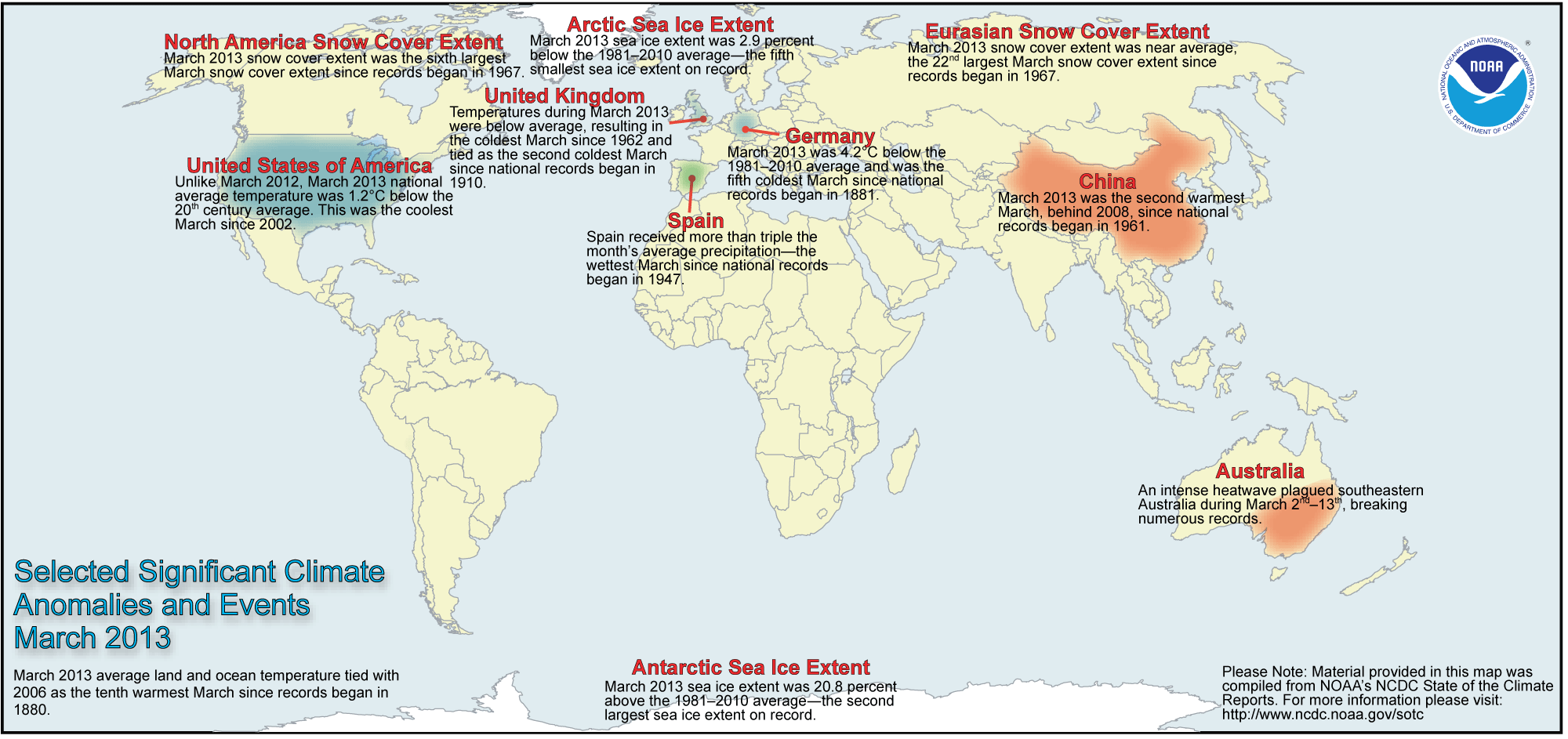
- Global temperatures for March 2013 reviewed -- Using
preliminary data collected from the global network of surface weather
stations, scientists at NOAA's National Climatic Data Center report
that the combined global land and ocean surface temperature for March
2013 tied the temperature for March 2006 as the tenth highest for any
March since sufficiently detailed global climate records began in 1880.
The global temperature for March 2013 was slightly more than one
Fahrenheit degree above the 20th century (1901-2000) average. The
scientists noted that March 2013 was the 337th consecutive month in
which the global temperature was above the 20th century average; the
last below-average temperature for any month was February 1985. When
considered separately, the average land temperature was the 11th
highest for any March since 1880, while the temperature over the oceans
was the ninth highest for March. Sea-surface temperatures across the
eastern half of the equatorial Pacific Ocean were slightly above
average in March due to ENSO-neutral conditions (ENSO = El
Niño/Southern Oscillation).
The researchers at the National Snow and Ice Data Center noted the areal extent of the Arctic sea ice
reached its annual maximum extent in mid March. The areal extent of this sea ice for March 2013 was
the fifth smallest since satellite surveillance began in 1979. On the
other hand, the extent of the Antarctic sea ice was the second largest
in the 35-year record. [NOAA/NCDC
State of the Climate] [NOAA
Environmental Visualization Laboratory] A global map of Selected Significant Climate Anomalies and Events for March 2013 is available from NCDC.
- Assessing the tsunami risk along the US East Coast --
A geoscientist from Boston College has been evaluating the possible
risk that a tsunami could have on the US East Coast. He warns that the
greatest threat of a tsunami would be one generated by an offshore
earthquake along the coast from New Jersey south to New Jersey. [ScienceDaily]
- Recent Antarctic climate and glacier changes appear to be near "upper bound" of normal --
An international team of researchers from the US, France and the
Netherlands report that the rate of thinning of the glaciers on the
edge of the Antarctic continent has accelerated during the last several
decades and have contributed significantly to global sea level rise.
However, the researchers cannot confidently attribute the rapid and
dramatic changes to human-caused global warming from their analysis of
ice cores. Some of the largest Antarctic warming has occurred during El
Niño events, where anomalous atmospheric and oceanic circulation
patterns result in a warm eastern equatorial Pacific Ocean. [University of Washington News]
- Sea level rise could be slowed by reducing certain atmospheric pollutants --
Researchers at the National Center for Atmospheric Research (NCAR)
claim that cutting the emissions of four atmospheric pollutants could
greatly slow the rise in global sea level by between 25 and 50 percent
during the remainder of this century. The four atmospheric pollutants
that were considered were methane, tropospheric ozone,
hydrofluorocarbons and black carbon. [NSF News]
- An All-Hazards Monitor -- This Web portal provides the user information from NOAA on
current environmental events that may pose as hazards such as tropical
weather, drought, floods, marine weather, tsunamis, rip currents,
Harmful Algal Blooms (HABs) and coral bleaching. [NOAAWatch]
- Global
and US Hazards/Climate Extremes -- A review and analysis of the global impacts of various
weather-related events, to include drought, floods and storms during
the current month. [NCDC]
- Earthweek -- Diary of the Planet [earthweek.com] Requires Adobe Acrobat Reader.

Historical Events:
- 22 April 1500...Portuguese navigator Pedro Álvares Cabral
became the first known European to sight Brazil, claiming it for
Portugal. (Wikipedia)
- 23 April 1924...A tube transmitter for radio fog-signal
stations, developed to take the place of the spark transmitters in use,
was placed in service on the Ambrose Channel Lightship and proved
successful. (USCG Historian's Office)
- 24 April 1884...USS Thetis, Bear,
and Alert sailed from New York to search for
Greeley expedition lost in the Arctic. (Naval Historical Center)
- 24 April 1928...The fathometer was patented by Herbert
Grove Dorsey (No. 1,667,540). The invention measured underwater depths
by using a series of electrical sounds and light signals. (Today in
Science History)
- 27 April 1521...The Portuguese navigator Ferdinand Magellan
was killed by natives during a tribal skirmish on Mactan Island in the
Philippines after completing nearly three-quarters of a trip around the
world. One of his ships, the Victoria, under the command of the Basque
navigator Juan Sebastiýn de Elcano, continued west to arrive at
Seville, Spain on 9 September 1522, the first ship to circumnavigate
the globe. (The History Channel)
- 28 April 1947...Norwegian anthropologist Thor Heyerdahl and
five others set out in a balsa wood craft known as Kon Tiki to prove
that Peruvian Indians could have settled in Polynesia. The trip took
101 days.
- 29 April 1770...The British explorer, Captain James Cook,
arrived at and named Botany Bay, Australia. (Wikipedia)
Return to DataStreme
Ocean Website
Prepared by AMS DS Ocean Central Staff and Edward J. Hopkins,
Ph.D., email hopkins@meteor.wisc.edu
© Copyright, 2013, The American Meteorological Society.