Weekly Ocean News
DATASTREME OCEAN PREVIEW WEEK: 20-24
January 2014
Items of Interest:
- Worldwide GLOBE at Night 2014 Campaign is underway -- The first of a series of GLOBE at Night citizen-science campaigns for 2014 will begin this Monday and run for 10 nights (20-29 January). GLOBE at Night is a worldwide, hands-on science and education program designed to encourage citizen-scientists worldwide to record the brightness of their night sky by matching the appearance of a constellation (Orion or Leo in the northern hemisphere, and Orion and Crux in the southern hemisphere) with seven star charts of progressively fainter stars. In addition to the 20-29 January campaign, the other four GLOBE at Night campaigns during the first five months of 2014 are on
19-28 February; 21-30 March; 20-29 April and 19-28 May.
[GLOBE at Night]
- Ocean charts, units, location and time -- Please
read this week's Supplemental
Information…In Greater Depth for a description of a several
types of oceanographic charts along with the definitions of some units
commonly used in ocean science to locate positions on the Earth's
surface and to identify time.
Ocean in the News:
- Eye on the tropics -- During the last
week, organized tropical cyclone (low pressure systems such as tropical
storms and hurricanes that form over tropical oceans) activity was
found across the Indian and western Pacific Ocean basins of the Southern
Hemisphere and the western Pacific in the Northern Hemisphere:
- In the South Indian Ocean Basin, Tropical Cyclone Colin continued to travel toward the southwest at the start of last week before curving toward the south and then to the southeast before dissipating by midweek. Passing roughly 1000 miles to the east-southeast of Diego Garcia, Colin had been a major category 4 tropical cyclone on the Saffir-Simpson Scale during the previous weekend. However, during the first part of last week, Colin weakened to a tropical storm and then lost its tropical characteristics, becoming a midlatitude (or extratropical) storm as it was located approximately 1200 miles to the northeast of the Kerguelen Archipelago. See the NASA Hurricane Page for additional information and satellite imagery on Tropical Cyclone
Colin.
Tropical Storm Deliwe (also known as Tropical Cyclone 09S) formed during the second half of last week
over the southern Mozambique Channel approximately 200 miles off the western coast of Madagascar. Deliwe traveled to the south-southwest, brushing along the coast of Madagascar on Friday before turning and heading to the west over this past weekend before dissipating. Additional information on Tropical Storm Deliwe and accompanying satellite images are available on the NASA Hurricane Page.
- In the South Pacific Ocean basin, the category 4 tropical cyclone (on the Saffir-Simpson Scale) identified as Cyclone Ian weakened to a tropical storm and dissipated at the start of last week slightly more than 1000 miles south of Pago Pago. Over the previous weekend, Ian had traveled across the Tonga Islands, where at least one person was killed because of the strong winds, high seas and torrential rain associated with this tropical cyclone. The NASA Hurricane Page has satellite imagery and
additional information on Cyclone Ian.
Near the end of the week, Tropical Storm June formed to the southeast of the Solomon Islands and traveled toward the south-southeast, passing just to the west of New Caledonia. Strong winds and heavy rain were reported on New Caledonia over this past weekend. June was expected to weaken to a tropical depression as it was forecast to continue traveling toward the south-southeast. Dissipation of June should occur by late Monday (local time) before it would reach the northern tip of New Zealand. Check the NASA Hurricane Page for satellite imagery and additional information on Tropical Storm June.
- In western North Pacific, Tropical Storm Lingling (also known as Agaton in the Philippines), formed late last week from an area of low pressure initially identified as System 91W that was situated to the east of Visayas and Mindanao in the southern Philippines. Over this past weekend, this system strengthened to a tropical depression and then a tropical storm when maximum sustained surface winds exceeded 40 mph as it traveled slowly southward across the Philippine Sea. As the slow-moving low pressure system developed into Lingling, it produced locally heavy rainfall across sections of the southern Philippines that had been flooded by several tropical storms and typhoons (which are hurricanes in the western North Pacific) late in 2013. The torrential rains at the end of last week produced floods and mudslides that claimed as many as 40 lives in the Philippines as of Sunday (local time). Lingling was forecast to travel toward the west and make landfall on Mindanao by late Monday as a tropical depression. Additional information concerning Tropical Storm Lingling (previously known as System 91 W) can be found on the NASA Hurricane Page.
- Satellites help rescue 253 people in 2013 -- During last year (2013), 253 people were rescued from life-threatening situations throughout the US and on its surrounding waters in part because of the role that NOAA’s fleet of seven operational satellites played. Over half of those rescued (55%) involved waterborne rescues. Detecting distress signals from emergency beacons, these NOAA satellites helped pinpoint the location of these people and relay this information to first responders who perform the actual rescue. NOAA's geosynchronous and polar-orbiting satellites are part of the international COSPAS-SARSAT (COSPAS a Russian abbreviation for "Space System for the Search of Vessels in Distress" and SARSAT "Search and Rescue Satellite Aided Tracking") system. [NOAA News]
- Cracks in Arctic sea ice leads to mercury contamination concerns -- Researchers participating in the Bromine, Ozone, and Mercury Experiment (BROMEX) in 2012 have measured increased concentrations of mercury near ground level after cracks formed in the Arctic sea ice off Barrow, AK. The scientists claim that the large leads or open seawater channels in the sea ice causes vigorous mixing of the air above these leads, which results in exposure of the relatively warm seawater to cold arctic air and the pumping of atmospheric mercury down to the surface. Consequently, more of the toxic mercury pollutant would enter the food chain and affect the health of fish, land animals and humans. The mercury, which is present in gaseous form, originated from subpolar latitudes. A warming Arctic has increased the leads in the sea ice and caused an increase in mercury pollution. [NASA Jet Propulsion Laboratory]
- Ice-loving sea anemones discovered under Antarctica ice shelf -- Scientists and engineers using an underwater robot with camera during the Antarctic Geological Drilling (ANDRILL) Program in December 2010 discovered several hundred thousand small sea anemones beneath the Ross Ice Shelf that extends off Antarctica. These polyps had burrowed into the underside of the ice shelf, their tentacles protruding into frigid water like flowers on a ceiling. [University of Nebraska-Lincoln News Releases]
- Saving archaeological evidence in Florida from sea level rise -- A researcher from Florida State University and a National Park Service archaeologist are undertaking a project designed to help minimize the impact that rising sea levels would have upon Florida's cultural sites. The team is concerned that prehistoric shell mounds found on some of the Sunshine State's beaches, including those in the Canaveral National Seashore and Everglades National Park, that represent thousands of years of archaeological evidence could be obliterated by rising sea level. To date, they have been collecting and compiling atmospheric and oceanographic data from modern, colonial and pre-colonial times that can be used to assess the risks to irreplaceable cultural resource sites. [Florida State University 24/7]
- West Coast oysters threatened by acidification and predators -- Researchers at the Bodega Marine Laboratory of the University of California, Davis warn that the Olympia oyster species that is native to the West Coast appears to be facing a double threat caused by ocean acidification and by invasive predators. Olympia oysters have declined considerably along the California coast. [University of California Davis News]
- An All-Hazards Monitor -- This Web
portal provides the user information from NOAA on current environmental
events that may pose as hazards such as tropical weather, drought,
floods, marine weather, tsunamis, rip currents, Harmful Algal Blooms
(HABs) and coral bleaching. [NOAAWatch]
- Earthweek -- Diary of the Planet [earthweek.com] Requires Adobe Acrobat Reader.

Concept of the Week: Touring the
DataStreme Ocean Website
Welcome to DataStreme Ocean! You are embarking on a study of
the world ocean and the role of the ocean in the Earth system. This
unique teacher enhancement course focuses on the flow and
transformations of energy and water into and out of the ocean, the
internal properties and circulation of the ocean, interactions between
the ocean and the other components of the Earth system, and the
human/societal impacts on and responses to those interactions.
Throughout this learning experience, you will be using the DataStreme
Ocean website to access and interpret a variety of
environmental information, including recent observational data. The
objective of this initial Concept of the Week is to
explore features of the DS Ocean website.
On Monday of each week of the course, we will post the current Weekly Ocean News that includes Ocean in
the News (a summary listing of recent events related to the
ocean), Concept of the Week (an in-depth analysis
of some topic related to the ocean in the Earth system), and Historical
Events (a list of past events such as tsunamis or specific
advances in the understanding of oceanography). When appropriate, a
feature called Supplemental Information-In Greater Depth will be provided on some topic related to the principal theme of the
week.
You will use the DS Ocean website to
access and download the weekly "Current Ocean Studies" (plus supporting
images) that complement Investigations found in your Ocean
Studies Investigations Manual. These materials should be
available Monday morning. Click the appropriate links to download and
print these electronic Current Ocean Studies and answer forms as well
as your Chapter Progress and Investigations Response forms.
The body of the DS Ocean website provides
links to the Earth System, information on Physical & Chemical,
Geological, and Biological aspects of the ocean, Atmosphere/Ocean
Interaction, the Great Lakes, and extras-a glossary of terms, maps,
educational links, and DataStreme Ocean information. Following each section is a link to other sites that
examine the various subsystems of the Earth system. Let's take a quick
tour to become more familiar with the DS Ocean website.
Under Physical & Chemical, click
on Sea
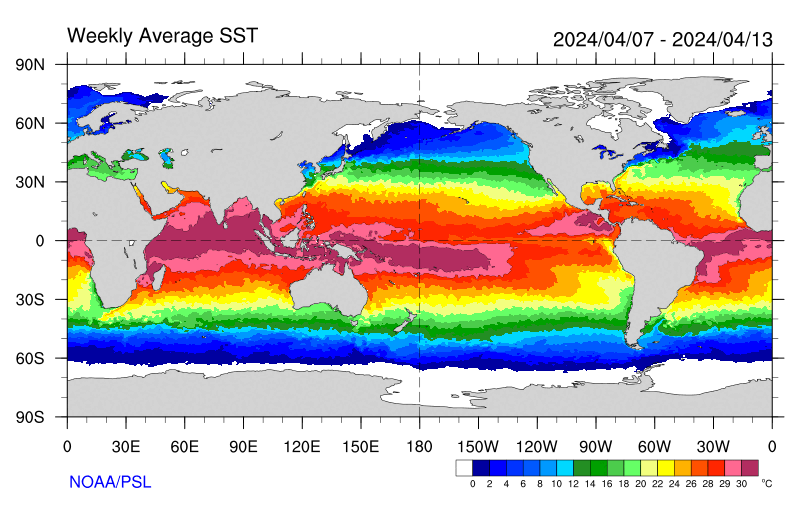
Surface Temperatures. This image uses a color scale
to depict the global pattern of sea surface temperatures (SSTs) (in
degrees Celsius) averaged over a recent 7-day period and based on
measurements by infrared sensors onboard Earth-orbiting satellites.
(Depending on your browser, you may have to place your mouse cursor on
the slide bar to the right and scroll down to view the entire image.)
Compare SSTs in the Northern Hemisphere with those in the Southern
Hemisphere. Return to the DS Ocean website.
Under Geological, click on Current
Earthquake Activity. The USGS Current World
Seismicity page provides a global map of the locations of seismic
(earthquake) events color-coded for the past seven days. The size of
the squares represents the magnitude of recent earthquakes. Note how
earthquakes are concentrated along the margin of the Pacific Ocean.
Details of recent earthquakes can be found by clicking on their map
squares. Return to the DS Ocean website.
The ocean is home to a wide variety of habitats and organisms.
Under Biological, click on Ocean
"Color" (Productivity). This is
a satellite-derived (SeaWiFS) color-coded map of biological
productivity in the surface waters of the world ocean is averaged from
October 1978 to date. Orange and red indicates the highest
productivity, while dark blue and violet indicate the lowest
productivity. Note the vast areas of relatively low productivity over
the central regions of the subtropical ocean basins. Individual months
within this period may be chosen for viewing. Now return to the DS
Ocean website.
Under Atmosphere/Ocean Interaction, click
on TRMM
Tropical Rainfall. The TRMM (Tropical
Rainfall Measuring Mission) page includes color-coded maps of
the Monthly Mean Rainrate (in mm per day) across the tropics for the
last 30 days ending on the present date. Changes in rainfall are linked
to large-scale shifts in the atmosphere/ocean circulation in the
tropics. Now return to the DS Ocean website.
Take a few minutes when you have time to browse the other data
and information sources available via the DS Ocean website. You should "bookmark" ("favorites") this page on your
computer. Return frequently to learn more about the many resources on
the ocean in the Earth system. Bon voyage!
Concept of the Week: Questions
- The latest global sea surface temperature map indicates
that SSTs are generally higher over the [(western)(eastern)] tropical Pacific Ocean.
- The USGS map of Current Earthquake Activity indicates that
earthquakes appear to be more common along the [(east)(west)] coast of North America.
Historical Events
- 20 January 1606...As many as 2000 people died around the
Severn Estuary in England as the result of severe flooding. (The
Weather Doctor)
- 20 January 1850...The Investigator,
which was the first ship to effect a Northwest Passage, left England.
- 20 January 1914...The International Ice Patrol Convention
was signed. (USCG Historian's Office)
- 20 January 1986...The United Kingdom and France announced
plans to construct the Channel Tunnel, a railway tunnel underneath the
English Channel, also known as the "Chunnel." (Wikipedia)
- 21 January 1881...The light was first shown at Tillamook
Lighthouse, located 19 miles south of the Columbia River entrance on
the Oregon coast. (USCG Historian's Office)
- 21 January 1941...The first commercial extraction of
magnesium from seawater was made at Freeport, TX.
- 21 January 1954...The first nuclear powered submarine, the
USS Nautilus, was launched on the Thames River in Groton, CT,
representing a landmark in the history of naval engineering and
submersible craft. First Lady Mamie Eisenhower christened the vessel,
which sailed beneath the Arctic icepack to the North Pole in 1958.
(Today in Science History)
- 23 January 1622...William Baffin, the English explorer who
sought the Northwest Passage as a route around the northern coast of
North America, died at an estimated age of 38 during the war between
the Shah of Persian and the Portuguese. In 1615, he explored what is
now known as Baffin Bay, coming within 800 miles of the North Pole. His
voyages were made with scientific care, determining latitudes, and
observing tides. With records made of his compass needle, he made the
first magnetic chart. He was the first to attempt a determination of
longitude by observing the moon. (Today in Science History)
- 23 January 1960... The Trieste, In
1960, a specially constructed submersible bathyscaphe descended to a
depth of 35,810 feet in the Pacific Ocean called the Challenger Deep,
the deepest point known to exist on Earth, in the Marianas Trench near
Guam. (Today in Science History)
- 26 January 1700...The Cascadia Earthquake (magnitude 9)
took place off the coast of British Columbia, as evidenced by Japanese
records. Landslides and a tsunami destroyed many Native American
villages along the coasts of Washington, Oregon and British Columbia,
including Vancouver Island. Japanese written history tells of a massive
tsunami striking fishing villages the next day along the coast of
Honshu, killing hundreds. (Wikipedia) (Today in Science History)
- 26 January 1983...The California coast was battered by a
storm, which produced record high tides, thirty-two foot waves, and
mudslides, causing millions of dollars in damage. The storm then moved
east and dumped four feet of snow on Lake Tahoe. (22nd-29th)
(The Weather Channel)
Return to DataStreme
Ocean Website
Prepared by DS Ocean Central Staff and Edward J. Hopkins,
Ph.D.,
email hopkins@meteor.wisc.edu
© Copyright, 2014, The American Meteorological Society.