Weekly Ocean News
DATASTREME OCEAN PREVIEW WEEK: 18-22
January 2016
Items of Interest:
- End of a long polar night -- After being below the horizon for approximately 65 days, the Sun should rise at Barrow, the northernmost city in Alaska, for the first time this new year on this coming Saturday, 23 January 2016, at 1:10 PM Alaska Standard Time (AKST). However, the Sun will only remain above the horizon for only 59 minutes, as it will set again at 2:09 PM. Although the Sun set for the final time last year at 1:15 PM AKST on 19 November 2015, residents of Barrow had roughly three hours of some diffuse sunlight each day that is equivalent to civil twilight, provided the cloud cover was not too thick. To check the sunrise and sunset times of Barrow or any location in the United States go to the US Naval Observatory's on-line, interactive service for the entire year.
- Ocean charts, units, location and time -- Please
read this week's Supplemental
Information…In Greater Depth for a description of a several
types of oceanographic charts along with the definitions of some units
commonly used in ocean science to locate positions on the Earth's
surface and to identify time.
Ocean in the News:
- Eye on the tropics -- During the last
week, organized tropical cyclones (low pressure systems such as tropical
storms and hurricanes that form over tropical oceans) were
found across the North Atlantic Ocean basin and the Pacific basins in the Northern and Southern Hemispheres:
- In the North Atlantic basin, an out of season subtropical storm formed over the far eastern Atlantic approximately 800 miles to the south-southwest of the Azores last Wednesday. This subtropical storm, identified as Alex (for the first named subtropical or tropical cyclone of 2016), intensified and gained tropical characteristics to become a hurricane by Thursday afternoon. Moving to the north, Alex lost its tropical characteristics, becoming an extratropical cyclone (or midlatitude storm) by Friday evening as it was nearly 300 miles to the north of Terceira in the Azores. Alex was the first hurricane to form in the North Atlantic basin during the month of January since 1938 and its peak 85-mph maximum sustained surface winds made Alex the strongest Atlantic hurricane to form in January as well. The NASA Hurricane Page and NASA Earth Observatory have additional information and satellite imagery on Hurricane Alex.
- In the central North Pacific basin,
Tropical Storm Pali intensified to become the first hurricane of 2016 for that basin at the start of the week as it traveled toward the south across the waters well to the southwest of the Hawaiian Islands. By early Tuesday, Pali had become a category 2 hurricane on the Saffir-Simpson Scale. During the second half of last week, Pali weakened to a tropical storm and then a tropical depression before dissipating approximately 1700 miles to the southwest of Honolulu, HI early on Friday. Additional information
and satellite images on Tropical Storm Pali can be obtained from NASA Hurricane Page.
- In the South Pacific basin, Tropical Cyclone Ula weakened early last week after becoming a category 4 tropical cyclone on the Saffir-Simpson Scale over the previous weekend. By midweek, Ula lost its tropical characteristics and became an extratropical cyclone before dissipating to the north of New Zealand. The NASA Hurricane Page has additional information and satellite images on Tropical Cyclone Ula.
A second tropical cyclone, identified as Tropical Cyclone Victor, formed late last week from a tropical depression located east of Pago Pago, American Samoa. Victor intensified to become a category 1 tropical cyclone on the Saffir-Simpson Scale as it curved toward the south. As of Monday (local time), Victor was located approximately 350 miles to the southeast of Pago Pago. A satellite image and additional information for Tropical Cyclone Victor are available on the NASA Hurricane Page.
- Unmanned aircraft improved to collect hurricane weather data -- Late in the first week of January, NOAA and Raytheon, a technology contractor, successfully demonstrated several improvements to the Coyote Unmanned Aircraft System (UAS) while completing a mid-flight launch of this aircraft from the NOAA P-3 Hurricane Hunter aircraft over Florida's Avon Park Air Force Range. Instruments on the Coyote collected weather data that included atmospheric air pressure, temperature, humidity, wind speed and direction as well as surface temperature at altitudes deemed too low for manned aircraft to safely navigate in the hurricane environment. These collected weather data should help improve hurricane forecasts. [NOAA Office of Oceanic & Atmospheric Research News]
- Expansion of Monitor National Marine Sanctuary is proposed -- Officials with NOAA's National Marine Sanctuaries program recently announced that public comments are being solicited through mid March 2015 on the agency's proposed expansion of the Monitor National Marine Sanctuary, which is located in the waters of the North Atlantic Ocean off the North Carolina coast and contains the famous Civil War-era ironclad USS Monitor and its crew. The Monitor sank in a storm off Cape Hatteras in December 1862. The proposed expansion of the nation's first national marine sanctuary would include the historically significant shipwrecks of several vessels sunk during World War II's Battle of the Atlantic, including the German U-boat, U-701, which sank in July 1942 off Cape Hatteras. [NOAA National Marine Sanctuaries News]
- Expansion of opportunities made for US aquaculture in Gulf of Mexico -- Early last week NOAA Fisheries officials announced that the final rule was published that implements the nation's first comprehensive regulatory program for aquaculture in federal waters. This ground-breaking rule creates a coordinated permitting system for federal waters in the Gulf of Mexico, which would permit expansion of aquaculture for seafood production and the creation of new jobs in an environmentally sustainable manner. [NOAA News] A 5-minute video shows a sampling of current aquaculture operations, processing, and research. [NOAA Fisheries Feature Stories]
Dr. Michael Rubino, director of the NOAA Fisheries Office of Aquaculture, was recently interviewed on offshore aquaculture and the future of sustainable seafood.
[NOAA Fisheries Feature Stories]
- Updated El Niño/Southern Oscillation (ENSO) Diagnostic Discussion & El Niño advisory outlook released -- Late last week forecasters at NOAA's Climate Prediction Center (CPC) and the International Research Institute for Climate and Society (IRI) released their monthly El Niño/Southern Oscillation (ENSO) Diagnostic Discussion in which they still maintained their El Niño advisory as much above-average sea surface temperatures (SST) persisted across the equatorial Pacific Ocean in December 2015, a sign of the continuation of the strong El Niño event (an anomalous large-scale atmospheric and oceanic circulation pattern characterized by warm waters in the eastern equatorial Pacific). SST values ranged from between two to three Celsius degrees above normal from the central into the eastern equatorial Pacific, with only some slight decrease in values. Therefore, the CPC forecasters continued their El Niño advisory, envisioning this current strong El Niño event to gradually weaken through this upcoming Northern Hemisphere spring (March through May 2016), followed by a transition to an anticipated ENSO-neutral condition during the late spring or early summer of 2016. [NOAA Climate Prediction Center]
A blog written by scientists from NOAA's Climate Prediction Center show that the current El Niño event during the three months running from October through December 2015 was as strong as the one in 1997-1998 that has been considered to be one of the strongest El Niño events since 1950. They base their analysis on the rankings of the SST values for one of the regions of the Pacific along the Equator identified as Niño 3.4.
[NOAA Climate.gov News]
- Upgrades to nation's weather, water and climate supercomputer capacities are made -- Kathryn Sullivan, PhD, NOAA's administrator recently announced that the nearly four-fold increase in the computing capacity of her agency's Weather and Climate Operational Supercomputer System has been made, which permits the computers to run at record speed. This increase along with the capacity to process and analyze earth observations at quadrillions of calculations per second is being made to allow NOAA to unveil a series of operational upgrades to its weather, water and climate forecast models. The computers, called Luna and Surge, are located at computing centers in Reston, VA and Orlando, FL. [NOAA News]
- New seafloor features found from map made from satellite data -- An international team of scientists have created a new map of the ocean floor using satellite altimetry data collected from the European Space Agency's CryoSat-2 and from the NASA/Centre National d'Etudes Spatiales (CNES) Jason-1 satellites. The height of sea level obtained from these satellite were used in computer models to generate maps of gravity anomaly within the ocean basins, which then can be used to produce detailed bathymetry maps showing underwater ridges, seamounts, and the edges of Earth's tectonic plates where seafloor gravity anomalies are positive (gravity is stronger than average) and deep troughs on the ocean floor where negative anomalies are detected. The sea floor maps have provided topographic features of the seafloor that oceanographers could study the evolution of Earth's continents and tectonic plates. [NASA Earth Observatory]
- An All-Hazards Monitor -- This Web portal provides the user information from NOAA's National Weather Service, FAA and FEMA on
current environmental events that may pose as hazards such as tropical
weather, fire weather, marine weather, severe weather, drought and
floods. [NOAA/NWS Daily Briefing]
- Earthweek -- Diary of the Planet [earthweek.com]
Concept of the Week: Touring the
DataStreme Ocean RealTime Ocean Portal Website
Welcome to DataStreme Ocean! You are embarking on a study of
the world ocean and the role of the ocean in the Earth system. This
unique teacher enhancement course focuses on the flow and
transformations of energy and water into and out of the ocean, the
internal properties and circulation of the ocean, interactions between
the ocean and the other components of the Earth system, and the
human/societal impacts on and responses to those interactions.
Throughout this learning experience, you will be using the RealTime Ocean Portal to access and interpret a variety of
environmental information, including recent observational data. The
objective of this initial Concept of the Week is to
explore features of the RealTime Ocean Portal website.
On Monday of each week of the course, we will post the current Weekly Ocean News that includes Ocean in
the News (a summary listing of recent events related to the
ocean), Concept of the Week (an in-depth analysis
of some topic related to the ocean in the Earth system), and Historical
Events (a list of past events such as tsunamis or specific
advances in the understanding of oceanography). When appropriate, a
feature called Supplemental Information-In Greater Depth will be provided on some topic related to the principal theme of the
week.
You will use the RealTime Ocean Portal to
access and download the weekly "Current Ocean Studies" that complement Investigations found in your Ocean
Studies Investigations Manual. These materials should be
available Monday morning. Click the appropriate links to download and
print these electronic Current Ocean Studies and answer forms as well
as your Chapter Progress and Investigations Response forms.
The body of the RealTime Ocean Portal provides
links to the Earth System, information on Physical & Chemical,
Geological, and Biological aspects of the ocean, Atmosphere/Ocean
Interaction, the Great Lakes, and extras-a glossary of terms, maps and
educational links. Following each section is a link to other sites that
examine the various subsystems of the Earth system. Let's take a quick
tour to become more familiar with the RealTime Ocean Portal.
Under Physical & Chemical, click
on Sea
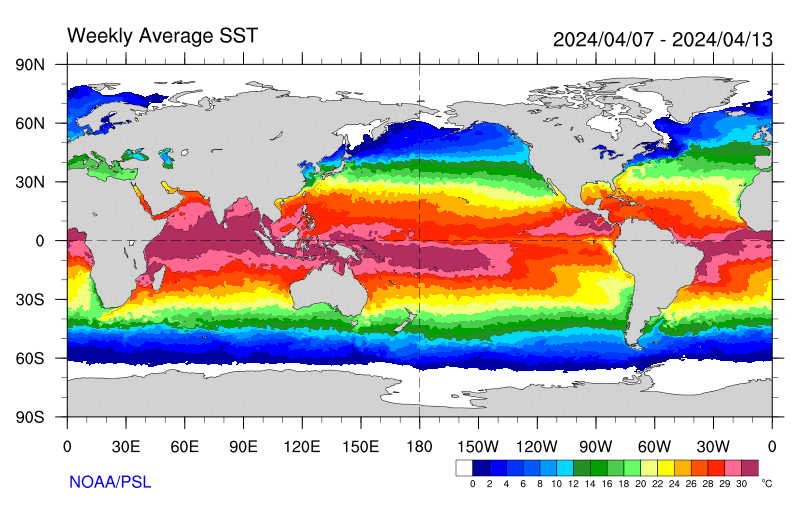
Surface Temperatures. This image uses a color scale
to depict the global pattern of sea surface temperatures (SSTs) (in
degrees Celsius) averaged over a recent 7-day period and based on
measurements by infrared sensors onboard Earth-orbiting satellites.
(Depending on your browser, you may have to place your mouse cursor on
the slide bar to the right and scroll down to view the entire image.)
Compare SSTs in the Northern Hemisphere with those in the Southern
Hemisphere. Return to the RealTime Ocean Portal.
Under Geological, click on Current
Earthquake Activity. The USGS Current World
Seismicity page provides a global map of the locations of seismic
(earthquake) events color-coded for the past seven days. The size of
the squares represents the magnitude of recent earthquakes. Note how
earthquakes are concentrated along the margin of the Pacific Ocean.
Details of recent earthquakes can be found by clicking on their map
squares. Return to the RealTime Ocean Portal.
The ocean is home to a wide variety of habitats and organisms.
Under Biological, click on Ocean
"Color" (Productivity). This is
a satellite-derived (SeaWiFS) color-coded map of biological
productivity in the surface waters of the world ocean is averaged from
October 1978 to date. Orange and red indicates the highest
productivity, while dark blue and violet indicate the lowest
productivity. Note the vast areas of relatively low productivity over
the central regions of the subtropical ocean basins. Individual months
within this period may be chosen for viewing. Now return to the RealTime Ocean Portal.
Under Atmosphere/Ocean Interaction, click
on TRMM/GPM
Tropical Rainfall. The TRMM/GPM (Tropical
Rainfall Measuring Mission) page includes color-coded maps of
the Monthly Mean Rainrate (in mm per day) across the tropics for the
last 30 days ending on the present date. Changes in rainfall are linked
to large-scale shifts in the atmosphere/ocean circulation in the
tropics. Now return to the RealTime Ocean Portal.
Take a few minutes when you have time to browse the other data
and information sources available via the RealTime Ocean Portal. Return frequently to learn more about the many resources on
the ocean in the Earth system. Bon voyage!
Concept of the Week: Questions
- The latest global sea surface temperature map indicates
that SSTs are generally higher over the [(western)(eastern)] tropical Pacific Ocean.
- The USGS map of Current Earthquake Activity indicates that
earthquakes appear to be more common along the [(east)(west)] coast of North America.
Historical Events
- 18 January 1778...The English explorer Captain James Cook
sailed past the island of Oahu, thereby becoming the first European to
see the Hawaiian Islands, which he called the "Sandwich Islands." (The
History Channel)
- 18-22 January 1978...The Atlantic's first-ever January
subtropical storm with tropical characteristics since records began in
1871 organized 1500 miles east-northeast of Puerto Rico. The storm
finally dissipated on the 22nd approximately 200 miles north of Puerto
Rico. (Accord's Weather Guide Calendar)
- 18-27 January 1980...Tropical Cyclone Hyacinthe produced 223.5 inches of
rainfall over the 10-day period at Cratère Commerson, on the island of La Reunion in the
Indian Ocean to set the global mark for rainfall from a tropical
cyclone during a 10-day period. The same storm dumped 127.6 inches of
rain in just 72 hours at Grand-Ilet, La Reunion Island. (The Weather
Doctor) (National Weather Service files)
- 19 January 1840...LT Charles Wilkes, USN was the first
American to sight the eastern Antarctic coast, claiming this portion of
the continent for the United States. The group that he led explored a
1500-mile stretch of the coast of eastern Antarctica, which later
became known as Wilkes Land. (Naval Historical Center)
- 19 January 1883: The steamers of Cimbria and Sultan collided in the North Sea due to heavy fog. This collision resulted in the death of 357 people. (National Weather Service files)
- 19 January 1946...Staged jointly by the USCG and USN, the
first public demonstration of LORAN was held at Floyd Bennett Field in
New York. (USCG Historian's Office)
- 19 January 1996...The tug Scandia and
its barge, the North Cape, ran aground on the shore
of Rhode Island, spilling 828,000 gallons of oil, the worst spill in
that state's history. The Coast Guard rescued the entire crew, pumped
off 1.5 million gallons of oil and conducted skimming operations. (USCG
Historian's Office)
- 20 January 1606...As many as 2000 people died around the
Severn Estuary in England as the result of severe flooding. (The
Weather Doctor)
- 20 January 1850...The Investigator,
which was the first ship to effect a Northwest Passage, left England.
- 20 January 1914...The International Ice Patrol Convention
was signed. (USCG Historian's Office)
- 20 January 1986...The United Kingdom and France announced
plans to construct the Channel Tunnel, a railway tunnel underneath the
English Channel, also known as the "Chunnel." (Wikipedia)
- 21 January 1881...The light was first shown at Tillamook
Lighthouse, located 19 miles south of the Columbia River entrance on
the Oregon coast. (USCG Historian's Office)
- 21 January 1941...The first commercial extraction of
magnesium from seawater was made at Freeport, TX.
- 21 January 1954...The first nuclear powered submarine, the
USS Nautilus, was launched on the Thames River in Groton, CT,
representing a landmark in the history of naval engineering and
submersible craft. First Lady Mamie Eisenhower christened the vessel,
which sailed beneath the Arctic icepack to the North Pole in 1958.
(Today in Science History)
- 23 January 1622...William Baffin, the English explorer who
sought the Northwest Passage as a route around the northern coast of
North America, died at an estimated age of 38 during the war between
the Shah of Persian and the Portuguese. In 1615, he explored what is
now known as Baffin Bay, coming within 800 miles of the North Pole. His
voyages were made with scientific care, determining latitudes, and
observing tides. With records made of his compass needle, he made the
first magnetic chart. He was the first to attempt a determination of
longitude by observing the moon. (Today in Science History)
- 23 January 1960... The Trieste, a specially constructed submersible bathyscaphe, descended to a
depth of 35,810 feet in the Pacific Ocean called the Challenger Deep,
the deepest point known to exist on Earth, in the Marianas Trench near
Guam. (Today in Science History)
Return to DataStreme Ocean's RealTime Ocean Portal
Prepared by DS Ocean Central Staff and Edward J. Hopkins,
Ph.D.,
email hopkins@aos.wisc.edu
© Copyright, 2016, The American Meteorological Society.