Weekly Ocean News
WEEK ONE: 30
January - 3 February 2017
Items of Interest:
- First images of Earth from nation's newest geosynchronous environmental satellite -- Early last week NOAA released the first images of Earth obtained from data collected by sensors onboard NOAA's recently launched Geostationary Operational Environmental Satellite (GOES)-16 satellite. This satellite is in geosynchronous orbit at an altitude of 22,300 miles above the Earth. The first images obtained from GOES-16 have four times the resolution of the agency's earlier satellites and are in color because of the number of channels used to detect sunlight reflected from Earth. [NOAA News] (Editor's note: One of the early images included a view of the Moon appearing over the limb of the Earth within two days of full moon. EJH)
- Ocean charts, units, location and time -- Please
read this week's Supplemental
Information...In Greater Depth for a description of a several
types of oceanographic charts along with the definitions of some units
commonly used in ocean science to locate positions on the Earth's
surface and to identify time.
Ocean in the News:
- Eye on the tropics -- During the last
week the only organized tropical cyclone (a low pressure system such as a tropical
storms or hurricane that forms over tropical oceans) that developed was Tropical Cyclone 3S over the South Indian Ocean basin of the Southern Hemisphere, which is currently in midsummer. Tropical Cyclone 3S, the third tropical cyclone to develop in the basin in the 2016/17 season, developed at the midpoint of last week off the coast of northwest Australia near the community of Learmonth. Over this past weekend, Tropical Cyclone traveled toward the west and west-southwest. As of early Monday (local time), this tropical cyclone had weakened and essentially dissipated well off the coast of northwest Australia. Additional information and satellite images are available for Tropical Cyclone 3S from the
NASA Hurricane Page.
- Viewing the current La Niña from a musical and Latin American perspective -- A scientist with Princeton University and NOAA's Geophysical Fluid Dynamics Laboratory wrote a guest post to the NOAA ENSO blog that focuses upon how the current weak La Niña has affected the precipitation patterns across South America and the Caribbean over the last several months. He used musical analogies to describe this La Niña event, which is an anomalous atmospheric and oceanic pattern frequently characterized by colder than average water in the eastern equatorial Pacific; it differs from the well-known El Niño event, which occurs with warmer than average waters across the eastern Pacific. Both La Niña and El Niño events are part of the El Niño-Southern Oscillation (ENSO) pattern that can cause anomalous shifts in the weather and climate across wide areas of the globe. [NOAA Climate.gov News]
- Coastal wetlands could be transformed by changes in precipitation and temperature during this century -- Researchers with the US Geological Survey (USGS) and the University of Texas Rio Grande Valley predict that changes in rainfall and temperatures during the remainder of the 21st century would transform wetlands along the Gulf of Mexico as well as around the globe. These changes to coastal wetlands would be in addition to anticipated global sea level rises caused by higher temperatures associated with human activity. The projected changes in temperature and precipitation could cause changes in plant communities, such as from salt marshes to mangrove swamps or to salty mud flats. The scientists based their research on field studies in ten estuaries along the Gulf Coast running from Texas to Florida and upon current and future climate conditions along this coast. [USGS News]
- Florida corals serve as proxy recorders of past cycles in temperature and precipitation over Gulf of Mexico -- A team of scientists from the US Geological Survey (USGS), the University of Texas Austin and Louisiana State University analyzed cores extracted from two species of massive coral, Orbicella faveolata and Siderastrea siderea, in Florida's Dry Tortugas National Park to reconstruct ocean temperatures extending back 278 years. This temperature time series reconstruction was generated from strontium/calcium (Sr/Ca) ratios and provided evidence of cycles in the temperature corresponding with the Atlantic Multidecadal Oscillation (AMO). The AMO is linked to rainfall over most of the United States, droughts in the Midwest, hurricane intensification and landfalls and ocean heat transfer processes taking place in the Caribbean and North Atlantic. [USGS News]
- Impact of 1815 Mt. Tambora eruption upon New England fisheries is explored -- A team of one dozen researchers from the University of Massachusetts Amherst and other research institutions across New England have investigated the impacts of Indonesia's Mt. Tambora in 1815 had upon the fisheries off the New England coast. The dust veil from the largest volcanic eruption in recorded history altered the climate of the Northern Hemisphere and was responsible for the extremely cold year of 1816 often called "The Year Without A Summer" across New England, Europe and Asia. In addition, the eruption adversely affected the distribution of fisheries along the New England coast along with the economic conditions in coastal communities, resulting in the year also being called the "Mackerel Year." [University of Massachusetts Amherst News]
- Variations in Earth's orbital elements and sea ice are in synch with glacial periods -- Scientists from Brown University and NOAA's Geophysical Fluid Dynamics Laboratory used computer simulations to show that two periodic variations in the Earth's orbital elements involving a 21,000 year precession cycle and a 100,000-year cycle in the orbital eccentricity to cause an expansion of sea ice in the Southern Hemisphere, which helps set a pace for the glacial-interglacial cycle. [Brown University News]
- An All-Hazards Monitor -- This Web portal provides the user information from NOAA's National Weather Service, FAA and FEMA on
current environmental events that may pose as hazards such as tropical
weather, fire weather, marine weather, severe weather, drought and
floods. [NOAA/NWS Daily Briefing]
- Earthweek -- Diary of the Planet [earthweek.com]
REPORTS FROM THE FIELD --
A request: If you have some ocean-related
experience that you would like to share with other DataStreme Ocean
participants, please send them to the email address appearing at the
bottom of this document for possible inclusion in a News file. Thank
you. EJH
Concept of the Week: Touring the
DataStreme Ocean RealTime Ocean Portal Website
NOTE: This Concept for the Week is a repeat of that which
appeared in last week's Weekly Ocean News.
Welcome to DataStreme Ocean! You are embarking on a study of
the world ocean and the role of the ocean in the Earth system. This
unique teacher enhancement course focuses on the flow and
transformations of energy and water into and out of the ocean, the
internal properties and circulation of the ocean, interactions between
the ocean and the other components of the Earth system, and the
human/societal impacts on and responses to those interactions.
Throughout this learning experience, you will be using the RealTime Ocean Portal to access and interpret a variety of
environmental information, including recent observational data. The
objective of this initial Concept of the Week is to
explore features of the RealTime Ocean Portal website.
On Monday of each week of the course, we will post the current Weekly Ocean News that includes Ocean in
the News (a summary listing of recent events related to the
ocean), Concept of the Week (an in-depth analysis
of some topic related to the ocean in the Earth system), and Historical
Events (a list of past events such as tsunamis or specific
advances in the understanding of oceanography). When appropriate, a
feature called Supplemental Information-In Greater Depth will be provided on some topic related to the principal theme of the
week.
You will use the RealTime Ocean Portal to
access and download the weekly "Current Ocean Studies" that complement Investigations found in your Ocean
Studies Investigations Manual. These materials should be
available Monday morning. Click the appropriate links to download and
print these electronic Current Ocean Studies and answer forms as well
as your Chapter Progress and Investigations Response forms.
The body of the RealTime Ocean Portal provides
links to the Earth System, information on Physical & Chemical,
Geological, and Biological aspects of the ocean, Atmosphere/Ocean
Interaction, the Great Lakes, and extras-a glossary of terms, maps and
educational links. Following each section is a link to other sites that
examine the various subsystems of the Earth system. Let's take a quick
tour to become more familiar with the RealTime Ocean Portal.
Under Physical & Chemical, click
on Sea
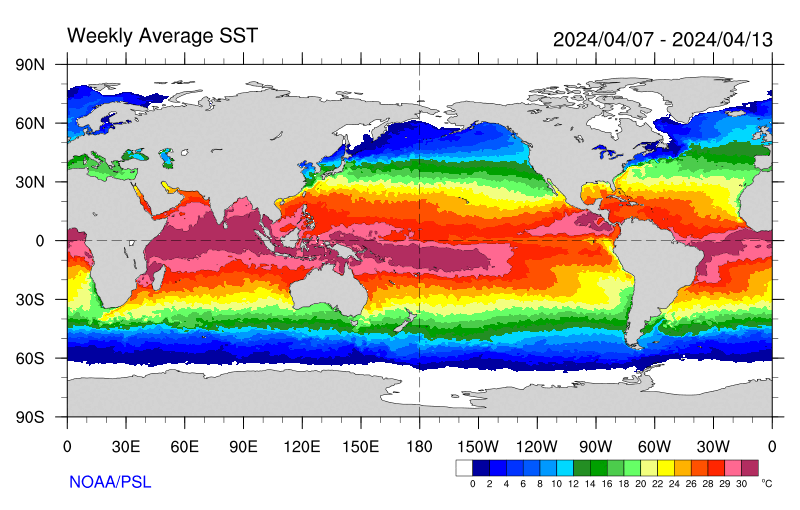
Surface Temperatures. This image uses a color scale
to depict the global pattern of sea surface temperatures (SSTs) (in
degrees Celsius) averaged over a recent 7-day period and based on
measurements by infrared sensors onboard Earth-orbiting satellites.
(Depending on your browser, you may have to place your mouse cursor on
the slide bar to the right and scroll down to view the entire image.)
Compare SSTs in the Northern Hemisphere with those in the Southern
Hemisphere. Return to the RealTime Ocean Portal.
Under Geological, click on Current
Earthquake Activity. The USGS Current World
Seismicity page provides a global map of the locations of seismic
(earthquake) events color-coded for the past seven days. The size of
the squares represents the magnitude of recent earthquakes. Note how
earthquakes are concentrated along the margin of the Pacific Ocean.
Details of recent earthquakes can be found by clicking on their map
squares. Return to the RealTime Ocean Portal.
The ocean is home to a wide variety of habitats and organisms.
Under Biological, click on Ocean
"Color" (Productivity). This is
a satellite-derived (SeaWiFS) color-coded map of biological
productivity in the surface waters of the world ocean is averaged from
October 1978 to date. Orange and red indicates the highest
productivity, while dark blue and violet indicate the lowest
productivity. Note the vast areas of relatively low productivity over
the central regions of the subtropical ocean basins. Individual months
within this period may be chosen for viewing. Now return to the RealTime Ocean Portal.
Under Atmosphere/Ocean Interaction, click
on TRMM/GPM
Tropical Rainfall. The TRMM/GPM (Tropical
Rainfall Measuring Mission) page includes color-coded maps of
the Monthly Mean Rainrate (in mm per day) across the tropics for the
last 30 days ending on the present date. Changes in rainfall are linked
to large-scale shifts in the atmosphere/ocean circulation in the
tropics. Now return to the RealTime Ocean Portal.
Take a few minutes when you have time to browse the other data
and information sources available via the RealTime Ocean Portal. Return frequently to learn more about the many resources on
the ocean in the Earth system. Bon voyage!
Concept of the Week: Questions
- The latest global sea surface temperature map indicates
that SSTs are generally higher over the [(western)(eastern)] tropical Pacific Ocean.
- The USGS map of Current Earthquake Activity indicates that
earthquakes appear to be more common along the [(east)(west)] coast of North America.
Historical Events
- 30 January 1790...The Original, the first boat specialized
as a lifeboat to rescue people from stormy seas was tested on the River
Tyne. This 30-foot long self-righting craft went out to shipwrecks for
40 years, saving hundreds of lives. William Wouldhave and Lionel Lukin
both claimed to be the inventor of the first lifeboat. (Wikipedia)
(Today in Science History)
- 30 January 1997...Surf up to 12 feet, with sets to 15 feet,
pounded the north and west shores of Hawaii. A wave swept eight people
into the ocean at Keane Point on Maui. Four tourists who were taking
pictures of the waves drowned. (Accord's Weather Guide Calendar)
- 1 February 1788...A patent for a steamboat was issued by
the state of Georgia to Isaac Briggs and William Longstreet. The patent
was the only one ever to be issued by Georgia, and first in the U.S.
for a steamboat. Much development had to follow before the steamboat
would be commercially viable. (Today in Science History)
- 1 February 1838...A U.S. patent (No. 588) was issued for
the screw propeller to John Ericsson, (1803-89), a Swedish American
engineer, who later designed and built the USS Monitor for the Union Navy
in the War of the Rebellion. (Today in Science History)
- 1 February 1811...The Bell Rock Lighthouse was lit for the
first time eleven miles off the east coast of Scotland. Using 24
lanterns, it began flashing its warning light atop a 100-foot white
stone tower. As the oldest sea-washed lighthouse in existence, it was
built by Robert Stevenson on a treacherous sandstone reef, which,
except at low tides, lies submerged just beneath the waves. In the
centuries before, the dangerous Bell Rock had claimed thousands of
lives, as vessels were wrecked on its razor-sharp serrated rocks.
(Today in Science History)
- 1 February 1953...An intense low-pressure system (966
millibars or 29.52 inches of mercury) swept across the North Sea. Wind
speeds at Aberdeen, Scotland exceeded 125 mph. A storm surge of 13
feet, aided by a high spring tide, breached the dams in as many as 100
places along the Zuider Zee in The Netherlands, flooding 3.95 million
acres or one-sixth of the country. More than 1800 deaths were
attributed to drowning and 50,000 people were evacuated. In addition,
this storm was responsible for the loss of 100,000 poultry, 25,00 pigs
and 35,000 cattle. (The Weather Doctor) (Accord's Weather Guide
Calendar)
- 2 February 1898...The naming of hurricane after women was always the center of controversy. In the Southern Hemisphere near Australia, tropical cyclones were once called Willy-Willies. An Australian Meteorologist, Clement Wragge is credited for giving female names to tropical cyclones by the end of the 19th Century. On this date, Wragge's weather journal showed a Willy-Willy named "Eline". (National Weather Service files)
- 2-3 February 1952...The only tropical storm of record to
hit the U.S. in February moved out of the Gulf of Mexico and across
southern Florida on the 3rd; at the time, it also represented the earliest reported
formation of a tropical storm on record in the Atlantic basin. The
storm produced 60-mph winds, and two to four inches of rain. (2nd-3rd)
(The Weather Channel)
- 2 February 1976...Groundhog Day Storm, one of the fiercest
Maritimes storms ever battered the Bay of Fundy region around Saint
John, New Brunswick with winds clocked at 118 mph, generating 39-foot
waves with swells of 32.5 feet. (The Weather Doctor)
- 3 February 1488...The Portuguese navigator Bartholomeu Diaz
landed at Mossal Bay, Cape of Good Hope, the first European known to
have landed on the southern extremity of Africa. He was also the first
known European to have traveled this far south and round the Cape.
(Wikipedia)
- 3 February 1880...Date of a terrific gale on the New Jersey
coast. Six vessels came ashore with 47 persons on board--all but two
survived. Nineteen USLSS crewmen won Gold Life-Saving Medals during the
wreck of the George Taulane. (USCG Historian's Office)
- 3 February 1943...The torpedoing of the transport
Dorchester saw USCGC Comanche and Escanaba respond. The crew of the
Escanaba used a new rescue technique when pulling survivors from the
water. This "retriever" technique used swimmers clad in wet suits to
swim to victims in the water and secure a line to them so they could be
hauled onto the ship. Although Escanaba saved 133 men (one died later)
and Comanche saved 97, over 600 men were lost, including the Four
Chaplains. (USCG Historian's Office)
- 3 February 1953...The French oceanographer Jacques-Yves
Cousteau published his most famous and lasting work, The Silent World,
which was made into a film three years later. (The History Channel)
- 5 February 1924...Hourly time signals from the Royal
Greenwich Observatory were broadcast for the first time. (Wikipedia)
- 5
February 1997...High winds pushed mountains of ice against the northern
shore of Lake Erie crushing several houses and cottages in Colchester,
Ontario. This phenomenon is known as ice shove. (The Weather Doctor)
- 5
February 2004 - Nineteen Chinese cockle-pickers from a group of 35
drowned after being trapped by rising tides in Morecambe Bay, England.
(Wikipedia)
Return to RealTime Ocean Portal
Prepared by DS Ocean Central Staff and Edward J. Hopkins,
Ph.D.,
email hopkins@aos.wisc.edu
© Copyright, 2017, The American Meteorological Society.