WEEKLY OCEAN NEWS
20-24 June 2016
DataStreme Ocean will return for Fall 2016 with
new Investigations files starting during Preview Week, Monday, 22 August 2016. All the current online website products will continue to be available throughout the summer break period.
Items of Interest:
- Happy Summer Solstice! The summer solstice will occur next Monday (officially, 20 June 2016 at 2234 Z, or
6:34 PM EDT, 5:34 PM CDT, etc.). At that time, the earth's spin axis is oriented such that the sun appears to be the farthest north in the local sky of most earth-bound observers. While most of us consider this event to be the start of astronomical summer, the British call the day the "Midsummer Day", as the apparent sun will begin its southward descent again. For essentially all locations in the Northern Hemisphere, daylight on Sunday will be the longest and the night will be the shortest of the year. Starting Monday, the length of darkness will begin to increase as we head toward the winter solstice on 21 December 2016 at 1044 Z. However, because the sun is not as perfect a time-keeper as a clock, the latest sunsets of the year at many mid-latitude locations will continue through about the first week of July -- a consequence of the earth being near aphelion (on 4 July 2016) and the apparent sun moving across the sky well to the north of the celestial equator.
- World Hydrography Day celebration -- The
International Hydrographic Organization (IHO) will celebrate its annual
World Hydrography Day on Tuesday, 21 June 2016, the 95th-anniversary
date on which the IHO was created in 1921. The theme for this year's
celebration is
"Hydrography - the key to well-managed seas and waterways," which is intended to focus the public's attention upon the importance of hydrography and the knowledge gained of the shape, nature and depth of the seafloor for the safe and sustainable use of the global oceans and other waterways.
[International
Hydrographic Organization]
- Ocean Sampling Day to be held -- On Tuesday, 21 June 2016, scientists and volunteers around the world plan on participating in Ocean Sampling Day (OSD) as they collect water samples from the Earth's oceans and rivers. This international collaboration is intended to collect baseline information on the diversity of marine microorganisms so that changes in ocean ecosystems can be detected by comparing samples from the same locations over time. [OSD & MyOSD 2016]
- Get Into Your (marine) Sanctuary!" -- NOAA's Office of National Marine Sanctuaries will be hosting its second National "Get into Your Sanctuary" celebration next weekend (25-26 June 2016) at all 14 sanctuaries in its jurisdiction. The public is invited to enjoy their experiences in a close sanctuary and submit their photographs to a photo contest. A listing of events at the 14 national marine sanctuaries (plus Hawaii's Papahānaumokuākea Marine National Monument) is provided.
[NOAA National Marine Sanctuaries]
- Celebrate Shark Week 2016 -- Next Sunday, 26 June 2016, marks the start of Shark Week 2016, a week-long series of feature television programs dedicated to sharks that will be run on the Discovery Channel through 3 July with new technology involving an interactive 360-degree video. The week is also promoted on social media networks. Shark Week was first run in July 1987 in an effort to raise public awareness and respect for sharks. [The Discovery Channel]
Ocean in the News:
- Eye on the tropics --- No organized tropical cyclone activity was reported during the last week across any of the ocean basins in either the Northern or Southern Hemispheres.
- Facts about sea turtles -- In recognition of Sea Turtle Week 2016 (13-17 June 2016), NOAA's Fisheries and National Ocean Service posted a variety of informational articles, podcasts and videos that provide background on sea turtles, which represent one of the world's most endangered species. Check the steps taken by the US to protect leatherback turtles and the different ways scientists study sea turtles. [NOAA Fisheries] or [NOAA News]
While the Pacific Leatherback sea turtle is highlighted [NOAA Fisheries] a study is also featured of the green, Kemp's Ridley, and loggerhead sea turtles in Florida.
[NOAA Fisheries]
- Nation's first marine national monument celebrates its tenth anniversary -- In mid June 2006 President George W. Bush signed a presidential proclamation that established the Northwestern Hawaiian Islands Marine National Monument, which was subsequently renamed Papahānaumokuākea. At the time this monument was the world's largest marine protected area, encompassing nearly 140,000 square miles of the Pacific Ocean near the Hawaiian Islands. More than 7000 marine species are protected within its boundaries. [NOAA National Ocean Service News]
- Expansion of marine sanctuary in Gulf of Mexico is proposed -- NOAA's Flower Garden Banks National Marine Sanctuary, which is located in the waters of the Gulf of Mexico approximately 100 miles off the Texas and Louisiana coast, is proposing to expand its boundaries to protect additional critical habitat in the Gulf of Mexico. A Draft Environmental Impact Statement has been provided that presents five alternatives for expansion. Public comment on these plans is invited through mid-August. [NOAA National Marine Sanctuaries News]
- Saltonstall-Kennedy Grant Program grant recommendations made --Earlier this month NOAA Fisheries recommended that 50 projects receive a total of more than $11 million under its 2016 Saltonstall-Kennedy (SK) Grant Program as part of its goal to address the needs of the nation's fishing communities, to optimize economic benefits by building and maintaining sustainable fisheries, and to increase other opportunities designed to keep working waterfronts viable. This year's recommended projects fall into seven priorities: 1.) aquiculture; 2.) fishery data collection; 3.) techniques for reducing bycatch and other long-term ecosystem change; 4.) promotion, development and marketing; 5.) socio-economic research and 7.) territorial science.[NOAA Fisheries News]
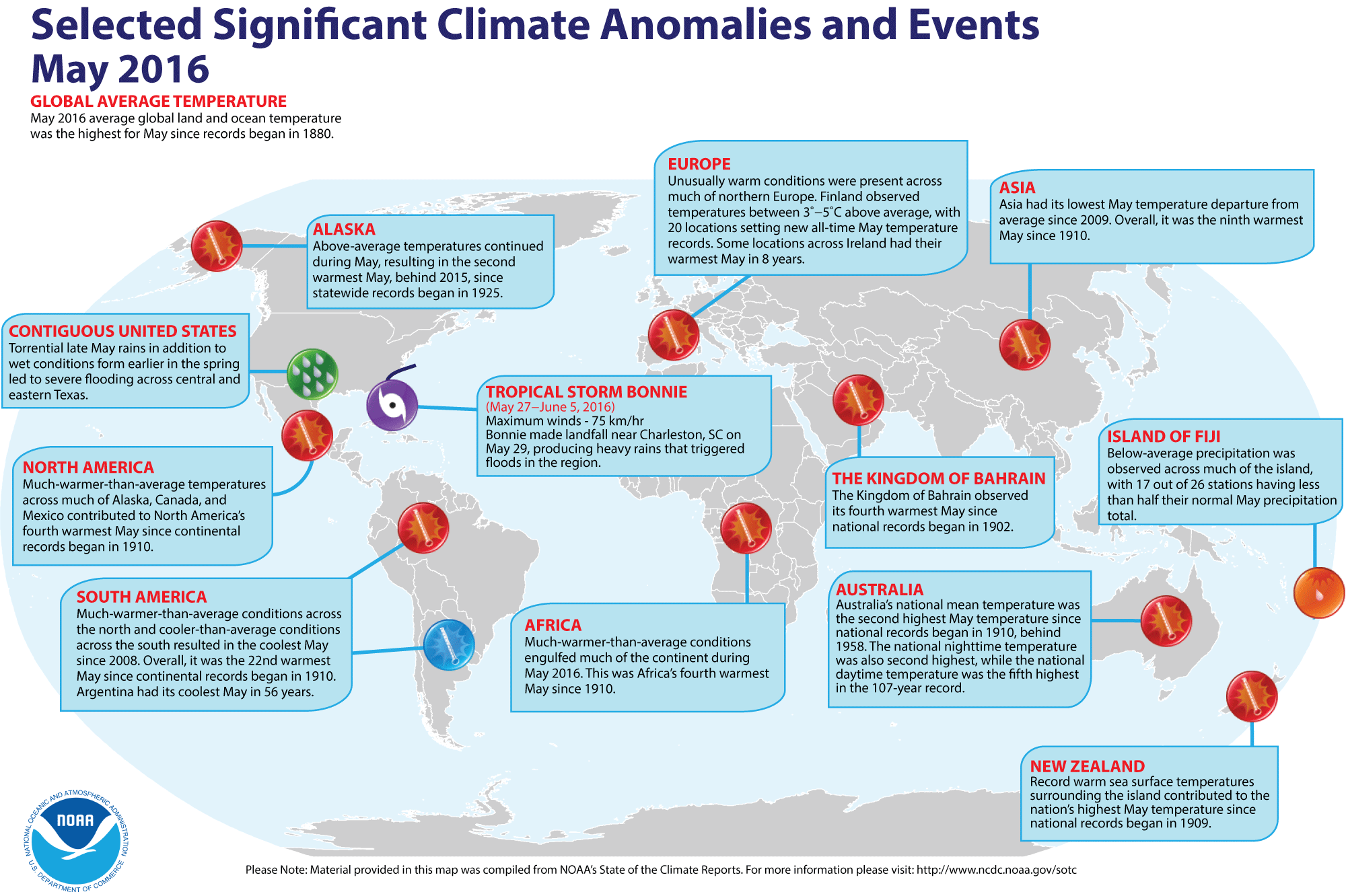
- Review of global weather and climate for May 2016 -- Scientists at NOAA's National Centers for Environmental Information (NCEI) report that the recently concluded month of May was the warmest May since sufficiently dense global climate records began in 1880. They based their report on preliminary calculations of the combined global land and ocean surface temperature for May 2016, which was 1.57 Fahrenheit degrees (0.87 Celsius degrees) above the 20th century (1901-2000) average May temperature of 58.6 degrees Fahrenheit. While this May 2016 global land and ocean temperature was a record, the temperature departure from the 20th-century average was the smallest monthly departure since August 2015 as it did not surpass 1.0 Celsius-degree for the first time in six months. When considered separately, the average May 2016 land surface temperature was 2.11 Fahrenheit degrees above the 20th century average, which meant that this land surface temperature was the third highest May land temperature since 1880. The global ocean surface temperature for May 2016 was 1.37 Fahrenheit degrees above the 20th century average, which represented a record May sea surface temperature.
In addition, the combined global land and ocean surface temperature for the last three months (March through May), which is considered meteorological spring in the Northern Hemisphere (fall in the Southern Hemisphere), was the highest since 1880. Furthermore, the ocean and land surface temperatures for this three-month interval were each records.
[NOAA/NCEI State of the Climate]
The May sea ice extent data for the Arctic Ocean and the waters around Antarctica were unavailable from the National Snow and Ice Data Center because of issues with the sensor onboard the Defense Meteorological Satellite Program (DMSP) F-17 satellite. [National Snow & Ice Data Center]
According to data from the Rutgers Global Snow Lab, the Northern Hemisphere snow cover extent for May was the fourth smallest in the 50-year period of record.
A global map of Selected Significant Climate Anomalies and Events for May 2016 is available from NCDC. - Milestones in atmospheric carbon dioxide levels reached around the globe -- During this past week the lead scientist for NOAA's Global Greenhouse Gas Reference Network reported that as of 23 May 2016, atmospheric carbon dioxide levels measured at the South Pole Station had surpassed 400 parts per million by volume (ppmv) for the first time in four million years. [NOAA News]
In a separate report, climate scientists with the United Kingdom's Met Office and the University of Exeter along with California's Scripps Institution of Oceanography noted that 2016 has an excellent chance of being the first year where the Mauna Loa atmospheric carbon dioxide record with be above the 400 ppmv level all-year around. The 400-ppmv level for carbon dioxide represents a symbolic threshold. The scientists claim that the strong El Niño event at the start of the year contributed to the rapid increase in the atmospheric carbon dioxide. [UK Met Office News]
- Annual Greenhouse Gas Index is updated -- Scientists in the Global Monitoring Division of the NOAA Earth System Research Laboratory recently provided an update of NOAA's Annual Greenhouse Gas Index (AGGI) for the calendar year 2015. The AGGI is an index that considers the combined influence that a set of long-lived greenhouse gases have upon the Earth's surface temperature, scaled to the influence these gases would have had in 1990, the year when the UN Kyoto Protocol was signed by nations to reduce emissions of the gases. The main greenhouse gases considered are carbon dioxide (CO2), methane (CH4), nitrous oxide (N2O) and halogenated compounds (such as CFC11 and CFC12). According to this most recent annual update, the AGGI for 2015 was 1.37, which means that at the end of the calendar year 2015, the warming influence of greenhouse gases had risen 37 percent above the 1990 baseline value. The scientists also calculated the total contribution of greenhouse gases would be equivalent to 485 ppmv (parts per million by volume) of CO2, of which the actual concentration of CO2 was 399 ppmv. The AGGI is calculated from air samples collected weekly from approximately 100 clean-air stations around the world. [NOAA Climate.gov News]
Note: The details of the AGGI and tables of data that include the annual values of AGGI, the global radiative forcing by CO2, CH4, N2O, CFC11 and CFC12 along with 15 minor green house gas constituents are listed from 1979 through 2015. In addition, annual CO2-equivalent totals are also provided. [Global Monitoring Division, NOAA Earth System Research Laboratory]
- Carbon dioxide emissions human activities found to outweigh those from volcanoes-- A feature article written by climate scientists, reveals that according to current estimates, human activities appear to emit at least sixty times more carbon dioxide into the atmosphere each year than the amount of this greenhouse gas released by volcanoes. These conclusions were based upon data obtained from the Carbon Dioxide Information Analysis Center at the US Department of Energy's Oak Ridge National Laboratory and from the US Geologic Survey. [NOAA Climate.gov News]
- An All-Hazards Monitor -- This Web portal provides the user information from NOAA's National Weather Service, FAA and FEMA on
current environmental events that may pose as hazards such as tropical
weather, fire weather, marine weather, severe weather, drought and
floods. [NOAA/NWS Daily Briefing]
- Earthweek -- Diary of the Planet [earthweek.com]
Historical Events:
- 20 June 1597...Willem Barents, the Dutch explorer who tried to search
for the Northeast Passage, died in the Arctic off the archipelago of Novaya
Zemlya when his ship became trapped in ice. (Wikipedia)
- 20 June 1819...The 320-ton paddle-wheel SS Savannah arrived in
Liverpool, England to become the first steamship to cross the Atlantic,
having left the port of Savannah, GA on 22 May. (InfoPlease Daily Almanac)
- 20 June 1940...The first successful west to east navigation of the
Northwest Passage began at Vancouver, BC. (Wikipedia)
- 21 June 1791...A hurricane, called El Temporal de Barreto - the
storm of Barreto, generated a monster ocean wave that carried off the
coffin of a rich, but hated, count as he lay in state in his mansion near
Havana, Cuba. (The Weather Doctor)
- 21 June 1886...A destructive hurricane hit the Apalachicola-Tallahassee
area of Florida on the summer solstice. Extensive damage was done in
Florida and throughout the southeast by this storm, which was the first
hurricane of the year. Damage was due mainly to extremely high tides.
(Intellicast)
- 21 June 1961...The first practical plant for the conversion of seawater
to drinking water at Freeport, TX was dedicated when President John Kennedy
pressed a switch installed in his Washington, DC office. The plant was
capable of producing about a million gallons of water a day, supplying
fresh water to Freeport at a cost of about $1.25 per thousand gallons. The
large-scale evaporation method used then has now been replaced by reverse
osmosis as special polymers are now used as filtering membranes. (Today in
Science History)
- 22 June 1675...The Royal Greenwich Observatory was created by Royal
Warrant in England by Charles II, with its practical astronomy serving as
its primary mission, including navigation, timekeeping and the
determination of star positions. In 1767 the observatory began publishing The Nautical Almanac, which established the longitude of Greenwich
as a baseline for time calculations. The almanac's popularity among
navigators led in part to the adoption (1884) of the Greenwich meridian as
the Earth's prime meridian (0 degrees longitude) and the international time
zones. (Today in Science History)
- 22 June 1948...Congress enacted Public Law 738, which authorized the
operation of floating ocean stations for the purpose of providing search
and rescue communication and air-navigation facilities, and meteorological
services in such ocean areas as are regularly traversed by aircraft of the
United States. (USCG Historian's Office)
- 23 June 1501...The Portuguese navigator, Pedro Alvares
Cabral, returned to Portugal after a voyage during which he claimed
Brazil for Portugal and then journeyed to India in search of pepper and
spices. (Wikipedia)
- 23 June 1611...English navigator Henry Hudson was set
adrift along with his son and seven loyal crew members in an open boat
in Hudson Bay by mutineers on his ship Discovery;
they were never seen again. He was on his fourth voyage and he had
become famous for attempting to find a route from Europe to Asia via
the Arctic Ocean. (Wikipedia)
- 23 June 1716...The Province of Massachusetts authorized
erection of first lighthouse in America on Great Brewster Island,
Boston Harbor. (USCG Historian's Office)
- 23 June 1938...The first "oceanarium" opened at Marineland
in St. Augustine, FL. (Today in Science History)
- 24 June 1497...The Italian navigator and explorer Giovanni
(John) Cabot, sailing in the service of England, landed in North
America on what is now Newfoundland, claiming the continent for
England. (Wikipedia)
- 25 June 1957...Hurricane Audrey moved northward, slowly strengthening until the 26th. At that time, a strong upper level trough led to its acceleration and the hurricane deepened rapidly on its final approach to the Texas/Louisiana border. Audrey became the strongest hurricane on record for the month of June upon landfall, as it reached category four strength. Its acceleration was unanticipated, and despite hurricane warnings in place, 418 people perished in the storm, mainly across southwest Louisiana. (National Weather Service files)
- 25 June 2012...Tropical Storm Debby dropped colossal amounts of rain on northern and central Florida. Curtis Mill, in the Panhandle near Tallahassee, received 28.78" of rain in about two days! (National Weather Service files)
- 26 June 1954...Eight fishermen were swept off the
breakwater of the Montrose Harbor in Chicago, IL by a seiche on Lake
Michigan. At the time, this killer wave rose suddenly from a serene
Lake Michigan; sunny skies and calm wind conditions were reported. The
seiche, produced by an earlier squall on the lake, caused the lake
water to rise ten feet. (Accord's Weather Guide Calendar)
- 26 June 1959...Following an opening ceremony attended by
President Eisenhower and Queen Elizabeth II, 28 naval vessels sailed
from the Atlantic to the Great Lakes, marking the formal opening of the
St. Lawrence Seaway to seagoing ships. The Seaway consists of a
navigational channel system of canals, locks, and dredged waterways,
permitting travel from the Gulf of St. Lawrence nearly 2500 miles
inland to Duluth, MN on Lake Superior. (Naval Historical Center) (The
History Channel)
- 26 June 1986...Hurricane Bonnie made landfall on the upper
Texas coast. A wind gust to 98 mph occurred at Sea Rim State Park. The
town of Ace recorded 13 inches of rain. (Intellicast)
- 26 June-7 July 1989...Tropical Storm Allison formed in the
Gulf of Mexico from remnants of Hurricane Cosme in the eastern North
Pacific. Periods of heavy rain caused flooding across parts of Texas,
Louisiana, Arkansas and Mississippi. Winnfield, LA reported a six-day
total of 29.52 inches of rain. This system was responsible for eleven
deaths and approximately $500 million in damage. (Accord's Weather
Guide Calendar)
Return to DataStreme Ocean's RealTime Ocean Portal
Prepared by DS Ocean Central Staff and Edward J. Hopkins,
Ph.D.,
email hopkins@aos.wisc.edu
© Copyright, 2016, The American Meteorological Society.